
Shadow Punisher (2026): Luo Yunxi and the Mystery of Why He Can’t Just Play Some Guy | Review & Cast
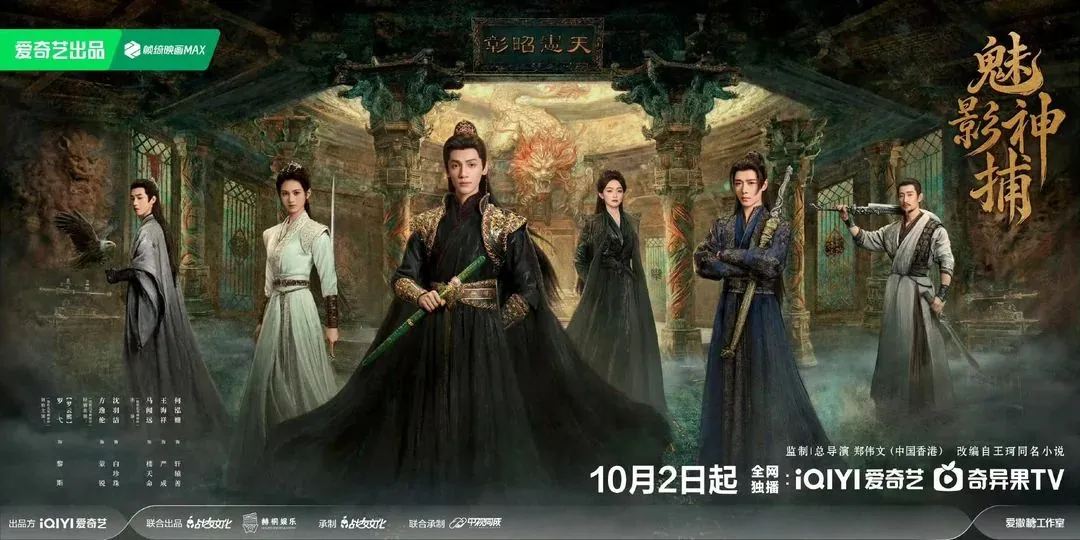
Shadow Punisher Poster - Courtesy of iQIYI

|
DetailsRATING: (6/10)
NATIVE TITLE: 魅影神捕 - Mèiyǐng shén bǔ YEAR: 2026 EPISODES: 30 DURATION: 45’ DIRECTOR: Zheng Wei Wen, Liu Chong Chong SCREENWRITER: Chen Yu Han, Hou Wen Wen ORIGINAL CREATOR: Wang Ke (魅影神捕 - Shadow Punisher) |


Disclaimer: the opinions expressed in this review refer exclusively to the drama. As I have not read the original work, I cannot say with certainty whether the issues identified can be attributed to the screenplay or to the source material. For this reason, my comments on the writing should be understood as an assessment of the adaptation rather than a judgment on the original work.
IN A NUTSHELL
Short on time? Here you’ll find the quick verdict, including the drama’s main strengths, weaknesses, and key features to help you decide if it’s right for you. For a more in-depth analysis, continue with the No Spoiler Review.
- What to expect: Shadow Punisher is a dark, mystery-driven xuanhuan , built around a series of criminal cases intertwined with secrets from the past, hidden identities, and tormented personal stories. Through investigations, twists, and intrigue, the series builds an increasingly complex picture, supported by an all-encompassing protagonist and a script that is at times overly solemn and heavy-handed. The accumulation of revelations and complications, however, does not always translate into an equally solid narrative: the clues struggle to guide the viewer toward the solution of the cases, the moral conflicts remain superficial, and the protagonist's displays of intelligence sometimes feel forced. The result is a drama capable of intriguing and entertaining, but one that often ends up confusing complexity with complication, sacrificing the coherence and depth that its own ambitions would require.
- Strengths: Luo Yunxi and Xu Zhengxi’s performances, a solid supporting cast, the stunning sets and costumes.
- Weaknesses: the overly protagonist-centric story, the needlessly convoluted investigations, the sidelined supporting characters, the weak writing.
- Recommended if you like: Luo Yunxi, mistery horror set in a fantasy world, revenge stories, complex court cases, international conspiracies, dramas that continually celebrate the exceptionality of their protagonist, series without a love line.
- Would I rewatch it? No.
Read on to understand what aspects of this drama didn't convince me.
Shadow Punisher is a story in which the shadows of the past loom menacingly, the secrets of the present multiply, and every truth seems to conceal a new deception. The more pieces emerge, the more complicated the plot becomes, in a game where distinguishing correct intuitions from the misleading becomes increasingly difficult. Yet, when every mystery hides a revelation and every revelation opens the way to a new enigma, the protagonist's acumen isn't always enough to tie together all the loose threads of a story that intertwines past conspiracies and present depravity.
In this review of the drama Shadow Punisher, after whatching all episodes, I will try to highlight its strengths and weaknesses, evaluating the effectiveness of its plots, investigations, and moral conflicts, as well as its ability to reconcile grand narrative ambitions with coherent writing.
Plot
Li Si is a skilled merchant and owner of Star-Gathering Pavilion, the best tavern in Tianhuang, but behind this unsuspecting facade lies a secret: he is actually the fourth prince of Dashi, believed to have died seventeen years earlier in a fire at the Mulan Imperial Hunting Ground.
Determined to shed light on this tragic affair, Li Si exploits a series of murders around Tianhuang to infiltrate the Divine Constable Bureau and access its archives, hoping to uncover clues to his past. The attempt fails, but thanks to his friendship with the crown prince, he manages to secure a position as a trainee constable.
Thus begins an adventure that leads him to join Constable Frost, Constable Ghost, and Constable Iron in investigating a series of unusual murder cases, seemingly unrelated but sharing disturbing ties to the magical arts practiced in the lost kingdom of Liluo.
Case after case, the investigations lead Li Si to shocking revelations about past events and reveal the outlines of a vast conspiracy hatched by Liluo against the Dashi. But when the truth comes out, his need for justice becomes a painful choice: protect his homeland or exact revenge against those who attempted to kill him?

THIS SECTION TAKES A CLOSER LOOK AT THE SCRIPT, CHARACTERS, CAST, AND TECHNICAL ASPECTS WITHOUT REVEALING MAJOR PLOT DEVELOPMENTS. FOR A COMPLETE ANALYSIS OF THE DRAMA, CONTINUE WITH THE SPOILER REVIEW.
Shadow Punisher Drama Review (No Spoilers)
Plot and Screenplay
Shadow Punisher is an investigative drama with a complex plot, in which mysteries, hidden identities, unexpected connections between characters, and plot twists pile up, sometimes giving the impression that the plot is being complicated more to lengthen the episodes than to make the investigation truly compelling.
The succession of revelations gives the story a seemingly rapid pace, alternating with lengthy investigative meetings in which the reasoning proceeds in rigidly paced steps: each character adds information, completes a connection, or formulates a conclusion, while the comparison between different perspectives often gives way to a succession of lines that seem to expose the reasoning written in the script rather than show the development of the insights of a real investigative team.
Added to this is the fact that the viewer doesn't always have the same clues as Li Si: some crucial information emerges only when the protagonist presents his conclusions, without being shown when and how he gathered them or the logical path that led to the solution.
The screenplay, moreover, tends to be rather heavy-handed: it reiterates the clues it deems important and repeatedly emphasizes the emotions it wants to evoke, rather than allowing them to gain meaning over the course of the narrative, almost as if fearing the viewer won't grasp their relevance. The result is a story that alternates excessive complication with a certain expository redundancy, leaving little room for the pleasure of discovery and elaboration.
The narrative register also appears inconsistent: the dark and solemn tone that dominates the series clashes with Li Si's occasional eccentric asides, designed to ease the tension and make the protagonist more sympathetic, but which often conflict with the context. This creates a contrast that could help characterize the protagonist, but which, in most cases, appears forced.
Characters and Romance
Li Si is a protagonist who embodies many of the recurring stereotypes of Luo Yunxi's characters: a mysterious identity, ties to the supernatural, exceptional powers, a precarious physical condition, and a past marked by conspiracies and betrayals, all compounded by a destiny that seems to make him the most important figure in the entire story. The result is a protagonist conceived to be simultaneously enigmatic, incredibly powerful, suffering, and exceptional—a combination that risks becoming a recurring formula, making his characters increasingly less unpredictable. I'm aware that for many viewers, Luo Yunxi may be the main draw of the series, but loving an actor doesn't mean you have to appreciate a script that seems to want to exalt his character at all costs.
This impression is reinforced by the characterization of the other characters, whose reactions often seem aimed at highlighting Li Si's extraordinary abilities. Her superiority is constantly reaffirmed, without necessarily having to demonstrate it, while the supporting cast ends up acting like a real fan club for the protagonist, rather than a group of characters with their own autonomy and equally recognizable abilities. The disparity also emerges in the expressive realm: Li Si can shift from irony to solemnity, from eccentricity to suffering, while much of the rest of the cast remains confined to a grave and uniform register, made up of frowning expressions and solemn dialogue.
Even the antagonists struggle to establish themselves as credible adversaries: their potential seems diminished when it comes to openly confronting Li Si, while deception and stratagems become the main resources with which they manage to embarrass him.
On the romantic front, finally, don't have any particular expectations: the series has been presented from the beginning as an investigative drama without a love line, so those looking for a significant romantic component would do well to take this into account.

Cast
Luo Yunxi proves himself to be a spontaneous and talented performer, whose physicality and elegance are perfect for the role of Li Si. It's a shame that the ease and aura of superiority of his characters are starting to irritate me a little. In Shadow Punisher, he even added some hand gestures to his repertoire, which he uses to accompany his speeches to emphasize his air of smugness, ending up sounding more like a magician than someone engaged in a serious and crucial conversation.
The main problem with the absolute centrality of Luo Yunxi's protagonists is that it ends up penalizing a supporting cast that, again, can count on undoubtedly talented performers.
Fang Yilun, for example, finds himself once again in the role of his sidekick: a taciturn and perpetually serious swordsman, skilled in wielding the sword but endowed with little autonomy and inferior skills to those of Li Si. An archetype that certainly has its raison d'être in wuxia, but which ends up squandering the potential of an actor who rarely seems to me to be valued as he deserves in the scripts assigned to him, the only exception of which appears to be Zhan Zhao Adventures.
The same goes for He Hong Shan, who doesn't find a role here that highlights his qualities, as he did in The Prisoner of Beauty and The Glory.
Xu Zhengxi stands out, one of my favorite actors precisely because of the ease with which he switches from solemnity to joviality, even eccentricity, proving convincing in both positive and negative roles. I'm glad that, contrary to what was announced, he hasn't given up acting. However, it's unfortunate that he's increasingly relegated to cameos or limited screen time.
I also appreciated Wang Hai Xiang, convincing as the experienced warrior, skilled yet jovial, and Zhao Xun, who brings Li Si's unpredictable and mysterious shifu to life. Finally, I found the performances of Ma Wen Yuan, whom I consider a young actor on the rise, and Shen Yu Jie, who didn't particularly shine here but had convinced me in Hard to Find, alongside Zhao Yi Qin, interesting and could hold some surprises in store for the future.
Visual Aspects and Soundtrack
From a technical standpoint, Shadow Punisher stands out for its solid and clean direction, characterized by far-from-banal framing choices and meticulous cinematography, which make the visual narrative enjoyable and dynamic. It's a shame that sometimes it is too heavy-handed, insisting on highlighting the emotionally or narratively significant moments, to the point of interrupting the immersive nature of the story at times.
It almost seems as if the director is following a manual to evoke emotion: the character on stage must appear to be suffering, be enveloped in a cinematography that highlights their inner turmoil, and solemnly deliver lines that express their pain, accompanied by tragic music, while the reactions of the others present serve to reiterate the emotional importance of the scene. The same visual insistence emerges on the investigative level, when a clue is shown, highlighted, and, if necessary, revisited through a flashback, ensuring there's no risk of it escaping the viewer's attention. At times, in short, the direction seems to want to deliver a ready-made emotion or a pre-packaged conclusion to the viewer, making up with visual insistence for the lack of narrative work necessary to make those emotions and conclusions truly comprehensible.
The work of the crew is of a completely different nature, contributing substantially to the drama's success. Particularly noteworthy are the architectural details of the buildings and the real mechanisms constructed for the filming, capable of combining a fantastical appearance with a believable functioning. In this respect, the practical work even surpasses the digital effects: while CGI convincingly conveys the magical powers and bird's-eye views of cities and buildings, the animals' rendering is more approximate, with fur moving in slow motion and expressions that aren't always lifelike.
The work of the costume design department, led by the excellent Huang Wei, is also excellent. She creates rich and whimsical outfits that are consistent with the setting and characterization. Makeup and hair follow the same lines, helping to define the characters' identities through visual choices that reflect their personalities and natures.
The soundtrack of Shadow Punisher alternates songs with interesting and original sounds and rhythms, such as the emotional and mysterious ballad 有魅 (Charismatic), performed by Liu Yuning, and the disturbing and theatrical 诡面问心 (Question Heart Behind Mask), sung by Sa Dingding, with compositions with more classical, slow and melancholic sounds, such as 萤火书 (Book of Fireflies) and 若 (If), or decidedly dramatic ones, such as 破晓 (Daybreak). Despite the variety of proposals and the expressive potential of the most characteristic songs, the soundtrack seems to favor the function of accompanying the dramatic sequences, helping to emphasize their emotional charge, rather than fully exploiting its versatility to accompany the different atmospheres of the drama. The result is a use of music that is sometimes more functional to reiterate the emotions that the direction intends to convey than to give depth to the sonic identity of the series and its many narrative nuances.

WARNING!
SPOILERS AHEAD. THIS SECTION PROVIDES A DETAILED ANALYSIS OF SPECIFIC ASPECTS OF THE SERIES. DO NOT CONTINUE IF YOU DON’T WANT TO KNOW ALL THE DETAILS OF THE DRAMA
Shadow Punisher Drama Review (Spoilers)
What Works
Luo Yunxi and the Work of the Production Crew
I struggle to find any positive aspects of Shadow Punisher, beyond the work of the technical department that physically created the sets, structures, and mechanisms shown in the series. It's the only area where I found something truly worthy of the production: meticulous and aesthetically satisfying work, capable of giving visual consistency to the narrative world and translating into tangible elements what the screenplay, in terms of story construction, struggles to sustain.
For the rest, the only thing that pushed me to continue watching until the end was the curiosity to understand where the hell the drama was going, in addition, of course, to the pleasure of seeing Luo Yunxi on screen. It wasn't so much a matter of engaging with the characters or genuine interest in their fates, but rather a desire to discover how the plots would unravel and how far the script would go in its complications. This curiosity stayed with me until the final episode, but I don't consider it a narrative achievement: maintaining the viewer's curiosity doesn't necessarily mean having constructed an effective narrative, especially when the desire to get to the end stems more from the need to make sense of what's been seen than from genuine interest in what will happen. In short, if there's one merit I can give to Shadow Punisher, it's that it entrusted the construction of its world to a technical team worthy of the production, whereas the writers failed to support it with an equally compelling narrative.
What Doesn't Work
An Investigation That Confuses Complexity with Complication
One of the aspects that least convinced me about Shadow Punisher is the structure of the investigations, in which complexity often seems to become a surrogate for narrative quality. Each answer generates new questions, the characters hide unexpected identities and connections, the crimes turn out to be more complex than they seemed, and their backstories accumulate enough suffering to transform every solution into an emotional tsunami. The problem is not that the cases are too complex, but that the screenplay seems to rely on the accumulation of complications, twists, and misfortunes to make them compelling, without worrying about the solidity of the solutions and their construction.
Added to this is the way the clues are handled that makes it difficult to follow Li Si's investigative path. Crucial information sometimes seems reserved for the protagonist, or emerges only when it's time to justify a pre-formulated deduction. Rather than witnessing the reconstruction of a crime through clues, hypotheses, and verification, we find ourselves trying to understand what information was omitted and what connections were introduced simply to facilitate the solution. The brilliance of an investigator, however, is not demonstrated simply by showing him arriving at the right answer: the viewer must be allowed to recognize the reasoning that led him there.
Furthermore, a solution can be surprising and unpredictable, but once revealed, it should still feel as if the elements necessary to reach it were already present in the story. However, when each case can be further complicated by the introduction of a new accomplice, a secret identity, or a connection to a larger conspiracy, the solution no longer feels like a point of arrival, but rather a provisional answer, awaiting the next revelation. By dint of wanting to surprise, the series thus ends up hindering the viewer's participation in the investigation, transforming the mystery into a accumulation of information that only gains meaning when Li Si presents the solution to the case through his usual explanation.
The comparison with Zhan Zhao Adventures clearly explains why this approach is not an effective framework for constructing an engaging investigation. In the drama starring Yang Yang, the viewer is often first shown who is behind the individual crimes and can then observe how seemingly isolated events connect, while the investigator gathers clues, formulates hypotheses, and gradually reconstructs the overall conspiracy. The audience's informational advantage doesn't eliminate suspense, but rather creates a second form of it: beyond wanting to discover how the case will conclude, we await the moment when Zhan Zhao will be able to recognize a truth the viewer has already discovered. Above all, we can concretely measure her progress and understand the origins of her conclusions. In Shadow Punisher, by contrast, Li Si sometimes seems to possess information the viewer doesn't possess, as if his puzzle already contains pieces that the script secretly delivers when needed. The difference is substantial: in the first case, we witness the construction of a solution; in the second, we risk witnessing its enunciation. And this makes watching particularly frustrating: a murder can be extremely complicated and produce a boring investigation if the detective simply presents a solution we haven't seen unfold; conversely, even a seemingly simple case can be compelling when every step must be proven and the culprit actively tries to hinder the search for the truth.
This weakness is also reflected in the relationship between the individual cases and the main plot. Shadow Punisher piles up questions about Li Si's identity, her past, and her connection to the Liluo survivors, but the clues that emerge during the investigation rarely contribute decisively to advancing the understanding of the overall story. The six deities, the court cases, and the collapsing statues seem to outline a common thread, but the recurrence of common symbols and references isn't enough to build a coherent investigation. The problem is that the discoveries related to the individual crimes seem to acquire concrete meaning especially in hindsight, when the final revelation allows the pieces scattered up to that point to be pieced together. Instead of helping the viewer gradually get closer to the truth, the investigations thus end up accumulating information whose relevance to the main plot remains uncertain for a long time.
It's a mechanism reminiscent of A League of Nobleman, where the six murders linked to the legend of the Six Sages of Yinjitian occupy a considerable portion of the narrative without significantly advancing the investigation into Zhang Ping's past. Even then, the clues seem connected to the central mystery, but their meaning remains suspended, awaiting further revelations. The repetition of cases thus generates expectations that are not immediately validated: rather than allowing the viewer to formulate hypotheses and progressively verify their suspicions, it invites them to accumulate information whose usefulness remains unclear. The result is a mystery that seems to advance mainly through accumulation, while its overall meaning remains largely frozen until the narrative decides to put all the pieces together. In this sense, A Prophet offers an example of how individual events can advance the main plot through a chain of cause and effect, making the story's movement perceptible even before its conclusion.
The writing's tendency to confuse complication with complexity is also demonstrated by the choice to distribute blame among multiple characters. Showing that a victim can become a perpetrator out of revenge, or that a perpetrator has in turn suffered violence and abuse, could give greater depth to individual cases, but it requires a conclusion capable of addressing the moral contradictions this approach reveals. Multiplying perspectives is not enough to achieve a complex conflict: we must question the differences between the characters' faults, the consequences of their actions, and the reasonableness of their reactions. Instead, Shadow Punisher sometimes seems to exploit these events to reiterate the emotional conflict tied to Li Si's past, making the characters' pain a further mirror of her trauma. The investigator's personal involvement could enrich the interpretation of the cases, but it shouldn't replace it: just because a story awakens painful memories in Li Si doesn't resolve the moral questions it raises. The risk is that the personal tragedies of the characters involved become primarily tools for deepening the protagonist's understanding, while their stories remain devoid of a self-contained conclusion.
In the end, therefore, what I find inconsistent isn't the presence of mysteries, tragic backstories, or twists per se, but the way they are used: complexity should enrich the investigation, suffering should stem from understanding the tragedy, and revelations should give new meaning to elements already introduced. When, instead, everything seems to primarily contribute to making Li Si increasingly exceptional and postponing the definitive solution to the mystery, the investigations lose their autonomy and their narrative function is reduced to keeping an answer pending. And at that point, you're no longer necessarily curious to discover the truth: you're just waiting to understand what other information the script has kept from us.

Li Si, Yet Another Exceptional Character Played by Luo Yunxi
Another aspect that convinced me less about Shadow Punisher is the characterization of Li Si, which seems to bring together a good part of the now recurring stereotypes in the characters played by Luo Yunxi: mysterious identity, ties to the supernatural world, exceptional powers, a precarious physical condition, a past marked by plots and betrayals and, of course, a destiny that seems to make him more important than anyone else. The result is a character who seems designed to be simultaneously enigmatic, powerful, suffering and destined for sacrifice. A combination that can work, but which risks becoming the actor's trademark, ending up making his characters all the same.
It is precisely the feeling of re-proposing a pattern already seen that has reduced my curiosity for the drama. It is no longer just a matter of discovering the character's personal history, but of glimpsing in advance the type of protagonist that the series intends to build: a fusion between the mysterious and powerful man, linked to a supernatural universe, and the lost prince seeking revenge. Added to this is the usual physical fragility, which once again transforms Luo Yunxi into Mr. 我没事 (lit. "I have nothing"), the man who continues to declare himself in perfect health even while spitting blood. Even his suffering therefore does not seem to be a condition capable of truly putting him in difficulty, but rather a further trait designed to make him extraordinary.
The comparison with Shen Zai Ye in The Princess's Gambit and Xiao Wuyi in Key to the Phoenix Heart proves that you don't have to give up secret identity or mystery to build enigmatic characters. These protagonists also have a hidden past, but the secret helps to create a tension between them and the surrounding world without automatically transforming them into the absolute center of every event. They can be intelligent and calculating without their every gesture having to certify their superiority. Even Tantai Jin, in Till the End of the Moon, was more interesting precisely because, despite his demonic nature and supernatural powers, he retained an emotional complexity that prevented his exceptionality from completely erasing his humanity and fallibility.
Even his weapon, the Heaven-Measuring Ruler, contributes to making him an extraordinary person. The problem is not that the protagonist has a very powerful weapon, but that this risks becoming an emergency button available to the screenplay, capable of resolving situations that would otherwise require him to really put his abilities to the test. Even the sacrifice loses part of its effectiveness: Li Si is already ill and the use of the Heaven-Measuring Ruler weakens him further, reintroducing another constant of Luo Yunxi's characters, that of the protagonist who constantly sacrifices himself for the greater good.
This same approach is reflected in the way Li Si relates to the investigations. In Shadow Punisher it happens that he develops a theory that seems confirmed by events and that, later, that same theory is denied; yet, the elements he had identified still end up leading to the correct solution. The mistake thus turns out to be more of a misdirection to the detriment of the viewer: Li Si can be wrong, but the narrative seems to ensure that he never really have to pay the consequences of your mistake. In a real detective story, the investigative process is made interesting by the distinction between what the investigator intuits and what he manages to prove or disprove, because it forces him to deal with uncertainty. When, however, even the wrong intuitions end up placing the protagonist on the right trajectory, the investigation stops being a test of his abilities and becomes another expedient to reiterate them.
What makes Li Si's characterization even more challenging is his comparison with the other characters. Eccentric gestures, deductions, powers, and philosophical reflections seem unique to Li Si and almost invariably lead to the same result: those around him appear constantly impressed by him. The other characters thus end up resembling a fan club for the protagonist, tasked with certifying a superiority that the screenplay has already established from the outset. Li Si doesn't have to earn admiration through his own actions, because it is recognized almost regardless of what he does. The result is a characterization that risks slipping from celebrating the protagonist's abilities to celebrating the protagonist as such.
In Zhan Zhao Adventures, Zhan Zhao and Bai Yu Tang worked as an investigative duo precisely because they possessed different yet complementary skills: neither was superior in every circumstance, and their collaboration allowed them to achieve goals that would have been more difficult to achieve individually. In Shadow Punisher, however, the members of the Divine Constable Bureau seem primarily to support Li Si and highlight his abilities. Their insights appear more elementary, their contribution less impactful, and their presence rarely seems to truly challenge the protagonist's abilities. Li Si's superiority, therefore, emerges not from a fair comparison of differing intelligences and abilities, but from the fact that the others are held at a lower intellectual level.
The same disparity is found in the characters' expressive register. Li Si is allowed to shift from eccentricity to solemnity, from irony to suffering, from lightness to gravity, while most of the other characters seem constrained to a uniform register, made up of frowning expressions and gravely delivered dialogue. This choice ends up further accentuating the contrast between the rest of the cast and Luo Yunxi, who is afforded a wider expressive range, while those around him often seem reduced to serving as a counterpoint to his intensity. I know that for many viewers, Luo Yunxi may be the main draw of the series, but loving an actor doesn't mean you have to appreciate a script that seems to want to turn his character into a figure to be exalted at all costs.
A Bloated, Rather Than Developed, Screenplay
Another of the less successful aspects of Shadow Punisher is the screenplay, which at times gives the impression of a short text entrusted to an artificial intelligence tasked with bringing it to the length of a standard script. The dialogues swell through repetitions, solemn declarations, and interminable discussions: one character expresses a position, another disputes it, the first reiterates it, and the conversation continues without the information acquired or the relationships between the characters evolving appreciably. The case of Meng Rui's arrest is emblematic: five minutes of discussion about the surrender of his sword, involving several characters, essentially achieves nothing. The repetitiveness of the lines thus seems to mask a certain lack of content, while their solemn tone is passed off as depth. It's not a question of slowness: a scene can last several minutes without anything noteworthy happening, as long as something significant emerges in the meantime, the relationships between characters change, or tension builds that will have consequences. The problem arises when the length fails to generate development and the scene simply rehashes arguments and positions already expressed.
The same tendency is reflected in investigations, which often seem to become more complicated to prolong the story than to make it compelling. The series accumulates mysteries, hidden identities, exceptional powers, and revelations, but an increasingly intricate plot isn't necessarily a more intelligent one. Shadow Punisher thus ends up confusing the quantity of the script with the quality of the narrative: on the one hand, the dialogues drag on without truly advancing the story; on the other, the cases become filled with complications that don't always contribute to a more solid or satisfying reconstruction of the facts. And it's a fundamental distinction: a well-developed script should add content to every scene, not simply minutes.

This tendency is accompanied by an overly heavy-handed approach to both the emotional and investigative aspects of the story. Screenwriters seem to constantly fear that the viewer won't understand which emotion they're supposed to feel: so they emphasize it, repeat it, and, if necessary, reiterate it through a flashback, leaving it to the director to reinforce it further. The same mechanism is transferred to the investigative level: when Li Si identifies a clue that the screenplay intends to signal as important for subsequent developments, he tends to repeatedly recall it, almost placing a glowing arrow above it to ensure the viewer doesn't lose sight of it. The problem isn't the reminder itself, but its insistence: rather than allowing the relevance of the clue to gradually emerge from the investigative reasoning, the screenplay repeatedly emphasizes it in advance, disrupting the narrative flow and reducing the pleasure of discovery.
Even the investigative meetings seem designed to simulate the progression of a reasoning without actually representing it. One character states a piece of information, a second adds the next, a third completes the passage, and a fourth sums it up, as if they were reading a proof rather than trying to solve a case to which they don't yet know the solution. In a credible investigative narrative, each character should bring different knowledge or perspectives; information should be compared, connections tested, and any contradictions identified, until a new lead emerges from the comparison. In Shadow Punisher, however, the characters seem to simply take turns completing a pre-written argument: rather than four investigators sharing information and reasoning together, it seems as if the screenwriter has distributed his sentences among four different mouths.
The paradox is that, while insisting on what it wants the viewer to notice, the screenplay hides the very elements necessary to follow the investigation. Some clues emerge only when Li Si invokes them to explain his own deductions or illustrate the solution to the case. The viewer thus finds himself in the paradoxical position of being insistently guided toward a solution, but lacking the crucial elements until the protagonist decides to reveal them.
Another weakness concerns the boundary between investigative expertise and the supernatural. In a xuanhuan, it's perfectly legitimate to attribute to characters abilities impossible in the real world, as long as they are established as rules of the narrative universe and respected with a certain consistency. The problem arises when the script seems unsure where real expertise ends and the supernatural begins. When Bai Zhenzhu briefly feels a suspect's pulse and claims to be able to accurately distinguish whether he's angry or scared by his pulse, he's not demonstrating any real diagnostic ability. If the Divine Constables possessed an extrasensory ability capable of recognizing emotions through physical contact, the scene might make sense. Presented instead as a demonstration of medical expertise, it becomes a narrative shortcut that attributes information to the characters that isn't justified by the procedure being shown. The question is that the screenwriters seem to want to simultaneously showcase the work of a rational detective and the spectacle of superhuman power, without clearly distinguishing between the two. But xuanhuan isn't a license to abolish the principle of cause and effect. You can invent a world in which a touch reveals emotions, but you can't take a real medical procedure, attribute it with abilities it doesn't possess, and expect the viewer to mistake it for a demonstration of brilliance.
Finally, the script struggles to find a balance between the dark and solemn tone that dominates the series and Li Si's occasional asides. The protagonist shifts from murders, trauma, and intrigue to quips or quirky behaviors that are meant to ease the tension and make him more likable, but often end up feeling forced. The protagonist's eccentricity, in itself, isn't incompatible with a dark story, but in a series where the overall tone is consistently grave, the dialogue solemn, and the characters seem to attribute momentous significance to every line, Li Si's sudden comic interludes risk seeming like grafts from another series.
Overall, Shadow Punisher seems to be trying to achieve through accumulation what it should be building through writing: long dialogue to suggest depth, complications to suggest intelligence, explanations to ensure understanding, mystery to fuel curiosity, and solemnity to give weight to events. But an effective screenplay shouldn't constantly tell the viewer what they're watching and what they should think: it should build a story solid enough to allow them to understand it, interpret it, and, above all, feel it.
A Direction That Underlines Everything
Also contributing to the burdensome nature of Shadow Punisher is its direction, which, like the screenplay, appears overly heavy-handed. The visuals seem to continually guide the viewer's reactions, emphasizing both Li Si's suffering and the tragedies that have befallen the other characters and victims of the investigations. Rather than helping the story build these emotions, the director seems to be compiling a checklist of visual devices to make them instantly recognizable.
The problem is that direction can emphasize suffering, but it cannot compensate for the lack of a story that allows us to understand it. A close-up, a pause, particular lighting, or an effective soundtrack can amplify the impact of a scene, but they can hardly compensate for insufficient characterization or a past the viewer doesn't know enough about. If the relationship between Li Si and her father hasn't been developed in a comprehensible way, focusing on her pained expression isn't enough to convey the depth of her wound. Likewise, repeatedly showing the suffering of victims of court cases isn't the same as crafting stories capable of conveying their tragedies. The risk is that the pain is exhibited rather than told, and that the staging ends up eliciting an emotion that the writing hasn't adequately prepared. This gives the impression that the direction isn't simply accompanying the characters' emotions, but feels the need to continually make them explicit, as if the viewer is incapable of grasping them without guidance.
It's, ultimately, the same flaw that emerges from the investigations: the screenplay wants Li Si to appear brilliant without constructing a narrative that allows us to appreciate his reasoning; the direction wants him to appear deeply wounded without the story having provided the viewer with the tools necessary to fully understand his pain. In both cases, the outcome is foregrounded before the narrative has done the work necessary to make it convincing. Shadow Punisher thus ends up underlining everything, explaining everything, and reiterating everything, leaving little room for the viewer to spontaneously enter into the story. And when every emotion is accompanied by a luminous arrow pointing to it, the risk is that the pathos, rather than growing, exhausts itself in its own ostentation.

Characters and Cast
Primary Characters
Li Si/Li Qingyang/Zhou Yan (Luo Yunxi) owner of Star-Gathering Pavilion, the best tavern in the capital of Dashi, he also manages an intelligence network with which he can obtain any kind of information. In reality, he is the fourth prince of Dashi, believed dead seventeen years earlier following a fire in the Mulan hunting ground, who decides to join the Divine Constables to uncover the truth about that tragic event. After his return to court, the Emperor bestows upon him the title of Prince Xian and the rank of Imperial Prince of the Seven Pearls.
Bai Zhenzhu (Shen Yu Jie) known as Constable Frost, is one of the Divine Constables of the Office of the Divine Constables. She is the daughter of Grand Secretary Bai and an expert in forensic analysis.
Meng Rui/Shen Jing'an (Fang Yilun) known as Constable Ghost, is one of the Divine Constables of the Office of the Divine Constables. He is the last disciple of the famous Netherworld Swordman, from whom he inherited the powerful sword Suihan (Severe-Cold). In reality, he is Shen Jing'an, Shen Baoquan's eldest son, orphaned seventeen years earlier by the Liluo survivors and becoming a swordsman.
Yan Cheng/Sanhuo (Wang Hai Xiang) known as Constable Iron, is one of the Chief Constables and Divine Constables of the Divine Constable Bureau and is a skilled swordsman.
Supporting Characters
Imperial Court
Emperor Shide (Li Ya Nan) emperor of Dashi and father of Li Si.
Guo Anbang (Zong Feng Yan) eunuch in charge of the imperial palace.
Zhou Tiao (Niu Zi Fan) second prince, the crown prince of Dashi. He has always been jealous of Zhou Yan which is why he tried to have him killed at the Mulan game reserve.
Chu Huan'er (Xiao Han) consort of Zhou Tiao.
Zhou Ye/Ye'er, son of Zhou Tiao and imperial grandson designated for succession.
Zhao Shanlei (Wang Xichao) eunuch in charge of the crown prince's palace. He is actually the Holy Lord (聖尊) of the Liluo Kingdom.
Zhou Miao (Wang Wen Jie) Prince Ding, first prince of Dashi. He is the son of a commoner, and despite his bitter rivalry with Zhou Tiao, he helped him cover up his attempt to kill Zhou Yan.
Ji Hingyi consort of Zhou Miao related to the Ji family of Mingling.
Zhou Zhu (Xu Zhengxi) Prince Ping, third prince of Dashi and commander of the Yulin Army stationed near the northern border of the country. He is the son of a foreign princess and is the only one who tried to discover the truth about Zhou Yan's death. After his father's death he ascends the throne as Emperor Ming.
Grand Secretary Bai Qi (Qian Yong Chen) Head of the Grand Secretariat and father of Bai Zhenzhu.
Xiao Ning (Dong Youlin) Vice Minister of Justice (刑部侍郎) of Dashi who belongs to the first prince's faction.
Huo Daozhang (Ruan Sheng Wen) Minister of Rites (礼部尚书) of Dashi who belongs to the crown prince's faction.
Divine Constable Bureau
Xuanyuan Shan (He Hong Shen) Head of the Divine Constable Bureau and sister of the late empress.
Chang Bo former Chief Constable of the Divine Constable Bureau. He was dismissed by Xuanyuan Shan following the alleged death of Zhou Yan to investigate the Liluo survivors whereabouts.
Lou Tianming (Ma Wenyuan) known as Constable Eagle is one of the Divine Constables of the Divine Constable Bureau. He is actually a member of the Heiye (Black Night) society.
Jiang Zhan (Chen Sheng Heng) and Ding Mao (Zhang Zi Xin) Constables of the Divine Constable Bureau.
Xiao Qi (Wang Yu Sen) apprentice constable of the Divine Constable Bureau.
Lao Tao doctor of the Divine Constable Bureau.
The Withered Blood Case and the Missing Children Case
Qing Wu (Qi Yan Di) Li Si's maid who is killed by Liluo survivors to create the Dead Bone Spice.
Sun Yuyao (Huang Bo Si) Doctor Sun's daughter, saved by Li Si from human traffickers.
Doctor Sun, owner of the Chunfeng Medical Hall (春風堂) in Dougu County, found dead in his residence.
Mr. Wang, servant of the Sun residence.
Du Yi'an (Xia Ming Hao) Dougu County Magistrate.
Wen Nansheng (Zhao Zhuo Ting | Liu Yong Qi) Dougu County coroner.
Mrs. Hua, mother of Yuanbao, one of the kidnapped children from Dougu County, and neighbor of Sun Yuyao.
Miss An Xiang/Fragrance, owner of the Tumi fragrance shop in Dougu County. She is the only one still in possession of a vial of Dead Bone Spice.
The Case of the Murder Warning By the Black Chests
Dao Yin, known as the Netherworld Swordman, he is Meng Rui's late shifu. He shocked the jianghu with his macabre way of predicting the outcome of his matches using black chests that showed the exact details of his opponent's death.
Wen Bu (Russel Tang) Crown Prince of Beikun. He travels to Dashi for peace talks but dies in the Envoy Residence after opening a strange black chest containing puppets.
Yan Zige (Zhan Xuan) number one martial arts master of the Beikun and bodyguard to Prince Wen Bu.
The Mingling Serial Corpse Case
Shama Reda, administrator of the Gong family, the most important shipping family in Mingling County.
Old Lady Wang (Carol Cheng) matriarch of the Gong family and grandmother of Gong Le. After the death of all her family members, she has gone mad and lives locked in an inner courtyard of the Gong residence.
Gong Le (Yu Yao) young master of the Gong family and sole survivor of the plague that wiped out his family seventeen years earlier. He is very studious and his only friend is Xia Jiuying.
Gong Sihai/Qiu Sihai (Zhang Junning) head of the Gong family, who came from another city to take control of the family business after the death of all of Old Lady Wang's sons.
Ji Ada (Ye Zu Xin) first young master of the Ji family and cousin of Princess Ji Hingyi. Officially, his family runs the rice trade in Mingling County, but secretly operates an illegal salt trade on behalf of the first prince.
Ji Er (Ye Zu Xin) second young master of the Ji family and Ji Ada's twin brother. He rarely goes out due to his chronic illness, which often confines him to bed.
Xiu Niang/Xiu Wei (Sun Zi Jun) Ji Er's personal maid. She is actually the only survivor from the Ministry of War from seventeen years earlier, whom the First Prince sent to supervise the Ji family's salt smuggle.
Huang Bingshui/Mazi (Song Wen Zuo) servant of the Ji family.
Xia Jiuying (Lu Keran) servant of the Ji family. After her mother's death, she lived for a while in the woods with wolves, then her hunting skills attracted the attention of Ji Ada, who brought her to the Ji residence.
Zhe Shan, the best boxer in the Ji family's clandestine fighting ring. He is found dead with his throat slashed by a bite in the Yan River.
Tie Sha (Jiang Xiao Lin) the second-best boxer in the Ji family's clandestine fighting ring.
Situ Bo (Jin Jin Xiu) magistrate of Mingling County.
Mr. Liu, imperial official in charge of documents and records. He is in charge of inventorying the assets seized from the Gong family.
The Lanyue Pavilion Ascension Case
Tang Wei, owner of Lanyue Pavilion. He is the only son of the late Minister Tang, who, after resigning, decided to pursue the path of immortality and was seen ascending to heaven on the back of a wooden bird.
Tang Yiming (Jiang Kai | Shu Ya Xin) former Minister of Public Works. In the third year of the Zhengwu Era, he was one of those responsible for the destruction of the Liluo Kingdom: to allow Hu Hai to infiltrate the royal palace, he destroyed all the defense mechanisms and secret passages that would have allowed the enemy to escape.
Qin Dayuan (Sha Bao Liang) butler of the Tang residence and Tang Wei's right-hand man.
Huang Gang (Ren Xi Hong) former Head of the Imperial Kitchens (前任御膳房总管) of Dashi and a friend of Tang Yiming. In the third year of the Zhengwu Era, he was one of those responsible for the destruction of the Liluo Kingdom: to allow Hu Hai to infiltrate the royal palace, he had contaminated the enemy soldiers' water supplies. He later decided to pursue the path of immortality and moved with his entire family to Mount Tianzhu.
Jiang Zeshui, former Deputy Commissioner of Water Management (前任河道监丞) of Dashi and a friend of Tang Yiming. In the third year of the Zhengwu Era, he was one of those responsible for the destruction of the Liluo Kingdom: to allow Hu Hai to infiltrate the royal palace, he had destroyed the water supplies of the Liluo capital, flooding the city. He later decided to pursue the path of immortality.
Hu Hai, former General Zhennan of Dashi and a friend of Tang Yiming. In the third year of the Zhengwu Era, he was one of those responsible for the destruction of the Liluo Kingdom: on Emperor Wuzong's orders, he attacked the capital of Liluo, breaking into the royal palace and killing the royals. He later decided to pursue the path of immortality and disappeared into the furnace of his private forge without a trace.
Sage Wuxin, leader of the Miaoxu Sect.
Kong Yuzi, former disciple of the Miaoxu Sect and wife of Qin Dayuan.
The Resurrected Shadow Puppeteer Murder Case
Yin Jie (Wei Wei) shadow puppeteer who had moved to Gutan County six years earlier. After some villagers from Yin Village assaulted and killed his wife and son, he took revenge by stabbing them and hanging them from a tree with puppet strings to bleed to death.
Yin Qin (Li Jia Ying) wife of Yin Jie.
Yin Hong, son of Yin Jie.
Gen Sheng, orphan whom Yin Jie had taken in as an apprentice.
Du Zhongtao (Xue Jing Zhi) magistrate of Gutan County and friend of Sui Bing.
Zhao Quan, chief constable of the Gutan County Bureau and subordinate of Du Zhongtao.
Sui Bing Supreme commander of the Xuanjie Battalion (玄颉营主帅). He belongs to the First Prince's faction and managed to secure the title of General Huaihua despite his defeats against the Beikun.
Ji Xun, Deputy Commander of the Xuanjie Battalion (玄颉营副将) and Sui Bing's right-hand man.
Yin Xiaoshan, resident of Yin Village who helps Li Si infiltrate Golden Dragon Pavilion as a servant.
Yun Hai, Abbot of Golden Dragon Pavilion and sole custodian of the powerful cultivation technique Ode to Canglang.
Chang Ping Zi, Principal of Golden Dragon Pavilion.
Director Liu, Director of the Golden Dragon Pavilion Kitchens.
Other Characters
Jin Se (Liang Song Qing) director of the Juxing Pavilion and head of Li Si's secret intelligence agency.
Li San (Zhao Xun) doctor of the Tianhuang underworld market and Li Si's shifu.
Lao Sitou/Old Geezer (Du Yu Ming) medicine and spice merchant of the Tianhuang underworld market.
Qiangong Linglong (Xiao Han) Regent Moon Queen of Liluo.
Yan Zisheng (Zhan Xuan) leader of the Yin Demons, the warriors of Liluo born from the mutation induced by the venom of the Chiying insect. He is Yan Zige's twin brother.
Zhou Zexi (Tu Xia Zhi) Deputy Commander of the Yulin Army and Zhou Zhu's right-hand man.
Shen Baoquan, scholar who disappeared with his family from the town of Yeqiao in the twentieth year of the Hongyun Era, the year of the attack on Zhou Yan. He was the father of Meng Rui.
Shen Guan, wife of Shen Baoquan and mother of Meng Rui.
Shen Lan, younger son of Shen Baoquan and younger brother of Meng Rui.

Favorite Character: Zhou Zhu
He is an upright and loyal man, deeply devoted to his nation and driven by a genuine sense of duty. Born to a foreign princess, he grew up in a disadvantaged position within the imperial family, far from his father's preferences and the prospects of succession to the throne. Yet, he never allowed the low regard he received to turn into resentment, nor did he ever seek to forcefully claim the privileges due to his birth. He chose, instead, to serve the country with dedication, agreeing to go to the front lines to defend its borders against the enemies of the Beikun.
His nobility of spirit emerges above all in his relationship with Li Si, the emperor's favored younger brother. Unlike his older brothers, he never considered Li Si a rival, maintaining a sincere and unconditional affection for him. Even after his passing, she continued to seek the truth about his death and continued to commemorate him every year, burning a cricket cage she had made with her own hands in memory of the last promise she made to her little brother. A simple and moving gesture, testifying to the genuineness of their bond.
The same sense of responsibility guides her behavior towards her nephew, the son of the crown prince, whom she tries her best to protect during his stay at the Golden Dragon Pavilion, patiently enduring the provocations of General Sui Bing, officially charged with the prince's protection.
During the investigation into the gruesome deaths in Gutan County, she welcomes the cooperation of the Divine Constables, recognizing their value where others consider them merely a nuisance. And when she discovers that Li Si is actually the brother she thought was dead, she does not hesitate to support him in his ascension to the throne and in the fight against the survivors of Liluo, even leading her own army against the invincible immortal warriors of the Heiye sect.
Not even his accession to the throne altered his character. Having become emperor, he remained humble and maintained the same trust and affection for Li Si as ever, showing genuine concern for his health. He also accepted his request not to abolish the institution, entrusting its leadership to his brother.
His greatness, therefore, lies not in ambition or the pursuit of power, but in the ability to exercise it without losing his humanity. Zhou Zhu was a ruler who placed duty at the service of the country, placed affection before dynastic rivalry, and knew how to recognize the value of others without fear of being overshadowed by it: a man who, despite every reason to harbor envy and resentment, always chose loyalty, generosity, and justice.
Un-Favorite Character: Zhou Tiao
He is a devious, calculating, and ambitious man, willing to sacrifice any connection to seize the throne. Consumed by envy over the emperor's predilection for his fourth son, he lured his brother into a trap during a hunting trip, attempting to eliminate him to secure the title of crown prince. His thirst for power is coupled with an idle and spendthrift nature that has made him unpopular with his ministers, forcing him to seek in Li Si a source of income capable of compensating for the shortfalls his vices caused in the state coffers. Rather than a capable ruler, he thus reveals himself to be a mediocre man incapable of governing himself without relying on the skills of others.
His pettiness is evident in his struggle with his elder brother for control of the ministries and in his attempt to exploit his son, who vaguely resembles the missing prince, to regain his father's favor and consolidate his own position in the line of succession. Even family affections thus become, in his eyes, instruments to be twisted to suit his own ambitions: when his son dies, he doesn't hesitate to turn mourning into a political weapon, even convincing the Minister of Rites to insert a device into the corpse that makes him appear alive, so he can frame his older brother for his murder.
Yet, while he plots against his family, convinced he controls their every move, he proves incapable of recognizing the conspiracy swirling around him. Blinded by his lust for power, he ends up unwittingly marrying the Queen of Liluo, unaware that the son he thought was his was actually an orphan picked up off the streets and used to lend credibility to the charade. His presumption makes him easy prey to the same deceptions he himself is accustomed to orchestrating.
Not even the discovery that Li Si is the fourth prince to survive his trap seems enough to dampen his ambition. Rather than acknowledge the weight of his guilt and accept defeat, Zhou Tiao continues to cling to the hope of retaining his right to the throne. His story thus paints the portrait of a man who confuses power with the right to prevail, affection with tools of convenience, and cunning with intelligence: an aspiring ruler whose ambition, rather than making him great, ends up exposing his moral weakness.
Recommended
- A LEAGUE OF NOBLEMAN
- LOVE OF NIRVANA
- WHISPERS OF FATE
- A PROPHET
- ZHAN ZHAO ADVENTURES
Thank you for reading all the way to the end!
I hope you enjoyed this article and found it helpful.
🈷️ Did you come across a term you weren't familiar with? Check out my Chinese Historical Drama Glossary, where you'll find explanations of official titles, government institutions, religion, myths, and many other aspects of Chinese culture.
☕ If you enjoy my content and would like to support Red Taotie, you can buy me a coffee on Ko-fi. Every contribution helps me continue creating reviews and in-depth articles.