
A Prophet (2026): Li Xian and Li Yitong, the Unexpected Con Artists | Review & Ending
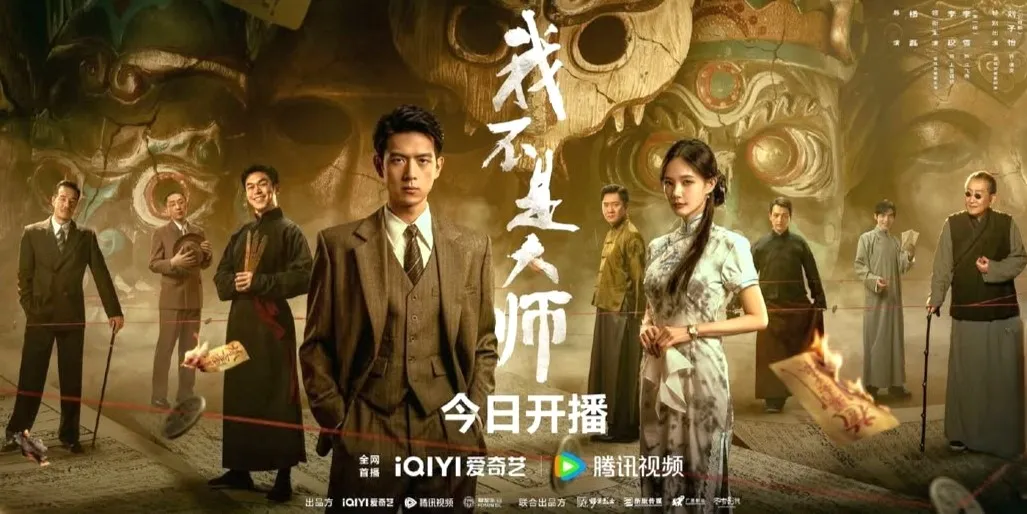
A Prophet Poster - Courtesy of iQIYI

|
DetailsRATING: (8.5/10) 


NATIVE TITLE: 我不是大师 - Wǒ bùshì dàshī YEAR: 2026 EPISODES: 24 DURATION: 45’ DIRECTOR: Yang Lei SCREENWRITER: Jiang Feng, Yang Zhe ORIGINAL CREATOR: Yi Zhi (我是个算命先生 - I am a fortune teller) RESPECTED CLICHÉS: 1 - 5 - 6 - 8 - 9 - 20 |
Disclaimer: the opinions expressed in this review refer exclusively to the drama. As I have not read the original work, I cannot say with certainty whether the issues identified can be attributed to the screenplay or to the source material. For this reason, my comments on the writing should be understood as an assessment of the adaptation rather than a judgment on the original work.
IN A NUTSHELL
Short on time? Here you’ll find the quick verdict, including the drama’s main strengths, weaknesses, and key features to help you decide if it’s right for you. For a more in-depth analysis, continue with the No Spoiler Review.
- What to expect: Through elaborate deceptions, false identities, and a complex psychological warfare between the protagonist and the leader of the sect that exterminated his family, A Prophet constructs a story in which every move opens up new possibilities and the consequences of the characters' actions continually fuel the plot. This mechanism is made effective by both the writing, which delivers a realistic and coherent story, and a cast capable of giving the characters charisma and depth, while the fast-paced editing, the visually evocative direction, and the original soundtrack strengthen the drama's identity. The narrative style, however, at times needlessly exacerbates the viewer's disorientation, and the drama culminates in an open ending that sacrifices conclusion to the promise of a sequel, leaving the first season without a fully satisfying payoff.
- Strengths: the fast-paced, disorienting narrative style, how one storyline leads into the next, the characters’ strong agency.
- Weaknesses: some directorial choices, the open ending.
- Recommended if you like: Li Xian and Li Yitong, dramas set in Republican China, the world of spiritual healers and popular beliefs, fast-paced and compelling stories, tales with truly surprising twists, series rich in visual suggestions.
- Would I rewatch it?Yes, in fact I'm already waiting for season two.
Read on to find out what makes this drama both compelling and disorienting.
In a world where truth hides behind a web of lies and every identity can be revealed as a mask, distinguishing deception from reality becomes an exercise in both insight and trust. A Prophet navigates this ambiguous territory, where appearances conceal ulterior motives and every move can prove fatal in the journey towards justice.
In this review of the drama A Prophet, after watching alla episodes, I will analyze how the drama constructs its intrigues, interweaves the protagonists' stories with the main plot, and uses direction to fuel the mystery. I will explore how these choices contribute to the story's success and whether they repay the viewer's trust.
Plot
In 1930s China, Wang Jiaxian sees his family destroyed by a scam orchestrated by the Tianxiang Sect, an organization that exploits popular superstition to manipulate and rob its victims.
Having survived the tragedy, he is taken as a disciple by Jin Buhuan, a former member of the sect, who teaches him to use the same techniques as his enemies to get close to them and counter their moves.
After eight years of preparation, Wang Jiaxian assumes the identity of Shangguan Chengming and infiltrates the Tianxiang Sect, taking part in their scams. This is the beginning of a plan for revenge that will lead him to gradually get closer to the sect leader, allowing him to attack the organization from within.
His path becomes complicated when he re-encounters Jiang Feiyan, a sect disciple implicated in the ruin of his family, and his ex-wife. As Chengming carries out increasingly elaborate scams to gain the trust of his adversaries, it becomes increasingly difficult for him to distinguish truth from lies, and carrying out his plan becomes increasingly risky.
Amidst deception, lies, and hidden truths, Chengming will have to contend not only with the wiles of the Tianxiang Sect members and their sect leader, but also with the resurgence of his feelings for Feiyan.
"A scam has two sides and so do people.
You must remember, what people believe isn’t a matter of truth or falsehood,
but of which way the scale in their own hearts tips."

THIS SECTION TAKES A CLOSER LOOK AT THE SCRIPT, CHARACTERS, CAST, AND TECHNICAL ASPECTS WITHOUT REVEALING MAJOR PLOT DEVELOPMENTS. FOR A COMPLETE ANALYSIS OF THE DRAMA, CONTINUE WITH THE SPOILER REVIEW.
A Prophet Drama Review (No Spoilers)
Plot and Narrative Pace
The plot of A Prophet revolves around a rather original subject: the world of scams and con artists. The story follows the protagonist's deceptions against the Tianxiang Sect, a con organization responsible for the death of his family. Chengming's plans, besides being believable and well-conceived, highlight his skills of observation and information gathering, as well as his ability to anticipate his opponents' moves. Each scam has its own development and conclusion, but its consequences impact the main plot, helping to advance it.
A Prophet doesn't skimp on twists, which arise both from the unexpected events that disrupt Chengming's plans and from the silent war of deception and counter-deception that pits him against the sect leader. In this confrontation, every move conceals an ulterior motive, and the ability to manipulate others' expectations becomes a double-edged sword. Tension thus arises from the uncertainty of who will be able to predict their opponent's moves and how long each will be able to maintain control of the situation.
Supporting this narrative construction is a rapid and disorienting directorial style, which alternates the main timeline with frequent flashbacks and dreamlike, delirious sequences, forcing the viewer to pay close attention to reconstruct events and reconsider their hypotheses in light of new information. These are not always presented in a linear fashion, and the viewer must therefore reconstruct the connections between events and distinguish different points of view as the story unfolds.
The pace is brisk and leaves few moments of respite, while the editing contributes to a mysterious and alienating atmosphere. I found this approach stimulating, as it invites active participation in solving the mystery rather than simply waiting for the story to provide all the answers. On the other hand, at times the pursuit of complexity ends up, in my opinion, making the story more convoluted than necessary.
Overall, A Prophet is a fast-paced and compelling series, especially suited to those who enjoy mysteries that require attention and a desire to piece together events. It may, however, prove challenging for those who prefer a linear narrative, one that gradually leads the viewer along and makes the connections between different pieces of information immediately recognizable.
Characters and Love Story
Despite being a highly plot-driven drama, A Prophet advances the narrative not only through intrigue, but also through the initiatives and decisions of individuals, whose personal motivations help shape events.
Shangguan Chengming is an enterprising and rational protagonist, capable of developing strategies, adapting to unexpected circumstances, and leveraging gathered information to advance his goal, without losing sight of his moral principles and concern for those close to him. His silent war with the sect leader unfolds in an interesting strategic confrontation, making the antagonist equally noteworthy. Truth and lies constantly overlap, making it difficult to distinguish who is lying, what their true intentions are, and how much of what is shown actually corresponds to reality. Even Jiang Feiyan, despite starting from a more ambiguous position, undergoes a developmental journey that leads her from being a tool in the hands of the sect leader to Chengming's ally.
On a romantic level, A Prophet isn't a particularly passionate drama, as the protagonists never develop a true romantic relationship over the course of the story. Although her attraction to Chengming was sincere, Feiyan never openly expresses her feelings for him, focusing instead on protecting him and helping him fight against the sect. Chengming, on the other hand, seems to still be in love with her despite the betrayal he suffered eight years earlier, but respects her decision not to resume their relationship. Their relationship is thus most explicitly expressed in flashbacks, which show their previous married life, while in the present, the bond between the two emerges primarily through mutual protection and cooperation.

Cast
One of the most pleasant surprises in A Prophet is how central the roles of the actors are to the success of a highly plot-driven drama.
Li Xian is perfect as Shangguan Chengming: the contrast between his serious face, the male lead's stage presence, and a surprisingly quirky nature conveys all the versatility of a character who must be able to improvise, manipulate his interlocutors, and defuse even the most tense situations without ever losing sight of his mission. His light-hearted acting and mocking expressions thus contribute to making Chengming charismatic and ironic, without sacrificing the seriousness of his goal.
Li Yitong proves to be a solid supporting actor, although the role of Feiyan leaves her less room to express the comic energy and vivacity she's shown in other roles (such as A Dream Within a Dream); she still effectively conveys both the concern for those she cares about and the self-control needed to carry out her plans.
Liu Guan Lin is fantastic, as always, bringing a successful balance between almost reckless lightheartedness and genuine loyalty to her values to her character, making him the ideal foil for easing the tension of Chengming's quest for revenge.
On the antagonist front, Guo Jing Lin is remarkable in his transition from friendliness to menace while maintaining an authentic expression. Wu Gang, on the other hand, convinces with a calm performance, which does not need emphatic gestures to be incisive.
The secondary casting choices also deserve mention: Zhao Jian manages to make his character both charming and believable as a soldier, yet dangerous and unpredictable; Shang Bai is perfectly at ease as the fierce and ambitious Sixth Batou, while Dang Tao almost inspires pity as the Second Batou, ruthless yet capable of unwavering loyalty.
Overall, the cast demonstrates how charisma, nuanced interpretations, and the ability to bring believability to very different characters are crucial to giving depth to a story built primarily around strategies and lies.
Visual Aspects and Soundtrack
From a technical standpoint, A Prophet stands out for its clean and controlled direction, which enriches the scenes with solutions that avoid a static mise-en-scène. The cinematography accompanies this approach with realistic colors, occasionally shifting toward sepia tones to recall the era, and a natural lighting that takes on surreal and evocative nuances in the dreamlike and delirious sequences.
The visual narrative is what contributes most to building the drama's disorienting experience: as seen in other works by Yang Lei, visual suggestions and interruptions of narrative linearity are an integral part of his directorial language. The story is therefore constructed to push the viewer to piece together events and reconsider their own conclusions, in a game of interpretations that sees them as the protagonists. An effective choice, but not without risks: in some passages, such as the cold open and the flashback within a flashback, the pursuit of disorientation becomes excessive, while the fragmented and frenetic editing deliberately accentuates the sense of urgency, sometimes to the detriment of fluidity.
The settings are very carefully crafted, from the lived-in interiors to the equally realistic exterior locations and city streets, while the green screens, while technically flawless, are often recognizable and unconvincing.
The costume design department does an excellent job, offering sophisticated costumes and aesthetically pleasing outfits, despite a few too many modern stiletto heels. The makeup and hairstyling also contribute to the overall credibility, with convincing hairstyles that are consistent with the setting.
The soundtrack of A Prophet is relatively modest, but stands out for its stylistic variety that allows it to effectively accompany the different registers that alternate throughout the series. Alongside romantic and melancholic songs like 越海 (Cross the Ocean) performed by Liu Yuning and 一曲白首 (Melody Through a Lifetime) sung by Mao Xiaoman, there are also more mysterious and enigmatic compositions, such as 贪嗔痴慢疑 (Greed, Anger, Delusion, Pride, Doubt), and songs with an almost tribal rhythm and distinctly rap-like sound, such as 卦 (Divination) by NZBZ (Nan Zheng Bei Zhan). It's precisely this contrast that makes the musical selection interesting: rather than relying on a single dominant repertoire, the series uses different sounds to accompany different moments of the narrative.
In particular, I found the opening sequence to be very successful, combining an animated montage featuring scenes from the drama with NZBZ's song, creating an energetic and engaging sequence that stands out from other dramas I've seen so far. Overall, while it's not a particularly rich soundtrack, I found it original and well-balanced, capable of enhancing the drama's different atmospheres and making its mark thanks in part to its less conventional musical choices.

WARNING!
SPOILERS AHEAD. THIS SECTION PROVIDES A DETAILED ANALYSIS OF SPECIFIC ASPECTS OF THE SERIES. DO NOT CONTINUE IF YOU DON’T WANT TO KNOW ALL THE DETAILS OF THE DRAMA
A Prophet Drama Review (Spoilers)
What Works
A Plot-Driven Drama, but with the Characters in the Driver’s Seat
One of the aspects I most appreciated about A Prophet is how it manages to be a strongly plot-driven drama, without reducing the characters to pawns dragged along by events. On the contrary, the story moves forward precisely because the characters act, triggering a chain of events that continually fuels the narrative.
Shangguan Chengming is the most obvious example: he is not a protagonist who passively waits for the script to assign him the next mission, but a character who observes, deduces, manipulates, and improvises, leveraging information and contacts gained through previous scams to gradually get closer to his goal. His agency is particularly evident in the way he manages the unexpected, adapting his plans without losing sight of the main mission—dismantling the Tianxiang Sect—and without abandoning his moral principles. His determination and desire to bring justice do not prevent him from showing his protectiveness towards Feiyan and Sha Liang and from caring for the sect's victims, while simultaneously seeking to punish other individuals responsible for abuses, such as the leader of the Beggar Gang and the murderous producer Tang Yushan. It is precisely this intertwining of objectives, reasoning skills, and concrete choices that makes Chengming such a captivating protagonist: even when we don't know his plans in advance, we always get the sense that he is actively trying to change the course of events, rather than simply following a predetermined sequence of events.
I also find Jiang Feiyan interesting: a morally ambiguous female protagonist whose agency complements Chengming's. Throughout her life, she has been exploited and manipulated by the sect leader, who recognized her potential and taught her to use it in the service of the Tianxiang Sect, transforming her into a tool for his own purposes. Yet, precisely through the deception of Chengming, Feiyan seems to realize that she no longer wants to be a pawn in the hands of others or continue to commit morally questionable acts on behalf of those who manipulate her. She thus decides to rebel against the cult leader and destroy the sect from within, a goal that ultimately coincides with Chengming's and leads her to actively collaborate in his plan. I find it interesting, therefore, that Feiyan also comes to independently redefine her own goals and choose a side, transforming her relationship with Chengming into an alliance based on a convergence of intent.
We are initially introduced to her character primarily through Chengming's memories, while her past and motivations remain mysterious for a long time. This opacity helps keep open the question of who Feiyan really is and how much her actions were influenced by the circumstances in which she grew up. Personally, I find a morally ambiguous character, whose motivations and reliability remain uncertain, more interesting than a villain whose nature is established in advance by the script. It's not necessary to grow to love Feiyan, but it's important to recognize that her complexity contributes to making the story more intriguing. Through her, too, A Prophet demonstrates its ability to construct characters who don't simply play a role in the plot, but who, through their choices and progressive self-awareness, contribute to determining its development.
Every Move Changes the Game
Another aspect I appreciated about A Prophet is its ability to intertwine the episodic structure with a solid and coherent horizontal plot, building a mystery that progressively unfolds through the scams in which Shangguan Chengming participates. These aren't simple plot devices to enliven the narrative or interludes that end once the current problem has been resolved: each scam has consequences, allowing the protagonist to gain new information, contacts, or resources, and helping him get closer to his ultimate goal: dismantling the Tianxiang Sect.
This creates a causal chain in which each new situation arises from what has happened before and influences subsequent developments, giving the story a clear direction even when it's not yet clear how Chengming will achieve his goal. The structure is particularly effective because it manages to reconcile the narrative rewards of individual arcs with the construction of a larger mystery: the scams have their own dynamics and development, but the information that emerges continues to feed the main plot, progressively altering our understanding of the events, Chengming's past, the Tianxiang Sect, and its leader. The result is a narrative that maintains a clear direction and gives the feeling of progressing through the characters' decisions, even though events are often clarified retroactively through flashbacks and reconstructions that force us to reconsider what we thought we understood.
What makes this construction particularly effective is the way the drama intertwines the mystery with the scams. The latter are well-crafted by Chengming, who prepares them in detail, studies his adversaries, and tries to anticipate their moves, but also finds himself having to improvise when something gets out of his control. The fact that we're often not shown his plan in advance allows us to witness events as they unfold, only later discovering how he managed to turn the situation to his advantage. This unpredictability is part of a mystery plot that unfolds through progressive revelations: information about Chengming's objectives, Feiyan's and the cult leader's past, the history of the Tianxian Sect, and the characters' motivations gain significance as the plot unfolds. At the same time, Chengming's confrontation with the cult leader turns into a silent war of deception and counter-deception, in which both seek to manipulate their opponent without us, the viewers, being able to be certain who is truly leading the game.
In a story where lies continually overlap with truth, we don't always know whether what we see corresponds to what is really happening or is simply the version someone wants us to believe. The mystery, therefore, is not only about uncovering the past, but also about understanding who really possesses the crucial information and what the intentions are behind each action. It is precisely this combination of ingenious scams, counter-strategies, and progressive revelations that makes the plot so engaging: A Prophet may disorient us with its time jumps and the fragmented way in which it distributes information, but it never gives the feeling that the story is proceeding in vain or that each new arc erases what came before. Beneath the complexity of the narrative remains a clear direction, and each piece contributes to building a larger picture.

A Fast-Paced, Disorienting Narrative Style
A final element that I personally appreciated about A Prophet is its rapid and disorienting narrative style, which helps build an atmosphere of mystery and uncertainty. Yang Lei doesn't lead the viewer through a linear succession of events, but forces them to reconstruct the chronology and connect information presented through the numerous flashbacks that punctuate the narrative, reconsidering their interpretations as the story unfolds. The drama transitions from a deliberately unsettling cold open to a present whose details are initially unclear, alternating between flashbacks and delirious sequences. I find these choices effective precisely because fragmentation is an integral part of the story: the editing and scene construction are designed to disorient the viewer, and they succeed very well. Although the narrative isn't immediately transparent, this doesn't mean that explanations are systematically postponed: simply, the information is provided through a non-linear structure.
This makes A Prophet a drama not suitable for everyone. The series requires constant attention and allows few breaks; the rapid pace and the need to constantly piece together events can be exhausting and turn the fragmentation into a source of frustration for those struggling to follow such a dense narrative. Personally, however, I didn't experience these characteristics as a problem; on the contrary, they're part of what makes the drama so stimulating. A narrative can be deliberately disorienting without being narratively poorly constructed: in this case, it's a successful stylistic choice, but it can make the viewing experience more challenging for some viewers than others. So if you need a linear story, an easily readable chronology, and a few moments to put your brain into energy-saving mode, I warn you: A Prophet might seem like divine punishment.
What Doesn't Work
Some Directorial Choices
The fact that I appreciated Yang Lei's narrative style doesn't mean, however, that I equally appreciated all the solutions adopted in A Prophet. At times, the pursuit of an extreme and disorienting narrative style seemed excessive to me, to the point of risking transforming an effective directorial choice into a stylistic exercise for its own sake. This is the case with the cold open, which in the first minutes drags us into a delirious nightmare made of macabre images, fragments of memories, and enigmatic phrases, in an attempt to suggest the circumstances of the extermination of Chengming's family and Feiyan's possible involvement. This sequence is undoubtedly impactful, but it also risks making the direction seem even more over-the-top than in the rest of the series, almost as if someone at the production meeting said, "So, to tell the story that Chengming's family was exterminated and that Feiyan might be involved, why don't we insert a delirious dream sequence in the first five minutes that makes little or no sense?"
The problem arises again in the sequence dedicated to the trap Chengming orchestrates against Du Binghui, with the introduction of a flashback within a flashback. Inserting one memory within another can be a functional choice, but it significantly increases the work required to orient oneself within the chronology and doesn't always offer a proportionate narrative advantage. In this case, Chengming switches from remembering his life with Feiyan to reliving an episode from his past with Jin Buhuan: while the latter is explaining how to defeat his enemies, he reveals that he is involved in the scam against him. It is at that point that Chengming stabs him. The intertwining of the two memories makes it particularly difficult to reconstruct the chronology of events, when it would have been possible to keep the two flashbacks separate, preserving the same mystery and conveying the same information without imposing an additional layer of nesting on the viewer.
It is here, in my opinion, that A Prophet occasionally risks confusing complexity with complication: just because a story should be disorienting doesn't mean every step should be as complicated as possible. It's not a choice that compromises the overall success of the narrative, but it's an excess that I found annoying precisely because it's not strictly necessary.
The Ending
The open ending is one of the most disappointing aspects of A Prophet, because it seems to confuse the possibility of continuing a story with the ability to conclude it. A satisfying ending doesn't necessarily have to resolve every conflict or answer every question, but it must give meaning to the journey accomplished, offering a narrative and emotional payoff commensurate with the viewer's investment. After twenty-four episodes spent reconstructing the protagonists' pasts, understanding what separated them, and following their choices and evolution in the present, I expected the season to reach a significant narrative point, even without definitively closing their story.
It's not the cliffhanger itself that bothers me, but rather the direction it takes. If the ending had shown Chengming receiving a letter from Sha Liang or Feiyan, asking for his help in solving a problem, I would have welcomed it with curiosity, believing that their adventure was destined to continue. The appearance of a man who introduces himself as the real Shangguan Chengming, however, has the opposite effect: rather than opening up a new perspective, it calls into question the one just concluded and leaves me with the feeling that the protagonist's nightmare isn't over yet.
More than the promise of a new adventure, the ending conveys the promise of another long series of complications yet to be faced, as if the first season were merely the premise for the second. But the possibility of a sequel doesn't equate to a payoff, nor can it justify reopening the game. And, considering how far from a given that Chinese dramas will receive a second season, postponing the task of making sense of the journey just described until a possible sequel seems particularly frustrating to me.

Characters and Cast
Primary Characters
Wang Jiaxian/Shangguan Chengming (Li Xian) first young master of the Wang family of Jianghuai. Eight years before the events of the story, his family was destroyed by a scam carried out by the Tianxiang Sect to steal their wealth. Left alone in the world, he wanders the streets until he meets Jin Buhuan, a former disciple of the Tianxiang Sect, who offers to help him carry out his revenge. Thanks to his teachings, Jiaxian manages to infiltrate the Tianxiang Sect and gradually gains the trust of the sect leader, whom he uses to pursue his revenge.
Jiang Feiyan (Li Yitong) fifth Batou and head of the Yuehaitang branch of the Tianxiang Sect. Eight years before the events of the story, she poses as an opera singer and convinces Wang Jiaxian to marry her, contributing to the extermination of his family. When the two meet again, she appears cold toward him, but in reality, she shares the same goal of destroying the Tianxiang Sect and will help her ex-husband carry out his plan for revenge.
Sha Liang (Liu Guan Lin) junior disciple (小腳) of the Longxuya branch of the Tianxiang Sect, to whom Shangguan Chengming is entrusted when he arrives in Qianshan. He is a simple and naive boy who genuinely grows fond of Chengming and helps him carry out his revenge.
Supporting Characters
Tianxiang Sect
Shen Yunhe, twenty-third leader of the Tianxiang Sect and deceased shifu of Zhou Xingsi.
Zhou Xingsi (Guo Jing Lin | Xu Yang), twenty-fourth leader of the Tianxiang Sect and father of Shangguan Chengming.
Shangguan Hong/A'Hong (Huang Yi | Liu Mei Han), disciple of the Tianxiang Sect, shimei of Zhou Xingsi, and his lover. She is the mother of the real Shangguan Chengming.
Zhang Dancheng/Jin Buhuan (Wu Gang) former disciple of the Tianxiang Sect and shidi of Zhou Xingsi, who seeks revenge on him for the wrong he suffered. He will help Wang Jiaxian infiltrate the sect and carry out his plan for revenge.
Qin Baichuan (Liu Jin Long) disciple of the Tianxiang Sect, shidi of Zhou Xingsi, leader of the Batous and the Muzilian branch of the Tianxiang Sect.
Qin Huiming, disciple of the Muzilian branch of the Tianxiang Sect and secret son of Qin Baichuan.
Ci Yanwang/Porcelain Yama (Dang Tao) disciple and second Batou of the Tianxiang Sect. He's a seemingly unscrupulous man who runs a funeral home. In reality, he's very loyal, a lover of antiques, and in love with Jiang Feiyan.
Mian Lizhen/Cotton Needle, disciple and third Batou of the Tianxiang Sect. He is a scholar and a close friend of the seventh Batou.
Zhang Zizhan, disciple and fourth Batou of the Tianxiang Sect. He studied abroad and is the most upright of all the Batou, so much so that he does not approve of the murders committed by the sect.
Huang Farong (Ai Xiao Qi) first disciple of the Yuehaitang branch of the Tianxiang Sect and wife of Zhang Zizhan.
Feng Zi Shou/Wind Master (Shang Bai) disciple and sixth Batou of the Tianxiang Sect. He is fierce and ambitious and is Zhou Xingsi's right-hand man.
Fan Yifei, disciple of the Tianxiang Sect and Feng Zi Shou's aide.
Xian Ren Shou/The Hand of the Immortal, disciple and seventh Batou of the Tianxiang Sect. He is a former opera singer, knows a few sleight of hand, and is a close friend of the third Batou.
Lv Ruhui (Wei Qian Xiang) disciple of the Muzilian branch of the Tianxiang Sect whose identity Wang Jialiang steals to gain access to the sect.
Wang Jiaxian Scam
Madam Zhu, disciple of the Yuehaitang branch of the Tianxiang Sect. Pretends to be Jiang Feiyan's ailing mother.
Du Binghui/Du xiazi (Liang Tian) blind healer who treated Jiang Feiyan's mother. He is actually the head of the Longxuya branch of the Tianxiang Sect.
Second Lady Wang (Xue Jia Ning) stepmother of Wang Jiaxian and mother of Wang Jialiang and Wang Jiashu.
Wang Jialiang and Wang Jiashu, half-siblings of Wang Jiaxian.
Chen Jiarong Scam
Hu Guangyuan (Hai Yi Tian) senior disciple of the Muzilian branch of the Tianxiang Sect and shishu (師叔) of Lyu Ruhui.
Da Gui, disciple of the Muzilian branch of the Tianxiang Sect and aide to Hu Guangyuan.
Chen Jiarong (Yue Yang) owner of several jewelry shops and pawn shops in Pangzhou.
Chen Qingying (Wang Yi Ting) daughter of Chen Jiarong, recently returned from her studies in England. She is targeted by the Tianxiang Sect to get closer to her father.
Song Bingzhang/Song Tiezui, fortune teller that Shangguan Chengming/Lin Shengxiang insists on consulting before buying a mine in Pangzhou. He is actually a member of the Tianxiang Sect, tasked with tricking Chen Jiarong into believing there is a gold vein in the abandoned tin mine on Mount Ping.
Zhu Wangfu, Chen Jiarong's driver. He is actually a disciple of the Tianxiang Sect.
Director Zhao, Director of the Pangzhou Police Department.
Qian Family Scam
Feng Siyuan (Zhao Jian) Division Commander of Qianshan. He is later appointed Deputy Director of the Yucheng Operations Command (行營副主任).
Lei San, Regimental Commander of Qianshan and Feng Siyuan's subordinate, involved in opium trafficking with the Tianxiang Sect.
Officer Xu, Lei San's orderly officer. To deceive Shangguan Chengming and involve him in the opium trade, he impersonates Zheng Tianming, the owner of a coal mine in Anping, who wants his son's corpse brought back to him through the Xiangxi Walking Corpse Rite.
Du Heng/A'Heng, zhizi (大侄子) of Du Binghui, involved in the opium trade with Lei San.
Qian Huairen (Wang Pei Lu) first master of the Qian family, pharmacists of Qianshan. He is forced by the Tianxiang Sect to produce Bashen Powder, a powerful anesthetic with which the sect carries out its scams, but testing it on himself ends up damaging his health.
Qian Huaiyi (Wang Jing) second master of the Qian family. He is an authoritarian man and has assumed the role of head of the family since his father died and his older brother became increasingly eccentric.
Qian Huaijin (Sun Shuang) third madam of the Qian family. She falls in love at first sight with Zhou Wenxin and, in order to marry him, asks her brothers to "take care" of his wife.
Zhou Wenxin (Zhang Xiao Qian) Qian Huaijin's husband. He runs the Qian's pharmacy, the Mingcao Hall (明草堂).
Bai Wenlan (Gao Rui Fei Er) Zhou Wenxin's ailing wife. To care for her, her husband often goes to Mingcao Hall, where he eventually attracts Qian Huaijin's attention. She disappears while Zhou Wenxin is out of town on business.
Fan Jialie Scam
Mei Xuanzi, leader of the Meihua Sect (梅花會), a rival of the Tianxiang Sect.
Fan Jialie, official of the Yucheng Police Department and owner of the Shunxiang Teahouse. He is in league with Mei Xuanzi.
Fan Zhehan, Fan Jialie's eldest son. He is an arrogant and idle man who despises his half-brother.
Fan Xinze (Xu Jun Shuo) Fan Jialie's illegitimate son with a prostitute. He manages the Shunxiang Teahouse and collects bribes intended for his father.
Yin Lian (He Mu Rong) prostitute from the Chunfeng brothel with whom Fan Xinze is in love. He wants to buy her out of the brothel, but her brother impregnates her and then forces her to take an abortifacient that kills her.
Wang Zhicheng, Director of the Yucheng Police Department. He is in league with Zhou Xingsi.
Guo Qianli, Officer of the Yucheng Police Department and Wang Zhicheng's subordinate. He is honest and ambitious and repeatedly helps Shangguan Chengming.
Madam Sang, Madam at Chunfeng House.
Cao San Scam
Cao San (Yang Yi Wei) leader of the Beggars' Gang (丐幫). He is a former beggar who carries on his leader's legacy by gathering orphans from the streets and forcing them to beg for him.
Madam Cao (Huang Xiao Lei) wife of Cao San. She is a practical and prudent woman who often scolds her husband for his carelessness.
Gou Zi (Wang Yu Ze) personal servant of Cao San. He is actually a member of the Tianxiang Sect.
Tang Yushan Scam
He Manzhi (Song Yi Xing) very talented actress whom Tang Yushan marries and then kills when she asks for a divorce.
Tang Yushan (Zhang Jing Wei) General Manager of the Changfeng Film Production Company and He Manzhi's ex-husband. He was a gambler who had become wealthy by marrying the actress and had founded a production company. When she asked for a divorce, he killed her and later tried to exploit her death to launch his latest film.
Yang Xiaozhong, director and old friend of Wang Jiaxian. He turns to the Tianxiang Sect to organize a scam against Tang Yushan and avenge He Manzhi's death.
Zhang Yinhua Scam
Li Shan, late head of the Li family. He was the first to perform the soul-trapping ritual (困魂局) on his deceased wife, a member of the Zhang family.
Li Yingfu, son of Li Shan and an official in Yuan Shikai's army. She has never forgiven her father for desecrating her mother's corpse with the soul-trapping ritual and decides to arrest Zhou Xingsi for fraud.
Li Yingjuan (Luo Hai Qiong | Li Jia Chen) daughter of Li Shan and fiancée of Zhang Yinhua. She is the first woman to be sacrificed by Zhang Yinhua with the soul-trapping ritual, but Shangguan Hong saves her.
Li Ling, niece of Li Yingjuan. Zhang Yinhua convinces her son to marry her so he can perform the soul-trapping ritual on her, but she is saved by Jiang Feiyan.
Zhang Yinhua, current head of the Zhang family and ex-husband of Li Yingjuan. He is a salt trafficker who, to enrich himself, has sacrificed, in addition to his wife, several concubines in the soul-trapping ritual of the Tianxiang Sect.
Zhang Yuanfan (Li Dian Zun) son of Zhang Yinhua. She is persuaded by her father to marry Li Ling so he can perform the soul-trapping ritual on her.
Liu Xijiao, Abao disciple of the Yuehaitang branch of the Tianxiang Sect, taken as a concubine by Zhang Yinhua to be sacrificed with the soul-trapping ritual. She was the woman Sha Liang was in love with.
Lu Qinhai Scam
President Liu, high-ranking Communist Party official and friend of Zhou Xingsi. He is a lover of the works of the painter Zheng Banqiao, whose painting Bamboo in a Gentle Breeze is owned by the Dongyu Chenggu auction house.
Song Yangqun, accomplice of Jin Buhuan who pretends to have been scammed by the Dongyu Chenggu auction house to lure Feng Zi Shou there.
Lu Qinhai, owner of the Dongyu Chenggu auction house and murderer of Wang Guifen, Feng Zi Shou's mother.

Favorite Character: Shangguan Chengming
He is a kind and altruistic guy, gifted with a brilliant intelligence and a tenacity that allows him to face even the most desperate situations without giving up.
Although he comes from a wealthy family and studied architecture abroad, he is unconstrained by social conventions, as demonstrated by his choice to marry Jiang Feiyan, an opera singer. Even after being betrayed by her and losing his family, he manages to look beyond his resentment and comes to forgive her. The same generosity emerges in his relationship with the master Jin Buhuan: despite discovering that he is involved in the deception that contributed to her family's downfall, she continues to worry about him and tries to prevent him from surrendering to Zhou Xingsi, knowing that he would face death. Similarly, he develops a sincere attachment to Sha Liang, a naive disciple of the Tianxiang Sect, a bond that his enemies do not hesitate to exploit on more than one occasion to put him in difficulty.
The loss of his family doesn't drive him to give up on life, but rather fuels an unwavering determination to pursue justice and dismantle the Tianxiang Sect. To achieve this, he infiltrates it, managing to gain the trust of its members solely through his skills.
Gifted with keen powers of observation and deduction, he knows how to read situations, identify others' weaknesses, and use the information he gathers to devise convincing scams. The contacts and knowledge he acquires during his exploits become invaluable tools, allowing him to turn even seemingly unfavorable situations to his advantage. His ability to maintain control, anticipate others' moves, and devise alternative plans allows him to react even when events threaten to spiral out of control, making flexibility one of his strengths. These qualities are particularly evident in his confrontation with Zhou Xingsi, where he demonstrates his ability to hold his own against an equally cunning opponent without being manipulated or caught off guard.
His determination does not translate into a blind thirst for revenge. He maintains a clear distinction between the pursuit of justice and the satisfaction of personal resentment: while carrying out his plan to destroy the Tianxiang Sect, he cares for those caught up in its schemes and seeks to protect those at risk of becoming victims of others' abuses, targeting the individuals responsible for these abuses, such as the leader of the Beggar Gang and the murderous producer Tang Yushan. His resourcefulness allows him to fight these injustices by using the same tools—deception, manipulation, and abuse of trust—used by his adversaries, without losing sight of his own moral principles.
Finally, what makes the character particularly successful is the contrast between the gravity of his mission and his light-hearted temperament. He may have a controlled attitude, but he never takes himself too seriously and knows how to use irony to lighten even the most tense situations. His mocking expressions and the way he approaches his interlocutors with an almost provocative ease contribute to his charm and allow him to disorient his opponents, making his improvisations even more believable.
It is precisely this balance that makes Shangguan Chengming such a fascinating protagonist: he is cunning enough to deceive his enemies, but he is not a manipulator incapable of feeling, nor an avenger willing to sacrifice anyone to achieve his goal. His humanity makes him vulnerable, but it is also what prevents his mission from turning into a simple showdown.
Un-Favorite Character: Zhou Xingsi
He is an ambiguous, devious, and ruthless man, capable of manipulating people and distorting the truth to his advantage with such skill that it is difficult, even for those closest to him, to distinguish his motives from the lies with which he seeks to justify his actions. Behind the image of a magnanimous leader, willing to do anything to protect the Tianxiang sect and its disciples, lies a cruel and calculating individual, who does not hesitate to resort to deception and violence when his interests require it.
His ruthlessness is first evident in his relationship with the previous sect leader, whose favorite disciple he had been, whom he killed without regret, ostensibly to prevent him from dismantling the sect. He accuses him of sacrificing the well-being of his followers in the name of the mission to overthrow the Qing Dynasty and restore the Ming Dynasty, forcing them to resort to deception to survive. Yet, behind this apparent concern lies a fundamental contradiction: he has no qualms about perpetuating the very methods he criticizes his predecessor for, even going so far as to kill to ensure his scams succeed, without truly questioning the necessity of those deaths or the possibility of avoiding them, and openly contradicting the rules of the Tianxiang sect itself.
The same ruthlessness characterizes his relationship with his fellow disciples, including Shangguan Hong, his former shimei and the mother of his son. When she, after leaving the sect because she disagreed with his methods, agrees to return to convince him to abdicate, he does not hesitate to stab her, causing her death. Here too, his willingness to resort to violence reveals how little even personal and family ties matter to his goals.
Likewise, he makes no distinction between his victims: he indiscriminately deceives those who have enriched themselves through their own abilities as well as those who have accumulated wealth through illicit activities or despicable actions, such as the leader of the Beggars' Gang and He Manzhi's husband. His is therefore not a kind of distorted justice, but a cynicism that recognizes no moral limits when it comes to pursuing his own goals.
Even more disturbing is his ability to present as acts of generosity and compassion actions that are actually driven by calculation. When he welcomes the Sixth Batou into the sect, still a boy, he appears to offer him a way out from the criminal gang he had been forced to join to financially support his widowed mother. In reality, Zhou Xingsi himself had subsequently commissioned the woman's murder, aiming to ensure his son's absolute loyalty. Behind the seemingly merciful gesture, therefore, lay a manipulative plan, exploiting the pain and vulnerability of a boy who, upon discovering the truth, ends up being killed by him.
A similar mechanism is repeated in the case of Feiyan. Zhou Xingsi kills his mother, ostensibly to save her from the abuse he subjected her to, but his true goal is to exploit the girl's skills for his scams. Even the supposed possibility of redemption granted to the Abao disciples who had abandoned the sect turns out to be a deception: after convincing them to return to carry out a scam by promising them absolution, he kills them. In all these episodes, his supposed magnanimity is merely a mask behind which he hides a desire to control others and bend them to his own needs.
Zhou Xingsi is, ultimately, a dangerous man precisely because he rarely reveals himself for who he is. He knows how to cloak cruelty with good intentions, transform exploitation into a form of protection, and justify his lies by resorting to principles he himself unhesitatingly violates. His skill at manipulating people lies not only in convincing them to trust him, but in confusing them to the point of questioning the legitimacy of their objections. It is this constant ambiguity, combined with his total lack of scruples when his interests are at stake, that makes him a despicable individual: a man who invokes the good of the sect to legitimize his own power, while remorselessly sacrificing the very people he claims to protect.
Recommended
- ARSENAL MILITARY ACADEMY
- CITY OF STREAMER
- FLOURISHED PEONY | IN THE NAME OF BLOSSOM
- LEGEND OF ZANG HAI
- MYSTIC NINE
Thank you for reading all the way to the end!
I hope you enjoyed this article and found it helpful.
🈷️ Did you come across a term you weren't familiar with? Check out my Chinese Historical Drama Glossary, where you'll find explanations of official titles, government institutions, religion, myths, and many other aspects of Chinese culture.
☕ If you enjoy my content and would like to support Red Taotie, you can buy me a coffee on Ko-fi. Every contribution helps me continue creating reviews and in-depth articles.