
A League of Nobleman (2023): When Song Weilong Makes You Miss the Annoying Female Lead | Retro Drama Talk
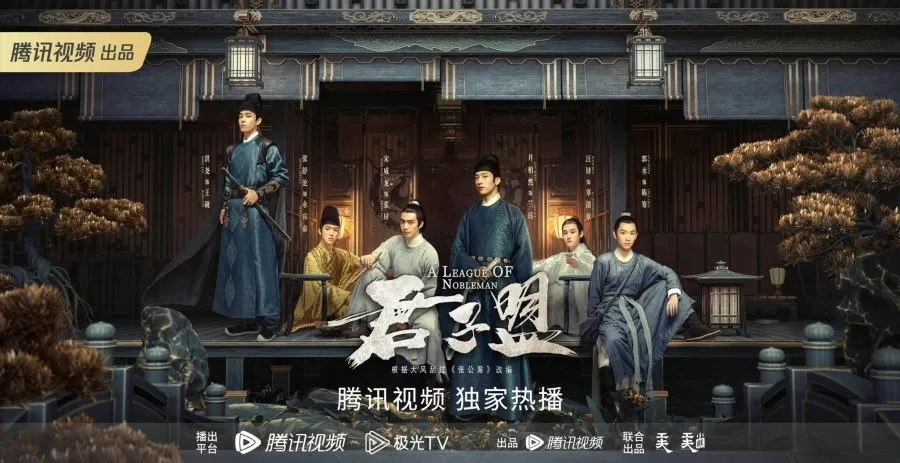
A League of Nobleman Poster - Courtesy of Tencent Video

|
DetailsRATING: (6/10)
NATIVE TITLE: 君子盟 – Jūnzǐ méng YEAR: 2023 EPISODES: 29 DURATION: 30’ DIRECTOR: Yang Fan, Jia Xiao Xiong SCREENWRITER: Pei Li, Yang Fan, Hai Jin Da Bao, A Ci ORIGINAL CREATOR: Da Feng Gua Guo (张公案 - Zhang’s Judicial Cases) |


Disclaimer: the opinions expressed in this review refer exclusively to the drama. As I have not read the original work, I cannot say with certainty whether the issues identified can be attributed to the screenplay or to the source material. For this reason, my comments on the writing should be understood as an assessment of the adaptation rather than a judgment on the original work.
IN A NUTSHELL
Short on time? Here you’ll find the quick verdict, including the drama’s main strengths, weaknesses, and key features to help you decide if it’s right for you. For a more in-depth analysis, continue with the No Spoiler Review.
- What to expect: A League of Nobleman is a darkly atmospheric historical investigative drama that blends mystery, disturbing legends, and court intrigue, following the encounter between two men whose shared pasts are more profound than they seem. The series constructs an original and richly thought-provoking story, capable of shifting from criminal investigation to political conspiracy without sacrificing a certain visual elegance. The problem is that this very ambition sometimes works against it: the investigative cases become so closely intertwined with the larger conspiracy that they lose some of their impact, while some of the supernatural devices devised to make them more captivating test the suspension of disbelief to the limit. The result is an overall fascinating drama, but one with a rather uneven pace and one that always seems to have more insight than it can truly develop.
- Strengths: the original premise, the mysterious atmosphere, the gripping political conspiracy.
- Weaknesses: the “fake procedural” setup, the inconsistent supernatural elements, the plot inconsistencies.
- Recommended if you like: Jing Boran and Song Weilong, historical investigative dramas with a dark atmosphere, stories with supernatural elements, tales of male friendship, and long-standing political conspiracies.
- Would I rewatch it? No.
Read on to find out why this drama doesn't work.
With its dreamlike atmosphere and slow-paced, mysterious narrative, A League of Nobleman slowly reveals a world of shadows, enigmas, and buried truths, following the adventures of two very different men who find themselves, almost against their will, at the center of a story where nothing is quite as it seems.
In this review of the drama A League of Nobleman, after watching all episodes, I'll analyze the plot, cast, setting, and all the elements that have contributed to making it one of the most talked-about series of recent years — but perhaps not always for the right reasons.
"It is said that when the ancient kingdom of Mo was founded,
the Lord of Creation Yinjitian sent Six Sages to Earth to educate the people.
Wenwulei, the Sage of Medicine, originated from the divine bird,
to alleviate the suffering of the people.
A’Nari, the Sage of Dance, to teach people
to express their feelings through dance.
Morigen, the Sage of Wisdom, with four heads and eight arms,
to instill wisdom into the world.
Zansang, the Sage of Agriculture, originated from a silkworm,
to educate the people in mulberry cultivation and weaving.
Wuyou, the Sage of Justice, with the crown of branches, to judge evil deeds.
Luonajin, the Sage of Music, skilled in playing various instruments,
to bring dogma to the world."
Plot
Zhang Ping is an orphan who, along with his friend Chen Chou, sells mian at the Dafu Market in the capital of Dayong to pay for the Imperial Examination. His dream is to become an official at the High Court of Justice, following in the footsteps of his idol, Inspector Mu Yesheng, author of The Bizarre Night Chronicles, a book that collects some of his most famous cases.
One day, Zhang Ping is unwillingly drawn into a theft case by Deputy Minister of Rites Lan Jue, and from that moment on, their paths become inextricably intertwined.
The two begin investigating a series of bizarre murders rocking the city, but their relationship is far from simple: convinced that Lan Jue is hiding dark secrets, Zhang Ping initially tries to discredit him and expose his alleged plots. However, when she discovers that the Deputy Minister is only trying to shed light on the tragic death of her father, unjustly convicted of high treason twenty years earlier, she decides to join him in his investigation.
Case after case, the two gather clues that bring them closer to the truth about their respective family tragedies and allow them to piece together, little by little, the events that marked their pasts.
Their search culminates in an encounter with the enigmatic scholar Gu Qing Zhang, destined to prove a crucial piece in piecing together the puzzle and finally shedding light on the unsolved mysteries.

THIS SECTION TAKES A CLOSER LOOK AT THE SCRIPT, CHARACTERS, CAST, AND TECHNICAL ASPECTS WITHOUT REVEALING MAJOR PLOT DEVELOPMENTS. FOR A COMPLETE ANALYSIS OF THE DRAMA, CONTINUE WITH THE SPOILER REVIEW.
A League of Nobleman Drama Review (No Spoiler)
Plot and Narrative Pacing
A League of Nobleman is a drama that, despite being presented as an investigative story, often uses court cases more as tools to develop the dynamic between the protagonists and advance the overarching political plot than as truly self-contained mysteries. This choice gives the narrative a strong unity, but it can be frustrating for those seeking the pleasure of following and solving each individual mystery. Furthermore, when every murder and every disturbing event is inevitably connected to the same secret, the narrative world paradoxically risks appearing less credible rather than more coherent, because it leaves no room for chance or coincidence.
The problem emerges from the first episodes, where the narrative progresses with a disarming slowness and a tone often so dull that each revelation seems less important than it should.
Furthermore, despite being based, at least on paper, on the rationality and investigative intuition of its protagonists, A League of Nobleman accumulates spectral suggestions and seemingly inexplicable phenomena that are consistently traced back to reality through explanations that are anything but convincing. The supernatural atmosphere seems to be introduced more to make the cases enigmatic and spectacular than to construct mysteries capable of withstanding the test of solution.
The direction also contributes to slowing the narrative pace. The investigations almost always take place at night or in environments so dark that the viewer is forced to rely on the characters' words to understand what actually happened. The frequent explanations and reconstructions thus end up replacing direct observation: instead of discovering clues alongside the protagonists, the viewer often has to wait for someone to metaphorically turn on the light and explain what they should have seen. Darkness certainly helps make bizarre crime scenes more suggestive — and perhaps even more plausible — but it also has the side effect of obscuring details: a method that may be effective for maintaining mystery, but decidedly less effective for making the viewer feel like an integral part of the investigation.
Characters and Relationships between the Protagonists
The characters in A League of Nobleman, overall, work, although I must admit that, in the first episodes, I almost missed the classic annoying female protagonist: as irritating as she was, she would probably have been less annoying than Zhang Ping. In the early episodes, in fact, the young man proves so stubborn, pedantic, and unreasonable that he elicits a reaction from the viewer that goes far beyond simple intolerance. Even though his characterization gains more depth as the story progresses, the initial impact remains decidedly hard to forget.
I did, however, appreciate the character of Lan Jue, even recognizing that his figure is based on a rather classic archetype: the serious and composed minister who, behind apparent loyalty to the sovereign, secretly carries out a plan to clear his father's name.
More interesting than the protagonists, however, are the antagonists, starting with the Empress Dowager, an enigmatic and ruthless figure, incapable of inspiring trust and constantly busy hiding the sins of her past, followed by the mysterious Mr. Jinghu, a menacing presence who operates in the shadows, sowing panic and waiting for the right moment to strike.
As for the relationship between Lan Jue and Zhang Ping, one gets the distinct feeling of being faced with a failed BL due to a choice in the script or, more likely, to comply with the limits imposed by Chinese censorship on same-sex romances. Their dynamic retains the structure of a relationship built around the meeting of two men destined to develop an emotional bond, but almost completely eliminates the romantic component. This not only deprives the narrative of a romantic relationship, but leaves in its place a void that the series fails to fill, making the relationship between the two protagonists more flat and less engaging than it could have been. A few more moments of emotional or sentimental tension would probably have made the importance they assume in each other's lives more credible, enhancing a dynamic that, as it is constructed, seems to promise much more than the series actually manages — or wants to — develop.

Cast
I found the cast of A League of Nobleman particularly interesting. Overall, the actors manage to enhance a narrative that isn't always effective, helping to maintain interest in a story that's often more compelling in its characters than in its plot development.
Among the performances, Oscar He stands out. He's a very young actor who, despite his age, has already played child versions of the protagonists numerous times. As Lan Jue as a child, he once again proves surprisingly expressive and convincing, managing to convey even the most complex emotions with ease.
Wang Duo is also extraordinary, continuing to stand out for his ability to portray ambiguous, tormented, and disturbing characters — roles in which he consistently surprises, maintaining a perfect balance between vulnerability and unease.
Song Weilong's performance, however, left me a little perplexed. His performance sometimes seems to betray a lack of character identification, accentuating some of Zhang Ping's flaws in the script and making it even harder to sympathize with him.
Jing Boran, on the other hand, gives a good performance. Despite his tendency to overdo his acting at times with overly pronounced lip movements, he manages to compensate for this small flaw with a voice so captivating that it almost becomes negligible.
Special mention goes to Hong Yao, whom I also appreciated in Arsenal Military Academy and whom I found particularly natural and confident, and Zhang Shu Lun, who is believable and moving in the role of the good and deeply human Emperor.
Completing the group is the excellent Shi Yue Ling, sufficiently disturbing in the role of the tyrannical Empress Dowager to whom she imbues a cold and threatening authority.
Visual Aspects and Soundtrack
From a technical standpoint, A League of Nobleman stands out for its meticulous direction, featuring carefully crafted shots that lend dynamism to an otherwise rather static narrative. Even the lighting, generally natural and set to warm tones, contributes to an elegant and realistic atmosphere, although this very choice ends up detracting from the scenes that should be the heart of the drama. As already mentioned, the investigations often take place at night or in dimly lit environments, a solution that certainly makes the crime scenes more evocative, but often leaves the viewer wondering what they're actually seeing, necessitating frequent explanations from the characters.
The sets and exteriors, including those reconstructed by the production crew, are well-crafted, while the limited CGI integrates quite well with the rest of the production. The costumes are generally simple and realistic, with a couple of truly notable exceptions worn by Jing Boran and Wang Duo; less convincing, however, are the wigs, deliberately understated, which for this very reason sometimes appear rather fake. I was also perplexed by the frequent vignetting applied to the images, even in completely ordinary scenes like those set at court: since it isn't associated with dreamlike or evocative moments, it was never clear to me what effect it was intended to produce on the viewer.
I found the opening theme, however, very successful: an intriguing and mysterious montage accompanied by rhythmic music and consisting of black-and-white images observed as if through water, likely a reference to the Water Illusion used by Zhang Ping. It's a shame that it was placed after the first scene of the episode rather than at the beginning: by starting the theme at a different point each time, the drama ends up turning it into a sort of mobile narrative pause, a choice that I personally find more alienating than effective.
The soundtrack stands out for its originality, alternating predominantly popular genres with very diverse sounds, which overall gives it a distinctive character. It ranges from 别 (Farewell), a modern, slow, and melancholic piece also performed by Jing Boran, to 天下大福 (Great Fortune for All Under Heaven), a delicate choral piece that recounts the lives of the people; from 一棚傀儡木雕成 (The Puppet Is Carved from Wood), a mysterious instrumental piece that combines tribal sounds with hints of guqin, to 牛儿醒了要吃草 (The Little Cow Woke Up and Wants to Eat Grass), which instead draws on the rhythms and melodies of Chinese folk songs. It is certainly a particular musical selection, which ends up placing more emphasis on the popular and tribal dimension of the drama than on the investigative and political one.

WARNING!
SPOILERS AHEAD. THIS SECTION PROVIDES A DETAILED ANALYSIS OF SPECIFIC ASPECTS OF THE SERIES. DO NOT CONTINUE IF YOU DON’T WANT TO KNOW ALL THE DETAILS OF THE DRAMA
A League of Nobleman Drama Review (Spoilers)
What Works
The Argument
It must be acknowledged that A League of Nobleman certainly has no shortage of original ideas. The legal cases faced by the protagonists are built around bizarre crimes, disturbing legends, and seemingly supernatural allure, while the overarching political plot unfolds a complex conspiracy, populated by ambiguous characters and secrets rooted in the past.
This last element, in particular, demonstrates considerable narrative potential. The story of the Empress Dowager, willing to replace her dying son with another child to retain power and ready, years later, to eliminate any possible threat through intrigue, mass poisoning, and false accusations, could have supported an entire political plot on its own. Likewise, the story of Gu Qing Zhang, the Crown Prince switched at birth, saved by Zhang Ping's mother and raised far from the court, who returns to the capital under a false identity to seek revenge on the woman responsible for his downfall. His past connection to Lan Jue — formed when the two were young students and marked by friendship, sacrifice, and unresolved secrets — adds further depth to a character who could have been a much more nuanced antagonist than a simple conspiracy theorist.
Taken individually, therefore, both narrative threads possess considerable strength: the court cases have the potential to construct independent mysteries, while the struggle for power at court offers a story of ambition, betrayal, and hidden identities rich enough to sustain itself even without further implications. Ironically, then, these two ideas would probably have worked better if they had been developed in two separate dramas: the first could have focused on independent investigations, capable of existing and being concluded without necessarily having to lead to the imperial court; The second could have told a more nuanced political story, without having to encompass every murder, legend, or suspicious event that occurred in the vicinity of the palace. The quest for absolute narrative coherence ends up damaging both threads: the court cases lose their autonomy, while the conspiracy becomes so omnipresent as to almost become a universal explanation. Two potentially very interesting ideas thus end up thwarting each other, when, separately, they could perhaps have created two more solid and engaging stories.
What Doesn't Work
Narrative Structure
One of the less successful aspects of A League of Nobleman is its structure: despite being presented as an investigative drama, it seems to have surprisingly limited interest in its own investigations. The court cases often appear as a simple vehicle to develop the dynamic between the two protagonists and advance the overarching political plot, while the current mystery is treated more like a necessary step than the true center of the narrative. Each new investigation initially gives the impression of opening a new path: a murder appears, a seemingly unrelated puzzle emerges, and the viewer thinks, "Interesting, let's see where this leads." The answer, after a while, becomes all too predictable: it always leads to the same secret court conspiracy.
The series thus ends up taking on the structure of a "fake procedural": it seems to follow a succession of different cases, but in reality it continues to unfold the same plot, only the body, the crime scene, or the type of supernatural suggestion changing. This choice might appeal to those who appreciate a compact and strongly unified narrative, but it risks becoming frustrating for those who watch detective stories primarily for the pleasure of tackling a new mystery and following its solution. When every murder, every disturbing fact, and every seemingly inexplicable phenomenon inevitably ends up leading back to the same political plot, narrative coherence ceases to seem like a strength and begins to resemble an obsession. Paradoxically, the narrative world becomes less credible precisely because everything is connected: there are no longer random events, limited crimes, or mysteries that can have a life of their own, but only new branches of the same conspiracy.
The weakness of the investigative component is also evident in the fact that, ironically, the frequent returns to the past — which in many dramas represent the slowest and most boring parts — often prove more engaging than investigations set in the present. Uncovering the traumas and experiences that have marked the protagonists seems more interesting than solving the court cases, and this gives a rather merciless indication of how subdued the rest of the narrative remains. It's not surprising, then, that one of the most memorable twists is the discovery that the heroic Inspector Mu Yesheng is actually the fearful Judge Tao: a revelation that concerns the characters' identities and pasts, not the resolution of an investigation.

Screenplay Inconsistencies
The narrative problems of A League of Nobleman are compounded by the fact that the story attempts to rely on the rationality and investigative acumen of its protagonists, yet continues to pepper the story with apparitions, curses, and inexplicable phenomena without always providing an equally convincing logical solution. The cases faced by the protagonists, in fact, are rife with seemingly supernatural elements that are consistently disproved, because in a rational investigation, the ghost, after all, cannot really be a ghost. It's a shame that the explanations offered to trace these phenomena back to reality are often so far-fetched that, in some cases, they are less credible than the presence of a spirit.
The manner in which some of the murders are committed is already improbable to say the least: the first victim dies of spontaneous combustion after his hair is coated in turpentine oil and hit by a beam of light reflected from a burning glass, while subsequent victims are killed by a poison called "Blood Mist," which, once inhaled, progressively hardens their limbs until they turn into stone statues. Equally difficult to accept is the "Water Illusion," the technique used by Zhang Ping to solve the cases: more than a form of hypnosis, it seems like a sort of astral projection that allows him to enter people's minds and literally walk through their memories.
The improbability, however, does not only concern the manner of the murders and the investigative techniques, but also extends to numerous devices used to move the plot and create suspense. In the fourth episode, for example, the young ballerina Li Niang attempts to have Lan Jue torn to pieces by a pack of wolves she has trained, while in the eighth it's difficult to understand what fortunate coincidence allowed the Assassin of the Six Sages to connect, through an underground conduit he dug, the residence of one of his victims to the cell where he was held as a child. Equally absurd is the story of the cat that torments Lan Jue in episode 15: during his delirium, in addition to seeing the ghost of Xuan Ji, the Deputy Minister is haunted by the distressing cry of an animal that turns out to be the cat Zhang Ping adopted before being expelled from the residence. The sequence offers Jing Boran the opportunity to effectively portray her character's madness and turmoil, but the explanation for the ghostly meow seems so arbitrary that it makes it difficult to take the entire scene seriously.
Added to these elements are some classic drama devices, used to create tension but now so overused as to be more artificial than engaging. In particular, I continue to be astonished by the extraordinary ease with which a single conspiracy theorist manages to incite an entire crowd against the protagonists: during the Imperial Examination, in fact, a scholar convinces the other candidates to expel Zhang Ping by claiming that he is in league with Lan Jue, the Chief Examiner, simply because the two had had contact before the test. No less improbable is the usual ploy of the fake fatal wound, thanks to which the protagonists manage to fool the villain on duty even when the latter possesses medical expertise that should allow him to recognize a non-lethal wound. These are solutions designed to heighten tension and seemingly endanger the characters, but which, instead of heightening the suspense, end up testing the viewer's patience.
Ending
Even the ending doesn't escape the drama's tendency to require an increasingly generous suspension of disbelief, concentrating into a few episodes many of the improbabilities and narrative devices that have weakened the entire series.
When the Empress Dowager issues an arrest warrant against the survivors of the Moluo Tribe, including Zhang Ping, the sacrifice of his shifu pushes the young man to return to his home village to discover the truth about his past. Once he reaches the Sacred Lake, Zhang Ping is hypnotized by its waters and suddenly recovers all his lost memories, including his knowledge of the local script and the location where his mother had hidden her diary, despite the fact that he was only three years old when she fled. Naturally, the manuscript has remained intact for decades and was not found even by Xuan Ji's men when they ransacked the village.
The diary reveals that Zhang Ping's mother had been hired by the Shamanic Bureau as a healer and had witnessed the fake healing ritual performed on the Crown Prince. After discovering that the ritual had been used by Xuan Ji to secretly replace the sickly newborn with another child — the current Emperor — the woman, moved by compassion, saved the real prince and took him to Moluo Village, where the Village Chief managed to cure him. Years later, in an attempt to bring the young man back to court, she sought the help of the trusted Minister Lan, Lan Jue's father: a meeting that unwittingly triggered the destruction of Moluo Village and the subsequent accusation of treason leveled against the minister. The reconstruction finally clarifies the connection between the protagonists' experiences and the great political conspiracy, but does so through a chain of revelations so convenient that it seems designed more to quickly settle the matter than to construct a truly convincing solution. The Sacred Lake thus becomes a sort of narrative archive capable of providing Zhang Ping, at the most opportune moment, with all the information necessary to reconstruct the puzzle.

Meanwhile, in the capital, Gu Qing Zhang reveals his true identity to Lan Jue and seeks her support in overthrowing the Empress Dowager. Fearing that the coup could plunge the Empire into chaos before the Emperor's return from the war, Zhang Ping and Lan Jue decide to warn the sovereign. However, Gu Qing Zhang stabs her to death, placing the blame on Zhang Ping, and uses the funeral ceremony to publicly denounce her crimes, claiming the throne. With a final trick, the protagonists finally manage to discredit him by demonstrating that the birth certificate he presented is fake, while the authentic one — found by Zhang Ping in the ruins of Moluo Village — conveniently remains in their possession. The final confrontation, which should represent the culmination of a long political game, is resolved through a succession of improvisations and coincidences so providential that it gives the impression that the screenplay has simply found the quickest way to overturn an already overly complex situation.
The solution also raises a logical problem that's difficult to ignore. To discredit Qing Zhang, Lan Jue and Zhang Ping claim he isn't the Empress Dowager's natural son, when in fact he is. But if the Crown Prince exchange never occurred, the event that caused the Moluo Village tragedy and Minister Lan's accusation of treason also disappears. It therefore becomes difficult to understand how the protagonists can prove that the Empress Dowager had unjustly accused the villagers and Minister Lan of collusion with the enemy. The ending thus seems to solve one immediate problem by creating another, without bothering to clarify the consequences its reconstruction would have on the entire political plot.
Now defeated, Qing Zhang plays his last card: he reveals that he has filled all the epiphyllum flowers scattered throughout the Imperial City with Blood Mist Poison, intending to poison the entire capital when they bloom. This ploy is even more daring than the previous Kongming lantern, detonated over Moluo Village to spread the same poison. It's hard not to wonder how Qing Zhang managed to introduce the substance into every single flower in the town, and, above all, how he could be sure that the poison would reach the entire population without being dispersed by the wind or the impending rains. The series' answer seems to be, once again, that the plan works because it has to work.
So, while Lan Jue, Chen Chou, and the ministers lead the villagers toward Mount Yunxiao, a rainstorm, both providentially and inexplicably caused by Zhang Ping, disperses the toxic cloud. Gu Qing Zhang then poisons the Empress Dowager and dies along with her, allowing the story to eliminate all the antagonists in a single gesture and definitively end the conflict. The capital is thus saved, and the following day, news arrives of the Emperor's victory over the enemy: a conclusion so swift and orderly that it almost seems more interested in dispelling the consequences of the ending than in processing them.
The result is an epilogue that certainly succeeds in unravelling the main mysteries and bringing closure to the long political conspiracy, but it does so by piling up providential revelations, unlikely coincidences, unresolved contradictions, and solutions that require an even greater suspension of disbelief than the investigation itself. The story finally finds all the answers, but seems little interested in whether these answers are compatible with one another or whether the method by which they are arrived at is credible. Rather than the culmination of a carefully developed narrative construction, the ending often feels like a long sequence of solutions devised to close all the remaining open plots, regardless of their plausibility.
Finally, the final revelation that Lan Jue has a son, removed from the residence for safety reasons, and a deceased wife also seems rather naive. These details have no real function in the development of the story, appearing primarily to certify the protagonists' heterosexuality and to reframe the relationship between Lan Jue and Zhang Ping within a more conventional framework. Introduced so late and without any adequate development, however, they fail to retroactively alter the viewer's impression of the nature of their bond and end up appearing as an unnecessary and rather clumsy addition.

Characters and Cast
Primary Characters
Zhang Ping/Ping’er/Kuruo (Song Weilong) is an orphan scholar who grew up with his shifu in Lijiadan Village, Sichuan County. To pay for the Imperial Exam, he sells mian in the Hanhui Pavilion, in the Capital of Dayong. His dream is to become an official of the High Court of Justice like his idol, Inspector Mu Yesheng, author of the book “The Bizarre Night Chronicles” in which some of his most famous cases are narrated. He discovers that he is the last survivor of the Moluo Tribe exterminated twenty years earlier by the Empress Dowager.
Lan Jue/Peizhi (Jing Boran) Deputy Minister of the Rites of Dayong. Despite the crime committed by his father, he was pardoned by the Emperor and managed to pass the Imperial Exam and enter the Ministry of Rites. He aims to become Minister of Rites to have access to confidential information that he hopes will help him discover the truth about his father’s death.
Gu Qing Zhang/Shulin/Jing Qizhe/Xiao Long/Mr. Jinghu (Wang Duo) scholar friend of Lan Jue’s youth. In fact, he is the real son of the Empress Dowager and Emperor Qingfeng, replaced as a newborn by his mother because he suffers from an incurable disease. He was supposed to be killed by Xuan Ji, but Zhang Ping’s mother saves him and takes him to Moluo Village where she cures and raises him. After miraculously escaping the massacre in the village, he returns to the Capital pretending to be a doctor to take revenge on the Empress Dowager.
Supporting Characters
Imperial Court
Consort Li (Shi Yue Ling) Empress Dowager of Dayong. She has ruled the Empire for years in place of Wang Xuan.
Wang Xuan/Qi Zhu (Shawn Zhang) young Emperor of Dayong supposed son of Consort Li. In fact he is a child with whom the Empress Dowager replaced her seriously ill son thirty years earlier.
Ying Xi (Wang Jian Guo) trusted eunuch of the Empress Dowager.
General Cao Zheng (Dang Tao) Commander of the Imperial Guards.
Xuan Ji (Yang Yun Zhuo) Chief Imperial Astronomer and former head of the Dayong Department of Incantation. He is one of the supporters of the Empress Dowager and designs the Hunxiang astronomical instrument (renamed “the Immortal Instrument”) for her. He was one of the architects of the Moluo Village massacre twenty years earlier.
Liu Xian (Yang Meng) Grand Preceptor of the Dayong. He is the Empress Dowager’s greatest political opponent, so much so that she will try several times to have him sentenced to death without success.
Gong Songming (Zhang Zhi Zhong) Minister of the Rites of Dayong, Gong Yuzhen’s grandfather and Lan Jue’s secret benefactor.
Ji Wen (Jing Ming) Deputy Minister of the Rites of Dayong and Lan Jue’s colleague.
Shao Zhi (Zhang Tian Qi) Deputy Minister of the Rites of Dayong and Lan Jue’s colleague. He helps Mr. Jinghu fix the Imperial Exam to thank him for avenging his parents.
Guo Yun (Qin Yi Ming) Deputy Minister of the Rites of Dayong, Lan Jue’s colleague and bitter rival. He is sentenced to exile for trying to have Lan Jue accused of high treason.
Wang Yan/Mowen (Hong Yao) Deputy Minister of Justice of Dayong and Lan Jue’s close friend. He volunteers to lead the army alongside the Emperor during the Second Southern Campaign.
Wang Qin (Ren Luo Min) Grand Commander of Dayong and Wang Yan’s father.
Dou Fang (Du Xiu Jun) Minister of Justice of Dayong.
Chu Fangtong, Minister of Finance and father of Chu Qi’er.
Banyue Pavilion Murder
Xie Hao (Yan Jin Feng) main dancer of the Banyue Pavilion and the inventor of puppet dancing. She steals Hong Luo’s stud for Lan Jue, but is killed before she can deliver it to him.
Zhi Xia (Ruan Jiu) dancer of the Banyue Pavilion who is very close to the deceased Xie Hao. Zhang Ping subjects her to the Water Illusion in order to reconstruct Xie Hao’s death.
Han Yan (Zhang Qiao Er) known as “The Pipa Fairy” is one of the musicians of the Banyue Pavilion. She is the lover of Vice Minister Guo Yun and for this reason she is initially suspected of being Xie Hao’s murderer.
Li Niang (Wang Jia Ning) dancer of the Banyue Pavilion. In fact she is the daughter of the former Military Governor of Jiannan, Liu Wen, who died in the tragic Southern Campaign along with 10,000 soldiers. Once unmasked, she kidnaps Lan Jue and takes him to the Sentry of Loyal Spirits (memorial monument of the Southern Campaign Army) to sacrifice him to the dead soldiers, but Zhang Ping finds them and saves the Deputy Minister.
Faihua Pavilion Murder
Wei Mao (Wei Wen Bing) Great Painter who goes to the Faihua Pavilion to find female subjects to portray in his last work.
Chu Qi’er (Zhu Yun Jun) daughter of the Minister of Finance who performs at the Faihua Pavilion for Wei Mao. She dies during the performance killed by the poison of the Assassin of the Six Sages.
Gong Yuzhen (Gu Yu Han) granddaughter of the Minister of Rites, she is a very talented multi-instrumentalist. She wants to perform at the Faihua Pavilion for the painter Wei Mao, but the envious Chu Qi’er has her raped by a group of thugs. In revenge, she has her rival killed by the Assassin of the Six Sages but then becomes the victim herself.
Other Murders
Divine Healer Sun doctor of the Baoshan Apothecary, author of the manual “Symptomatic Diagnosis” and expert healer. He is killed by the poison of the Assassin of the Six Sages.
Four sages of the Feng Family, euditi twins, talents in various disciplines, who live in the Wuming Pavilion, on the outskirts of Ning’an. They are killed by the poison of the Assassin of the Six Sages.
Miss Wu, weaver of the Yunshang Laboratory, the only one who knows the technique of producing Red Gold Silk. She is killed by the poison of the Assassin of the Six Sages.
Tao Zhoufeng (Zhang Shao Rong) Judge of the High Court of Justice, known for his commitment to the re-education of prisoners and author of the “Pamphlet on Persuasion and Kindness”. He is involved in the case of the Assassin of the Six Sages and in that of the theft of the phoenix head of the Immortal Instrument. It turns out he is the true author of “The Bizarre Night Chronicles”.
Assassin of the Six Sages (Chen Chuang) orphan on whom, for years, the doctor of the Huian Apothecary has experimented with poisons of his invention. Thanks to the sacrifice of his friends A’Hu and Shi Nu he manages to escape from the cell where he is detained and become a toxicologist at the Imperial Medical Academy. There he creates the Blood Mist Poison with which he takes revenge on his tormentor, but then he gets involved in the intrigues of the Empress Dowager and ends up working as a gravedigger. When he meets Mr. Jinghu, the latter tells him that by sacrificing the Six Sages of the legend of the same name to Yinjitian he could live forever in the Pure Land together with A’Hu and Shi Nu. For this reason he commits several murders in the Capital, but is stopped by Zhang Ping. He helped the Head of the Astronomical Bureau Xuan Ji to kill the inhabitants of the Moluo Village by providing him with the Blood Mist Poison.
Ma Lian (Ding Yu Jia) son of the Governor of Jiangnan County and fiancé of the Empress Dowager’s niece. The Imperial Examination theme is revealed to him in advance by Mr. Jinghu so he pays the scholar Cheng Zishang to write the paper for him which he submits to the exam and then kills him.
Cheng Zishang (Li Guo Jing) poor scholar who, to pay for the Imperial Examination, writes letters for neighbors and essays for other scholars. Ma Lian asks him to write an essay on the exam topic for him and then kills him to silence him. On the day of the drawing for the seats in the Examination Hall, he draws Guiyou, making Mr. Jinghu’s prophecy come true that says “Regarding the Autumn exam that will be held in the Examination Hall, Guiyou will bring misfortune“.
Other Characters
Chen Chou (Guo Cheng) Zhang Ping’s friend, roommate and business partner. The two live together in Xiaohaozi Alley and sell mian at the Dafu Market.
Great Sage Zhang (Hou Tong Jiang) shifu of Zhang Ping who adopted him when he was very young. He lives on Mount Yuntou, near Lijiadan Village, in Sichuan County.
Xu Dong (Jampa Tseten) bodyguard of Lan Jue.
Liu Yun (Wang Kuang Yu) Lan Jue’s subordinate.
Lan Lin (Li Tai Yan) former Minister of Dayong and father of Lan Jue. He was accused of having colluded with the King of Nandong, causing the failure of the Southern Campaign and the death of 10,000 soldiers. For this he was sentenced to death twenty years before the events narrated in the drama.
Director Wang (Fan Mao) Official of the Ministry of Works in charge of supervising the construction of the Hunxiang astronomical instrument.
Chang Wei (Zhang Lei) former Official of the Ministry of Works skilled in building Kunming lanterns. He helped the Chief of the Astronomical Bureau Xuan Ji kill the residents of Moluo Village by blowing up one of his lanterns loaded with Blood Mist Poison in flight.
Hong Luo (Li Long) fake merchant of the Yueliang kingdom. In reality, he is a spy who travels between the various states to collect and sell secret information that he hides in a stud on his belt. The last letter he intercepts is the one written by Lan Jue to the Minister of Rites of Nandong to find evidence that will clear his father of the accusation of collusion with Nandong.

Favorite Character: Wang Xuan
He is a just and wise ruler, little interested in power and wealth. Although the Empress Dowager prevents him from ruling freely and his very presence on the throne is the result of a replacement, he continues to put the people before personal ambition.
Determined to prevent his subjects from suffering under the rule of an oppressive ruler indifferent to their needs, he demonstrates a deep sense of duty and a strong bond with the common people.
His integrity is also evident in his relationships with officials: when Lan Jue faces the death penalty following the disastrous outcome of the Phoenix Head case, he does not hesitate to openly defy the Empress Dowager to save a man he believes to be honest.
He frequently exhorts ministers to act with integrity and tries to personally set a good example, leading the army against Nandong's enemies rather than remaining safe in the capital.
Even when his mentor, Liu Xian, supports his removal to restore the throne to the true Crown Prince, he demonstrates his deep understanding of good governance teachings, transforming a position acquired by chance into a true calling to serve the Empire.
His benevolence is also evident in his relationships with young scholars like Zhang Ping. After the death of Judge Tao, when the student begins to doubt his conviction to join the High Court of Justice, he encourages him not to give up his ideals and continues to support him thereafter, even suggesting the possibility of becoming Prime Minister.
Although not the legitimate ruler by succession, he demonstrates his possession of all the essential qualities of a good Emperor: wisdom, a sense of justice, and the willingness to put the well-being of the people above his own interests.
Un-Favorite Character: Zhang Ping
Despite being one of the main characters and thus playing a predominantly positive role, he paradoxically turns out to be one of the story's least praiseworthy characters. Gifted with exceptional intelligence and extraordinary investigative talent, he is also stubborn, unreasonable, and often incapable of considering the bigger picture or the consequences of his actions.
Despite his keen sense of logic, he seems unable to form deep bonds with others: with the exception of his shifu and, after recovering his childhood memories, his mother, he rarely shows genuine affection towards those close to him.
His stubbornness doesn't seem to stem from a desire to do good: initially, he relentlessly attempts to uncover Lan Jue's secrets not because he's actually been harmed by her behavior, but because he can't accept that the vice minister has managed to deceive him and use him to achieve his own goals. Even when he decides to help him investigate his father's death, he does so not because he is convinced of the man's innocence or because he shares the goal of clearing his father's name, but above all to satisfy his own insatiable thirst for truth.
His intelligence does not prevent him from making surprisingly reckless decisions, such as attempting to confront the Imperial Guards responsible for his master's death alone or hastily submitting his Imperial Examination paper in order to rush to investigate Cheng Zishang's death.
On several occasions, he behaves with the impulsiveness of a child, endangering even those who try to help him: he chases the Assassin of the Six Sages into the underground passages beneath the Wuming Pavilion, dragging Lan Jue into a situation that leads to both of them being imprisoned, and then ends up kidnapped by the assassin himself, forcing the vice minister to intervene to save him.
The determination and acumen that should make him an admirable protagonist often end up turning into stubbornness, recklessness, and an inability to look beyond his own goals. Zhang Ping wants to know the truth at all costs, but rarely seems willing to ask himself who should pay the price for his choices.
RECOMMENDED:
- THE UNTAMED
- MISTERIOUS LOTUS CASEBOOK
- CORONER'S DIARY
- THE WANTED DETECTIVE
- ZHAN ZHAO ADVENTURES
Thank you for reading all the way to the end!
I hope you enjoyed this article and found it helpful.
🈷️ Did you come across a term you weren't familiar with? Check out my Chinese Historical Drama Glossary, where you'll find explanations of official titles, government institutions, religion, myths, and many other aspects of Chinese culture.
☕ If you enjoy my content and would like to support Red Taotie, you can buy me a coffee on Ko-fi. Every contribution helps me continue creating reviews and in-depth articles.