
The Glory (2025): an Unnoticed Drama That Amazes More Than Expected | Review & Explanation of the Ending
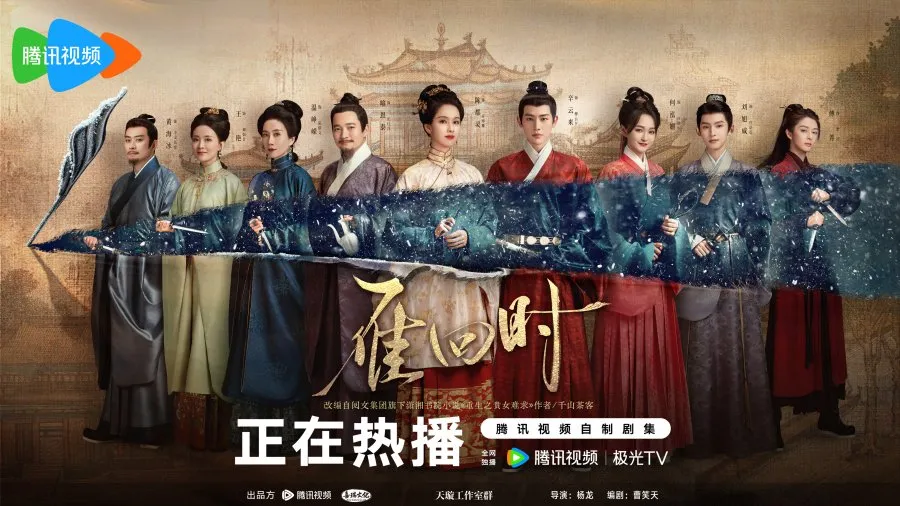
The Glory Poster - Courtesy of Tencent Video

|
DetailsRATING: (7.5/10)
NATIVE TITLE: 雁回时 – Yàn huí shí | 贵女 – Guì nv YEAR 2025 EPISODES: 30 DURATION: 45’ DIRECTOR: Yang Long SCREENWRITER: Cao Xian Tian, Cao Zhou Er, Lu Shu Ting ORIGINAL CREATOR: Qian Shan Cha Ke (重生之贵女难求 - Rebirth of a Noble Lady Hard to Get) |


IN A NUTSHELL
- What to expect: The Glory is an all-female revenge drama, in which men appear as obstacles—if not actual antagonists—to women's personal fulfillment, and where even family ties become tools to be twisted to their own ends. In a world where the past is indelible and every wound leaves an indelible mark, the protagonist embarks, together with the protagonist, on her journey of revenge against the family that abandoned her, a microcosm riddled with unspeakable secrets and ambiguous identities, where no one is truly what they seem.
- Strengths: the gripping plot, the refined aesthetics.
- Weaknesses: the excessive impulsiveness of the female protagonist, the poor chemistry between the ML and the FL, the small inconsistencies in the plot.
- Recommended if you like: Chen Du Ling, revenge stories, strong and cunning protagonists, love stories with strong emotional tension.
- Would I rewatch it? Probably yes, even if it was a trying sight.
If you want to know what convinced me and what didn't about this series, keep reading.
The Glory is a drama whose release went almost unnoticed, not only because the original title was changed mid-season (it was originally going to be called 贵女 – Guì nv) but also because of a less-than-successful promotional campaign. With its intense plot that intertwines revenge, personal redemption, and complex relationships, however, this series firmly ranks among the dramas that promise to raise the most anticipation of the season.
In this review of the drama The Glory, I will analyze the series' plot, cast, and narrative development, attempting to give you a comprehensive opinion on this fascinating yet complex production.
"If everyone thinks someone is cruel and oppressive and works together to isolate them, chances are that they are actually a good person."
Plot
Zhuang Han Yan is the only legitimate daughter of the Zhuang family, but on the very day of her birth, a prophecy sealed her fate: deemed a harbinger of misfortune, she is chased away from the residence and sent to live with an acquaintance of her father's in Danzhou.
For seventeen years, she grew up in a hostile environment, enduring the abuse of her adoptive father and his wife, to the point of committing an extreme act to save her own life.
Left alone, she decides to return to the capital with her friend Chai Jing to reunite with her real family, unaware that even more dangerous dangers lurk within the walls of the Zhuang Residence.
There, she discovers a reality far different from what she had imagined: a wheelchair-bound mother consumed by resentment toward her husband, a Second Lady who is anything but benevolent, and brothers who hide more than they reveal.
Trying to navigate the intrigues and tensions of her family, Han Yan finds an unexpected ally in Fu Yun Xi, Deputy Minister of the Court of Judicial Review, her former fiancé and the widower of her sister, Zhuang Yu Qin. Through grief, secrets, and betrayal, their relationship evolves into marriage, but remains marked by mistrust and ulterior motives: both continue to use each other to further their own goals.
Thanks to her cunning and the support of a group of noblewomen who have become her allies, Han Yan will finally achieve her revenge, while finding, in the Fu Residence, the familial warmth that had always been denied her.

The Glory Drama Review (No Spoilers)
Plot and Screenplay
The Glory captures the attention thanks to its original story, an unconventional protagonist, and a plot full of twists and turns, often truly surprising but not always convincing.
I often felt that certain twists and turns were overly forced, to the point where I wondered not so much how the protagonists had ended up in certain situations, but rather how their adversaries had managed to orchestrate such impeccable plans that they could foresee every variable without ever being discovered. On the one hand, this helped make the protagonists more human and fallible, far from the aura of perfection that many dramas tend to build around them; on the other, however, it conflicted with the meticulousness and strategic intelligence that the two — especially FL — demonstrated when they were the ones pulling the strings.
Added to this is the handling of flashbacks that I found frustrating at times: inserted at the beginning of episodes without a real introduction, they are useful for clarifying previous events, but they end up disrupting the flow and disorienting, forcing the viewer to continually reconstruct the narrative thread instead of being carried away by its tension.
In terms of the screenplay, The Glory initially demonstrates remarkable solidity, effectively conveying the logic and meticulousness with which the characters construct and carry out their plans. However, in the second half of the drama, I felt that this narrative precision gradually slipped into a certain rhetorical emphasis, especially in the way the theme of female revenge is developed.
The intent is clear and, in some ways, understandable, but it ends up feeling a bit forced: the male world is often portrayed in a highly negative light, populated by misogynistic and mean men, some of whom even turn against the protagonist and plot revenge simply for being rejected.
At the same time, on the female side, we witness a display of sisterhood that at times seems artificial: relationships that until a moment before were marked by rivalry or indifference suddenly transform into deep and unconditional bonds, with characters willing to risk everything for each other without any real emotional journey. In this context, even the subplots introduced in the final episodes seem to be bent toward a single goal: reinforcing the message of female solidarity, but ultimately sacrificing some of the coherence and complexity that characterized the first part of the series.
Characters and Main Love Story
As for the characters, The Glory stands out for its surprisingly rich and multifaceted characterization: even the secondary characters are never mere extras, but complex individuals, riddled with contradictions, affections, and resentments that make them vivid and passionate.
The protagonists themselves, and FL in particular, distance themselves from the idea of absolute moral integrity: their actions often stem from selfishness, self-interest, or anger, and they don't hesitate to hurt others to get what they want. It is precisely here, perhaps, that one of the most peculiar aspects of the series lies: in its portrayal of a female protagonist dominated by resentment, incapable or unwilling to show tenderness and empathy towards anyone other than her mother.
Also standing out in this context is the figure of the main antagonist, a character crafted with great effectiveness, capable of surprising us with her duplicity, her opportunism, and a cruelty that is all the more disturbing because it is so unsuspected.
Even on the romantic front the drama deliberately chooses to depart from the canons of classic romance, but the result left me with some doubts. The emotional distance between the protagonists is such that it makes it difficult to understand the nature of their bond, suspended between repressed feelings and mutual exploitation. From their attitudes, it's never clear whether they love each other and are trying to repress their feelings to pursue their own goals, or whether they hate each other and are pretending to be close only to exploit each other.
While this ambiguity could be an original and distinctive narrative choice, it also feels like it keeps the characters emotionally one step behind, perhaps also due to less than convincing acting performances, which ultimately result in limited and ineffective engagement.

Cast
As for the cast, The Glory left me with a decidedly ambivalent feeling: while the overall quality is undoubtedly high, it's hard to ignore how the drama seems to work despite its protagonists, rather than because of them.
Chen Du Ling confirms all the limitations already revealed in Till the End of the Moon: her extremely limited expressiveness and her perpetually annoyed air end up making her performance monotonous and draining the intensity of scenes that would require subtle emotional involvement. His interactions with Xin Yun Lai only accentuate the problem: the chemistry between the two is virtually nonexistent, and many of their shared scenes slip into an almost embarrassing stiffness.
Xin Yun Lai seems to take refuge in a "minimalist" performance that often lapses into inexpressiveness: his consistently stern face, never truly broken by emotional nuances, gives the impression of a character more performed than lived.
The supporting cast, with their sharply contrasting performances, ends up further exposing these weaknesses: Yu En Tai and Wen Zheng Rong dominate the scene with layered and incisive performances, capable of conveying all the complexity of their characters.
Around them, actors such as Wang Yan, as Zhuang Shi Yang's concubine, He Hong Shan, as Zhuang Han Yan's half-sister, and the ever-present Huang Hai Bing, extremely passionate as Ruan Xi Wen's ex-lover, offer solid and credible performances, helping to flesh out a narrative world that, paradoxically, seems most alive in its secondary characters.
In this context, Fu Jing also manages to stand out, bringing to the screen a genuine emotionality that contrasts with the protagonists' detachment and represents a ray of light in a series dominated by dark emotions.
The overall result is that while the supporting actors enrich and support the narrative, the two main actors end up representing its weakest point, leaving the feeling that the drama's emotional impact could have been significantly greater with more incisive performances.
Visual Aspects and Soundtrack
Aesthetically, The Glory conveys a sense of evident care that is evident from the very first shots. The direction demonstrates a sure hand in crafting images with a strong artistic impact: the snow-covered views, in particular, are captivating with their suspended beauty, evoking a sense of calm that effectively contrasts with the narrative tension. The color palette, while rich, never appears excessive; on the contrary, it is carefully calibrated, as is the use of lighting, always well-balanced and directed to accompany the scenes without ever overpowering them.
The sets also contribute significantly to this immersion: the imperial residences and rooms are furnished with taste and precision, conveying a sense of refinement that appears coherent and believable. The Ming-style costumes, along with the hairstyles and hair ornaments, elegantly complete this picture, revealing an attention to detail that hardly goes unnoticed.
The soundtrack has a more inconsistent impact: the slow, melancholic melodies consistently accompany the overall tone of the series, emphasizing that constant sense of regret and nostalgia that runs through the narrative. However, beyond their emotional function, they are rarely memorable: the sounds tend to conform to already-heard patterns, failing to build a true, distinctive identity. The only element that manages to break this monotony is the alternation between male and female voices, a well-calibrated choice that adds an extra nuance, although it is not enough, on its own, to truly elevate the musical structure.

WARNING!
FROM THIS POINT ON THE SPOILER SECTION BEGINS. DO NOT CONTINUE IF YOU DO NOT WANT TO KNOW ALL THE DETAILS OF THE DRAMA.
The Glory Drama Review (Spoilers)
What Works
The Original Idea
If there's one aspect where The Glory truly stands out, it's in the narrative idea that forms its backbone: a surprisingly rich and original structure, which on paper has a rare strength.
The image of a little girl abandoned by her parents because they believed she was a harbinger of misfortune, entrusted to those who were supposed to protect her but instead subjected her to abuse and mistreatment, has an immediate and deeply disturbing impact.
Even more interesting is the female protagonist's return, not as a victim but as an agent of revenge, within a family that turns out to be far more ambiguous than it seems: her father, seemingly upright, emerges as the true puppet master in the shadows, while her mother, initially portrayed as a villain, turns out to be the only one who somehow protected her and wanted to keep her away from that domestic hell. It's a world where no one truly says what they think, and where every gesture seems to betray a different intention than stated, creating a climate of constant suspicion.
Added to this are bold narrative twists, such as the FL's marriage to her sister's widower — a union born from a bond established at birth combined with the FL's need for survival — and the presence of a little girl, starved for affection, desperately seeking a mother figure while her father, aware of his own approaching death, tries to secure her future.
And then there's the protagonist's stubborn desire to restore her mother's dignity and autonomy, freeing her from the control of a man who embodies a form of evil all the more disturbing because it disguises itself as respectability.
These are all powerful narrative insights, capable of building a dense and layered plot, and precisely for this reason, they are even more frustrating when, over the course of the narrative, their execution fails to live up to the premise.
The Antagonist
In this dense and complex landscape, the figure of Zhuang Shi Yang emerges with a force as intense as it is disturbing. He is one of the most unsuspecting and, in some ways, most successful villains I've encountered in a drama recently. His originality lies not so much in his actions — often brutal — as in the veneer of respectability behind which he manages to conceal them: a man who presents himself as upright, devoted to his family, seemingly uninterested in power, and who for this very reason is even more believable in his hypocrisy.
He is a character constructed with ruthless internal coherence: his suffocating upbringing and the belief that life has penalized him seem to have ingrained a silent resentment within him, transforming him into a lucid manipulator, capable of operating on multiple levels without ever truly exposing himself.
What is striking is his ability to deny not only to others, but also to himself, the viciousness of his actions, lying with an almost disarming ease. Reflecting on how he won his wife's hand by destroying her family, on the murder of his father to gain Pei Da Fu's favor, on his calculated management of Zhou Ru Yin — first kept tied to him, then sacrificed as a scapegoat — or on his cold-blooded sacrifice of his daughter Yu Shan by marrying her off to a violent man, emerges the portrait of a man willing to do anything to secure his position and his life, that he perceives as constantly threatened.
And this is perhaps the most interesting aspect: Zhuang Shi Yang embodies not only the lust for power or wealth, but something more subtle and, ultimately, more human — the fear of succumbing — which ultimately corrupts him completely, making him all the more terrifying and plausible.

What Doesn't Work
The Excesses of Screenwriting
The revenge plot of The Glory, as magnetic as it is, ends up, as the episodes progress, derailing towards a crudeness so exacerbated that it becomes, at times, excessive for a drama that moves neither in a war context nor around the figures of hitmen.
I must admit that the initial impact took me by surprise: the first scenes of domestic violence are unexpectedly harsh, almost unsettling, and in hindsight, they work as a statement of intent —b ecause episode after episode, the series ups the ante until torture, beatings, and attempted murders become an almost constant presence, so much so that halfway through the show, I found myself wondering, not without some concern, whether any of the main characters would make it to the end alive.
Making everything even more uncontrolled and fragile from a realist perspective is the excessive audacity of the two protagonists: despite being able to count on the support of the Court of Judicial Review, they act as if they enjoyed far greater authority, going so far as to blackmail and threaten ministers and nobles without any explicit imperial approval.
As the story progresses, the FL seems to progressively lose control, slipping into an impulsiveness that leads to extreme and dramatic gestures: she brandishes weapons in broad daylight, threatens high-ranking figures such as Noble Consort Miao with the pin given to her by Chai Jing, and even stabs the ML who tries to stop her as, blinded by rage, she heads towards the Zhuang Residence with the intent of killing her father.
These are moments that clearly aim for dramatic intensity, but which end up undermining the internal coherence of the story, leaving the feeling that tension is often sought through excess rather than constructed with real narrative rigor.
The Main Love Story
As if to counterbalance the protagonist's excessive impulsiveness, the relationship between her and Fu Yun Xi remains surprisingly cold throughout the drama, almost impervious to any form of real emotional connection.
The two observe, study, suspect, and above all, use each other with such consistency that even a hint of complicity is impossible: more than partners, they seem like two strategists, each locked in their own scheme.
This is further accentuated by the rigidity of the acting performances, which in potentially romantic scenes translates into mechanical gestures, blank stares, and interactions that fizzle out instead of sparking, leaving a feeling of awkwardness that's hard to ignore.
In this sense, the scene in episode 10 is perhaps the most emblematic moment: the moment in which the FL offers herself to the ML in the hope of obtaining his help in rescuing Chai Jing from the prison of the Court of Judicial Review should have been full of tension and ambiguity, but instead ends up being awkward. At this point, it no longer matters whether the gesture stems from strategic calculation, an emotional impulse, or her own uncontrolled desperation, what remains is a sequence rendered and interpreted in such a rigid and unnuanced way that it becomes more disturbing than engaging.

The Minor Inconsistencies
Then there is a whole constellation of coincidences which, taken individually, might not even represent a problem, but which, taken together, end up undermining the credibility of the plot, creating a sense of dissonance that is difficult to ignore.
I found myself momentarily disconnected from the story several times while watching, precisely because of the accumulation of these details: from Fu Yun Xi's unlikely discovery of the Danzhou murder weapon — a ridiculously small hairpin retrieved from the bottom of a well filled with water — to the almost surreal speed with which Han Yan manages, in the space of a single day and with the family assets seized, to gather all the evidence necessary to exonerate her father. In a matter of hours, he finds and bribes the real estate agent who sold his father's house, gets a job at Duchess Shunping's residence, and even manages to bribe a courtesan to obtain crucial information: a chain of events that seems to bend to the demands of the screenplay rather than skill.
Similarly, Fu Yun Xi's deductions at times verge on narrative omniscience: connecting Zhuang Shi Yang to Pei Da Fu based on the taste of a Yinan dish and a testimony placed with surgical precision in time requires a stretch of imagination that struggles to sustain. No less questionable is the ploy by which the only evidence of his undercover operation vanishes with the death of Prime Minister Wen Ming Chang, without the latter ever having informed the Emperor of a plan that, theoretically, responded to an imperial order—a gap that seems more functional to the story than consistent with the logic of palace bureaucracy.
And finally, the issue of the promissory notes made out to Han Yan: even if we were to admit the forgery of the signature, it remains difficult to accept that a child could have been the valid financier of such a large amount of debt, or that Fu Yun Xi could have played a role in the affair when the two didn't even know each other.
These are all elements that, rather than strengthening the plot, end up giving the impression of a narrative that proceeds by shortcuts, requiring the viewer to make an increasingly demanding effort to suspend disbelief in order to overlook the plot's numerous absurdities.
Interpretation of the Ending
The ending of The Glory surprised me first and foremost for its attempt to heal every fracture: all the unresolved issues seem to be resolved, frictions dissolve one after another, and the narrative converges toward an unusually serene and bright epilogue compared to the dark tones that have dominated the series. Han Yan asks Tan Yun Xian to save Fu Yun Xi and finally manages to clear things up with Kou Ayi; Zhuang Yu Shan, freed from Duke Qi's yoke, joins her mother in helping the protagonists unmask Zhuang Shi Yang. Yet, just when it seems the story is about to grant itself a conciliatory conclusion, the dark streak that has permeated it from the beginning forcefully resurfaces: in the turmoil of the final events, we sense that Zhou Ru Yin kills her husband, a liberating act that nevertheless brings the narrative back to a more somber atmosphere.
The final scene, set during New Year's celebrations, takes on symbolic and ambiguous tones: the families of Fu Yun Xi and Zhuang Han Yan reunite in a setting that, at first glance, appears warm and reassuring, but soon reveals an anomalous composition. Among those present are the dead, mingling with the living in a sort of suspended, almost unreal vision that blurs the lines between dream and reality. In the final shot, this ambiguity crystallizes: the characters separate into two distinct groups, the living on one side and the dead on the other—and Fu Yun Xi also appears. It is an image that suggests that his fate is already sealed and that the happiness he has just achieved is, ultimately, only temporary. A bittersweet ending, but one that is in keeping with a story that describes life as a fragile dimension, where peace is always on the verge of being shattered and where happy endings can never be taken for granted.

Characters and Cast
Primary Characters
Zhuang Han Yan (Chen Du Ling) Third Young Lady of the Zhuang family, Zhuang Shi Yang's only legitimate daughter. On the day of her birth, she is recognized as the "Barefoot Ghost" who will bring ruin to the Zhuang family, so she is chased away from the residence and sent to live with Zhang You Chang in Danzhou. Seventeen years later, she kills her foster parents and returns to the capital to discover the true reason behind her removal, but finds a web of intrigue more dense than she imagined.
Fu Yun Xi (Xin Yun Lai) Deputy Minister of the Court of Judicial Review and adopted son of civil officer Fu Ping Sheng. When he was still a child, his parents had concluded a marriage agreement with the Zhuang family in which he was to marry Zhuang Han Yan. After her removal from the residence, however, he married to Zhuang Yu Qin, his fiancée's older sister, with whom he had a daughter, Fu Ling Zhi.
Chai Jing (Fu Jing) orphan found unconscious on the beach and rescued at Danzhou by Zhuang Han Yan. She works as an armed escort on cargo ships and, since childhood, has been accustomed only to fighting, but meeting Han Yan changes her perspective. She grows so fond of her friend that she becomes her guardian angel: she accompanies her in search of her true parents and, to avoid her imprisonment, takes the blame for the murder of the Zhangs. When Han Yan marries Fu Yun Xi, she decides to return to the sea so as not to disturb the couple's happiness.
Supporting Characters
Zhang You Chang (Peng Yi Cheng) former student of the Hanlin Academy and a classmate of Zhuang Shi Yang. Zhuang Han Yan was entrusted to him as a baby, and he and his wife raised her for seventeen years amidst abuse and oppression. To save herself, the girl was eventually forced to kill them and flee to the capital.
Zhuang Shi Yang (Yu En Tai) scholar from Yinan, is the Head of the Zhuang Family. He is an Auditor of the Hanlin Academy, but hides the secret identity of the adopted son of the powerful eunuch Pei Da Fu and he is the administrator of his vast estate.
Ruan Xi Wen (Wen Zheng Rong) First Lady of the Zhuang Family and mother of Zhuang Han Yan. She is the only daughter of Grand Scholar Ruan of the Hanlin Academy and one of the most prominent noblewomen in the capital. In her youth, she was engaged to Yuwen Chang An, but after the fall of her family, she decides to accept Zhuang Shi Yang's marriage proposal, unaware that he was the one responsible for her clan's downfall.
Nanny Chen (Hong Hua) and Ji Lan (Bai Yi Ru) First Lady Zhuang's servants.
Shu Hong (Wei Jin) trusted maid at the Zhuang Residence, assigned to Zhuang Han Yan by Ruan Xi Wen.
Yuwen Chang An (Huang Hai Bing) Imperial Left-Wing Censor. He was Ruan Xi Wen's betrothed, but while he was on an official mission in Qingzhou, she agreed to marry Zhuang Shi Yang, driven by her family's downfall, leaving him with eternal regret. Since then, he had been keeping a close eye on Zhuang Shi Yang for any signs of his criminal activities.
Zhou Ru Yin (Wang Yan) Second Lady of the Zhuang Family and mother of Zhuang Yu Qin, Zhuang Yu Shan, and Zhuang Yu Chi. She bribed the Taoist Duan to predict an ominous future for Zhuang Han Yan, thus chasing her away from the residence. She is also the one who tries in every way to disfavor Ruan Xi Wen with her husband in order to obtain the title of First Lady.
Nanny Tao (He Miao) cook at the Zhuang Residence, promoted to nanny by Zhou Ru Yin. She has been an accomplice in Zhuang Shi Yang's shady dealings for years.
Zhuang Yu Qin (Yang Sai Sai) First Young Lady of the Zhuang Family and daughter of Zhou Ru Yin. She marries Fu Yun Xi and has a daughter with him, but dies two years after their wedding after drinking poisoned wine intended for her husband.
Fu Ling Zhi/A'Zhi (Huang Bo Si) daughter of Fu Yun Xi and Zhuang Yu Qin. She becomes very fond of Zhuang Han Yan and, after she marries her father, insists on calling her mum.
Zhuang Yu Shan (He Hong Shan) Second Young Lady of the Zhuang family and daughter of Zhou Ru Yin. She has always been in love with Fu Yun Xi, but her mother never allowed her to marry him, instead pushing her to marry the brutal, yet noble, Duke Qi.
Cui Yun (Lou Xin Yue) personal maid to Zhuang Yu Shan. To help her mistress, she tries everything she can to have Zhuang Han Yan expelled, but is discovered placing the pillow of a smallpox patient from Nanshan Sanatorium in the girl's room and is severely punished.
Lang'er (Cai Ze Min) personal maid to Zhuang Yu Shan. She repeatedly attempts to defame Zhuang Han Yan on the orders of the Second Lady and is expelled from the residence.
Zhuang Yu Chi (Liu Xu Wei) First Young Lord of the Zhuang Family, son of Zhou Ru Yin and younger brother of Zhuang Yu Qin and Zhuang Yu Shan. He is accidentally mortally wounded while attempting to kill Zhuang Han Yan the night before her wedding to Fu Yun Xi.
Zhuang Han Liang (Shi Qiang) Supervisory Secretary, father of Zhuang Shi Yang and grandfather of Zhuang Han Yan. He dies on the day of his granddaughter's birth, poisoned by his son on the orders of Pei Da Fu because he refused to submit to him.
Noble Lady Wei (Zhang Hai Yan) Matriarch of the Zhuang Family and wife of Zhuang Han Liang. She knows her son is her husband's murderer and, for fear of being poisoned, tries never to contradict him and takes large quantities of tonics and miracle pills daily.
Taoist Duan (Huang Fei) Taoist priest who predicted Zhuang Han Yan's dire fate. In reality, he is Cui Ah Niu, a fugitive criminal from the Liangguang region who, to avoid prison, hid in the capital under the guise of a Taoist priest and helped Zhou Ru Yin frame Zhuang Han Yan.
Fu Ping Sheng official in the Ministry of Personnel and adoptive father of Fu Yun Xi. He died of illness a few years before the events of the drama.
Madam Qiu (Gao Yu) Wife of Fu Ping Sheng and adoptive mother of Fu Yun Xi. She is a gentle and kind woman and, due to her poor health, has taken in her unmarried cousin to manage the Fu Residency in her stead.
Aunt Kou (Dong Wei Jia) cousin of Madam Fu and "aunt" of Fu Yun Xi. She is a decisive and authoritarian woman and is in charge of managing the Fu Residency. Initially, she gives Zhuang Han Yan a hard time because she fears she wants to take over the management of the household, but the two eventually make up.
Mu Feng (Song Pei Ze) official of the Court of Judicial Review, subordinate to Fu Yun Xi and brother of Mu Yan.
Mu Yan (Chen Kang) Official of the Court of Judicial Review, subordinate to Fu Yun Xi and brother of Mu Feng.
Yan Ren Du (Shen Tai) Minister of the Court of Judicial Review and superior to Fu Yun Xi.
Pei Da Fu (Wei Yu) eunuch who for years exercised exclusive control over the court, promoting his supporters and eliminating political opponents. He is the founder and leader of the Zhouhang Gang, a group of officials aiming to subvert the political order of the empire. He has amassed untold wealth, and only his attempt to manipulate the appointment of the Crown Prince leads to his arrest and death in the prison of the Court of Judicial Review. His assets have never been found and are believed to be in the hands of his adopted son, whose identity, however, is unknown even to his followers.
Wu You Zhi (Yan Jia Wei) Duke Shunping, a member of the imperial family. He is a puppet who acts as Pei Da Fu's fake adoptive son to protect the identity of his true adoptive son.
Lady Pan (A Di Ya) Duchess Shunping. She helps Zhuang Han Yan find Wu You Zhi's body and save her father from being accused of being Pei Da Fu's adoptive son.
Wen Ming Chang (Pang Jing) Former Prime Minister. He is killed by Pei Da Fu to prevent him from discovering and eliminating his supporters at court. He is the only one who knows about Fu Yun Xi's undercover activity within the Zhouhang Gang.
Noble Consort Miao (Li Sheng) Ruan Xi Wen's longtime friend and rival. In their youth, she and Xi Wen were the most prominent noblewomen in the capital; however, one’s entry into the imperial harem and the other’s loss of the use of her legs marked their withdrawal from social life. She believed her friend had a better fate than her, but, upon learning of the abuses Xi Wen had suffered at the Zhuang Residence, she changed her mind and decided to help her regain the use of her legs. For this, Zhuang Shi Yang had her accused of usurping the throne and sentenced to death by the Emperor.
Yao Zhi Dong (Yang Yong Wen) Grand Scholar of the Hall of Literary Fame. He is the initiator of the petition against Noble Consort Miao, which he withdraws only after Zhuang Han Yan obtains his daughter's divorce from the cruel Duke Qi.
Yao Wang Shu (Sheng Lang Xi) only daughter of Yao Zhi Dong and Duchess Qi. Her husband wants her to behave like his late wife, Pei Ying Yue, so he constantly beats and humiliates her. With the help of Zhuang Han Yan, she manages to divorce her husband.
Zhu Qin (Shan Si Jie) Duke Qi and husband of Yao Wang Shu. Unable to accept his wife's death, at the suggestion of the Taoist Duan, he administers nine water talismans to Yao Wang Shu in an attempt to draw his late wife's spirit into her. After divorcing Yao Wang Shu, he agrees to marry Zhuang Yu Shan, even though he had actually fallen for Zhuang Han Yan.
Deng Shou Jie (Li Bao An) Chancellor of the Imperial Academy, father-in-law of Zhang Wan Yun and grandfather of Deng Chan and Deng Zai Ye. He is one of the signatories of the petition against Imperial Consort Miao.
Zhang Wan Yun (Liu Min) daughter-in-law of the Deng family, wife of Deng Shou Jie's deceased son and mother of Deng Zai Ye and Deng Chan. She has an affair with the student Cheng Lei and, thanks to the help of Zhuang Han Yan and Fu Yun Xi, manages to fulfill her dream and elope with him.
Cheng Lei (Wu Ji Feng) Student at the Imperial Academy. During the Lantern Festival, he accidentally comes across the manuscript "The Legend of Hua Yue," written by Zhang Wan Yun under the pen name Chang Zhi Xue. He is fascinated by it and decides to begin an anonymous correspondence with her through the manuscript. When Deng Shou Jie discovers this, he thinks the novel was written by his niece and wants to force them to marry. However, with the help of Zhuang Han Yan and Fu Yun Xi, he manages to clarify matters and elope with his beloved.
Deng Zai Ye (Liu Bang Hao) Young Lord of the Deng family and grandson of Deng Shou Jie.
Deng Chan (Liao Hui Jia) First Young Lady of the Deng family and granddaughter of Deng Shou Jie. She is engaged to Zheng Zi Yan, her childhood sweetheart, but due to her mother's affair with Cheng Lei, she she risks being forced to marry the student.
Zheng Zi Yan (Chen Yue) First Young Lord of the Zheng family. He has always been in love with Deng Chan, but due to the latter's mother's affair with Cheng Lei, he risks having to give up his fiancée. Fortunately, the two eventually manage to get married thanks to the help of Zhuang Han Yan and Fu Yun Xi.
Zheng Shi Chang (Liu Shuo) Minister, father of Zheng Zi Yan and future father-in-law of Deng Chan.
Li Jia Qi (Zeng zi Ye) Daughter of the Right Chancellor and friend of Zhuang Yu Shan. During the Lantern Festival, she is used by Zhuang Yu Shan to humiliate Zhuang Han Yan, but eventually becomes her friend.
Tan Yun Xian (Jia Shu Yi) Doctor of the Imperial Medical Academy, highly experienced in solving complicated medical cases. At the request of Noble Consort Miao, she heals Ruan Xi Wen's legs and helps Zhuang Han Yan create an antidote to cure Fu Yun Xi.
He Wen Shen (Yang Ting Dong) scholar from Yinan who has come to the capital to take the Imperial Examination. Zhou Ru Yin wants to marry him to Zhuang Yu Shan, but he asks for Zhuang Han Yan's hand in marriage. However, she rejects him and marries Fu Yun Xi. So, to avenge the humiliation, he tries to have her arrested for stealing documents from the Office of Transmissions.
Yang Ping (Ding Nan) scholar of Yinan and neighbor of Zhuang Han Yan in Danzhou, seeks revenge on Han Yan for having maimed him following an argument, thus preventing him from pursuing a public career. He therefore provides Zhou Ru Yin with proof that she killed his adoptive parents.
Sun Min (Li Xiao Lei) forensic pathologist at the Censorate and a friend of Yuwen Chang An. He safeguards for him the remains of Zhuang Han Liang, which the Censor removed from the Zhuang tomb in Danzhou, as well as all the evidence his friend has gathered over the years to prove Zhuang Shi Yang's guilt.

Favorite Character: Chai Jing
She is one of the most luminous and touching characters in The Glory, a silent yet profoundly significant presence who stands out in a world dominated by ambiguity and ulterior motives.
Trained from childhood to kill and repress every emotion in order to serve her master, she is astonishing for the purity of the feelings she develops throughout the story: the bond she builds with Han Yan begins almost paradoxically — when the girl attempts to rob her — yet quickly transforms into a sincere, unadulterated affection, perhaps the only truly authentic one in the drama.
Over time, she becomes a sort of guardian angel for her "barefoot ghost", choosing to dedicate her life to her: she follows her, protects her, gets her hands dirty in her place, and even goes so far as to sacrifice herself by taking on the guilt of someone else's. The pinnacle of this devotion is manifested in the prison of the Court of Judicial Review, where she endures unspeakable torture and nearly loses the use of her hands rather than betray her.
Yet her kindness is evident beyond her sacrifice: she demonstrates a clarity and gentleness capable of guiding Han Yan through moments of confusion, helping her understand her own feelings, and remaining by her side without ever asking for anything in return.
Her farewell, after her friend's wedding to Fu Yun Xi, is perhaps the most emblematic gesture of her love: a silent and definitive renunciation, dictated not by jealousy but by the desire to entrust her to the person she truly loves, as if, once her task is accomplished, she has no choice but to step aside.
In a tale dominated by revenge and manipulation, she represents a rare and precious exception: proof that even in the darkest context, a form of absolute and selfless loyalty can exist.
Un-Favorite Character: Zhuang Han Yan
Paradoxically, the protagonist is the character who left me most perplexed in the entire drama, both because of the narrative choices surrounding her and because of Chen Du Ling's performance, which struggles to truly convey her inner complexity.
At the beginning of the story, her character is striking for her tactical finesse: despite a childhood marked by indifference and growing up in a hostile environment, she moves with admirable clarity and self-control, orchestrating every gesture and every word with the apparent precision of someone with a clear plan in mind and knowing exactly how to carry it out.
However, this balance gradually breaks down when she reconnects with her mother, fragile and consumed by remorse: from that point on, she seems to lose her strategic cool, allowing herself to be carried away by an increasingly marked impulsiveness. Her actions become increasingly reckless, almost reckless, until they escalate into extreme behavior—flagrant threats, violent gestures, and decisions made in the heat of anger, such as when she stabs Fu Yun Xi rather than be stopped in her quest for revenge.
Making the character even more difficult to embrace is a certain emotional inconsistency: beyond the bond of pure convenience she forms with the male protagonist, what's particularly striking is the coldness with which she treats A'Zhi, a little girl who seeks in her only a mother figure. This behavior is profoundly at odds with her own past as an abandoned daughter, making it difficult to understand how she can't recognize herself in the desperate need for love of a little girl orphaned at a young age.
Likewise, her stance as a champion of female independence often sounds more rhetorical than authentic, especially given her own choices: her marriage to Fu Yun Xi, contracted to exploit her position and pursue her own goals, introduces a note of hypocrisy that undermines the feminist message she purports to espouse.
Only at the end does an attempt at rehabilitation seem to emerge, when she takes the risk of saving her husband—first from imprisonment, then from death—but even this momentum, while significant, arrives almost as a belated addition, more instrumental in closing a narrative arc marked by excess and impulsiveness than in truly restoring her full emotional coherence.
RECOMMENDED:
- THE SONG OF GLORY
- SONG OF YOUTH
- THE LEGEND OF ANLE
- LOVE OF NIRVANA
- LEGEND OF ZANG HAI
Thanks for reading this far!
I hope you enjoyed my article. If you like my work and want to support me, buy me a coffee ☕