
The Road to Splendor (2026): Did Ding Yuxi and Deng Enxi Recapture the Magic of Melody of Golden Age? | Review & Ending
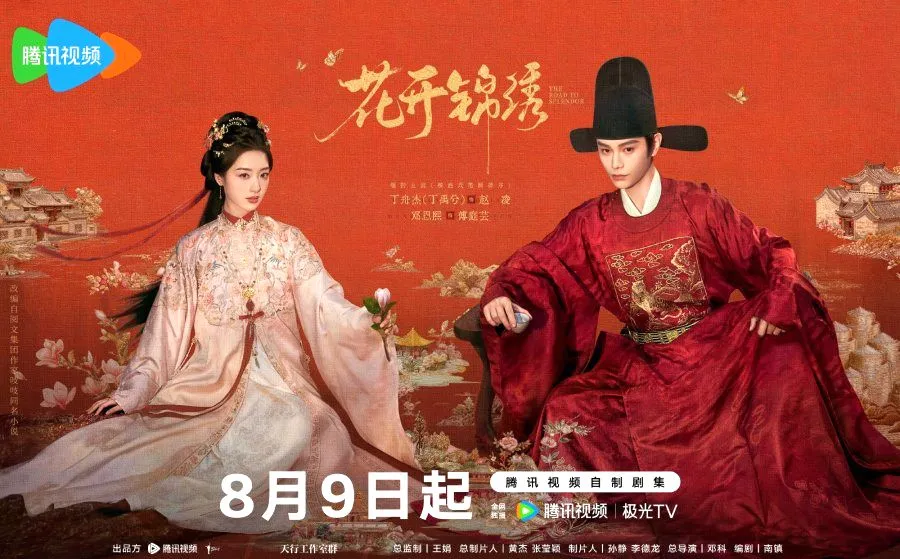
The Road to Splendor Poster - Courtesy of Tencent Video

|
DetailsRATING: (7/10)
NATIVE TITLE: 花开锦绣 - Huā kāi jǐnxiù YEAR: 2026 EPISODES: 36 DURATION: 40’ DIRECTOR: Deng Ke, Gao Cong Kai>SCREENWRITER: Nan Zhen ORIGINAL CREATOR: Zhi Zhi (花开锦绣 - Flowers in full bloom) RESPECTED CLICHÉS: 1 - 4 - 6 - 9 - 10 - 11 - 12 - 13 - 18 |


Disclaimer: the opinions expressed in this review refer exclusively to the drama. As I have not read the original work, I cannot say with certainty whether the issues identified can be attributed to the screenplay or to the source material. For this reason, my comments on the writing should be understood as an assessment of the adaptation rather than a judgment on the original work.
IN A NUTSHELL
Short on time? Here you’ll find the quick verdict, including the drama’s main strengths, weaknesses, and key features to help you decide if it’s right for you. For a more in-depth analysis, continue with the No Spoiler Review.
- What to expect: The Road to Splendor is a historical-romantic drama set in the Ming Dynasty that combines family history, romance, social ascent, and political intrigue. At the center of the story are Fu Tingyun, a young woman forced to rebuild her life after being abandoned by her family, and Zhao Ling, a salt trafficker who enters her life almost by chance and ends up becoming her most valuable ally. Their journey gradually takes them beyond the realm of family conflicts, towards an ever-expanding world of reputation, power, and politics. In the first half, the drama successfully allows the protagonists to evolve alongside the world around them, flanking their various conflicts with a relationship based on trust, mutual respect, and the complementary nature of their skills. In the second half, however, this richness gradually diminishes: the story becomes more fragmented, the subplots increasingly indistinguishable from the main arc, and the conflicts are replayed in increasingly similar ways, ultimately sacrificing part of the political and relational potential initially built. The result is a visually very well-crafted drama supported by interesting characters, but penalized by a script that, especially in the second half, seems unable to maintain the same direction and variety.
- Strengths: the original premise, realistic characterisation, the male lead’s concept.
- Weaknesses: repetitive conflicts, lack of narrative hierarchy, lack of focus on the leads’ relationship.
- Recommended if you like: the Ding Yuxi-Deng Enxi couple, enemies-to-lovers dramas, strong but not "girl boss" female protagonists, shrewd but not brilliant male protagonists, tender but not very passionate love stories, love triangles with the SML who is already married but obsessed with the FL.
- Would I rewatch it? No, because the second half is really too repetitive.
Read on to understand why this drama only half works.
The Road to Splendor is a drama that leaves you with the feeling of having experienced a story capable of captivating, surprising, and at times moving, but of having stopped just when the plot seemed on the verge of revealing all it could have been. Behind the beauty of the images and the charm of its protagonists, there remains the impression of a potential only partially fulfilled, of a story that, after opening many avenues, fails to always fully explore them.
In this review of the drama The Road to Splendor, I will focus not only on its strengths and weaknesses, but also on the way the screenplay initially manages to enhance the story and then gradually ends up losing some of its richness.
Plot
Shortly before her official engagement to Yu Jingxu, a young lord of the Yu family of officials, Fu Tingyun, ninth lady of the prestigious Fu family, is embroiled in a scandal by the dissolute Zuo Junjie, who, determined to marry her, publicly claims to have had intimate relations with her.
To preserve the family honor, Old Madam Fu attempts to cover up the affair by sending her niece to a convent and secretly ordering her murder. But thanks to the help of the salt trafficker Zhao Ling, whom she had met some time earlier during an investigation by her uncle into salt smuggling, Tingyun manages to escape.
Against her mother's advice, Tingyun then decides to go to Linchun, where an imperial envoy is investigating the illegal trading of salt permits. Thanks to her cunning and Zhao Ling's cooperation, she manages to solve the case, obtaining a new family register for herself and a recommendation for Zhao Ling to join the army. Now in love with her and determined to protect her, the young man does everything he can to rise through the ranks until he obtains a rank that allows him to enter the court and secure Tingyun's respectable status once they marry.
Their rise, however, will not be easy, and once in the capital, the two will find themselves facing the hidden dangers of the court, including the powerful Yu family, determined to eliminate them because they consider them a threat to their excessive power.
Between political intrigues, difficult choices, and repeated attacks on Tingyun's reputation, the couple will have to navigate the murky waters of the capital, trying to escape the intrigues of the Yus and, at the same time, improve the conditions of Zhao Ling's comrades remaining in the Gandu District, a remote and neglected province in the northwest of the kingdom.
"Some couples in this world share a bed but not a heart, yet play the part in public.
Some treat each other with respect, yet remain worlds apart.
Some weather the storms together, yet still lose to time.
Some have run their course, yet are bound together all the same.
Tingyun, I want to ask you something:
when we’re married someday, what kind of couple do you hope we’ll be?"

THIS SECTION TAKES A CLOSER LOOK AT THE SCRIPT, CHARACTERS, CAST, AND TECHNICAL ASPECTS WITHOUT REVEALING MAJOR PLOT DEVELOPMENTS. FOR A COMPLETE ANALYSIS OF THE DRAMA, CONTINUE WITH THE SPOILER REVIEW.
The Road To Splendor Drama Review (No Spoilers)
Plot and Screenplay
The Road to Splendor is a drama that starts with an excellent narrative premise, but develops it in an increasingly uneven manner and, especially in the second half, fails to fully exploit its potential. In the first half, the series builds a relatively dynamic world, in which conflicts evolve with the plot, characters gradually gain more and more agency, and their decisions produce consequences capable of influencing the plot and propelling it forward. In the second half, however, the story often seems to proceed by accumulation: it reiterates dynamics that had worked, prolongs conflicts introduced in the first half, and multiplies small obstacles, ultimately penalizing the main narrative arc. The result is a drama that remains very lively but becomes progressively less directional: a lot happens, but what happens doesn't always truly contribute to advancing the story.
It's also a shame because, especially in the first half, the screenplay demonstrates its ability to construct particularly effective situations and dialogue. Conversations often manage to convey to the viewer the values, social norms, and concepts of the era without becoming academic lectures: the characters speak according to the mentality of their time, and their dialogue generally remains natural and consistent with the topic, appearing neither rhetorical nor artificially literary. This balance is very rare in historical dramas, where characters often seem to speak more in clichés than to convey information.
As the episodes progress, the narrative hierarchy also becomes increasingly less legible. Subplots, temporary obstacles, preparatory elements, and truly central developments all receive equal weight, while the passages that should connect them are often compressed or eliminated. The screenplay tends to show us the outcome of a narrative arc rather than the path that led to it, or it has the protagonists leap from one problem to another without dwelling sufficiently on the consequences of what has just happened. It's a setting that produces a peculiar pace: not exactly slow, because events continue to unfold, but fragmented, with a succession of micro-developments that paradoxically end up sapping tension from the main plots. This is perhaps one of the most problematic aspects of the drama: the script always seems to have something to say, but each twist seems to conclude without significantly altering the balance between protagonists and antagonists.
Characters and Love Story
The characters appear complex and multifaceted, however they also end up suffering from the repetitiveness of the story. In the first part, Zhao Ling and Fu Tingyun actively contributed to the construction of the plot and, above all, they were an interesting couple because they solved problems together thanks to the complementarity of their skills. In the second half, however, the screenplay seems to decide from time to time when to allow them to collaborate and fully use their skills. From being characters who determined the direction of events they become thus more and more often characters who react to events already predisposed by the plot. The same goes for the antagonists: initially they have understandable motivations that are consistent with their characters and their attacks are effective precisely because they catch the protagonists off guard. As the story progresses, however, Zhao Ling and Tingyun become competent enough to almost systematically neutralize the threats made to them. The antagonism remains, but progressively loses narrative weight because it continues to create obstacles without producing tangible developments.
The management of the relationship between Zhao Ling and Fu Tingyun also suffers from structural limitations. Before marriage the two demonstrated a natural closeness; after the wedding, however, their intimacy is represented much more rarely and through often more formal gestures. And this weakens their relationship because the viewer expects marriage to open a new phase in their relationship, the phase in which two people who have chosen each other finally build a life together and learn to face new responsibilities as a couple. The screenplay, however, dedicates relatively little space to their daily lives and above all continues to use the relationship as a terrain on which to produce new conflicts. The result is a paradox that is difficult to ignore: just when the protagonists have reached a more stable sentimental position and would have a better chance of living their relationship naturally, their intimacy ends up being shown even less. For this reason, despite having a well-constructed protagonist couple and a relationship that can be very engaging in the first part, The Road to Splendor could disappoint those looking for a particularly passionate love story or one with a strong romantic component. The relationship between Zhao Ling and Tingyun is important to the plot, but the series ends up telling it more through the problems the two face together than through the pleasure of simply seeing them experience their relationship.
Cast
The cast also does a good job overall in conveying the personalities and motivations of the various characters, although I found some performances more successful than others.
Ding Yuxi is, as usual, very spontaneous and expressive, and I find the role of Zhao Ling in the first half—an impulsive, brash, and instinctive salt dealer—to be particularly suited to him. It was precisely in this part that I rediscovered the lively and natural acting that I had so appreciated in Fight for Love, while the portrayal of Zhao Ling, the colder and more controlled imperial official, seemed decidedly less in keeping with him.
Deng Enxi is an actress I like and had already appreciated in Melody of Golden Age, but in The Road to Splendor she lacks a bit of vitality: her Fu Tingyun is credible, but sometimes lacks the spark that makes her reactions more spontaneous.
Wen Zheng Rong, on the other hand, is, as always, very effective in the roles of shrewd and ambitious women. Her Lady Yu possesses that controlled coolness and remarkable ability to read people that the actress had already demonstrated in The Glory, making it clear that she is the one holding the reins of the family even when it seems like others are doing the taking. I found the performances of Fan Shi Ran and Dong Zi Fan to be rather static and unengaging: both try to convey their characters' desperation, but fail to always convey their emotions with the necessary intensity.
A special mention goes to You Jing Ru, who manages to imbue Widow Zuo with that mix of stubbornness and blind desire for revenge that makes her a truly unbearable antagonist—in the best sense of the word.
Visual Aspects and Soundtrack
The direction of The Road to Splendor demonstrates above-average visual care not only in the big spectacular scenes, but also in the construction of more mundane moments. One seemingly insignificant detail seems particularly revealing to me: during the journey to the capital, Zhao Ling catches a rabbit, which she then cooks over a fire. In many dramas, such a scene would have simply been omitted, cutting directly to the image of the rabbit already on the spit; here, however, the hunting moment is also shown. It's a choice devoid of any narrative purpose, but precisely for this reason, it is significant: it gives the impression of a director attentive to the continuity of the action and the construction of a world that doesn't exist only when the plot has something to tell. The same care is found in the landscape pans: I found the sequences set in the desert particularly beautiful; they are realistic and immersive, truly conveying the sensation of vast, wild space, unlike what happened in Royal Betrothal. Also very evocative are the views of the Palace of the Ming and Qing Dynasties at Hengdian World Studios, where the drama's court scenes are set.
It's a shame that this visual richness seems to diminish significantly in the second half of the series: the exterior locations are fewer, the panoramic views and spectacular shots disappear, while the story focuses almost exclusively on the interiors of the imperial palace and noble residences. In this sense, it's significant that, despite spending a good portion of the second half in the capital, we are virtually never shown even a single stroll through its streets.
The photography is generally very successful: the lighting maintains a natural look and helps make the environments believable, even if spotlights are occasionally used as additional light sources to create evocative effects or accentuate the emotion of a moment; when this happens, the artifice is quite evident and slightly breaks the illusion.
The Ming-style costumes are another strong point of The Road to Splendor, thanks to patterns, cuts, and details that effectively convey the atmosphere of the period, especially in the noblewomen's dresses and military uniforms, as well as the elaborate and always meticulously crafted hairstyles.
The action sequences in the first half also deserve a mention: the kung fu choreography performed by Ding Yuxi is precise and well-constructed, and despite the frenetic shooting, remains legible, dynamic, and believable.
Overall, it is precisely the attention to detail—from seemingly superfluous details to sweeping panoramas—that makes The Road to Splendor feel like a drama with a particularly visual ambition. And perhaps this is why the reduction in production scale in the second half is even more evident: it's not just a question of the number of locations or spectacular scenes, but of the sensation of a world suddenly becoming smaller.
The soundtrack of The Road to Splendor stands out for its predominantly slow and melancholic sounds, while still managing to avoid the uniformity that often characterizes the OSTs of historical sentimental dramas. The most romantic and touching melodies, such as 无归 (No Return) and 云中鸟 (Birds Amidst Clouds), alternate with more delicate pieces such as 一诺 (A Promise), masterfully performed by Liu Yuning, and more epic sounds such as 黄沙骨 (Bones in the Yellow Sand). Although the common theme of most of the songs is that of romantic longing, adapted to the drama's historical setting, each maintains its own sonic identity. The result is a soundtrack that effectively accompanies the story's diverse nuances—from sentimentality to the more dramatic and adventurous—without ever giving the impression that the songs are simply variations on the same arrangement.

WARNING!
SPOILERS AHEAD. THIS SECTION PROVIDES A DETAILED ANALYSIS OF SPECIFIC ASPECTS OF THE SERIES. DO NOT CONTINUE IF YOU DON’T WANT TO KNOW ALL THE DETAILS OF THE DRAMA
The Road To Splendor Drama Review (Spoilers)
What Works
The Premise
The premise of The Road to Splendor is one of the aspects that most convinced me about the drama. The story begins with a relatively simple premise — a woman abandoned by her family after being wrongfully accused, who must rebuild her position in a deeply conservative society — but gradually expands it to include family and marital dynamics, survival, social and political advancement, and power struggles, without losing sight of the protagonists' journey of growth. After being disowned, Fu Tingyun must not only prove her innocence, but gradually regain autonomy, reputation, and social recognition. This is complemented by the story of Zhao Ling, who begins from a marginal social position and gradually builds her rise to the top of the power structures, developing a relationship with Tingyun based not on simple protection, but on trust and mutual respect.
I especially appreciated the fact that the protagonists didn't seem to be part of a world constructed exclusively around their love story: Zhao Ling had her own goals, Tingyun had to earn a place for herself that no one was willing to give her, and the secondary characters brought with them interests, ambitions, and conflicts that could clash with those of the couple. The relationship between the protagonists also worked precisely because it developed within this broader context: Zhao Ling and Tingyun weren't simply two people destined to fall in love, but two individuals who gradually learned to trust each other, to recognize each other's strengths, and to become allies before becoming lovers.
It's a structure that therefore offered many possible paths, and the first part demonstrates how the material lent itself to developing them: the story moves from survival to personal redemption, from family intrigues to building Zhao Ling's career, maintaining a good variety of conflicts and allowing each element to evolve in relation to the others. And this is precisely why the second half left me a bit disappointed: not because the story had exhausted its possibilities, but because the screenplay seems to exploit them less and less, preferring to reiterate already used conflicts and multiply obstacles rather than completing the protagonists' journey. After the achievement of a social position, Zhao Ling's entry into politics and their marriage, the drama still had a completely new phase to explore: Tingyun's social standing, Zhao Ling's new responsibilities and how the couple built a life together within a complex political world. It is precisely this possibility, clearly glimpsed in the first half but only partially developed in the second, that makes me consider The Road to Splendor a drama with a successful plot, but not fully valorized by the screenplay.
The Characters
One of the things I appreciated most about the drama was the writing of the characters because the script demonstrates that it treats them not as pawns but as people. Even when they play an antagonistic role, they rarely seem to move because the script needs an obstacle: each one acts according to an internal logic, with desires, fears, and limitations that make even the wrong decisions understandable.
Fu Tingyun, for example, initially accepts the arranged marriage arranged by her grandmother because she has internalized a precise concept of duty and family security, only to gradually understand that she has the right to choose her own future. Zhao Ling, on the other hand, displays a much more independent and irreverent attitude from the beginning, consistent with a completely different social experience. Fan Yake doesn't betray Tingyun simply out of jealousy: she sees marriage as one of the few concrete possibilities for securing a secure position for herself and acts accordingly. Even Yu Jing Xiu confuses what she wants from a wife—docility, predictability, lack of conflict—with what she truly needs from a partner, ultimately discovering that the woman she considered more manageable was playing a different game than she had imagined. Finally, Mrs. Yu also works because she isn't just the classic antagonistic mother-in-law, but a woman who perfectly understands the mechanisms of power and uses them to pursue her own ambitions. Their desires thus collide without needing to turn anyone into the absolute "villain" of the situation: the characters' choices can be strategically flawed and still remain perfectly consistent with the convictions of those who made them.
This attention to the internal logic of the characters is particularly interesting in Zhi Zhi's portrayal of female agency. One of the aspects I most appreciate about her novels is her ability to talk about empowerment without resorting to an anachronistic conception of female independence. Her protagonists don't necessarily have to openly reject all the rules of the society they live in to gain autonomy; Rather, they learn to understand how to use them to their advantage. In a context where a woman can't simply leave her family, build a career, and live by her own rules, there are other levers available. And Fu Tingyun demonstrates growth in precisely this direction: she doesn't simply go from oppressed woman to rebel, but from someone forced to submit to the rules to someone capable of negotiating her own space of autonomy within them. It's a more subtle form of agency, but also more credible given the historical context. And this is probably one of the reasons why the female characterizations in the first part are so convincing: the drama doesn't need to transform Fu Tingyun into a 21st-century "girl boss" who constantly challenges men and institutions to prove her strength. It's enough to show us a woman who learns the system well enough to stop being just a pawn.
The Male Lead's Concept
Among the characters, the one I appreciated the most is definitely the male lead. Zhao Ling draws on several elements of the classic male lead of the historical-romantic drama, but combines them in a less conventional way than the archetype of the powerful man, endowed with an important institutional position, an intimidating reputation, extraordinary skills, and seemingly unattainable. Zhao Ling starts almost from the opposite extreme: he is not a great official, not a prestigious general, nor even a fallen nobleman waiting to regain his rank, but a salt trafficker. And above all, it doesn't turn out in hindsight that he is someone much more important than he seemed: his relatively low social position is an integral part of his characterization and concretely conditions the way he can help Fu Tingyun. When he enters her life, he lacks the institutional power necessary to solve her problems and must therefore find concrete solutions, take on responsibilities, and, when necessary, call his life back.
His relationship with Tingyun also follows a less conventional trajectory. Zhao Ling doesn't simply fall in love with her and decide to protect her: he meets her, initially helps her out of convenience, then continues to do so because he has begun to care, and only gradually realizes he wants something more. When he agrees to accompany her to the capital, for example, he does so even though he could have considered his task complete after saving her life. When Tingyun, however, flees to seek the imperial envoy and rebuild her legal position, Zhao Ling decides to indulge her because he understands she is trying to defend her freedom. And when he joins the army, he does so above all to offer her a concrete choice, seeking a way to protect her that his status had previously prevented him from providing.
This is where, in my opinion, the character becomes truly interesting: Zhao Ling doesn't just want to protect Fu Tingyun: he wants her to be free to choose. He's in love with her, he's jealous, and he naturally hopes that one day she'll reciprocate his feelings, but he never turns this desire into a right. In a story where marriage is constantly used as a tool of control, the difference is significant: he prefers Tingyun to live a secure life rather than be forced to marry someone against her will. Not because he's a modern man accidentally catapulted into Ming Dynasty China, but because, while accepting the social constraints of his time, he comes to recognize Tingyun as a person with a will of her own.
Zhao Ling therefore doesn't need to be the most powerful or intelligent man in the room to function as a protagonist. His strength lies above all in his ability to act, adapt to circumstances, get his hands dirty, and see Fu Tingyun as a person rather than a marital position to be occupied. And this, in my opinion, is the most successful aspect of his characterization: he's interesting not because he thinks like us, but because, within the world he lives in, he chooses to behave differently from the men around him.
This is why his attitude in the second half left me perplexed. The greater caution required by his new position would be perfectly consistent with his evolution, but the fact that he begins to exclude Tingyun from his decisions under the pretext of protecting her ends up contradicting the very trust in his judgment that had characterized their relationship. His protectiveness thus slips into a paternalism that brings him closer to the type of ML from which, in the first half, he had distinguished himself.

What Doesn't Work
The Repetitiveness of Conflicts
A concrete problem with the second half of The Road to Splendor is the drastic reduction in conflict variety. And by “variety,” I don't necessarily mean the number of antagonists: even a single villain can sustain a long story, as long as the conflict evolves and the types of obstacles the protagonists face change. In the first half, the drama managed to do so through a combination of arranged marriage, family conflicts, escape, survival, Zhao Ling's entry into the army, Fu Tingyun's suitors, and the latter's gradual gain in autonomy. Not all of these subplots received equal space nor were they equally successful, but they contributed to giving the narrative world a certain variety.
And it is precisely here, in my opinion, that the second part of The Road to Splendor begins to lose ground: Instead of developing the story, the screenplay seems to have identified the dynamics that worked in the first part and transformed them into a formula to be replicated. Did the conflict with Widow Zuo work? It is revisited, in different ways, through Mrs. Yu and Fan Yake. Did the intrigues surrounding Tingyun's reputation work? Here are new accusations and new attempts to discredit her. Did the obstacles to Zhao Ling and Tingyun's marriage create tension? Here are others. The problem, therefore, is not the simple recurrence of certain elements, but the fact that they no longer seem to take the story in a new direction.
A clear example is the plots of Mrs. Yu and Fan Yake. Both initially had specific motivations consistent with their characters: the former saw Tingyun as a threat to her ambitions, the latter was driven by insecurity and a desire to gain the Yu family's approval. Their intrigues worked because they helped build the conflict and, simultaneously, define their characters. As the story progresses, however, the dynamic crystallizes: they continue to look for new ways to harm Tingyun, while she is now competent enough to neutralize them almost systematically. The conflict remains, but it no longer leads anywhere because it has lost much of its effectiveness.
Yu Jing Xiu also gradually loses the ability to generate conflict independently: in the first half, she made bad decisions, argued with her mother, and tried, however clumsily, to escape family expectations, driven in part by her newfound love for Fu Tingyun. In the second half, however, her subservience to her mother prevails over any personal initiative. The same thing happens to Wu Youde, who, instead of introducing a new narrative thread, quickly becomes absorbed in the marital intrigue.
In short, in the first part, The Road to Splendor used its own dynamics to advance the story; in the second, it seems to use the story to reassert its own dynamics. And so the narrative world, which initially seemed to have a life of its own, ends up increasingly gravitating around a small number of recurring plot devices, the most popular of which seems to be questioning Tingyun's reputation, used at times to harm her, hinder Zhao Ling, or try to separate them.
Managing Plot Hierarchy and the Protagonists' Loss of Agency
The problem of repetitive conflicts reflects, in my opinion, an even bigger flaw: the loss of a clear hierarchy in the organization of the plot. A long story like The Road to Splendor can easily contain subplots, secondary intrigues, and small twists, but it should always be possible to understand what the main objective is, what the temporary obstacles are, and what elements will become important later. In the second half of the drama, however, everything tends to have equal weight.
This is precisely where, in my opinion, the problem of micro-twists emerges. The issue is not so much that the story allows itself deviations, but that these rarely seem to have consequences for the main arc or significantly alter the balance between protagonists and antagonists. And this is narratively costly: it means investing the viewer's time in events that, once concluded, haven't truly moved the story forward, while simultaneously diverting attention from the main plot.
This is particularly evident at court. In a complex court, the salt trade reform should have generated far more complex conflicts: economic interests, political ambitions, military concerns, and factional rivalries could have pushed different characters toward different positions, forcing Zhao Ling to build alliances to counter Censor Yu's faction and constantly adjust her strategy in response to their moves. Instead, the story ends up being reduced to the personal conflict between Zhao Ling and Yu Guodong, and while it's perfectly normal in a political struggle for opponents to try to discredit each other, even through individual attacks, in this case, such attacks don't seem to become real moves within a larger political game. They don't push Zhao Ling to develop a strategy that allows her to predict or at least neutralize them in advance, they don't force Censor Yu to change his approach, and, above all, they don't significantly alter the balance between the two factions. The attack arrives, the protagonists manage to overcome it, and the story essentially returns to its starting point.
This is why, having reached the thirty-fourth episode, one gets the impression that the underlying situation hasn't really changed: Censor Yu is still there, Zhao Ling is still there, and the salt reform that Zhao Ling would like to boycott is still there. In the meantime, we've witnessed a huge number of events, but most of them seem to have served primarily to make us jump out of our seats, fearing that something might happen to the protagonists, while their position has never really changed.
This is a mistake I consider particularly serious on the part of an adapter: the dialogue and individual scenes can be entrusted to the work of the other screenwriters, but giving the story a coherent structure, selecting what deserves to be retained, and above all transforming the original material into a narrative capable of working in the new format should be one of their primary responsibilities. The screenplay of The Road to Splendor, on the other hand, seems to know how to make individual moments interesting, but, especially in the second half, it progressively loses control of the relationship between the individual twists and the story as a whole. The first half was successful enough to suggest that behind such careful writing there was also a solid narrative structure; as the story progressed, however, the cracks began to become increasingly evident.
This approach inevitably ends up impacting the protagonists as well: if events don't produce lasting changes and obstacles don't alter the balance between the characters, Zhao Ling and Tingyun have fewer and fewer opportunities to shape the story and increasingly limit themselves to reacting to what happens. The problem is reflected above all in their complementarity: in the first part, the two proved intelligent in different ways, managing to compensate for their respective weaknesses and, by combining their skills, arriving at better solutions than they would have found separately; in the second part, however, the script seems to artificially separate their skills, entrusting Tingyun with the intuitions and strategic solutions and relegating Zhao Ling to action and the practical management of plans.
The result is a ML progressively deprived of the cunning that his past as a salt trafficker should have given him: a man who survived that world should have at least some ability to read situations, assess risks, and anticipate others' moves. In the drama, however, his caution and awe of the Emperor often translate into inaction or questionable decisions, the consequences of which Tingyun is ultimately left to remedy. Yet the Emperor continues to entrust him with increasingly important tasks, even though, to the viewer, the sovereign's trust in him appears less and less justified: whenever Zhao Ling faces a problem, Tingyun is often the one to step in and find the solution—whenever the script allows her to do so.
This is why the drama has succeeded in the arduous task of making me reevaluate the brilliant protagonist pairings that appear in other series. Before The Road to Splendor, in fact, I would have preferred less perfect and more human characters; now I've come to the conclusion that two "Mary Sues" capable of solving everything three moves ahead are still preferable to a ML whose intelligence and skills are systematically stripped away by the script just to highlight the FL.

The Story's Connecting Points
The five-year timeskip in episode 18 is probably one of the most obvious examples of another problem of the second half: the screenplay's tendency to dismiss the connecting points between one story arc and the next, showing the results without devoting enough space to the path that led to them.
After Zhao Ling leaves for war, the drama shows Fu Tingyun reading a letter in which she tells him everything that has happened to her in the meantime: she continued to teach at the girls' school, redesigned the army uniforms, received three public commendations, and was entered into the county records. Then the superimposed text "Five years later" appears, and the story begins to show us events in real time again. The problem isn't so much that the drama chose to condense five years, but that it chose to tell us the results instead of showing us the path that led to them. A few frames would have been enough: Fu Tingyun working on the sketches for the new uniforms, the drawings becoming real clothes, the soldiers wearing them and the officials exchanging a satisfied look; or the moment she receives one of her awards and the people applaud her. There was no need to transform each conquest into a storyline: a few images were enough to make us sense the time passed and, above all, to allow us to witness Tingyun's maturation. And the same goes for Zhao Ling. The drama tells us that those five years of war allowed him to earn a prestigious position in the army and return to the capital as a trusted official of the Emperor, but it virtually leaves us without showing how he got there. We see a few fragments of the fighting, but most of the images dedicated to his military experience show him resting with his comrades next to the corpses, thinking of Tingyun. These are effective images to remind us of the separation and harshness of war, but we don't see the exploits that earned him prestige, the decisions that set him apart from other commanders, or the moment his valor was recognized. Before the timeskip, therefore, we have two characters still trying to find their way; five years later, we find them both in completely different positions, but the narrative has almost entirely skipped the process that led them there. The change is interesting, but the narrative asks us to accept it as already accomplished.
The same problem resurfaces later, when Zhao Ling, charged with overseeing aid for the drought-stricken population, suddenly receives a letter from the Salt Censor Inspector revealing the embezzlement of Anzhou's salt tax revenue. He finds himself investigating Censor Yu, with almost no indication of the transition from his previous assignment to his new one. What happened to the work he was doing? Did he hand it over to someone else? Is he still working on it in parallel? The series doesn't seem interested in showing us this, because it's already moved on to the next issue. It's a mechanism that, when repeated repeatedly, produces a curious sense of constant advancement without any real progression: the protagonists seem to acquire new positions, face new problems, and reach new heights of awareness, but often lack precisely those connecting scenes that would allow the viewer to understand how they got there. And so the second half not only feels more fragmented: it also gives the impression that the story proceeds with pre-packaged outcomes, rather than showing us the process through which the characters and their lives arrive at those outcomes.
Managing the Protagonists' Relationship
Another significant flaw in the writing of the second half concerns the management of the relationship between the two protagonists. Before their marriage, Zhao Ling and Tingyun were extremely present in each other's lives: they shared space, sought each other out, protected each other, respected each other, and had developed a natural familiarity. Above all, they were accustomed to involving each other in decisions: when Zhao Ling had a problem, she would talk to Tingyun about it and together they would seek a solution. In the second half, however, she increasingly tends to make decisions independently and withhold important information from her under the pretext of wanting to protect her. A more cautious and risk-aware attitude would be perfectly consistent with her evolution; the problem is that this caution ends up calling into question the very trust that had characterized their relationship. In the first half, Zhao Ling recognized Tingyun's ability to understand situations and make sound decisions, and treated her as someone to be involved, not protected by keeping her in the dark. This also set him apart from many other male protagonists in the genre. This is why his attitude in the second half is particularly jarring: his desire to protect her gradually slips into a paternalism presented as love, bringing him closer to the very type of ML that I personally find most irritating.
After their marriage, moreover, their intimacy is represented much less often through spontaneous gestures, daily complicity, small rituals, or simple conversations devoid of any immediate narrative function. The result is almost paradoxical: a couple who freely chose each other and built their relationship before getting married ends up being portrayed as if marriage had imposed a distance that didn't exist before. But the problem goes beyond physical contact. Above all, scenes that allow us to see what being husband and wife means to them are missing. Zhao Ling and Tingyun discuss problems, collaborate when the plot requires it, and face the consequences of intrigues together, but we increasingly rarely see them simply living together. This is particularly detrimental in a second half that devotes increasing space to subplots external to the couple: if the narrative world continues to present them with new challenges, but the screenplay fails to show their relationship outside of those conflicts, the relationship inevitably ends up feeling static and unengaging.
The problem, therefore, is not so much the lack of romance as the lack of a distinct dimension to their relationship. Marriage should have ushered in a new phase of their relationship, one of shared routines, complicity, and family responsibilities; instead, it seems to have provided the screenplay with a new context in which they could work together, while their previous mode of communication is progressively diminished. And considering how much the first half succeeded in building the couple through their mutual presence and recognition of each other's abilities, it is perhaps one of the most missed opportunities of the second half of the drama.
Ending
The ending focuses on many of the problems I found to characterize the second half of the drama. First, the marital conflict between Zhao Ling and Tingyun, which turns out to be the usual artificial rift constructed solely for the purpose of heightening romantic angst. In the final episodes, the two almost divorce because Zhao Ling first refuses to explain to his wife why he killed her father and then agrees to sacrifice General Mo Yi to obey the Emperor without informing her of the situation. Tingyun then struggles, in vain, to find evidence to exonerate Mo Yi, even going so far as to promise the general's wife that she will save him, only to discover that Zhao Ling has been entrusted with the execution. These misunderstandings could have easily been avoided through dialogue, and the fact that the drama concentrates them in rapid succession in the final episodes gives the impression that the script needs one final reason for the couple's breakup before the happy ending.
Even more questionable is the way the script once again chooses to portray the relationship between Zhao Ling and the Emperor. After sacrificing Mo Yi, the emperor subjects him to a final test of loyalty, imprisoning him and Tingyun and demanding that he sacrifice his wife to prove his loyalty. This choice seems ill-advised, especially given what has happened up to that point: the Emperor has already repeatedly tested Zhao Ling, exploiting his devotion, and pushing him to sacrifice a man dear to him to protect the interests of the court. Reaching this point and demanding further proof doesn't seem like a natural progression in the relationship between the two, but rather a new obstacle introduced by the script to allow the story to have one last moment of tension.
Making this situation even more artificial is the way the screenwriters have to rehash the friction between Zhao Ling and Jin Yuanbao to allow Censor Yu to have the protagonist imprisoned. Jin Yuanbao's old resentment seemed largely overcome after he, in Yongning, took the extreme step of cutting off his ear to swear loyalty to Zhao Ling, but it suddenly resurfaces just when the plot needs it. It's not that the two couldn't distance themselves again, but I find it absurd that the script once again revives a conflict that seemed settled and brings it to the forefront to provide the Yus with the means they need to strike Zhao Ling. Here too, then, the problem isn't simply the obstacle, but the feeling that the screenplay continues to rehash familiar contrasts.
Tingyun's behavior also reflects the need to refocus attention on Zhao Ling at the end. To allow the protagonist to perform one final heroic feat by traveling to Anzhou to gather evidence against Censor Yu, the screenplay ultimately deprives Tingyun of the clarity that had characterized her from the beginning: first, she fatalistically tells General Commander Wang that Zhao Ling's life is in the hands of fate, then, when Fan Yake gives her a chest full of poetry books as a farewell gift, she doesn't even suspect that it might contain the evidence against the Yus she had requested, almost getting away with it. This is yet another example of what I consider one of the most glaring weaknesses of the second half: instead of allowing the two protagonists to utilize their respective abilities together, the screenplay seems forced to distribute intelligence between them in turns, taking it from one to give it back to the other.
Finally, even the conclusion of some secondary subplots seemed unsatisfactory to me. Yu Jingxiu doesn't truly rebel against his parents, as his development suggested: he simply ends up accidentally killing his father, who falls and hits his head on a corner. Fan Yake manages to rebuild her life by becoming a teacher at the Ganlin Girls' School, but her son's fate remains much more uncertain: overwhelmed by the downfall of the Yu family, he loses the chance to take the imperial exam due to his grandfather's crimes and will find himself forced to develop skills that no one in his family can teach him, in order to provide for himself. Here too, the drama seems more interested in bringing the main characters' journeys to a less bitter conclusion than in fully developing the consequences of their choices. The result is an ending that wraps up the open story, but rarely gives the sense that these resolutions are the true culmination of the story.

Characters and Cast
Primary Characters
Fu Tingyun/Xie Tingyun/Quanhui (Deng Enxi) ninth lady of the Fu family of Huaying. Initially destined to marry the noble scholar Yu Jingxu, she is overwhelmed by the defamatory accusations of the dissolute Zuo Junjie, forcing her to retire to a convent and nearly costing her life. Thanks to her cunning, however, she manages to save herself and, with the help of the salt dealer Zhao Ling, whom she met while investigating her uncle's salt smuggling, escapes the family's control and rebuilds a new life. Growing closer to Zhao Ling, she decides to exploit this to gain a respectable position in society and, eventually, truly falls in love with him, transforming their marriage agreement into something deeper.
Zhao Ling/Huchen/Jiuweijiao (Ding Yuxi) salt smuggler from the northwest. After helping Fu Tingyun escape the family's control, he agrees to accompany her to the capital, but she takes him to Linchun where the Crown Prince is investigating the illegal sale of salt trading permits. There, he gains the Prince's trust, who urges him to join the army to obtain a position that will allow him to enter the court. Now in love with Tingyun, Zhao Ling agrees to join the Ganlin Battalion, but it won't be easy for him to rise through the ranks. Over time, he goes from platoon officer (總旗) to deputy regiment commander (指挥佥事), then deputy commander of the Capital Guard (京衛指揮僉事), and finally deputy chief censor (僉都御史), accumulating a power that brings him social recognition but also the envy of other court officials, including Cendore Yu, who sees him as a potential threat to his position.
Fan Yake (Fan Shi Ran) Fan Kun's daughter and Fu Tingyun's childhood friend. During the Yu family's stay in Huaying, she unexpectedly catches the eye of Yu Jingxu, so when Tingyun is accused of licentiousness by Zuo Junjie, she agrees to testify against her in order to gain a chance to marry the young scholar. Once married, however, the two begin to drift apart, and the final rift occurs when Yu Jingxu reunites with Fu Tingyun in Ganlin and falls in love with her. Despite her mother-in-law's renewed support, Yake is unable to regain her husband's love, so much so that she ultimately decides to abandon both him and the son she had with him shortly before the final collapse of the Yu family.
Yu Jingxu (Dong Zi Fan) young lord of the Yu family. When his mother takes him to Huaying to announce her engagement to Fu Tingyun, he resists and, having fallen for Fan Yake, decides to help Zuo Junjie frame Tingyun. After marrying Yake and passing the imperial examination, he becomes a Compiler of the Hanlin Academy (翰林修撰) and is sent to Ganlin as an inspector. There he meets Fu Tingyun again and reappraises her, eventually falling in love with her. Once he returns to the capital, thanks to his father's influence, he is appointed Inspector of the Ministry of Revenue (户部给事中), but his ambition is not equal to that of Censor Yu, and the conflicts with his family and his wife increase. His only solace becomes Wu Youde, the concubine his mother procures for him to smooth over their differences, and who finally speaks to him of the object of her desire, Fu Tingyun.
Supporting Characters
Fu Family
Venerable Lady Fu (Chi Peng) matriarch of the Fu family of Huaying. To further her sons' political careers, she exploits the reputation of the family's women and the four paifang bows they obtained, forces her nephew's widow into a life of chastity, and attempts to marry Tingyun into an influential family. Therefore, when Tingyun is engulfed in scandal, she decides to sacrifice her despite knowing her innocence.
Magistrate Fu (Ma Yue) First Lord of the Fu family, uncle of Fu Tingyun, and county magistrate (知县) of Huaying.
First Lady Fu (Deng Ying) wife of Magistrate Fu, aunt of Fu Tingyun, and mother-in-law of Widow Zuo.
Madam Zuo (You Jing Ru) wife of First Lady Fu's deceased son. To maintain the Fu family's prestige, she has been prevented from remarrying, so she has decided to target Fu Tingyun by plotting to have her marry her inept younger brother.
Han Yan (Zhou Rui Rui) Madam Zuo's personal maid.
Zuo Junjie (Wang Run Ze) Madam Zuo's vicious younger brother. To achieve a comfortable life despite his mediocrity, he decides to indulge his sister's plan and marry Fu Tingyun. He then attempts to ruin the girl's reputation and, thanks to the unexpected help of Yu Jingxu, almost succeeds, but Tingyun escapes and obtains a new family register.
Fu Shichang (Yu Yi) fifth lord of the Fu family and the father of Fu Tingyun and Fu Tingzhuo. He is an ambitious and selfish man who tries everything he can to obtain an official position, even sacrificing his own family members.
Xie Yuzhen (Shi Yue Ling) fifth Madam Fu, wife of Fu Shichang and mother of Fu Tingyun and Fu Tingzhuo. She is a docile woman, resigned to her husband's bullying, but she supports her daughter's desire to escape the family and achieve a respectable place in society.
Fu Tingzhuo (Lin Xin Ze) Seventh Young Lord of the Fu family and older brother of Fu Tingyun. He is a meek boy who often bows to his father's demands, but his deep bond with his sister pushes him to rebel and escape his parent's control.
Madam Shen (Fu Dong Nuan) wife of Fu Tingzhuo. She is a kind and understanding woman who loves her husband deeply and is willing to give up everything to support his decisions.
Shen Congsi, Madam Shen's older brother and Fu Tingzhuo's brother-in-law. Thanks to Fu Tingyun, he is appointed Salt Censor (安州巡鹽御史) of Anzhou, but is poisoned by Yu Guodong when he discovers that he is investigating his crimes.
Yu Wei (Chang Su Sheng) Fu Tingyun's personal maid. She is forced to commit suicide by the servants of Venerable Lady Fu who were tasked with killing Tingyun.
Mo Xiang (Xiao Shi Yu) Fu Tingyun's personal maid. She is killed by Widow Zuo to prevent her from confessing to stealing Fu Tingyun's underwear and delivering it to Zuo Junjie.
Fan Kun (Ji Chen Mu) tutor staying at the Fu residence and father of Fan Yake.
Mo Zhan (Shi Xin Tong) Fan Yake's personal maid.
Yu Family
Madam Yu (Wen Zheng Rong) Yu Guodong's wife and Yu Jingxu's mother. She hopes to marry her son to Fu Tingyun, but when she is embroiled in a scandal with Zuo Junjie, she agrees to marry Yu Jingxu to Fan Yake. In Yongning Prefecture, she hosts the Crown Prince and helps Fu Tingyun dismantle the illegal trading of salt permits. Following this incident, she realizes how dangerous Fu Tingyun is to her husband's illegal trade and will do everything she can to discredit her.
Nanny Shu (Hu Xiao Ting) Madam Yu's personal maid.
Yu Guodong (Tan Kai) Left Censor (都察院左都御史) of Dacheng. He is a corrupt and power-hungry man who has no qualms about sacrificing his own son for his own advancement. He is involved in illegal salt trade activities in several provinces of the kingdom, so he tries his best to implement the salt trade reform and targets Zhao Ling who wants to thwart it.
Cheng Xin (Yang Zhi He) Yu Jingxu's personal servant.
Zhao Ling's Gang
Jin Yuanbao (Wu Hao Chen) salt merchant and longtime friend of Zhao Ling. Their relationship is highly conflicted, and despite the help she receives from Zhao Ling over the years, she often finds herself betraying him, almost having him killed.
A'Sen (Zhang En Shuo | Li Ze Yu) Zhao Ling's young aide. He is an orphan taken in by Zhao Ling when he is a salt trafficker. Over the years, he becomes very fond of both him and Fu Tingyun. During his stay in Ganlin, he falls in love with the daughter of General Commander Wang and eventually wins her hand.
Da Chuan (Gui Pei Yu) and Biao Zi (Yuan Ruo Hang) trusted aides of Zhao Ling's gang who follow him throughout his rise to prominence.
Yang Yucheng (Zhang Jing Wei) salt trafficker and Jiuweijiao's right-hand man. After Zhao Ling kills Jiuweijiao, she tries to eliminate him to get hold of the smuggler's mark, but later realizes that he is an honorable man and decides to put herself at his service.
Ganlin Garrison
General Commander Wang Yi (Wei Zi Xin) Battalion Commander (千户) of Gandu District (甘渡道) and superior to Mo Yi and Zhao Ling. He is a stern but just man and is very attached to his soldiers, whom he tries in every way to protect when he is at court.
Lady Wang (Lv Xiao Lin) wife of General Commander Wang. She is a serious and rigorous woman but spares no effort when it comes to helping the wives of her husband's subordinates, including Fu Tingyun.
Second Miss Wang (Li Mei Yi Bing | Li Bai Hui) Second daughter of General Commander Wang. In Ganlin, she frequents and becomes fond of A'Sen and eventually obtains permission to marry him.
General Mo Yi (Zhang Cheng He) General of the Mobile Troops (遊擊將軍) of Dacheng and Wang Yi's post doctor. He is assigned to help the Crown Prince dismantle the illegal buying and selling of salt trading permits in Yongning Prefecture. There, he meets Fu Tingyun and Zhao Ling and becomes so fond of them that they help them settle in Ganlin. Once he returns to the capital, he becomes entangled in Grand Secretary Yu's schemes and ends up being sentenced to death.
Madam Mo (Fan Tian Tian) General Mo's wife. She is a forthright and spontaneous woman and initially dislikes Fu Tingyun, but eventually warms to her and helps her repeatedly.
Madam Lu (Dong Wei Jia) General Mo's unofficial concubine (外室) and Lu Dahu's sister. Given her brother's violent and dissolute nature, she tries everything she can to get rid of him, so she decides to help him persuade Fu Tingyun to marry him.
Lu Dahu (Zhu Jian) deputy battalion commander (副千户) of Gandu District and brother-in-law of Mo Yi. He is a violent and vicious man who tries to exploit his relationship with Mo Yi to advance in rank. He falls in love with Tingyun and, in an attempt to win her over, takes advantage of a mission and has Zhao Ling kidnapped by salt traffickers. His plan, however, fails, and Zhao Ling ultimately kills him.
Tuo ye (Cui Shao Han) salt trafficker from Ganlin. At Lu Dahu's request, he kidnaps Zhao Ling, but is ultimately killed by the latter, earning him a promotion.
Li Mao (Sun Zhi Hong) councilor (参议) of Gandu District. He is in league with the Yus and, after helping Yu Jingxu in Ganlin, is promoted to Division Director of the Ministry of Revenue (戸部清吏司郎中). However, his corruption comes to light and Zhao Ling has him arrested.
Imperial Court
Great Empress Dowager (Mu Li Yan) Grandmother of the Sixteenth Prince. She is the one who raised the Crown Prince, protecting him from court intrigues until his election as Emperor.
Sixteenth Master (Bai Shu) Crown Prince of Dacheng. He is sent to Linchun to investigate the illegal trading of salt permits in Yongning Prefecture, where he receives unexpected help from Fu Tingyun and Zhao Ling. To reward them, he grants her a new family register and him a letter of recommendation to join the army. Following his father's death, he ascends the throne and recalls Zhao Ling to the capital, making him his most trusted minister.
Lian Sheng (Wang Jin Hao) Chief eunuch and attendant to the Emperor.
Master Zhao/Master Zhenghe (Yu Bo) Advisor to the Crown Prince. After the Prince's accession to the throne, he enters the monastery, but continues to advise the young emperor at the request of Fu Tingyun and Zhao Ling.
Qin Feyu (Xu Sheng Jin) Commander of the Brocade Uniform Guards (錦衣衛) and bodyguard to the Sixteenth Prince during the Linchun investigation. He will help Zhao Ling gather evidence of the Yu family's crimes, leading to their final indictment.
Minister Liu (Shi Dan Jiang) Deputy Right Censor (都察院右佥都御史) of the Dacheng.
Grand Secretary Tian (Cui Zhi Gang) Grand Secretary of the Wenhua Palace (文華殿大學士). He is a wise and far-sighted man who prefers to stay out of court conflicts and not join any political faction. Zhao Ling, however, manages to use his position to occasionally gain support in his fight against Grand Secretary Yu.
Tian Wanyi (Zhang Meng) Daughter of Grand Secretary Tian and wife of Vice Minister Wei. She is a very shrewd and observant woman and immediately understands Tingyun's value, but is initially misled by Fan Yake and treats her with aloofness.
Wei Donglin (Han Dong) Left Vice Minister of the Ministry of Personnel (吏部左侍郎). He is a foolish and unintelligent man who constantly relies on his father-in-law's guidance to maintain his position at court.
Other Characters
Zheng Sanniang (Zhao Yuan Yuan) woman whom Fu Tingyun saves during his first trip to the capital and who, in repaying his debt, enters into her service, helping her reach Linchun.
Zheng San (Fu Jia) husband of Zheng Sanniang. Once reunited with his wife, he also enters into Fu Tingyun's service.
Yan Shuo Zheng (Qian Yong Chen) Commissioner of Salt Transportation (盐运使) of Xidu District. Despite his official position, he turns a blind eye to his wife's crimes and ends up being sentenced along with her following the Crown Prince's investigation.
Madam Yan (Zhao Ke) wife of Yan Shuo Zheng. She exchanges salt trading permits for precious gifts that she accumulates as dowries for her three daughters. After being cornered by Fu Tingyun, she decides to cooperate and confess to her and her husband's crimes in exchange for a pardon for her daughters.
Madam Wu (Li Fei Er) salt merchant from Anzhou. She is sent to the capital during the salt reform as a representative of the Anzhou merchants. There, she tries her best to gain the protection of an important family by offering her niece as a bride, but becomes entangled in the Yu family's scheming and is killed.
Wu Youde/Lingyi (Zhong Li Li) Madam Wu's niece. In reality, she is a courtesan purchased by Lady Wu to gain the protection of a powerful family in the capital through her marriage. After countless vicissitudes, she ends up becoming the concubine of Yu Jingxu, whose favors she manages to gain thanks to her closeness to Fu Tingyun.
Cai Rong (Su Qi) Wu Youde's personal maid.
Feng Laosi (Wang Xing Han) Huaying salt merchant. He is Jiuweijiao's bitter rival and will do everything he can to eliminate Zhao Ling and his gang.
Liu Wenyuan, Prefect (知府) of Anzhou implicated in the Yu's crimes.

Favorite Character: Wu Youde
She's one of the supporting characters I found most interesting precisely because of the contrast between the role society has imposed on her and the person she truly is.
Bought and trained as a child by Mrs. Wu to gain the favor of one of the capital's powerful families through marriage, she is essentially a good and innocent girl who learned very early to survive in a world determined to turn her into a tool to please men. Raised amidst hunger, punishment, and harsh teachings designed to make her a docile and accommodating wife, she arrives in the capital convinced that a good marriage can finally free her from the life of hardship and the rigid rules imposed by her stepmother.
The reality, however, turns out to be much more complicated. She must learn to navigate social hierarchies, rivalries, and envy, becoming the target of other women who fear her presence will steal the attentions of their men. It is against this backdrop that she decides to accept the role of Yu Jingxu's concubine, convinced that she can manage him thanks to her knowledge of Fu Tingyun and that she can protect herself within the Yu family through her own cunning. Her strategy isn't always flawless, but her ability to read people and anticipate their moves allows her to save herself several times and, above all, to grow closer to Tingyun, who recognizes in her a situation not unlike his own and ends up genuinely taking a liking to her.
The death of the woman she calls her aunt, caused by Mrs. Yu, represents a turning point for her: she realizes she isn't truly safe within her husband's family and begins to search for a way out. To ensure her own survival, she chooses to sincerely collaborate with Tingyun, sharing her knowledge of the Yus and repeatedly providing her with information about their plans. Her prudence and instinct for self-preservation thus become tools she uses not to harm others, but to build a better future for herself and help, as much as possible, a person she truly respects.
When the Yu family is on the verge of collapse, her services to Tingyun finally allow her to obtain a new family registry and a position as manager of one of the Xie family's shops, far from her husband and the dangerous environment in which she had tried to survive.
She thus neither becomes a heroic figure nor does she suddenly cease to be prudent and opportunistic: she simply learns to use her intelligence to gain a space of autonomy. It is precisely this, in my opinion, that makes her such a successful figure: her capacity for self-preservation is born not from cruelty, but from necessity, and her cunning does not erase her goodness. In a world that had raised her to consider marriage the only way to secure a future, Wu Youde finally manages to build a life that no longer depends on a man.
Un-Favorite Character: Fu Shichang
He is one of the most petty and opportunistic characters in the drama: a profoundly selfish man whose political ambition ultimately prevails over any family bond or moral principle. Despite years of study, he is essentially a mediocre man, lacking the qualities to build the prestige he aspires to on his own. He is therefore forced to live off his family name, the paifang obtained from the women of his clan, and the social prestige they bring him. His ambition stems not from a desire to serve the state or prove his worth, but from the belief that he is entitled to a prestigious position simply because he belongs to an important family.
This mentality also shapes the way he treats his own family: he even considers his daughter a political investment and hopes that Tingyun can marry him advantageously enough to boost his career. However, when the girl is accused of an illicit relationship with a dissolute man, he does not hesitate to sacrifice her to save his family reputation and his own chances of advancement, going so far as to publicly disown her.
Even more revealing is his behavior toward his mother: to remain in the capital while awaiting an appointment, he refuses to return the now elderly and ailing woman to her ancestral home, contributing to her death, and then turns mourning into a means of self-promotion. For another seven years, he ostentatiously displays filial devotion while exploiting the mourning period in the hope of finally securing an official position.
His hypocrisy emerges even more clearly when Tingyun returns to the capital. Not only does he refuse to reconcile with her, but he even prevents his wife from meeting her and denies the couple his consent to their marriage. Then, as soon as he realizes that Zhao Ling enjoys the Emperor's favor, he changes his attitude and attempts to use the very marriage he had thwarted as a bargaining chip to gain a position at court. When the blackmail fails, he sides with the Yu family and agrees to contribute to the destruction of his daughter's honor, providing testimony against her and going so far as to poison his own wife in order to hinder Zhao Ling's investigation into the Yus' wrongdoing.
Throughout his life, he exploits his family's generosity as if it were his right: he oppresses his wife and son with his own ambitions and treats his daughter-in-law like a servant, hiding his selfishness behind the facade of family duties. This is perhaps the most detestable aspect of his character: he doesn't simply demand sacrifices from others, but transforms them into moral obligations.
And precisely for this reason, his end is particularly satisfying. When Zhao Ling, exasperated, goes so far as to kill him, he immediately loses every vestige of dignity and, terrified of death, offers to denounce the Yus and provide evidence of their involvement in his wife's murder in exchange for his own life. After spending his entire life sacrificing others for his own gain, we discover he possesses not even a shred of pride.
Fu Shichang is not a great political opponent, defeated by a more capable opponent: he is simply a mediocre man who has spent his life trying to gain a prestige he has never managed to achieve.
RECOMMENDED:
- A DREAM OF SPLENDOR
- THE AUTUMN BALLAD
- MELODY OF GOLDEN AGE
- FLOURISHED PEONY
- GLORY
Thank you for reading all the way to the end!
I hope you enjoyed this article and found it helpful.
🈷️ Did you come across a term you weren't familiar with? Check out my Chinese Historical Drama Glossary, where you'll find explanations of official titles, government institutions, religion, myths, and many other aspects of Chinese culture.
☕ If you enjoy my content and would like to support Red Taotie, you can buy me a coffee on Ko-fi. Every contribution helps me continue creating reviews and in-depth articles.