
Royal Betrothal (2026): When a Promising Rise to Power Turns into a Heroic Tale | Dropped Drama Club
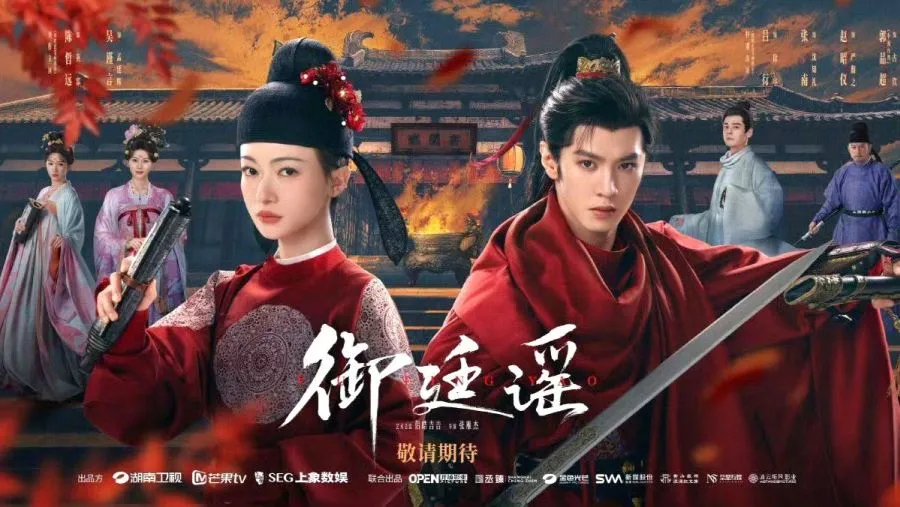
Royal Betrothal Poster - Courtesy of Hunan TV

|
DetailsRATING OF EPISODES WATCHED: (6.5/10)
NATIVE TITLE: 御廷谣 - Yù tíng yáo | 江山为聘 - Jiāngshān wèi pìn YEAR: 2026 TOTAL EPISODES: 32 WATCHED EPISODES: 14 DURATION: 45’ DIRECTOR: Zhang Yan Jie SCREENWRITER: Liu Ting Ting, Fei Bi, Wang Xin Yi, Feng Yue Chi ORIGINAL CREATOR: Xing Yan Yan (江山为聘 - The Empire as a Betrothal Gift) STATUS: 🟡 (Temporarily on Hold) |


Disclaimer: the opinions expressed in this review refer exclusively to the drama. As I have not read the original work, I cannot say with certainty whether the issues identified can be attributed to the screenplay or to the source material. For this reason, my comments on the writing should be understood as an assessment of the adaptation rather than a judgment on the original work.
IN A NUTSHELL
Short on time? Here you’ll find the quick verdict, including the drama’s main strengths, weaknesses, and key features to help you decide if it’s right for you. For a more in-depth analysis, continue with the No Spoiler Review.
- What to expect: Royal Betrothal is a historical drama that chronicles the journey of a young woman from humble origins, marked by a traumatic past, who enters the imperial bureaucracy with the aim of fighting corruption and injustice. The series combines elements of political ascension, court intrigue, and romance, presenting a protagonist destined to confront a power system dominated by men and conflicting interests. Despite a premise that suggests a political tale, Royal Betrothal chooses a path closer to a fictionalized historical adventure. Intrigue and conflict are used primarily to enhance the protagonists' abilities, while antagonists and secondary characters rarely assume the complexity necessary to represent a true system of power. The result is a story in which the protagonist seems to move in a narrative world constructed to confirm her exceptionalism.
- Strengths: the ambitious narrative premise, the lack of downtime, the concept of the female protagonist.
- Weaknesses: the excessive mythologization of the protagonist, the archetypal characterization of secondary characters and antagonists, the CGI.
- Who might like it anyway: those who like Wu Jin Yan and Chen Zhe Yuan, those who prefer strong and ambitious protagonists, those looking for a romanticized historical adventure, those who love stories focused on female empowerment.
Read on to understand what didn't convince me about this drama.
Royal Betrothal had all the makings of an ambitious story: a premise full of potential, a determined protagonist who deals with politics, power and social injustices, but over the course of viewing the narrative progressively took the path of a more fictionalized historical adventure.
The problem is not the tone chosen by the series, but the distance between what it seemed to promise and what it actually tells. And it is precisely this disconnect between the initial expectations and the direction taken by the drama that is the reason why Royal Betrothal enters the Dropped Drama Club: not because it is devoid of quality or interesting elements, but because the story it has chosen to tell is not the one that pushed me to start it.
Plot
After losing her family and growing up exposed to society's violence and injustice, Meng Ting Hui strives to pass the imperial examination to enter the state bureaucracy and fight against abuse and lawlessness. Her talent attracts the attention of Emperor, Ying Gua, who chooses to support her in her rise to power.
Amid court intrigue, ideological struggles, and a bond destined to intertwine with the future of the empire, the young girl finds herself challenging a conservative and corrupt system that seems unwilling to change and facing dangerous hidden threats.

THIS SECTION TAKES A CLOSER LOOK AT THE SCRIPT, CHARACTERS, CAST, AND TECHNICAL ASPECTS WITHOUT REVEALING MAJOR PLOT DEVELOPMENTS. FOR A COMPLETE ANALYSIS OF THE DRAMA, CONTINUE WITH THE SPOILER REVIEW.
Royal Betrothal Drama Review (No Spoiler)
Why I Started
I began Royal Betrothal primarily for its premise, which seemed to combine several elements I typically appreciate in historical dramas: a spectacular political rise, a female protagonist determined to establish herself within the imperial court, and a tangle of justice, power, and emotion.
The idea of following the journey of a young woman from humble origins, marked by a difficult past but determined to change an unjust system, caught my attention because it recalled the type of story that made dramas like The Legend of Zhuohua so interesting: not just a brilliant protagonist, but a journey of obstacles, compromises, and struggles to assert oneself in an initially hostile environment.
I was also curious to see Chen Zheyuan in a historical role, different from the younger, more romantic characters he's best known for, especially as an emperor forced to balance his political role with his relationship with his protagonist.
Review of Episodes Watched
The narrative premise around which Royal Betrothal unfolds seems very interesting. The story begins with a potentially ambitious idea: a young woman who survived a childhood marked by violence and injustice enters the imperial bureaucracy with the aim of fighting the system's abuses. It's a premise that encompasses many of the elements that make historical dramas about coming of age fascinating: social redemption, the confrontation with an institutional environment dominated by an all-male elite, the relationship between personal ideals and political power.
Precisely for this reason the protagonist initially manages to capture attention. Her character is built around characteristics that usually make a female character in a historical drama interesting: intelligence, determination, and a strong sense of justice. Her personal history provides a clear motivation for her choices and makes her desire to change a reality she considers unjust understandable.
The problem is that FL is made so exceptional from the start that it loses part of her growth trajectory: rather than showing her gradual conquest of a role within a complex system, one often gets the sense that the system itself is constructed to confirm her abilities. The obstacles she encounters rarely truly challenge her worldview; more often, they become opportunities to once again demonstrate her competence and determination.
This impression also emerges from the construction of the characters surrounding her. The supporting characters often serve a predominantly narrative function: some lighten the tone, others support the group dynamics, still others serve to highlight the protagonists' qualities. The antagonists follow a similar logic. While they represent concrete threats within individual story arcs, they are rarely developed as adversaries with goals, strategies, or worldviews capable of truly competing with those of the protagonist. Their primary function remains to provide obstacles that allow the heroine to demonstrate her capabilities.
It is precisely the combination of these elements that defines the narrative register of Royal Betrothal. Despite the presence of corruption, power struggles, and imperial institutions, the series is closer to a fictionalized historical adventure than to a political drama. Intrigue is used not primarily to explore the workings of a system of power, but to build conflict, heighten tension, and test — and consequently highlight — the protagonists' abilities. Political complexity thus remains primarily a narrative framework for a highly character-driven story.
The pacing follows the same pattern. The narrative moves quickly, alternating between conflicts, revelations, and moments of action without dwelling at length on the consequences of events or institutional dynamics. At the same time, however, the story is easy to follow because the key information is generally provided with sufficient clarity. The result is a linear, flowing, and dynamic narrative that prioritizes adventure progression over emotional character development.
The writing maintains a solemn tone consistent with the genre, frequently resorting to reflections on justice, responsibility, destiny, and duty. However, many declarations of principle employ recurring rhetorical formulas, which can make some comparisons less impactful than they could be. The dialogues are thus useful in reiterating the values central to the story, but less effective in transforming them into elements of genuine narrative conflict.
The cast as a whole proves effective in supporting the script's choices, consistently adapting to the archetypes assigned to the various characters. The performances work primarily because the actors manage to maintain a certain uniformity of register, even when the characterizations tend to be quite strong.
Wu Jin Yan proves particularly comfortable in the roles of strong and determined protagonists, delivering a solid and convincing performance. However, there remains a certain age discrepancy between the actress and the character: at times, the protagonist appears slightly older than the young woman the story is supposed to represent.
Chen Zhe Yuan is undoubtedly talented and manages to exploit the character's charm well; her performance, however, also highlights an expressive range that sometimes seems limited, especially in scenes that require more marked emotional nuance.
Zhao Zhao Yi maintains a deliberately over-the-top performance. While in Glory this tone still remained within the limits of the character's believability, here it often ends up being excessive, further accentuating the archetypal nature of some secondary characters. This choice is consistent with the series' fictionalized tone, which is somewhat similar to the romantic comedy style in which he played one of his most famous roles, Romance of Hua Rong.
Liang Yong Qi delivers a good performance, playing, as often happens in his roles, on the character's ambiguity: he manages to initially present himself as a jovial and seemingly harmless figure, gradually allowing a more calculating and dangerous side to emerge.
Rounding out the cast are veterans Dylan Kuo and Lu Xing, whose more restrained performances help give the ensemble a more solid feel.
From a technical standpoint, Royal Betrothal displays a fairly evident level of attention to detail. The direction is solid and works well for the chosen narrative: the action scenes are readable, emotional moments are given sufficient space, and the staging supports the series' adventurous tone well. The visuals are also one of its strengths. The costumes show good attention to materials, cuts, and details, while the sets and scenery help create a pleasant historical setting that is consistent with the drama's atmosphere.
However, there are some critical issues. The CGI is less convincing than other aspects of the production: some digital reconstructions, especially those set in the desert, appear poorly integrated with the live-action shots. Even the use of lighting sometimes helps to highlight this distance, with digital backgrounds that seem to belong to a different environment than the actors on stage. The final effect is that of a production that is visually refined in some elements, but less uniform when it comes to combining real sets and virtual effects.
The soundtrack fits coherently into the drama's melancholic atmosphere, with predominantly slow pieces that alternate Western accompaniments based primarily on strings and piano with occasional forays into traditional Eastern instruments. The arrangements are meticulously crafted and effectively contribute to sustaining the series' emotional tone, but rarely stray from the now-familiar sounds of historical drama series. Overall, therefore, the soundtrack tends to maintain a certain stylistic uniformity, sometimes leaving a feeling of déjà vu and making it difficult to distinguish the individual songs outside of the general atmosphere they help to create.

WARNING!
SPOILERS AHEAD. IN THIS SECTION I GIVE MY PERSONAL OPINION ON THE DRAMA AND SPECIFICALLY ANALYZE SOME ASPECTS OF THE SERIES. DO NOT CONTINUE IF YOU DON’T WANT TO KNOW ALL THE DETAILS OF THE DRAMA
Royal Betrothal Drama Review (Spoiler)
Breaking Point
There wasn't a single episode or specific scene that made me decide to abandon Royal Betrothal. My decision came gradually, as the series increasingly showed a different direction from what I expected.
The problem wasn't the presence of fictional elements or a particularly competent protagonist, but the fact that the drama seemed to favor a heroic adventure structure over the political and institutional journey its premise had suggested. Episode after episode, I had the feeling that the obstacles were constructed primarily to confirm the protagonist's exceptionalism, rather than to truly test her.
At that point, I realized that the series wasn't heading towards the kind of story I was looking for and that my interest wasn't strong enough to justify the time it took to get to the conclusion.
Why I Dropped It
My viewing experience with Royal Betrothal was marked above all by the gap between what the drama seemed to promise and what it actually delivers. The premise had all the elements to attract those, like me, who seek not only a love story or a spectacular adventure in historical dramas, but also a believable political journey: a woman of humble origins, a past marked by injustice, her entry into the imperial bureaucracy, a young emperor, corruption, power struggles, and the promise of a rise to the top of the state.
For this reason, I expected a story similar to The Legend of Zhuohua: not necessarily a copy, but at least a tale in which the true focus was on seeing a woman slowly conquer her space within a complex and hostile system.
The reality, however, turned out to be very different. More than a historical drama about the rise of an important political figure, Royal Betrothal is a historical adventure with a strongly fictionalized tone. The intrigues, conflicts, and dramatic situations serve primarily to create suspense and highlight the protagonists' extraordinary abilities, rather than to realistically represent the workings of a political or social system.
Part of the problem likely also stems from the choices made regarding its positioning. The original title 江山为聘 (lit. I Will Offer You the Kingdom as a Wedding Gift) clearly conveyed the idea of a story in which love and power were intertwined, while the subsequent title 御廷谣 (lit. The Ballad of the Imperial Court) evokes completely different expectations: palace intrigue, factional struggles, and a more political narrative. Ultimately, Royal Betrothal is not a bad drama, but it is a different drama than its title and promotion seemed to suggest.
This impression emerges above all from the way the female protagonist is constructed. Her personal history — a childhood marked by violence and injustice — provides a powerful motivation for her desire to fight abuse, but the narrative often tends to transform her trauma and abilities into automatic confirmation of her moral superiority.
The problem isn't having an extremely competent protagonist: a woman capable of emerging from a hostile environment can be very compelling. The problem arises when the world around her seems to exist primarily to demonstrate how extraordinary she is. Obstacles don't seem to alter her path or force her to confront difficult choices; they more often end up confirming that she was right all along. Society's violence, corruption, and abuse of power become primarily tools to aggrandize her, rather than complex problems she must figure out how to address.
The relationship with the male protagonist also follows a similar dynamic. The series emphasizes the fact that he was the first to recognize her value and believe in her abilities. A romantic premise that's certainly effective for those who love the theme of destiny and the special bond between the protagonists, but it risks reducing the figure of the emperor to the role of someone who confirms the protagonist's greatness, rather than showing him as a political figure with his own goals and conflicts.
This impression also emerges when observing the supporting characters and antagonists. In a more ambitious political drama, supporting characters would tend to have a function more closely tied to the system they operate in, representing different social interests, ideological positions, or power dynamics; even the antagonists would have goals and motivations capable of transforming them into true political adversaries.
In Royal Betrothal, however, the supporting characters seem to be constructed according to recognizable archetypes and primarily serve a counterpoint function: they lighten the narrative, strengthen group dynamics, or highlight the protagonists' positive qualities. The antagonists, for their part, appear more often as narrative obstacles than as complex figures with independent motivations: they represent the evil the protagonist must confront. The snake cave isn't a realistic situation to be faced; it's the hero's test. The bandit leader isn't a character with his own vision; he's the absolute manifestation of evil. The corrupt system isn't an environment for the FL to learn to navigate; it's a backdrop that serves to demonstrate the necessity of their mission.
And it's precisely this progressive imbalance that led me to abandon watching: not because Royal Betrothal is necessarily a low-quality drama, but because the story I wanted to see — a realistic political rise within a complex system — wasn't the story the series seemed to be trying to tell.

Characters and Cast
Primary Characters
Meng Ting Hui/Meng Meng (Wu Jin Yan) an orphan from Shazhou who wants to pass the imperial examination to become an official and fight oppression. After achieving three Zhuangyuan (状元) rankings in the imperial examination for women, the emperor appoints her as director of the Censorship Office (察闻院主事).
Ying Gua/He Du (Chen Zhe Yuan) emperor of Da Ning. He is a brilliant and enterprising young man, but his initiatives are often hindered by the Left Chancellor, who has been entrusted with the running of the kingdom by the late emperor. To regain control of the court, he decides to reinstitute the imperial examination for women and support Meng Ting Hui's rise to power.
Supporting Characters
Shazhou Prefecture
Ding Chong (Xiang Xia) tyrannical prefect (刺史) of Shazhou, disciple of the Left Chancellor and maternal uncle of Jiang Mei Er.
Mr. Wang (Wang Ying Xiang) Vice-prefect (通判) of Shazhou.
Feng Lu (Qi Hang) leader of the Heihu Gang of Shazhou.
Jiang Mei Er/An Ru Lan (Zhang Ke Ying) classmate of Meng Ting Hui in Shazhou and niece of Ding Chong. After her uncle's arrest, she flees to the capital and obtains first place in the Jingzhao Metropolitan Examination by passing off Meng Ting Hui's paper as her own.
Yan Fu Zhi (Zhao Zhao Yi) friend of Meng Ting Hui and the owner of the Bofenglou restaurant in Shazhou. When Meng Ting Hui travels to the capital to take the imperial exam, she follows her and opens a branch of her restaurant.
Imperial Court
Shen Wu Chen (Zhao Bin) Grand Preceptor (太傅) of the Da Ning and advisor to the Emperor.
Shen Zhi Shu (Yan Yu Chen) Shen Wu Chen's eldest son and the Emperor's cousin. He is appointed Imperial Commissioner for the Observation of Local Customs (采风使) to monitor the situation in the capital.
Shen Zhi Li/Le Yan (Zhang Nan) Shen Wu Chen's daughter and Gu Qin's disciple. After passing the imperial examination, she was appointed deputy director of the Censorship Office to assist Meng Ting Hui.
Huang Bo/Lao Huang (Song Qi) Imperial guard and right-hand man to the Emperor.
Di Nian/A'Nian (Huang Zu Xin) Adopted son of Shen Wu Chen and commander of the Shenwei Guards (神卫都尉).
Eunuch You (He Qiang) Chief eunuch and attendant to the Emperor.
Xu Ting (Lu Xing) Left Chancellor (左相国) of the Da Ning and political opponent of the Emperor.
Huo An (Zhao Qing He) Head of the Left Chancellor's personal guards.
Gu Qin (Dylan Kuo) Right Chancellor (右相国) of the Da Ning and master of Shen Zhi Li.
Yuan Ling Yi (He Du Juan) Gu Qin's wife.
Liu Ren (Gong Zheng Nan) Minister of War (兵部尚书) of Da Ning.
Wen Tao (Zhou Yun Shen) Minister of Revenue (户部尚书) of Da Ning.
Wan Kai (Yuan Man) Minister of Justice (刑部尚书) of Da Ning.
Huxiao Gang
Ling Yun Fei (Sheng Yi Lun) Leader of the Huxiao Gang and sworn enemy of Meng Ting Hui.
Lv Er (Shao Jun Ze) Lv Da's younger brother and deputy leader of the Huxiao Gang. He helps Jiang Mei Er have Meng Ting Hui arrested by the prefect of Jingzhao after the theft of the imperial examination paper.
Lv Da (Hai Yang) Lv Er's older brother and deputy leader of the Huxiao Gang.
Blood Moon Society
Yin Qing/Master Shangguan (Liang Yong Qi) Palace pharmacist hired by Meng Ting Hui as an assistant in the Censorship Office. He is actually the head of the Blood Moon Society and the last remaining member of the Zhongwan royal house.
Situ Xue (Kuang Yu Ting) the most famous musician in the capital, owner of the Huiyin House, and a member of the Blood Moon Society.
Other Characters
Dong Shou Cai (Shen Xue Wei) prefect (府尹) of Jingzhao and accomplice of the Huxiao Gang.
Liu Ru Yan (Sun Jing Jing) owner of the Wanchun Pavilion and accomplice of the Huxiao Gang.
RECOMMENDED:
- LEGEND OF THE PHOENIX
- THE LEGEND OF ZHUOHUA
- MELODY OF GOLDEN AGE
- A SPLENDID MATCH
- THE FIRST JASMINE
Thank you for reading all the way to the end!
I hope you enjoyed this article and found it helpful.
🈷️ Did you come across a term you weren't familiar with? Check out my Chinese Historical Drama Glossary, where you'll find explanations of official titles, government institutions, religion, myths, and many other aspects of Chinese culture.
☕ If you enjoy my content and would like to support Red Taotie, you can buy me a coffee on Ko-fi. Every contribution helps me continue creating reviews and in-depth articles.