
Ashes to Crown (2026): Revenge Is Just the Beginning for Chen Duling | Review & Cast
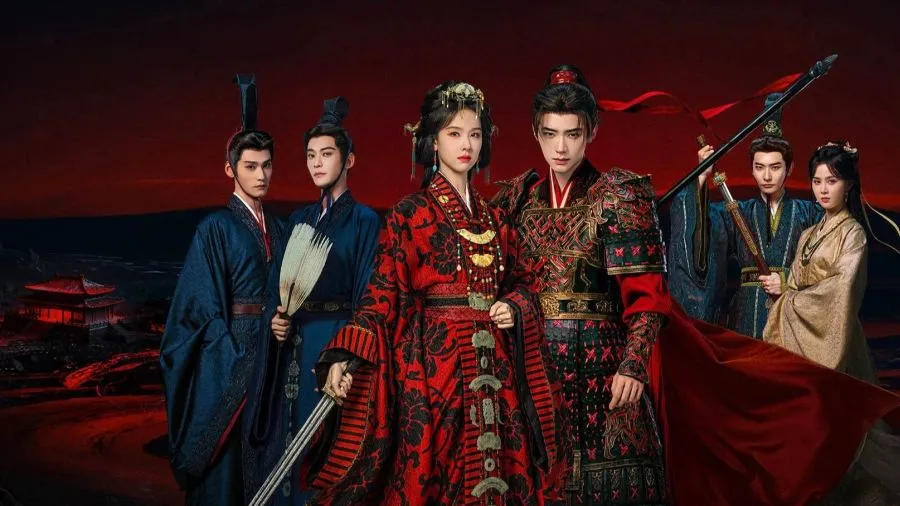
Ashes to Crown Poster - Courtesy of Youku

|
DetailsRATING: (7/10)
NATIVE TITLE: 翘楚 - Qiáochǔ YEAR: 2026 EPISODES: 24 DURATION: 45’ DIRECTOR: Yang Long SCREENWRITER: Li Min, Xia Meng Ying ORIGINAL CREATOR: Xi Xing (楚后 - Outstanding) RESPECTED CLICHÉS: 4 - 5 - 10 - 15 |


IN A NUTSHELL
- What to expect: Ashes to Crown is a historical drama that tells the story of Chu Zhao, a young woman who, after witnessing the ruin of her family and the destruction of everything she loved, receives the opportunity to go back in time and rewrite her own destiny. What might seem like a classic story of rebirth and revenge, however, quickly turns into a complex political game, in which every alliance hides ulterior motives and every choice can have unpredictable consequences. Between precarious alliances, power plays, and a love story slowly built on mutual trust, the drama offers numerous interesting insights, but also shows several weaknesses in its worldbuilding and pacing that partially limit its narrative impact.
- Strengths: the main love story, the characterization, the engaging political storyline.
- Weaknesses: the fragmented storytelling, the underdeveloped worldbuilding, the frantic pacing of some episodes.
- Recommended if you like: Zhou Yi Ran and Chen Du Ling, dramas of rebirth and revenge, series with a strong political component and a fast pace, tormented slow-burn romances.
- Would I rewatch it? Yes, a drama with Zhou Yi Ran and Chen Du Ling is always worth watching.
Read on to find out what convinced me and what didn't about this series.
Ashes to Crown is a series that, despite its obvious flaws, still manages to hold the viewer's interest thanks to the strength of its ideas. For much of the show, you get the feeling of a constantly evolving story, caught between political intrigue, a desire for revenge, and a quest for survival, rarely giving its characters or the world time to pause and breathe. Yet, this very narrative urgency is one of the reasons that drives the viewer to continue episode after episode, to discover Chu Zhao's next move and how the delicate balance of power at court will shift once again.
In this review of the drama Ashes to Crown, I tried to understand why some of its narrative choices are so engaging and others more problematic, and why the story is interesting overall, despite sometimes leaving the feeling of not fully exploiting its potential.
Plot
In the nineteenth year of the Tianshu Era, Chu Zhao, beloved daughter of General Chu Ling and wife of the newly crowned Emperor Xiao Xun, believes she has a peaceful future ahead of her. However, beneath the Empire's apparent stability lie power struggles, personal ambitions, and plots destined to overwhelm her family.
Betrayed by the man she loves, she watches helplessly as the Chu clan falls: her father is accused of high treason and executed, her family is exterminated, and she herself dies after discovering Xiao Xun's true face.
When fate offers her a second chance, Chu Zhao resolves to change the course of events and prevent Xiao Xun from rising to power. But the task proves far more difficult than expected. Court intrigues are already ignited, political alliances are fragile, and the enemies who contributed to her downfall continue to weave their plots in the shadows.
As she tries to protect her father, save the young Imperial Grandson, and thwart her adversaries' plans, Chu Zhao finds herself embroiled in a complex political game involving ambitious ministers, aristocratic families, and pretenders to the throne.
Unexpectedly, she finds an ally in Xie Yan Lai, a young officer who once served under her father. Despite his rebellious and aloof nature, he gradually becomes one of her most trusted allies.
Amid border wars, power plays, betrayals, and feelings brewing amidst the chaos, Chu Zhao must decide how far she is willing to go to change destiny.
Cause rewriting the future requires more than simply defeating your enemies: you must also face the consequences of your choices and discover what price you are willing to pay for the survival of your family and your kingdom.
"Dying is easy, living takes true strength."

Ashes to Crown Drama Review (No Spoilers)
Plot and Narrative Pace
Ashes to Crown is a narratively intriguing and potentially powerful rebirth drama, yet it doesn't always live up to its ambitions in terms of narrative fluidity and emotional construction.
The choice to have the protagonist be reborn just before the breaking point, when many events are already in motion and the margin for changing fate appears limited, generates a constant tension that becomes one of the main drivers of the story. The viewer isn't asked to observe how the future is gradually being reshaped, but rather to follow the protagonist's attempt to divert, contain, or exploit a series of events that seem already headed in a specific direction. This approach can be extremely engaging for those who enjoy stories built on urgency and the sense of imminent danger, but it also ends up impacting the narrative's readability and priorities.
The narrative tends to prioritize advancing the revenge plot over building the story's foundations. Scenes unfold rapidly, introducing factions, alliances, and rivalries, but rarely linger long enough for the viewer to fully grasp the workings of the political and social environment in which the characters operate. This creates a sense of fragmentation and alienation that pervades much of the viewing experience: events are connected, but the sense of continuity and familiarity that allows relationships, tensions, and changes to unfold naturally is often lacking.
This approach also ultimately hinders the introspection inherent in the narrative's political component. The characters' decisions and their consequences are generally understandable, but the drama rarely shows the mental journey that leads to those choices, suppressing reflections, doubts, and intermediate steps in strategic reasoning. As a result, the viewer understands what is happening, but is not always able to fully follow the mental process that led to certain developments. On the contrary, the series devotes much more attention to the emotional and relational dimensions of the story: family and emotional ties, particularly those of Chu Zhao with her parents and Xie Yan Lai, benefit from numerous scenes that explore feelings, internal conflicts, and the emotional consequences of events. This creates an interesting contrast between a political plot that tends to prioritize pacing and the progression of events, and a sentimental dimension that instead finds time to dwell on the characters and their emotions. For this reason, I perceived Ashes to Crown as a series capable of arousing emotions and maintaining curiosity and interest in the plot, but one that pays less attention to the construction and understanding of its strategic dynamics.
Characters and Love Story
The characters are undoubtedly one of the most successful aspects of Ashes to Crown.
Chu Zhao is an interesting protagonist because, despite being intelligent, determined, and gifted with foresight, she never appears truly in control. Instead, she constantly finds herself pitted against opponents who possess a crucial advantage: years of political experience and a deep understanding of court dynamics. Her struggle is therefore not just against individual enemies, but against an entire system of pedantic bureaucrats, social hierarchies, and gender biases, an aspect that makes each of her successes both satisfying and precarious. Not all of her emotional reactions seemed equally convincing to me, but overall she remains a nuanced and engaging character.
The antagonists are equally successful, each driven by different but believable motivations: the ambitious Deng Yi, determined to redeem his humble origins through power; the refined and manipulative Xia Yan Fang, committed to preserving his house's influence; and Xiao Xun, an opportunistic and ruthless aspirant to the throne.
Thanks to the presence of such diverse antagonists, the political storyline of Ashes to Crown often proves to be one of the most engaging elements of the series. Rather than relying on simple clashes between opposing factions, the drama builds a constantly evolving web of alliances, rivalries, and personal interests, in which each character seeks to pursue their own goals through strategy, persuasion, and political calculation, an aspect that helps maintain high tension even in the most dialogue-heavy sequences. Court intrigues, political maneuvers, power struggles, and attempts at manipulation are constantly intertwined, creating a context in which threats come not only from declared enemies but also from temporary allies and the convenience of the moment. While not reaching the complexity of the best productions focused on court politics, Ashes to Crown still manages to construct a plot sufficiently complex to stimulate the viewer's curiosity and make the constant oscillations in the balance of power between the characters believable.
The love story between Chu Zhao and Xie Yan Lai is also one of the series' strong points. Rather than an immediate romantic attraction, their relationship gradually builds on trust, cooperation, and mutual support in a context dominated by constant danger. Xie Yan Lai initially establishes herself as one of the few allies Chu Zhao can rely on, although his feelings for her are rooted in a past event that lends credibility to his constant closeness to the protagonist. I particularly appreciated how the relationship develops naturally, gradually transforming an alliance born out of necessity into a genuine emotional bond. Despite occasionally resorting to a few romantic clichés and somewhat overblown melodramatic moments, the pairing works thanks to the good chemistry between the leads and the solidity of the relationship built over the course of the story, proving to be one of the most engaging and satisfying elements of the drama.

Cast
The cast of Ashes to Crown is overall quite solid and contributes significantly to the drama's success, albeit with mixed results.
Chen Du Ling is an actress who has shown clear growth in recent years, as evidenced by the increasingly central roles she's been given (not least in Veil of Shadows). In this project, however, I had the feeling that she's still lacking something expressively: in some scenes, her expressions fail to fully match the character's emotions, especially when a form of subtle cunning or strategic calculation should emerge. In those moments, what should be a mischievous smile tends to sound almost good-natured, somewhat attenuating the narrative intent.
On the contrary, Zhou Yi Ran proves to be a very promising actor, capable of constructing a multifaceted and believable character thanks to an intense screen presence and a shadowy beauty that adapts well to the different nuances of his roles, from the most restrained crown prince to the most ruthless general. Although he has room for growth in terms of expressiveness, he remains an actor I find particularly interesting and who in other projects, such as Twelve Letters, has already impressed me with his ability to move.
The performances of the three main antagonists are also very successful. Tang Xiao Tian, whom I had already appreciated in dramas such as The Sword and the Brocade and The Ingenious One, delivers a convincing performance in bringing a character more ambiguous and less linear than his previous roles. Gao Mao Tong is equally effective, though perhaps less nuanced than Tang Xiao Tian. Wang Rui Chang, on the other hand, manages to convey Xiao Xun's cowardice and cruelty well, adding a touch of lucid madness that makes his performance particularly impactful.
Finally, praise goes to Jiang Kai, who confirms his solid performance, making General Chu an authoritative presence, without sacrificing more intimate and emotional nuances that enrich his humanity. Also noteworthy is the performance of the young Wu Jia Jun, who portrays the young emperor with naturalness and realism, maintaining good credibility despite the complexity of the role.
Visual Aspects and Soundtrack
Visually, Ashes to Crown presents itself as a fairly solid production, supported by a direction that, while not particularly brilliant, demonstrates a good command of the television language. The shots are often meticulously crafted and professional, with interesting cuts that help give dynamism to the scenes and showcase the actors. Among the devices I found most effective was the choice to represent memories by leaving only the characters in the foreground or those speaking in color, a simple yet visually effective solution that helps distinguish these moments from the rest of the narrative. Likewise, I found the decision not to directly show the major battles, preferring to focus on the before and after, to be rather astute: a choice that likely stems from production needs, but which nevertheless manages to summarize the events without giving the impression of being too obviously missing.
While the direction convinced me, one aspect that left me with some reservations was the cinematography, which tends to maintain very high brightness in practically every situation. While this makes the images consistently sharp and easily readable, it sometimes flattens the scenes, depriving them of their natural depth. The color palette, characterized by highly saturated colors, also occasionally contributes to dampening the dramatic atmosphere the story seeks to build. This is a shame, because the settings deserved greater attention: the locations at Hengdian World Studios are rich in detail and effectively convey the sense of a lived-in historical world, while the desert landscapes that form the backdrop to some sequences add visual variety and provide the drama with some of its most evocative views.
I must admit that this drama has its greatest limitations on a technical level. The editing often uses very sharp cuts between scenes, which end up accentuating the sense of fragmentation already present in the writing. I often felt that the scenes were juxtaposed without any real fluidity, resulting in a less fluid viewing experience than it could have been. The dubbing isn't always flawless either: on occasion, I noticed a slight asynchrony between voice and image, which, while not compromising the viewing experience, tends to draw attention to an aspect that should go unnoticed.
Where the series truly impresses is in the costumes and makeup department. The clothes and accessories appear thoughtful, believable, and well-crafted, helping to give the characters visual consistency without ever appearing overly artificial or theatrical. I also appreciated the work done on the makeup, which in most scenes remains light and natural, and which, in the more dramatic or dramatic moments, even allows for a certain degree of imperfection. It's a choice that helps preserve the rawness of certain situations and makes the characters more human and less like glossy figures from a photo shoot.
The soundtrack of Ashes to Crown moves almost entirely along romantic and melancholic coordinates, offering a collection of songs that effectively accompany the emotional tone of the series without standing out for particular originality. The tracks alternate between more classical and dramatic arrangements, such as those dominated by the strings of 执棋 (Holding the Chess Piece), to others with a more modern feel, such as the piece performed by Liu Yu Ning or the one sung by Zhong Zi Ning. While there are some references to traditional Chinese music through the occasional use of traditional instruments, it is primarily the Western instruments and orchestral arrangements that define the drama's sonic identity.
Overall, the pieces seem designed primarily to accompany, rather than to surprise, but all serve their purpose adequately, reinforcing the sentimental atmosphere and sense of melancholy that permeates the story. And among the various pieces, the one by Liu Yu Ning entitled 幽光 (Faint Light) is probably the most effective, if only for the way in which his interpretation manages to give more emotional weight to a musical writing that would otherwise risk remaining a bit standardized.

WARNING!
FROM THIS POINT ON THE SPOILER SECTION BEGINS. DO NOT CONTINUE IF YOU DO NOT WANT TO KNOW ALL THE DETAILS OF THE DRAMA.
Ashes to Crown Drama Review (Spoilers)
What Works
The Characterization
The characters are probably one of the strongest aspects of Ashes to Crown. Chu Zhao, in particular, is an interesting protagonist because the drama avoids presenting her as an infallible strategist destined to dominate anyone who stands in her way. She is intelligent, determined, and courageous, but from the first episodes it becomes clear that she has found herself caught up in a game much bigger than herself. Her opponents possess not only intelligence and ambition: they have years of political experience, a deep understanding of court dynamics, and a network of relationships built over time. Chu Zhao may rely on her knowledge of the future, her ability to improvise, and a strong will to survive, but this does not mean she is truly in control of the situation. Indeed, for much of the story we see her moving in an extremely precarious position, forced to confront not only her main antagonist, Xiao Xun, but an entire system composed of powerful figures like Deng Yi and Xia Yan Fang, hostile ministers, gender prejudices, and the mistrust of the aristocracy. Precisely for this reason, each of her victories generates more tension than relief: instead of thinking "she made it," the viewer finds themselves wondering how much longer they'll be able to maintain their balance.
One of the aspects I most appreciated is the way the character changes over the course of the series. As the episodes progress, Chu Zhao progressively hardens, becoming more ruthless and beginning to use the same political and manipulative tools as her adversaries. It's a transformation that raises an interesting question: is she managing to save herself, or is she slowly becoming what she was trying to escape? Not all of her reactions, however, seemed equally convincing to me. At times, her emotional involvement seems more intense than the narrative can justify. This is the case with the discovery that Mrs. Ge is actually her mother: I understand the shock of finding a person thought to be dead and discovering that she'd been deceived by her father for years, but I found her harsh reaction toward him excessive. Likewise, his reaction to the discovery that Xie Yan Lai administered the poison that caused General Chu's death seemed a bit too blunt to me: while not trying to exonerate himself, Xie Yan Lai had always shown respect and admiration for the general, and I would have expected at least a moment of doubt about the possibility of his manipulation.
Her political counterparts also contribute to making the drama particularly interesting. Deng Yi is perhaps the most immediately understandable: born into a poor family, he sees power and wealth as personal revenge for a life that denied him privilege and opportunity. His unbridled ambition makes him a dangerous antagonist, but also coherent in his motivations. On the opposing side is Xia Yan Fang, Prime Minister and representative of one of the kingdom's most prestigious families. While Deng Yi wants to seize power, Xia Yan Fang wants to preserve and consolidate it, convinced of his family's superiority. His main weapon is not force, but the ability to influence and manipulate those around him, including the Emperor himself. Finally, there is Xiao Xun, perhaps the most personal of Chu Zhao's adversaries. Heir to the Prince of Xiaonan and a political hostage for much of his life, he is patient, opportunistic, and deeply ambitious. After seeing his chance at the throne vanish due to the actions of the reborn Chu Zhao, he returns to forging increasingly dangerous alliances in order to gain power and finally rid himself of the woman he now considers an enemy. Together, these three characters embody different forms of ambition and contribute to a surprisingly rich political landscape, in which no conflict ever seems reducible to a simple good versus evil.
The Main Love Story
The love story between Chu Zhao and Xie Yan Lai is also among the most successful aspects of Ashes to Crown, especially because it chooses to develop through trust and collaboration rather than romance. When Chu Zhao is named Grand Princess, she suddenly finds herself surrounded by enemies, intrigues, and power games in which she cannot afford to easily trust anyone. Xie Yan Lai thus becomes, first and foremost, a necessary ally: a man outside the court factions, connected to General Chu, and one of the few people who, both in his past and present life, has demonstrated his willingness to protect her. Their relationship therefore arises from a rational rather than emotional choice, from a mutual convenience that gradually gives way to something deeper.
What I found particularly interesting is that the drama avoids immediately turning Xie Yan Lai into a classic romantic hero. On the contrary, the character initially appears shy, distrustful, and intolerant of impositions, with an attitude that makes him difficult to decipher and anything but reassuring. Precisely for this reason, the discovery of his feelings for Chu Zhao takes on greater weight. Behind his apparent indifference lies a silent devotion rooted in an episode that occurred years earlier, when Chu Zhao saved his life from a lynching. Since then, Xie Yan Lai has continued to watch over her from the shadows, trying to repay that debt without ever revealing his presence. This dynamic gives the character greater emotional depth and makes his constant presence at the protagonist's side believable.
More than a tale of love at first sight, Ashes to Crown therefore builds a relationship based on loyalty, mutual support, and the ability to rely on others in a context where trust is an extremely rare resource. In a drama dominated by political intrigue, betrayal, and power struggles, the relationship between Chu Zhao and Xie Yan Lai ends up representing one of the few points of emotional stability in the story, making the transition from alliance to romance a natural one. This doesn't mean it's free from clichés: the relationship occasionally stumbles into romantic clichés, and at times, the melodramatic element emerges more strongly than necessary — there are scenes that focus a bit too much on sacrifice, misunderstandings, or dramatic intensity. However, thanks to the solid construction of the relationship and the good chemistry between the two characters, these excesses don't compromise the final result. On the contrary, the love story almost always manages to maintain its balance and remain one of the most compelling and satisfying elements of the entire drama.

What Doesn't Work
The Screenplay and Worldbuilding
I think the biggest flaw in Ashes to Crown is the screenplay combined with the less-than-stellar editing. On the one hand, the opening is fast-paced, but on the other, the narrative often gives the impression of proceeding in separate blocks rather than through a truly fluid progression. Scenes follow one another, accumulating information, plot twists, and changes of situation, but not always with the necessary transitions to convey a sense of a natural progression. The result is a construction that at times resembles that of a dilated minidrama: fragmented enough to require the viewer to make a few logical leaps, with characters entering the scene without a solid introduction and with a question constantly lingering in the mind: what exactly is the point the story is trying to develop at this moment? The result is that something precious is lost: the time needed to build familiarity with the narrative world, to let relationships settle, and to gradually build tension.
What weighs on this feeling, first and foremost, is the way the protagonist's early life is condensed. The series almost seems to simply say: "Xiao Xun is responsible for Chu Zhao's downfall; he exterminated his family out of ambition and lust for power. Got that? Good, now let's focus on revenge." It's an understandable choice, especially considering that that timeline is destined to be rewritten, but initially I struggled to emotionally invest in the characters. I wouldn't have needed five episodes dedicated to examining every single mistake made in the first timeline, but a little more information about the characters' backgrounds and motivations would have made the prologue less schematic and more engaging.
This choice is also reflected in the overall worldbuilding. While it's clear that there's a complex political structure behind the story, made up of aristocratic families, court factions, and consolidated power relationships, the series spends relatively little time explaining how it works. Much information is provided as it becomes necessary to the plot, without any progressive construction of context. As a result, the viewer understands which sides are at play and who the protagonist's adversaries are, but struggles to perceive the world as a living, layered reality that exists independently of the events being recounted. This choice favors pacing and immediate tension, but it partially limits the sense of immersion and depth of the setting.
The problem is that this approach doesn't just affect the beginning; it continues to characterize the entire series. Even when the plot stabilizes, the story continues to advance through sequences that connect to previous events without generating a strong sense of narrative continuity. Rather than following a natural flow of cause and effect, one often feels like witnessing a succession of episodes serving to reach the next point in the plot.
It's clear that this structure is closely tied to the rebirth model chosen by the series. Unlike other dramas that give the protagonist time to develop a strategy and gradually change her destiny, Ashes to Crown opts for a sort of "tight rebirth": when the protagonist goes back in time, the breaking point is already near, events are already in motion, and many dynamics seem to have acquired an inertia that's difficult to stop. More than redesigning the future, her mission seems to consist of walking a tightrope while everything around her threatens to collapse. The pleasure the series seeks to offer therefore comes from the tension of seeing how she will manage to deviate, minimize, or even exploit a destiny that seems already underway. The question that haunts the viewer is not so much "what will she do now?" as "how will she manage to emerge alive from the situation she faces?"
This is a very different approach from the one adopted, for example, in the drama Si Jin, where rebirth leaves the protagonist with broader scope for action. In that model, the future appears more flexible: one can try, make mistakes, correct course, and observe how even small decisions produce ever-new consequences. The pleasure of viewing, then, comes from the character's evolution and from observing the changes her choices generate in the world around her. In Ashes to Crown, however, the dominant question is almost always "how can this situation be saved?", transforming much of the narrative into an anxious wait. For those who enjoy inevitable tension, find small but decisive changes rewarding, and appreciate stories in which protagonists must resist a fate already in motion, this choice can be extremely engaging. Personally, however, I tend to prefer stories that demonstrate a genuine learning curve, where micro-decisions progressively alter macro-results and the future still seems open to many possibilities. For this reason, I perceived the structure of Ashes to Crown as a source of almost constant tension, in which every scene seems to transform into a calculation of survival rather than an opportunity for exploration.
This construction also ends up penalizing introspection related to the story's political dimension. While it's generally clear what decisions the characters make and what consequences their actions produce, the drama pays less attention to the mental journey that leads them to those choices. It often lacks the hesitations, intermediate considerations, and micro-course corrections that allow the viewer to closely follow the protagonists' strategic reasoning. As a result, we almost always understand what a character is doing, but more rarely how they arrived at a particular conclusion. This aspect partially reduces engagement with the political component of the narrative, which at times seems to move faster than the viewer's ability to absorb all its implications.
Curiously, the same criticality is not found in the emotional and relational sphere. When the series focuses on family or emotional ties, the narrative finds time to dwell on feelings, internal conflicts, and the emotional consequences of events. Chu Zhao's relationship with her parents, as well as that with Xie Yan Lai, benefits from numerous emotionally charged scenes that allow us to clearly understand the characters' states of mind and share their pain, regrets, and hopes. This creates a clear distinction between the drama's two sides: on the one hand, a political plot that often constrains the decision-making process to prioritize the progression of events; on the other, a familial and sentimental dimension that is given much more room to breathe and develop emotionally. This very contrast makes it even more evident that one of Ashes to Crown's limitations lies not in its ability to build emotions, but in the little time it dedicates to making the strategic path of its characters equally transparent.

Characters and Cast
Primary Characters
Chu Zhao (Chen Du Ling) the only daughter of General Chu Ling. Having grown up in the border prefecture of Yunzhong, she is eager to discover life in the kingdom's capital, so she moves there. There she meets Xiao Xun and, against her father's will, marries him, thus sealing the downfall of her family. Following the Anping Rebellion, she discovers that Xiao Xun was only interested in her father's military power. After attaining the throne, he sentences his father-in-law and his entire family to death, and assassinates his wife as well. After being reborn, she decides to change her fate and that of her family: she saves the Imperial Grandson and has him named heir to the throne, obtaining the title of Grand Princess and Regent of Da Chu.
Xie Yan Lai/Fu Jin/A’Jiu (Zhou Yi Ran) General Chu’s attendant. He is actually the ninth son of the Xie Clan of Gaoyang. In Chu Zhao’s first life, he is the one who avenges her death by killing Xiao Xun. In the second timeline, after being appointed Commander of the Imperial Guards by Chu Zhao, he helps her face her enemies and avenge her family.
Xiao Xun (Wang Rui Chang) heir apparent to the Prince of Xiaonan. He is a devious, treacherous, and power-hungry man who, in Chu Zhao's first life, convinced her that he was in love with her in order to exploit General Chu's military power and ascend to the throne, then killed her and her entire family. In the second timeline, he escapes all the traps Chu Zhao set to frame him and attempts to ascend the throne again by pretending to intervene militarily to protect the capital from an enemy invasion.
Xie Yan Fang/San gongzi (Tang Xiao Tian) Prime Minister of Da Chu belongs to the prestigious Xie clan of Gaoyang. He is the brother of the Crown Prince's Princess Consort, thus Xiao Yu's uncle, and is also Xie Yan Lai's older brother. His goal is to preserve his clan's influence within the court.
Deng Yi (Gao Mao Tong) Imperial Censor of Da Chu. Despite being in league with Xiao Xun, in the second timeline he agrees to help Chu Zhao become Grand Princess and is therefore appointed Imperial Preceptor. His goal is to redeem his humble origins by obtaining a powerful position within the court.
Supporting Characters
Clan Chu
Chu Ling (Jiang Kai | Shen Tai) Guard General known as the God of War of Da Chu, stationed in Yunzhong Prefecture. He is Chu Zhao's father. In Chu Zhao's first life, he was accused of rebellion and summarily executed by Xiao Xun in front of his daughter. In the second timeline, his health deteriorated after taking the Ranxueyin Pill (Bloodburn Pill), the Xie family's miracle cure, administered to him by Xie Yan Lai after a serious injury.
Zhong Chang Rong (Zhou Kui) Deputy to General Chu.
A'Le (Zeng Xue Yao) Personal maid to Chu Zhao.
Chu Lan (Liu Xu) Brother of Chu Ling. He is in collusion with Xiao Xun and, in Chu Zhao's first life, he was the one who poisoned Xiao Yu.
Chu Tang (Wu Shi Le) Chu Zhao's cousin and Chu Lan's daughter. She agrees to help Chu Zhao monitor the situation in the capital while she is in Yunzhong.
Cangmu Stronghold
Mrs. Ge/Mu Mian Hong/Alan Ruoying (Han Jing) leader of Cangmu Stronghold, is actually Chu Zhao's mother. A former commander of the Northern Desert Army, she was sentenced to death by her state for initiating peace talks and was rescued by Chu Ling and taken to Da Chu. However the Emperor of Da Chu never approved of their union and forced the general to get rid of her. For this reason, she faked her own death and took refuge in Cangmu Stronghold, assuming the identity of a bandit leader.
Ge Laosan/San'er (Li Long) Mrs. Ge's younger brother and member of the Cangmu Stronghold.
Ge Xiao Man (Wang Yi Bei) Mrs. Ge's nephew and member of the Cangmu Stronghold.
Imperial Court
Xiao Jing (Wei Wei) late Emperor and grandfather of Xiao Yu. He was a stubborn and suspicious man who had come to distrust even the faithful Chu Ling. In Chu Zhao's first life after the Anping Rebellion, he had left the throne to the treacherous Xiao Xun, but in the second timeline, Chu Zhao managed to persuade him to abdicate in favor of his grandson, appointing herself Grand Princess and the child's guardian.
Xiao Yu (Wu Jia Jun) Imperial Grandson of Da Chu. In Chu Zhao's first life, he had been poisoned by Chu Lan, while in the second timeline, Chu Zhao managed to save him and have him named successor to the throne, becoming his guardian and his only family figure.
Xiao Zhu (Wang Zhou Cheng) Third Prince of Da Chu who, at Xiao Xun's suggestion, started the Anping Rebellion in the nineteenth year of the Tianshu Era by poisoning the Emperor and the Crown Prince. He was eventually killed by Xiao Xun himself, determined to keep the throne for himself.
Zhou Bing (Liang Guo Rong) Minister of Rites of Da Chu and grandfather of Zhou Jiang. He is an honest official who has always kept himself outside of court factions.
Zhou Jiang/A'Jiang (Zhou Yu Ting) Zhou Bing's granddaughter and friend of Chu Tang. When Chu Lan is accused of taking part in the Anping Rebellion, she helps her friend's family flee.
Prince of Xiaonan's Residence
Xiao Hong (Zhao Qi) Prince of Xiaonan, younger brother of the late Emperor and father of Xiao Xun. He is a fearful but treacherous man who dares not openly challenge the Emperor but supports his son in his attempted revolt.
Ning Kun (Zhou Yun Shen) Xiao Hong's assistant.
Tie Ying (Huo Xing Yu) Xiao Xun's bodyguard and commander of the Prince of Xiaonan's elite army.
Clan Xie
Du Qi (Xu Zhou Lun) Xie Yan Fang's bodyguard.
Clan Deng
Mrs. Deng (Rong Rong) Deng Yi's mother. She is a woman of humble origins who suffers from dementia, but to whom her son is very fond.
Shao Yu (Fa Xuan Ge) Deng Yi's assistant.
Other Characters
Liang Qiang (Zhang Shi An) member of the Liang family exiled for supporting the Third Prince's rebellion. In Chu Zhao's first life, he was the commander of General Chu's vanguard battalion, while in the second timeline, he is a private in the Wangcheng Guard who, after the siege of the city, is appointed commander of General Chu's vanguard battalion.
General Zhao (Bi Han Wen) Commander of the Wangcheng Guard.
A'Xiang (Zhu Zi An) little inhabitant of Wei Village whom Xie Yan Lai tried to save during the fire set in his village by Xiao Xun.
King of the Northern Desert (Han Dong) ruler of the northern territories who plots with Xiao Xun to gain control of the border territories of Da Chu in exchange for his assistance in overthrowing the government.

Favorite Character: Chu Zhao
She is a strong and multifaceted protagonist, distinguished by her intelligence, courage, and a profound sense of humanity.
After receiving a second chance to change her destiny, she resolutely faces a hostile world of political intrigue, betrayal, and power struggles, without ever completely abandoning her principles. Although the desire for revenge against Xiao Xun initially drives her actions, she repeatedly demonstrates that she is not driven solely by resentment.
Behind her apparent coldness lies a young woman capable of genuinely caring for those around her and putting their well-being before her own interests. This is demonstrated by the bond she develops with the young Imperial Grandson Xiao Yu: although she initially approaches him for strategic reasons, she soon comes to consider him a true younger brother, even feeling deeply guilty when her actions expose him to danger. Likewise, her relationship with Xie Yan Lai evolves from a simple alliance of convenience to one of sincere mutual trust. Although the discovery of her involvement in the events that led to General Chu's death deeply wounds her, she ultimately chooses to believe in his good faith and protect him once again, just as years earlier she had unknowingly saved him from a lynching during her first trip to the capital.
Family ties also occupy a central place in her life. Behind her independent and sometimes rebellious attitude lies a deep love for her father, which drives her to do everything in her power to prevent his tragic fate. The subsequent reunion with her mother, after years of believing her dead, represents another experience that deeply affects her, forcing her to confront conflicting emotions of happiness, grief, and disbelief.
What makes her particularly admirable, however, is her ability not to be completely consumed by revenge. Although tormented by memories of her previous life and the desire to punish those who took everything from her, she continues to care for the fate of the innocent, protects the most vulnerable, and stands up for what she believes is right.
Not even the hostility of the court, the prejudices of the nobles, or the machinations of her adversaries can discourage her. Indeed, it is precisely in the most difficult situations that her moral strength emerges, leading her to save those who have betrayed her and to defend those who cannot do so themselves.
Although at times impulsive and contradictory, Chu Zhao thus embodies the courage of those who refuse to bow to injustice and the generosity of those who, despite having lost almost everything, continue to fight to build a better future not only for themselves, but also for others.
Un-Favorite Character: Xiao Xun
He is undoubtedly one of the most devious, ruthless and morally reprehensible characters in Ashes to Crown.
Behind the appearance of the noble, polite and loyal prince lies a man who is cold, manipulative and willing to sacrifice anyone in order to achieve his goal: to conquer the throne and redeem the years spent as a political hostage at the imperial court.
His ambition knows no limits or moral principles. To advance to power he systematically exploits the weaknesses of others, manipulating allies and imperial officials without any consideration for the consequences of his own actions. He convinces the Third Prince to poison the Emperor, his brother, and the consorts of the inner court, pushes the naive Chu Lan to kill the Imperial Grandson while in his custody, and repeatedly attempts to turn the political chaos of the kingdom into a personal opportunity.
His cruelty emerges particularly clearly in Chu Zhao's early life. While pretending to love her and appreciate her intelligence, he uses General Chu's prestige and military power to consolidate his position, while secretly slowly poisoning him. Once she has what she wants, she lures the general to the capital by deception, has him executed before the eyes of her daughter, decreeing the extermination of the entire Chu clan and eliminating Chu Zhao herself.
Not even after the protagonist's rebirth does her behavior change: she continues to plot in the shadows, organizes rebellions, makes alliances with external enemies and does not hesitate to endanger the kingdom in order to create the conditions favorable to her own rise.
What makes him a particularly dangerous antagonist is that his strength lies not in military prowess or charisma, but in patience, planning and total lack of scruples. Thanks to his intelligence and the support of influential figures such as Deng Yi, he often manages to escape the traps that Chu Zhao sets for him and regroup after each defeat. He is a man willing to sacrifice innocents, destabilize the empire and hand over entire regions to the enemy in order to gain power he believes is his due.
Precisely this combination of ambition, opportunism and total indifference towards the suffering of others makes him one of the most detestable antagonists of the entire series.
RECOMMENDED:
- THE LONG BALLAD
- WONDERLAND OF LOVE
- ECHOES OF THE SELF
- FIGHT FOR LOVE
- SI JIN
Thanks for reading this far!
I hope you enjoyed my article. If you like my work and want to support me, buy me a coffee☕