
Veil of Shadows (2026): the Best Drama Fantasy of the Year? | Review & Ending
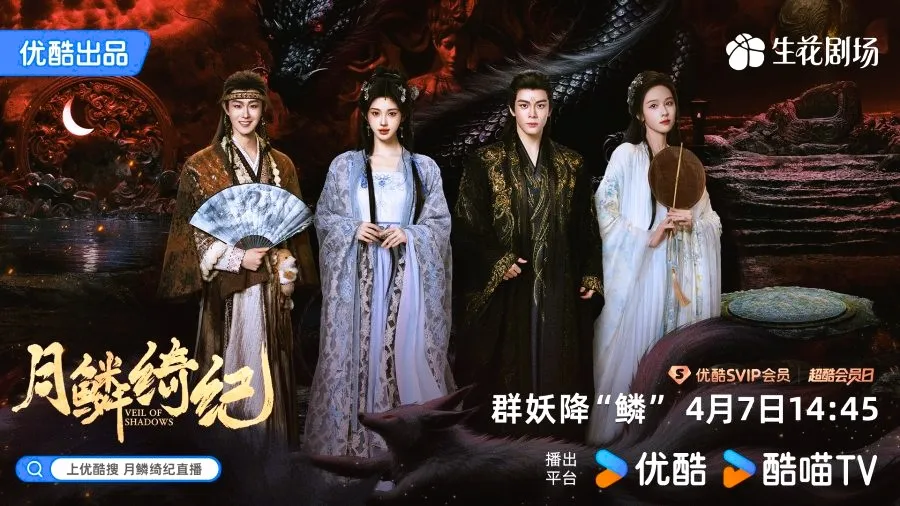
Veil of Shadows Poster - Courtesy of Youku

|
DetailsRATING: (8/10)
NATIVE TITLE: 月鳞绮纪 – Yuè lín qǐ jì YEAR: 2026 EPISODES: 29 DURATION: 45’ DIRECTOR: Guo Jing Ming SCREENWRITER: Guo Jing Ming |


IN A NUTSHELL
- What to expect: Veil of Shadows is a drama that immediately captivates, thanks to its fast pace and intense kung fu fights, but requires a certain amount of attention to be truly understood. It alternates moments of classic romance with more complex ones, often walking the line between what is clearly explained and what the viewer is asked to piece together for themselves. It is precisely this balance, along with a superb management of visual effects and an engaging portrayal of love stories, that makes it one of the most unmissable series in the panorama of modern xuanhaun.
- Strengths: the gripping plot, the solid and satisfying script, the direction and the spectacular visual effects.
- Weaknesses: the unconvincing acting of the cast, the ending too rushed.
- Recommended if you like: ensemble dramas with two pairs of protagonists, xuanhuan with a strong romantic component, complex plots of intrigue, complex fight scenes, characters devoted to sacrifice.
- Would I rewatch it? Yes, I think it's among the best xuanhuan of recent years.
Read on to learn all the merits of this series.
Veil of Shadows is a fantasy tale that envelops and disorients, a weave of light and shadow in which the boundary between truth and illusion dissolves until it becomes part of the narrative itself. In this drama, there is a constant tension between the allure of the enigma and the concreteness of the facts, between the seduction of the image and the weight of fate, which takes the viewer on a journey as evocative as it is, at times, challenging.
In this review of the drama Veil of Shadows, after watching all episodes, I will analyze this dual nature, both magnetic and destabilizing, attempting to dismantle its complexity without losing the sense of magic it leaves behind.
Plot
Wu Shi Guang is an orphan who grew up in the village of the Flood Dragon clan.
Years after the destruction of his village, apparently ordered by the Dragon Deity, he travels to Luo'an with his lifelong friend, the weasel demon You Chi, and, posing as a demon hunter, attempts to infiltrate the Shilin Sect to carry out his plan for revenge against the Dragon Deity.
To gain entry to the sect, he joins the hunt for a powerful nine-tailed fox demon. During the mission, he meets Lu Wu Yi and Wu Wang Yan, two demon hunters who reveal themselves to be immortal foxes belonging to the mysterious Formless Moon Sect, and Ji Ling and Li Jie, skilled members of the Shilin Sect.
Through clashes, deceptions, and forced alliances, the bonds between the five grow ever deeper: Wu Shi Guang, in particular, grows closer to Wu Wang Yan, while an equally significant relationship develops between Lu Wu Yi and Ji Ling, despite all harboring secrets and ulterior motives.
The truth begins to emerge when they are sucked into the Illusion of the Starstone, an experience that forces them to relive fragments of the past, allowing them to piece together their history.
Wu Shi Guang thus discovers that he is the tenth son of the Dragon Deity Pan Gu, destined to succeed him as protector of the Earth and finally defeat the Demon Lord Jiu Ying, previously sealed away thanks to the sacrifice of his nine brothers.
With the help of his new allies, Wu Shi Guang manages to obtain the power of the Dragon Deity, but the final confrontation with Jiu Ying proves anything but simple: the battle puts at risk not only the fate of the world, but also everything he has built along the way, including his bond with Wu Wang Yan.
"Mortal couples bind strands of their hair together.
At first, I don’t understand what it meant, I only wanted a good omen.
But when I braided you hair together with mine, I realized that once hair strands are entwined, unless they break, they are almost impossible to part.
You and I are the same: we were fated to be entrangled a long time ago."

Review of the Chinese drama Veil of Shadows (No Spoiler)
Plot and Screenplay
Veil of Shadows is a fantasy drama whose ambitious story builds its strength on a multilayered narrative structure, capable of offering a view of the story from multiple perspectives.
Its plot appears as a dense, almost impenetrable web of lies and truths, a narrative labyrinth in which every certainty seems destined to be questioned and then reassembled in a different light. Yet, what is striking is precisely the solidity with which this complex system manages to hold itself together: the multiple subplots that emerge from the characters' memories, illusions, visions, and past events do not overlap chaotically, but rather end up fitting together with surprising precision, conveying a sense of order and coherence that is rare, especially in a drama of this complexity.
The worldbuilding, while gradually revealed through various narrative devices, manages to provide a complete and coherent picture, without ever generating a sense of confusion or gaps to be filled. Indeed, the screenplay almost seems to anticipate the viewer's doubts, offering timely answers and maintaining narrative continuity.
This clarity is also reflected in the handling of potentially problematic narrative structures, such as narrative arcs based on the protagonists' access to other people's memories. These structures, often associated with a certain verbosity, are here reworked in a balanced and functional manner. These segments contribute significantly to the construction of the narrative world, allowing for the conveyance of complex information without weighing down the narrative with overly didactic explanations. The result is a fluid narrative, in which each element is progressively recomposed within a coherent framework, providing a sense of satisfaction that is rare and difficult to find in similar works.
Overall, it seems like nothing is left to chance in this drama: every revelation finds its place and contributes to strengthening the story's structure, rather than generating confusion. The result is a story that manages to avoid the frequent logical flaws typical of xianxia and xuanhuan, offering a more engaging and satisfying viewing experience even compared to series with a seemingly simpler structure.
Characters and Love Stories
The dialogue in Veil of Shadows, while fully in keeping with the heroic and romantic tone typical of xianxia — one characterized by sacrifices for one's loved one and for humanity — never seem banal or overly rhetorical. On the contrary, many lines are almost poetic, with an ability to touch genuine emotional chords without ever slipping into the familiar, so much so that one rarely feels the need to hear stereotypes.
This feeling is reinforced by a character development that, despite relying on recognizable archetypes — the cunning and seductive fox demons, the benevolent and heroic dragon demons, the devoted attendants, the disciples willing to do anything to protect the weak and innocent, and, on the other hand, an antagonist devoid of any remorse or mercy — still manages to work within the world delineated by the screenplay. There's something reassuring about their familiarity, the fact that they move according to recognizable dynamics, even if the screenwriter occasionally plays with these expectations, making us believe they're about to deviate from that path only to then, with a certain coherence, bring them back to their true nature.
Even on the sentimental level, despite often moving towards markedly melodramatic tones — particularly in the relationship between Lu Wu Yi and Ji Ling — the drama manages to build bonds that are surprisingly engaging. There's an underlying tenderness to these bonds, something almost comforting in the way they develop and deepen over time, before the viewer's eyes, which allows the viewer to grow fond of the characters and empathize with them, despite the cast's obvious limitations. The direction plays a fundamental role in this process: it is precisely in the more intimate scenes that, in my opinion, one perceives greater care, with effective shots and a sense of the scene capable of enhancing the actors and guiding them towards a more convincing performance, at least partially compensating for an expressive range that is not always up to par.
Not everyone found the romantic component equally effective: some viewers noted how the heavily layered subplots and frequent scene changes ended up fragmenting the dynamics between the main couples, partially preventing them from fully enjoying the romantic scenes. The attention distributed across multiple characters and narrative arcs, rather than focusing on a single relationship, can actually be distracting for those seeking a central, overarching love story. For this reason, the drama may not be the ideal choice for those who prefer more linear narratives or those focused on a single couple, while it tends to work better with those who appreciate ensemble structures and the presence of multiple intertwined relationship dynamics.

Cast
In this sense, the cast of Veil of Shadows proves, predictably, to be the weakest link in the entire narrative: no actor truly stands out for his charisma or depth, yet, almost against all expectations, the story still manages to hold together thanks to a successful balance between an engaging plot, a script that's anything but predictable, and solid direction that makes up for the acting shortcomings.
Ju Jing Yi maintains her recognizable style, featuring affected and childish acting that often proves irritating, but which, in this case, ends up not entirely out of place in her portrayal of the naive and mischievous fox demon Lu Wu Yi.
I continue to have a love-hate relationship with Chen Du Ling: there is always something about her that doesn't completely convince me, as if she lacked that expressive spark capable of truly bringing the scene to life, but here I found her more at ease in the role of the seductress (compared to her roles in dramas like The Glory or Till the End of the Moon) and, something I didn't expect, In her intimate scenes with Joseph Zeng, she seemed surprisingly natural, perhaps more so than in any of her other works.
He still doesn't win me over due to his limited expressive range, with his eyes constantly wide open or puckered in a sort of "puppy eyes" that he displays in the more emotional scenes. Yet I have to give him credit for managing to loosen up his co-star's rigidity in the couple scenes, making their intimate moments among the most believable in the entire drama.
Tian Jia Rui still seemed rather immature to me, but I can't help but appreciate his commitment, especially considering the difficulty of juggling five distinct roles, an undertaking that would have tested even more seasoned actors.
Wu Han, delightful as the weasel demon You Chi, brought a breath of genuine lightness, perfectly complementing the impassive Wu Shi Guang. Then there's a whole host of young faces, clearly cast more for visual impact than anything else, including Yan An, who is likely destined to leave a lasting impression on many female viewers.
And finally, there's Chang Hua Sen, a constant presence in recent dramas, who deserves a mention not so much for his acting chops as for the determination with which he continues to challenge himself, accepting supporting roles and building, step by step, a growth path that I hope will lead him to the goal he aspires to.
Visual Aspects and Soundtrack
Visually, Veil of Shadows stands out for its remarkable aesthetic precision and evident care in the composition of each scene, giving the impression of a deeply felt project. The use of refined shots, wind, and slow motion contribute to defining an immersive visual language, while the cold, desaturated color palette, combined with the filters, creates a dark atmosphere yet in keeping with the narrative. Even the lighting play a fundamental role in modulating the emotional tone of the sequences, precisely accompanying the sensations the scene seeks to convey.
This almost obsessive attention to aesthetics, however, was not perceived equally by everyone: some viewers considered it excessive, going so far as to compare the drama to a long music video, visually captivating but at times too focused on the image and showcasing the performers. This observation is partly understandable, especially in those sequences where the visuals seem to take precedence over the narrative pace. At the same time, however, it's difficult not to consider how this choice is perfectly consistent with the nature of the project: Veil of Shadows is a fantasy drama, a genre in which the aesthetic component is not a mere ornament but an integral part of the story, and it also falls into the category of idol dramas, where fan service—that is, the desire to maximize the stage presence of the actors, often C-pop idols—is a central element of the experience. Precisely for this reason, the series may not be suitable for those who don't like idol dramas and prefer more realistic historical dramas, while it tends to work better with those who appreciate a more videogame-like type of visual language.
In this context, a particularly distinctive directorial choice comes into play, aiming to convey emotions through close-up frontal shots during dialogue, so as to capture every minimal expressive variation. This is a surprisingly effective solution, but also inherently risky, as it depends heavily on the balance between acting, lighting, and visual construction.
The visuals are also supported by well-crafted and integrated digital effects, which maintain the narrative's credibility without breaking immersion, as well as carefully crafted and evocative interior and exterior settings. Although limited in variety, they are consistent with the drama's fantastical structure and capable of conveying a sense of authenticity.
Even the action sequences, although sometimes long and complex, are fully integrated into this aesthetic design, proving to be visually satisfying and a key element of the overall narrative experience.
I cannot praise Huang Wei's costumes enough, as they are undoubtedly one of the most successful and visually satisfying elements of the entire drama. There's something sumptuously fairytale-like about the way each dress is conceived, a refinement of materials and lines that distinguishes the designer's style and contributes decisively not only to the characterization of the characters but also to the construction of the overall atmosphere. Each costume seems to speak the language of the narrative world, amplifying its allure and making it even more immersive. In this sense, I found the dresses worn by Chen Du Ling and Tian Jia Rui particularly captivating, as they manage to combine opulence and stage presence in a truly memorable way.
The makeup and hairstyling follow the same lines, the latter featuring elaborate yet refined accessories, capable of enhancing both the female and male characters without ever being excessive but rather contributing to the rich and harmonious aesthetic that defines the drama's visual identity.
The soundtrack of Veil of Shadows imposes itself as a constant and strongly identifying presence within the narrative, used with precision to accompany and punctuate every change in tone. The music, in fact, intervenes promptly to underline both the most dramatic and tense moments as well as the romantic and passionate ones, emphasizing the key passages of the scene and making the enjoyment of the drama extremely engaging and immediate.
Sonically, the musical dimension displays appreciable variety, moving effortlessly between very different registers: from the slow and melancholic atmospheres of 雾时光 (Misty Hours), to the more epic and evocative ones of 月之纪 (Chronicles of the Moon) and 花鳞 (Flower Scales), up to the lighter and more carefree tones of 一千一万朵 (Countless Blossoms).
This richness is also reflected in the orchestration, which alternates traditional Chinese instruments with more typically Western solutions, and in the vocal interpretations, where powerful and incisive timbres coexist alongside more delicate and introspective voices. In this sense, Liu Yu Ning stands out in particular, who, unlike what happened in Love Beyond the Grave, manages to find a more convincing balance here, offering a slow and romantic interpretation once again but characterised by a greater personality both in rhythm and execution.

WARNING!
FROM THIS POINT ON THE SPOILER SECTION BEGINS. DO NOT CONTINUE IF YOU DO NOT WANT TO KNOW ALL THE DETAILS OF THE DRAMA.
Review of the Chinese drama Veil of Shadows (Spoiler)
What Works
Sreenplay
One of the aspects I most appreciated in Veil of Shadows is undoubtedly the clarity of the plot, a quality that's far from obvious in a drama that moves along such complex narrative lines. The worldbuilding is solid and well-structured, and even though it's revealed gradually through memories, dialogue, visions, and flashbacks — with some more classic explanations here and there — it still manages to paint a surprisingly complete picture of the story.
I never felt like I'd missed a step or needed to fill in gaps, which happens all too often in productions of this kind. On the contrary, here the script almost seems to anticipate the viewer's doubts: every time that natural "why?" surfaces, it doesn't take long before the story itself takes charge of providing an answer, whether entrusted to a dialogue, a memory, or a vision. This approach, while at times risking being overly explanatory, avoids that annoying feeling of incompleteness or internal inconsistency that often plagues fantasy dramas, allowing even the most complex developments to be followed with a truly satisfying sense of continuity and coherence.
In this sense, the clarity of the plot is further confirmed by the management of narrative arcs based on the protagonists' access to other people's memories. After watching several xianxia, I'm rather prejudiced against this solution: too often, it tends to be wordy and serves more to artificially extend the drama's duration than to truly clarify events. In Veil of Shadows, however, this structure is handled with great balance and awareness, proving not only well-crafted but also essential to the completion of the worldbuilding. Through these segments, the narrative manages to convey complex information while avoiding excessive use of long flashbacks or didactic explanations, while maintaining a good flow. There's evident care in the way information is distributed and reassembled, so much so that ultimately it conveys a rare sense of coherence and satisfaction.
The Starstone Illusion story arc is the most striking example of this: despite being structured across three distinct timelines — that of Di Zhu and Man Man, which took place a thousand years earlier; that of Yuan Xizai and Yuan Wuhuo, which took place a hundred and fifty years earlier; and that of Qing Yi and Cang Hao, which unfolded a century before the main events — it still manages to offer a coherent and perfectly consecutive reconstruction of events. Events are precisely linked, leaving no unresolved elements, and providing precise answers to the questions raised throughout the viewing. A similar mechanism can be found in Su Jian's painting illusion, when Wu Wang Yan realizes that words he thought he was addressing to Lu Wu Yi actually belonged to Su Jian. This revelation retroactively redefines what had previously been shown about Wu Wang Yan's experience, ultimately engaging the viewer, who realizes they have been led along the same illusion. The choice to narrate Wu Shi Guang's birth through fragments of Chi Wei's memory, which resurface each time he absorbs a portion of the Dragon Deity's power, also demonstrates a certain narrative intelligence: rather than burdening the story with frontal explanations or endless flashbacks, it transforms the exposition into a more dynamic and immersive experience, capable of maintaining attention while fulfilling a predominantly explanatory function.
It is precisely in light of this careful and layered construction that it becomes even more evident how, in Veil of Shadows, nothing seems truly left to chance: each revelation finds its place within a larger plan and, rather than generating confusion, contributes to strengthening the overall structure. It is plausible that part of this effectiveness derives from the fact that the director and screenwriter are the same: it almost feels as if the entire architecture of the story was already clear from the beginning, as if the staging were nothing more than the natural extension of an already perfectly defined idea, then coherently transferred to the screen. Precisely for this reason, it is natural to wonder how much more engaging watching many series would be if such cohesion were more frequent, considering how much it manages to raise the level of the narrative and avoid those logical flaws that often emerge even in productions with a much more linear structure.

Visual Aspects
Veil of Shadows immediately strikes with its spectacular aesthetic and the meticulous care with which each scene appears to have been conceived and composed. It's difficult to determine how much of an impact the director's screenwriting has on this, but the feeling is that of being in front of a work in which form and content are one a continuation of the other. The refined framing, the use of wind, and slow motion contribute to building a recognizable visual imagery, while the palette of cold, desaturated colors, along with the filters, perfectly complements the fantastical atmosphere of the story, making it dark and mysterious at the right point without ever weighing it down. Even the strategically placed blurs help modulate the tone of the scenes, evoking anxiety, melancholy, or nostalgia at times, while the lighting—both in color and positioning—precisely accompanies the feelings, reinforcing the impact of each sequence.
This context also includes the directorial choice to convey emotions through a distinctive visual language, surprisingly effective yet somewhat risky: during dialogue, the camera often lingers on frontal shots of the actor speaking, as if to capture and amplify every minimal change in expression. It's a solution that works thanks to a well-calibrated balance between lighting, filters, and acting, elements precisely orchestrated within the scene, but which, precisely because of its simplicity, remains intrinsically bold: if even one of these factors is missing, or the rhythm of the exchange is prolonged or intensified, the effect slips into an almost mechanical dynamic, similar to a visual tennis match, with inevitable repercussions on the viewer's emotional engagement.
Further supporting the aesthetic success is surprisingly solid CGI: fantastical settings, spells, and magical weapons are believable and well-integrated, with a level of simulation that never completely betrays their artificial nature, maintaining the charm of the world depicted. The settings, though limited, are meticulously crafted and evocative: the interiors fit perfectly into the epic fantasy world of the xuanhuan, while the exteriors, often digitally reconstructed, still manage to convey a sense of realism. Unlike in Love Beyond the Grave, here the cities and backlots appear lived-in, concrete, and not simply artificial sets.
Even the fight scenes, which, especially in the early episodes, can be long and drawn-out, end up proving to be a fundamental part of the drama's language, on a par with the romantic sequences. Their choreography and visual rendering make them extremely satisfying, fully justifying their running time. Emblematic in this sense is the underwater fight between Yuan Wuhuo and Li Jie, a rare sequence in dramas, handled with remarkable skill both in the framing—which avoids revealing the presence of actor Yan An's stunt double—and in the choreography, maintaining the tension and elegance of the fight even in such a complex context.
And then there's that touch of aesthetic generosity that doesn't go unnoticed: it's hard not to notice how director Guo Jing Ming seems to have given particular attention to the female audience, casually inserting a series of scenes in which the more handsome male characters find themselves, for sometimes ridiculous reasons, shirtless. Of course, the director tries to find a narrative explanation—the rebirth of Yuan Wuhuo and Li Jie from the butterfly demon's cocoon, Wu Shi Guang's application of a patch to hide the demonic symbol on his chest, Mo Yuntan's explosion of power in the final battle against Jiu Ying—but the suspicion that this is a choice made to please the audience is hard to ignore. The result is a series of moments that oscillate between visual gratification and an almost involuntary irony, helping to define a complex aesthetic that, while taking itself very seriously, occasionally seems to allow for a decidedly flirtatious, albeit appreciable, wink.

What Doesn't Work
Cast
The cast of Veil of Shadows proves to be the weakest link in the entire narrative, not so much due to individual, less-than-stellar performances, but rather to a general lack of acting incisiveness, which prevents the characters from acquiring the emotional depth that the writing would otherwise require.
What emerges is an acting style often anchored to predictable registers or limited expressive solutions, which ultimately flatten the nuances of the roles. On the one hand, there are those, like Ju Jing Yi, who take refuge in deliberately affected facial expressions and tone, which in some cases even manage to find a certain coherence with the character, but which overall come across as repetitive and unnatural; on the other, there are those who display a more controlled stage presence but lack the spark that truly brings the performance to life, like Chen Du Ling and Joseph Zang. Even in cases where there's room for improvement—for example, in roles more suited to the actors' abilities or in better-constructed relational dynamics—the feeling is that the result depends more on context than on a true mastery of the expressive means. Even in moments of greater emotional intensity, a certain rigidity emerges, often due to recurring and unvaried expressiveness, which limits engagement.
A partial exception is the handling of the couple scenes, where the interaction between the actors sometimes manages to compensate for individual weaknesses, producing more believable and spontaneous moments. However, even this isn't enough to completely fill a fundamental gap: that of a cast that, despite being supported by attentive direction and a solid narrative structure, struggles to establish itself as the true emotional engine of the story.
Ending
Despite the remarkable clarity that characterizes much of the narrative, the ending of Veil of Shadows introduces a sudden change of direction, becoming suddenly more confusing and fragmented, almost as if the coherence built up to that point were sacrificed in the face of the need to compress and accelerate the concluding developments following the forced reduction in the number of episodes. The result is a sequence of events that, while maintaining a strong emotional charge, raises a considerable number of questions that are difficult to decipher without the support of the same script that until this point had been guiding the viewer with precision.
For example, if, upon giving his dragon scale to Lu Wu Yi, Ji Ling dies and vanishes like all demons, how is it possible that Li Jie manages to find his heart stone containing his memories? And, if Chi Wei has also disappeared, where does the fragment of his power still present on Earth come from, which should allow the stone to be cultivated? Even more problematic is the logical scaling down of the Dragon Deity's Power: what until a few episodes earlier was presented as supreme strength, in episode 28 proves insufficient to defeat Jiu Ying, requiring the intervention of Ji Ling, who, after dying and then being resurrected, mysteriously remains in possession of the Spirit Sealing Ring. Xie Ling Xi's return from the Illusion of the Starstone, then, remains equally ambiguous: resurrection, residual manifestation of power, or simple projection?
But it is above all the handling of the epilogue that leaves one perplexed: the alteration of the past, with the killing of the Fox Queen/Jiu Ying and the "kidnapping" of Lu Wu Yi by Ji Ling fifty years before the main events, redefines the present in an unclear way. If the events experienced by the protagonists never happened — as suggested by the fact that Wu Wang Yan and Wu Shi Guang do not know each other — how then can we explain the discovery of the latter's identity as the Tenth Dragon Son and his ascension to Dragon Deity? And again: how did he recover the fragments of the Dragon Deity's power from the four demons — Bai Ze, Xiaowei, Wu Zhiqi, and Han Ba — and take control of the Shilin Sect? How did the sect's disciples handle Ji Ling's disappearance until Wu Shi Guang's arrival? And, above all, who collected the fragments of Jiu Ying's consciousness scattered throughout various living beings, a crucial element that had previously ensured his cyclical survival? The fact that only Wu Shi Guang seems to retain memory of the previous timeline further accentuates the sense of a conclusion that, while satisfying, ends up partially undermining that satisfying sense of internal coherence that until that point had represented one of the drama's most evident strengths.

Characters and Cast
Primary Characters
Lu Wu Yi/Yu Wei/Di Zhu/A’Wu (Ju Jing Yi) immortal nine-tailed fox demon belonging to the Formless Moon Sect. She is one of the seven guardians of the Oracle Stone and the Sacred Spring that, according to legend, was used by the goddess Nuwa to shape humans. Her surname refers to dew (露, lù). She is tasked by the Fox Queens with finding Xiaowei, a fox demon accused of feeding on human flesh, thus violating the sect's laws. In reality, she is a demon created by Jiu Ying fifty years earlier using body parts of the immortal foxes killed by Xie Ling Xi during the Flood Dragon Clan massacre. In the Starstone Illusion arc, she is Di Zhu, daughter of the Local Indigenous Chief of the Aodeng Tribe. Her hand is highly coveted because her father left her the Starstone as a dowry, the meteorite fragment found by the Aodeng after the meteor shower that put an end to the serious epidemic that had broken out in the village.
Wu Wang Yan/Qing Yi (Chen Du Ling) thousand-year-old immortal nine-tailed fox demon belonging to the Formless Moon Sect. She is one of the seven guardians of the Oracle Stone and the Sacred Spring of the Formless Moon Palace. She is tasked, along with her sister Lu Wu Yi, with finding Xiaowei, a fox demon accused of feeding on human flesh, thus violating the sect's laws. In the Starstone Illusion arc, Qing Yi is the wife of the leader of the Flood Dragon Clan and adoptive mother of Wu Shi Guang.
Wu Shi Guang/Cang Hao (Joseph Zang) wandering demon hunter who seeks to kill the Dragon Deity because he holds him responsible for the massacre in his village fifty years earlier. He is actually the Tenth Son of the Dragon, born from the union of the inverse scales of Pan Gu's nine sons, given by his brothers before the clash with Jiu Ying. His task is to absorb the fragments of power left by Chi Wei into the four demons he has chosen to transform into the Dragon Deity and finally eliminate Jiu Ying. In the Starstone Illusion arc, he is Cang Hao, leader of the Flood Dragon Clan and adoptive father of Wu Shi Guang himself.
You Chi (Wu Han) weasel demon and childhood friend of Wu Shi Guang. His father had taken Shi Guang in after he escaped the extermination of the Flood Dragon Clan, and the two became close friends. Together they left the Weasel Demon Clan to become demon hunters and attempt to gain admission into the Shilin Sect to kill the Dragon Deity.
Chi Wen/Ji Ling/Ji Can/Man Man/A'Ji (Tian Jia Rui) Dragon Deity, last descendant of the dragon clan, leader of the Shilin Sect, and Lu Wu Yi's "fated one". In reality, he is a red fox rescued by the true Dragon Deity Chi Wen (Wang Duo) at Lake Yumian and tasked with impersonating him until the Tenth Dragon Son awakens. To see the world outside the Shilin Sect without risking death, he transfers part of his consciousness and his Spirit-Binding Ring to a puppet, with whom Lu Wu Yi later falls in love. To become the Dragon Deity, he received a dragon scale from Chi Wen, which, feeding on his loneliness, gave birth to Ji Can, a demon with the power to travel back in time (the Rewind of Sun and Moon). In the Starstone Illusion arc, he is Man Man, a high-ranking Green Ape demon who, in league with Wu Zhiqi, seduces Di Zhu to steal the Starstone from her, causing the extermination of the Aodeng Tribe.
Li Jie/Yuan Xizai (Yan An) commander of the Shilin Sect's demon hunters and attendant of the Dragon Deity. He is a mortal with no memories who appeared ten years earlier at the gates of the Shilin Sect. When the Dragon Deity welcomes him, he tasks him with extracting the demonic sword embedded in Mount Nandang's rocks to use as a weapon during his missions. In reality, he is one of the two obsessions of the late Shilin Sect commander, Yuan Wuhuo, who took human form when the six-eyed butterfly demon fused with his body and who wants to protect Ji Ling at all costs. In the Starstone Illusion arc, he is Yuan Xizai, a demon hunter of the Shilin Sect and the late brother of Commander Yuan Wuhuo.
Supporting Characters
Xiaowei's Story Arc
Bing Xiaowei/Liu Wei Xue/Lady Wei (Zhong Ling Er | Xia Zhi Guang) immortal nine-tailed fox demon belonging to the Formless Moon Sect. In search of her savior, Wang Sheng, she ventured into the mortal world and apparently consumed human flesh to maintain her human appearance. For this reason, she is hunted by the Formless Moon Sect and the demon hunters of the Shilin Sect, and to hide her demonic aura, she decided to cut off her Spirit Tail, losing her sense of smell. In an attempt to find Wang Sheng, she first impersonates Lady Wei, the priestess of the Weimiao Pavilion, famous for its love talismans, and later Liu Wei Xue, Wei Qing's idle cousin. Her power is the Fox's Call.
Wei Qing (Zuo Chen Yi) head of the Wei weaver family of Luo'an and the fiancé of Yu Sheng Wei. To make Yu Sheng Wei fall in love with him, he gives her a love talisman from the Weimiao Pavilion imbued with Xiaowei's seductive power.
Yu Sheng Wei/Wang Sheng (Rao Jia Di) daughter of the Yu family of Luo'an, a famous embroiderer and Wei Qing's betrothed. She is the reincarnation of Wang Sheng, Xiaowei's savior.
Luo Wei (Gao Jia Yan) housekeeper of the Wei Mansion. She is an orphan rescued by Yu Sheng Wei from a life of hardship in the Old City and recommended as an administrator at the Wei Mansion. Out of gratitude to her savior, she agrees to work with Liu Wei Xue to break the love talisman's spell by seducing Wei Qing. In the end, however, so as not to have to give up her new life of comfort, she kills Yu Sheng Wei.
Yuan Wuhuo (Yan An) six-eyed butterfly demon, accomplice of Jiu Ying. Using half of the Spirit-Storing Jade, he created the Spirit-Storing Butterfly, an artifact that can absorb the power of the Dragon Deity. Using the divination technique of the Heavenly Sticks, he helps Xiaowei find Wang Sheng and gives Wu Zhiqi the Starstone to push them to self-destruct and absorb the power of the Dragon Deity. In reality, it is one of the two obsessions of the late commander of the Shilin Sect, Yuan Wuhuo, who took human form when the butterfly demon fused with his body and who wants to free Ji Ling from her burdensome mission at all costs.
Wu Zhiqi and the Starstone Illusion Story Arc
Jiu Ying/Fox Queen (Jiang Yi Yan) Lord of Demons. His story begins with the arrival of the Starstone on Earth: it was the power of the Stone that hatched his egg and nourished him until he began to cultivate, absorbing the desperation of the people. For this reason, he sparked a bloody war between mortals and demons and sought to use the Starstone as a weapon to further the devastation. Eventually, his nine heads were imprisoned by the power of the nine sons of the Dragon Deity Pan Gu, who transformed themselves into mountains to seal him away. However, his spirit split into fragments that the demon scattered among mortals. One of those fragments ended up in the Oracle Stone of the Formless Moon Sect; one in the body of the Fox Queen; one in Li Wu Yi; one in Wu Shi Guang; and one in the portion of the Starstone possessed by Wu Zhiqi.
Wu Zhiqi (Omid) high-ranking Green Ape demon who lent part of his power, the Wrathful Sandstorm, to Ji Ling, but then took it back to force Yuan Wuhuo to give him the Starstone. A thousand years earlier, he had pushed Man Man to steal the Starstone to cure his younger brother A'Yuan, unleashing the hurricane that destroyed the Aodeng Tribe. He later caused the Starstone to explode, sickening his tribe, and then petrified them with a spell taught to him by Tian Di while waiting for a cure. Finally, to free their souls, he set out again to find the Starstone, but his desire was exploited by Yuan Wuhuo to trap Ji Ling and her companions in the Starstone Illusion.
Tian Di/Xie Ling Xi (Liu Yu | Fan Shi Qi) human form of the Starstone. He is imprisoned in a cave by Wu Zhiqi to be used as a weapon to exterminate mortals and avenge his younger brother's death. Following his escape and encounter with Chi Wen, he assumes the identity of Xie Ling Xi, known as the demonic monk and later master of Wu Shi Guang.
Ao Erlie (He Qiang) chieftain of the Aoden Tribe and father of Di Zhi.
You Guai (Li Bin) You Chi's father, who took in Wu Shi Guang after he escaped the extermination of the Flood Dragon Clan. He sacrifices his life fighting a fragment of Jiu Ying's spirit to allow Shi Guang and his companions to escape the Starstone Illusion.
Han Ba's Story Arc
Han Ba/Yan Bi (Chang Hua Sen) high-ranking drought demon who lent part of his power to Ji Ling, but then had to take it back to contain his devastating power. Whenever he opens his mouth or his body is damaged, his power is released, causing severe drought. For this reason, he lived in solitude for centuries inside a tree. However, when he emerged from hiding, he fell in love with Su Jian, and his feelings were exploited by Jiu Ying to bring devastation to Luo'an. To save his beloved's life, he damaged his meridians, but Chi Wen healed him by giving him part of his power in exchange for the demonic power of the Searing Flames.
Su Jian (Jin Jing) girl from Luo'an who falls in love with Han Ba at first sight and tries everything to make him speak. At Jiu Ying's instigation, Wu Wang Yan puts her into a coma and convinces Han Ba that the only way to wake her is to talk to her. Using this ploy, Han Ba releases his power, causing a severe drought in Luo'an. This calamity results in the death of Su Jian's mother and serious injury to the girl. To save her, Han Ba decides to give her his demonic power, seriously damaging his meridians. After being stripped of her memories, she marries her fiancé Cui Jun.
Mu Long (Jin Jing) Su Jian's great-granddaughter, she lives with her great-grandmother in Luo'an. She is a very shy girl, and after Su Jian's death, Han Ba introduces himself to her under the new identity of Yan Bi and helps her collect stories to help her overcome her stuttering and make friends. You Chi falls in love with her.
Shilin Sect
Bai Ze (Wu Zheng Rong) high-ranking demon known as the All-Seeing One who collaborates with the Shilin Sect and lends part of his power to Ji Ling, allowing him to use his Eastern Purple Lightning.
Mo Yuntan (Chen Ruo Xuan) Qisha hunter of the Southern Dipper. He is one of the four double-flower demon hunters (the most powerful hunters) of the Shilin Sect and is sent to help the puppet Ji Ling and Li Jie hunt down Bing Xiaowei. His weapon is the Spirit Brush.
Si Feng (Jiang Zhen Yu) greedy wolf demon hunter of the Northern Dipper. She is one of the four double-flower demon hunters of the Shilin Sect and is also a friend of Wu Wang Yan.
Hua Qi (Zhou Lingxu) Tiantong hunter of the Southern Dipper. He is one of the four double-flower demon hunters of the Shilin Sect and is one of the assistants Bai Ze assigns to You Chi to save Wu Shi Guang from the Starstone Illusion.
Jin Zheng (Gao Zi Tian) Pojun hunter of the Northern Dipper. He is one of the four double-flower demon hunters of the Shilin Sect and is one of the assistants Bai Ze assigns to You Chi to save Wu Shi Guang from the Starstone Illusion. His weapon is the Golden Resonance.
Ye Dao Xuan, first attendant of the Dragon Deity who served both Chi Wen and Ji Ling.
Ye Chang Sheng (Zhang Shi An) attendant of the Dragon Deity and grandson of Ye Dao Xuan in the service of Ji Ling.

Favorite Character: Ji Ling
He is one of the brightest and most tragic characters in Veil of Shadows, a figure defined by a profound goodness that permeates every phase of his existence.
Generous, altruistic, and intrinsically inclined to goodness, he immediately shows his true nature when, still a small, blind red fox, he uses the power granted to him by Chi Wen to help the humans struck by the explosion of the Starstone, spontaneously choosing to put others before himself.
This same disposition remains unchanged even after the most difficult trials: despite the long imprisonment inflicted on him by Yuan Wuhuo in the secret chamber of the Shilin Sect, he bears no grudge and, on the contrary, even goes so far as to sacrifice himself for him, absorbing Chi Wen's dragon scale and accepting the burdensome destiny of succeeding him as Dragon Deity.
From that moment, his life changes radically: forced into hiding and living in the shadows for years, he renounces the lightness of his original nature to fulfill a grueling mission: to absorb the evil power of the spirit fragments scattered among mortals by the Demon Lord Jiu Ying.
The loneliness and weight of this responsibility slowly corrupt the dragon scale within him, transforming it into a dark presence that threatens to trap him forever.
Yet, even on this occasion, he does not lose his humanity: for years, he is content to observe the world through a puppet animated by his own conscience, renouncing an authentic existence. Even when Lu Wu Yi falls in love with that effigy, he chooses to reject it, once again putting duty before his own feelings.
When he finally decides to accept that love, he is faced with a further test: the discovery that Lu Wu Yi was created by the Demon Lord to deceive him.
Despite this, the feelings between the two remain sincere, but their relationship is marked by a cruel destiny, one of sacrifice and renunciation. Ji Ling accepts the prospect of dying to save humanity and, at the same time, the prospect of losing the woman he loves, destined to vanish with Jiu Ying's defeat. In an attempt to protect her, he even gives her his dragon scale, condemning himself to dissolution.
Even after his resurrection, his story knows no respite: the choice to remain forever trapped in the Illusion of the Starstone, even alongside Lu Wu Yi, represents the final act in a journey marked by continuous sacrifices.
Ji Ling thus remains the emblem of a silent and unwavering goodness, a character whose life, transformed by his encounter with the Dragon Deity, has been entirely devoted to others, even at the cost of his own happiness.
Un-Favorite Character: Yuan Wuhuo
He is one of those characters who, despite formally being among the "good guys," leaves behind a trail of questionable choices and painful consequences, revealing a deeply ambiguous side.
From a young age, he demonstrated a tendency to force the fate of others in the name of a distorted idea of protection: the decision to administer dragon marrow to his frail and blind little brother Xizai to make him stronger, despite knowing it could kill him, appears as an act of selfishness disguised as love.
After their parents' death, he insists on dragging him down his own path, pushing him to become a demon hunter for the Shilin Sect, as if the only way to save him was to mold him in his own image.
The tragedy that follows the explosion of the Starstone, with Xizai's death, translates into a blind desire to revive his brother. Thus the generous Ji Ling becomes the target of his frustration: unable to save Xizai, having exhausted all the power Chi Wen had bestowed upon him, he is imprisoned for years in the Shilin Sect's secret chamber, punished for a crime not his own.
The situation becomes even more disturbing when he reacts with increasing ferocity to Ji Ling's bond with the puppet that once belonged to Xizai, coming to see it as a personal affront that the little fox, once evolved, takes on Xizai's appearance.
Yet, even in this rigidity, his contradictions are evident: Ji Ling's sweetness and innocence eventually crack his armor, completely winning him over when the little demon sacrifices himself for him, absorbing Chi Wen's dragon scale and accepting a fate that was not his.
But even this isn't enough to completely redeem him, because the consequences of his actions extend beyond his own death. The six-eyed butterfly demon, possessing his body, gives concrete form to two of his most morbid obsessions: on the one hand, the desire to protect Ji Ling at all costs, embodied by Li Jie, a devoted attendant of the Dragon Deity; on the other, the desire to free him from his burden, which takes the form of the demon Yuan Wuhuo, determined to sabotage Chi Wen's plans, endangering Ji Ling's own life.
Even when the Yuan Wuhuo part of this obsession seems to dissolve, what remains is not a peaceful figure: Li Jie retains a clear resentment towards Wu Shi Guang, guilty in his eyes of having taken Ji Ling's place, which drives him to refuse to recognize him as the new Dragon Deity.
Only the rewriting of the ending seems to alleviate this tension, but it's not enough to erase the overall impression of a character marked by impulsive choices, incapable of managing his own pain without turning it into something destructive.
Yuan Wuhuo thus remains a deeply contradictory figure, in whom love and protection are constantly confused with control and obsession.
RECOMMENDED:
- TILL THE END OF THE MOON
- BACK FROM THE BRINK
- MOONLIT REUNION
- WHEN DESTINY BRINGS THE DEMON
- LOVE BEYOND THE GRAVE
Thanks for reading this far!
I hope you enjoyed my article. If you like my work and want to support me, buy me a coffee ☕