
Echoes of the Self (2025): What Remains of Love When You’re at War with Yourself? | Cast & Explanation of the Ending
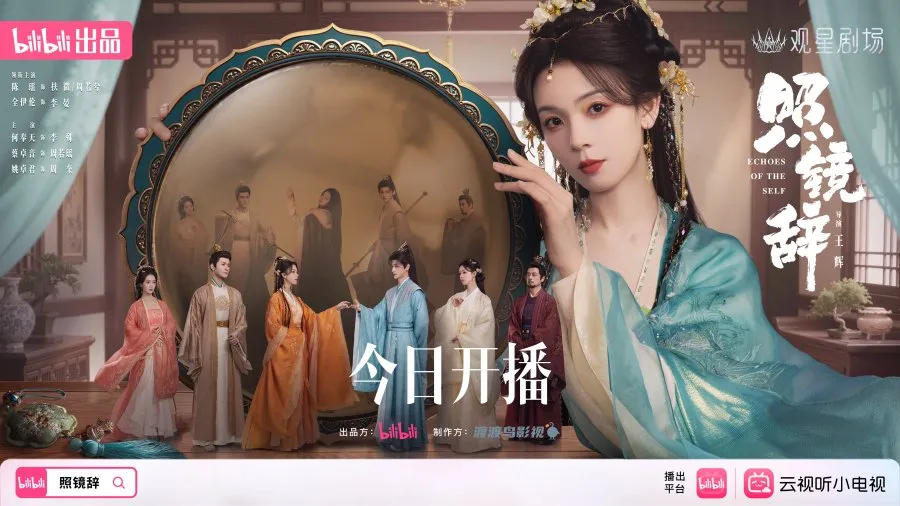
Echoes of the Self Poster - Courtesy of bilibili

|
DetailsRATING: (7/10)
NATIVE TITLE: 照镜辞 – Zhào jìng cí YEAR: 2025 EPISODES: 22 DURATION: 20’ DIRECTOR: Wang Hui SCREENWRITER: Cao Rusha RESPECTED CLICHÉS: 1 - 4 - 5 - 8 - 9 - 11 - 13 |


IN A NUTSHELL
- What to expect: Echoes of the Self is a short drama where court intrigue, revenge, and rebirth intertwine with a reflection on identity and second chances. With its unstable yet fascinating balance of introspection, political conspiracies, and a tragic and passionate love story, the series blends diverse influences into a compact yet layered narrative. The result is a fast-paced, emotionally charged tale that reveals a clear narrative ambition: despite operating within the constraints of a short format, the drama stands out for the strength of its ideas and its ability to engage from the start.
- Strengths: the engaging plot, the excellent cast, the tender and passionate ML.
- Weaknesses: the indecisiveness in love of the protagonists, the flaws in the direction, the half-backed ending.
- Recommended if you like: Quan Yi Lun and Chen Yao, dramas of rebirth and transmigration, tormented but passionate love stories, solid and layered conspiracy plots.
- Would I rewatch it? Yes.
Read on to find out why you shouldn’t miss this drama.
What would you do if you had the chance to live a second life and correct your mistakes? This is the question posed by the drama Echoes of the Self, a story in which life isn't a one-way street, but a cycle that can — and must — be rewritten. Chen Yao plays Zhou Ruo Xi, a woman who chooses ambition over love but, at the height of power, falls prey to her own greed. Quan Yi Lun plays Li Yan, the man who loves her enough to risk everything to save her.
In this review of the drama Echoes of the Self, after I watched all episodes, I'll try to explain how this short series stands out from the others and why it's truly worth watching.
Plot
Following her mother's murder, Zhou Ruo Xi vows revenge and does everything she can to obtain the title of Empress and have the members of her clan implicated in her beloved mother's death condemned.
The girl is unaware that her rise to power was actually engineered by Emperor Li Shi, who plans to use her to purge the court of corruption and then accuses her of high treason and has her executed.
Unexpectedly, after her tragic end, Zhou Ruo Xi is reborn in a time before the dramatic events that led to her death, and resolves to do everything she can to try to change her fate.
She then assumes the identity of Princess Fu Wei, an envoy from Daqian who is in Yunrui for a marriage alliance, and desperately tries to save her mother, introducing herself to the Zhou residence as the woman's niece. Here she reunites with her devious family, her past self, and Li Yan, the thirteenth prince and general of Yunrui, her lost love.
As she struggles to convince young Rou Xi not to repeat her mistakes and her lover not to fall for her again, she confronts the ghosts of her past to avenge her mother's death and foil a conspiracy that could subvert the established order of Yunrui.
Helping her on her mission are the devoted Li Yan, who renews his vows to her as memories of his previous life resurface, and Li Shi who, in this life, stands by her side.
After gathering clues, uncovering intrigues, and facing dangers, the three succeed in restoring peace to Yunrui, but they find themselves paying a very high price.

Echoes of the Self Drama Review (No Spoilers)
Plot and Screenplay
The plot of Echoes of the Self is highly engaging, even if it sometimes feels like it's trying to tackle too many themes at once: time travel, rebirth, and transmigration coexist in a plot that, while overall effective, is at times a bit difficult to follow. The drama condenses three different narrative genres — much-loved by audiences — into just 22 episodes, though they don't always blend seamlessly, sometimes leaving the viewer feeling disjointed. The underlying idea, however, is original and demonstrates a certain creative ambition that, even if imperfectly executed, is definitely worth watching.
The political intrigue subplot is undoubtedly one of the drama's focal points: alliances and court secrets intertwine with the protagonist's plans for revenge, creating a layered, intense, and tense narrative. However, the complexities surrounding the themes of rebirth and transmigration, combined with the series' inherent brevity, sometimes obscure the clarity of the exposition, exposing plot holes that the writers attempt to resolve with quick character explanations.
Although, in the initial phase, the power dynamics and relationships between the characters are somewhat unclear, almost sacrificed to leave more space for the protagonist's personal experiences and her tormented love story, in the final episodes, the political plot finds its balance: alliances are clarified, characters' motivations are more coherently defined, and the screen time dedicated to this part of the plot increases significantly, allowing the viewer to fully appreciate its complexity and narrative tension.
The result is a satisfying conclusion, which ties up the loose ends and restores a sense of completeness to the entire story, alleviating the feeling of elusive incompleteness that lingered in the story's initial stages.
Even the screenplay, despite some coherence flaws, is good: the jokes appear realistic and well-conceived and the dialogues convincing.
Characters and Love Story
The writing shines, especially in the characterization of the main characters. The reborn Zhou Ruo Xi is an excellent female figure: determined, mature, and intelligent, with the calm of someone who knows how to handle any situation. She proves shrewd and capable, and treats her younger self with patience and affection, despite the fact that the younger self repeatedly thwarts her plans, doesn't trust her, and often acts impulsively, doing the exact opposite of what she's advised. Li Yan is an equally fascinating figure: he's a skilled fighter, he's insightful, he's very protective of the FL, and Quan Yi Lun's acting makes him adorable.
With just 22 episodes, each about twenty minutes long, Echoes of the Self is a rather short series, which explains why some narrative elements haven't had a chance to fully develop. Among these, the love story between the protagonists stands out above all others, which appears more affirmed than actually constructed: we are told that there is a deep bond between them that is destined to overcome death, but the narrative dedicates little time to showing its birth or evolution, making it difficult for the viewer to perceive its emotional intensity and leaving the task of rendering the feeling believable to the skill of the actors.

Cast
From an acting standpoint, I have to commend the entire cast because they definitely did an excellent job.
Quan Yi Lun is among my favorite actors because he perfectly conveys the integrity and devotion of his characters (as he did in An Ancient Love Song and Youthful Glory). Furthermore, his calm performance and captivating smile captivated me from his first appearances, making him my favorite actor for romantic dramas.
Chen Yao certainly has a solid background (also demonstrated in Whispers of Fate), so much so that she was able to credibly play two roles that, despite representing the same person, display completely different personalities. It's a shame that the plot didn't allow her to show a little more affection for her co-star, making her performance a bit incomplete.
I found the acting of Yao Zhuo Jun, He Feng Tian, and Song Zong Xuan very intense and believable, but I'd like to particularly praise the performance of the young Li Kai Wen, whom I had already appreciated in Melody of Golden Age and who will surely have the opportunity to shine even brighter in the future.
Visual Aspects and Soundtrack
The fact that Echoes of the Self is a low-budget drama is clear from the start, but this is especially evident in its visual presentation.
The settings, sets, and visual effects, while functional, aren't always meticulously crafted and sometimes give the impression of having been hastily assembled, ultimately resulting in a fake appearance.
Directorially, there's an excessive use of close-ups during dialogue, which makes some scenes feel static and limits the visual depth of the narrative.
On the other hand, the costumes are surprisingly beautiful and sophisticated for a series of this type: elegant, well-made, and capable of giving the characters a remarkable presence.
Overall, therefore, I must admit that the technical limitations don't detract from the enjoyment of the final product: the drama still manages to be realistic and believable, a sign that the production has given the series a certain amount of attention, despite limited resources.
The soundtrack is also surprisingly good for a short drama, and among all of them, I particularly appreciated the main theme 繁华之上 (Above the Bustling World), performed by Jiu Yuan.

WARNING!
FROM THIS POINT ON THE SPOILER SECTION BEGINS. DO NOT CONTINUE IF YOU DO NOT WANT TO KNOW ALL THE DETAILS OF THE DRAMA.
Echoes of the Self Drama Review (Spoilers)
What Works
The Plot
While it's clear that the story encompasses more depth than the short format allows, and that it likely could have been fully expressed had it been presented in a standard format, Echoes of the Self is, overall, a surprisingly compelling watch, capable of leaving, upon completion, a sincere sense of satisfaction and fulfillment.
Despite the density of narrative elements — from time travel to rebirth to transmigration — the story still manages to engage thanks to a well-constructed subplot of political intrigue and rich in twists, most notably the revelation of the identity of the protagonist's father, Crown Prince of Daqing, who survived the uprising thirty years earlier and is now poised to reclaim power by usurping the throne of Yunrui with the secret support of his daughter.
The narrative choice of transforming the younger version of the protagonist into her most dangerous antagonist also plays a key role in maintaining the tension: in addition to having to avenge her mother's death and foil her father's rebellion, the protagonist finds herself fighting against someone she cannot harm, yet whose plans she must simultaneously distrust and thwart. It is precisely this dynamic that gives the story emotional momentum and makes the rebirth plot not only engaging but also unusually original, allowing the series to overcome, at least in part, the obvious limitations of a plot that is overly crowded with narrative devices.
What Doesn't Work
The Inconsistencies Related to the Rebirth
At first glance, Echoes of the Self is somewhat reminiscent of Si Jin due to its use of the theme of rebirth as a narrative fulcrum, but it is more convoluted than the latter because it chooses to insert the element of the protagonist's transmigration into the story. Ignoring the "basic" rules of time travel, in fact, the FL is not reborn in her own body, but rather in a strange hybrid form of a duplicate of herself, with a mortal body but devoid of vital parameters (a bit like what happens in the series Twisted Fate of Love). This decision inevitably opens up some logical flaws, which, however, unlike Twisted Fate of Love, are addressed with a certain lightheartedness by the screenwriter, who prefers not to provide explanations and trusts the viewer to suspend critical thinking and let themselves be carried away by the story. While on the one hand the approach works, on the other it causes the plot to lose some coherence.
The inconsistencies mainly concern the evolution of the female protagonist and her love story.
Although the first version of the FL — the Demon Empress — is not clearly presented to us, from the very first scenes she appears as a woman completely blinded by power, devoid of wisdom and emotion. Following the tragedy that marks the end of her life and that of her beloved, it is reasonable to imagine that she has undergone a profound transformation, yet the change she exhibits after her rebirth is sudden and inconsistent: in her final days as empress, in fact, she shows no sign of repentance or remorse, yet in her new life she suddenly becomes thoughtful and compassionate, almost as if she were a completely different person.
Even her intense relationship with Li Yan seems based on inconsistent premises. Their love is shown to us as a feeling capable of defying death and fate, but in her new life, the young Zhou Rou Xi clearly admits that she wants to exploit Li Yan only to gain his political support, which undermines the credibility of their bond even in the first story arc: how authentic could a love be that the FL had so easily put aside when she earned the chance to marry the Crown Prince?

The Love Story
The main love story is rather weak because it lacks any real emotional progression and seems largely to exist within the author's intentions. The series explains the evolution of the love between Zhou Ruo Xi and Li Yan only through brief flashbacks, ultimately offering us a very limited and partial view of the story.
Furthermore, after her rebirth, the protagonist, despite repeatedly showing remorse for rejecting Li Yan, remains constantly trapped in her past and guilt for having led her lover to his death in her previous life due to her thirst for power. This emotional burden makes her hesitant, unable to give in to her feelings, and the result is an unbalanced love story, where he appears sincerely and totally devoted, while she always maintains a certain distance, expressing her feelings in a lukewarm and measured manner. This approach is certainly consistent with the evolution of her character, but it ends up dampening the romantic tension that could have made their story so passionate.
Fortunately, Quan Yi Lun’s intense and affectionate performance adequately makes up for the female lead’s lack of enthusiasm, providing us with a love story that is still worth watching and that also gives us some beautiful moments such as the scene of Zhou Ruo Xi and Li Yan’s wedding night.
Interpretation of the Ending
The ending left me with some doubts that I tried, somehow, to resolve on my own. After having passionately followed the events of Zhou Rou Xi and Li Yan, their sudden death — which seems to reenact the one that occurred in their previous lives — and the final revelation — according to which the entire story is the product of her mind — seemed to undermine the internal coherence of the story. If everything we saw was truly a creation of the protagonist, and she did not actually journey within the novel (as happens in A Dream Within a Dream or The Journey of Legend), then how is it possible that, in modern reality, the two protagonists recognize each other and find each other as if they truly shared that past?
Personally, I filled in the narrative gaps by hypothesizing that FL was writing, in the form of a novel, her memories of a past life and that she had accidentally met her distant love in the modern world. However, the drama's visual presentation doesn't clearly suggest this (also because at the end, a figure appears from behind who bears a striking resemblance to Zhou Rou Xi, leading to the two protagonists' reunion).
So, the choice to conclude the drama with a happy ending, in which the two are reunited despite the tragedy that separated them in the fictional/past world, works on an emotional level but not on a logical one: the drama certainly intended to suggest that the love between Zhou Rou Xi and Li Yan transcends the confines of time and space, but the execution leaves the viewer feeling disoriented rather than fulfilled.

Characters and Cast
Primary Characters
Zhou Ruo Xi/Xi’er/Fu Wei (Chen Yao) Second Miss of the Zhou family and daughter of Wang Ruo Jin. In her first life, through deception, she manages to become the Empress of Yunrui and avenged her mother’s death by having the entire Zhou family sentenced to death. Her rise was, in reality, planned by the Emperor, who exploited her thirst for power to purge the court of corruption and then accused her of usurping the throne, sentencing her to death. In her second life, her future self tries to help her exact her revenge without participating in court intrigues, but she marries the Crown Prince anyway and, only at the end, helps the protagonists stop Zhou Kui.
Li Yan/A’Yan (Quan Yi Lun) Thirteenth son of the Emperor and general of Yunrui. In his first life, he falls in love with Zhou Ruo Xi, but she abandons him to marry the Crown Prince and use his power to avenge her mother’s death. Ultimately, he sacrifices his life to save his beloved. In his second life, he falls in love with the reborn Zhou Ruo Xi, who has assumed the identity of Princess Fu Wei. This time, he manages to marry her, but he sacrifices part of his life force to prolong her life and is destined to die prematurely.
Li Shu (He Feng Tian) Crown Prince and future Emperor of Yunrui. In his first life, he falls in love with Zhou Ruo Yao, but she is driven to suicide by Zhou Ruo Xi, who takes her place as Princess Consort. Once appointed Emperor, he exploits Zhou Ruo Xi’s thirst for power to purge the court of corruption, then has her accused of usurping the throne and sentenced to death. In his second life, he marries Zhou Ruo Xi, but allies himself with his brother and the reborn Zhou Ruo Xi to quell the revolt started by Zhou Kui and save his father.
Zhou Kui (Yao Zhuo Jun) Minister of Protocol of Yunrui and father of Zhou Ruo Xi and Zhou Ruo Yao. He is a devious and power-hungry man who, in order to climb the social ladder, relegates his first wife to the rank of concubine so he can marry another woman. He then colludes with his father-in-law to amass a huge amount of wealth and endorses the harassment inflicted by his legitimate wife on the concubine and her daughter. In reality, he is the Crown Prince of Daqing, miraculously saved from the revolt — secretly supported by the Emperor of Yunrui — that broke out in his kingdom thirty years earlier, who wants to regain power by usurping the Yunrui throne.
Supporting Characters
Wang Ruo Jin (Zhang Yuan Yu) Second Lady of the Zhou Residence, belonging to the Wang clan of Yuzhou and mother of Zhou Ruo Xi. She is actually the sister of the Empress of Daqing, but her family has never treated her with respect, so much so that they married her off to a man who ignores her. She is accused of loan sharking by Cui Qiong Hua and beaten to death. After her rebirth, Zhou Ruo Xi tries to save her but fails, so she promises to avenge her to prevent her past self from repeating her mistakes.
Cui Qiong Hua (Wang Zi Yu) First Lady of the Zhou Residence and mother of Zhou Ruo Yao. To maintain her title as legitimate wife and secure a good marriage for her daughter, she oppresses her husband’s concubine and her daughter.
Zhou Ruo Yao/Yao’er (Zhuo Yin Cai) Zhou Ruo Xi’s older sister and Zhou Kui’s legitimate daughter. She catches the attention of the Crown Prince, but Zhou Ruo Xi disfigures her and forces her to commit suicide to take her place and become Empress. After her rebirth, Zhou Ruo Xi realizes she has wronged her because she is the only one who treats her with affection, so she tries to prevent her from a sad end and does everything she can to help her leave as she wishes.
Nanny Liu (Li Shi Yan) Cui Qiong Hua’s personal maid involved in the loan sharking case involving the Cui family.
Cui Yuan’an (Zhan Shuang Jun) younger son of Marquis Cui, the Marquis Protector of the Nation, and brother of Cui Qiong Hua. He attempts to kill Li Shu for having his father convicted and ruined his family.
Liang Feng (Li Kai Wen) Li Yan’s deputy and attendant. In his first life, he dies to save the general and the Demon Empress from the Emperor’s ambush. In his second life, he helps Li Yan and the reborn Zhou Ruo Xi quell the revolt started by Zhou Kui.
Princess Fu Wei (Wen Qing) Princess of Daqing who travels to Yunrui to conclude a political marriage. In her first life, she is killed by bandits at a post station in Yunrui. In her second life, she is replaced by the reborn Zhou Ruo Xi, but Li Yan manages to find her and keeps her in his residence to prevent his beloved from being exposed.
Ling Lan (Yao Xiao Xiao) personal maid to Princess Fu Wei. In reality, she is a spy in the service of Zhou Kui.

Favorite Character: Li Yan
He is a fascinating and exceptionally positive male figure.
He is a sharp and capable man, a valiant fighter, but also a sweet and protective man towards the protagonist, to whom he devotes absolute and sincere affection.
In his first life, his devotion to Zhou Ruo Xi reaches a poignant tragic level: despite being aware of her obsession with power, which drove her to abandon him to marry the Crown Prince, he chooses to love her unreservedly, even sacrificing his own life to save her.
In their second existence, his feelings acquire a new depth: he recognizes in Fu Wei the same purity and compassion as the young woman he fell in love with, and for this reason, he firmly rejects the advances of the Zhou Ruo Xi of the past, devoting himself to Fu Wei.
It's admirable how he continues to try to win Fu Wei's heart, despite the obstacles, her identity, and his constant hesitation, and how he decides to give her part of his lifeblood to keep her alive.
Strength and tenderness, determination and respect coexist within him: a rare balance that makes him one of the most luminous male figures in the entire story.
Un-Favorite Character: Zhou Ruo Xi
She is a complex, ambiguous, and contradictory character.
Raised in an environment where weakness and naivety left her vulnerable, after her mother's death she developed a strong obsession with revenge that made her callous and calculating.
Initially, she believed the only way to survive was to cling to those in authority, even at the cost of losing herself and her true love.
When she finally gains power, the strength she developed took on distorted contours: she became selfish, ambitious, and consumed by the desire for redemption.
When she is reborn to atone for the sins of the past, she appears calm, resolute, naturally authoritative, and compassionate. She seems to represent the only chance of redemption for young Zhou Ruo Xi, who, however, ignored her advice most of the time.
The two versions of Zhou Ruo Xi — despite sharing the same face — are two completely different people, with openly conflicting ideals and priorities, but who, in the end, demonstrate the same sense of justice.
Despite everything, young Zhou Ruo Xi retains a vestige of conscience that pushes her, at the crucial moment, to help thwart the rebellion orchestrated by her father — a gesture that demonstrates that, deep down, she has never been entirely evil and blind to the common good.
RECOMMENDED:
- TWISTED FATE OF LOVE
- LOVE BEHIND THE MELODY
- LADY REVENGER RETURNS FROM THE FIRE
- IN BLOSSOM
- SI JIN
Thanks for reading this far!
I hope you enjoyed my article. If you like my work and want to support me, buy me a coffee☕