
Brocade Odyssey (2024): When Shu Brocade Captivates More Than the Plot | Retro Drama Talk
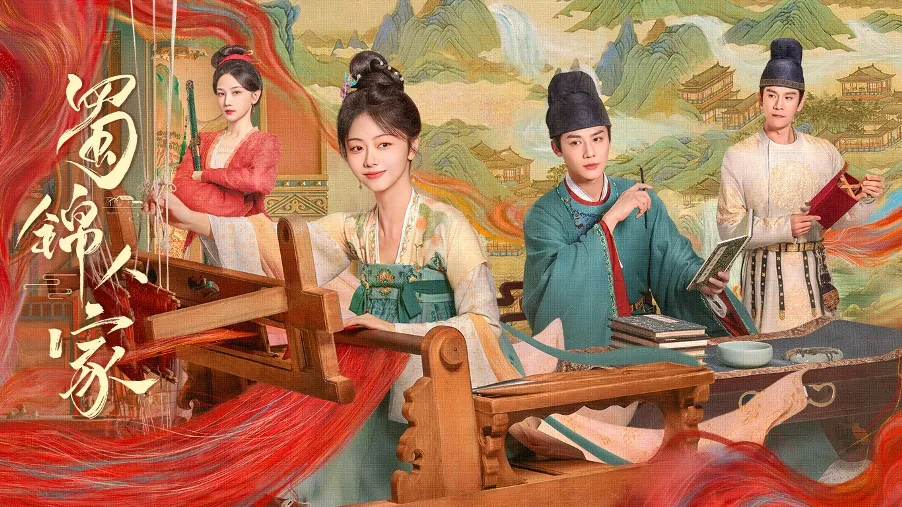
Brocade Odyssey Poster - Courtesy of Youku

|
DetailsRATING: (7.5/10)
NATIVE TITLE: 蜀锦人家 – Shǔjǐn rénjiā YEAR: 2024 EPISODES: 40 DURATION: 45’ DIRECTOR: Liu Hai Bo, Song Yang, Ben Fang SCREENWRITER: Wang Hong, Zhao Mian, Xue Hui Min ORIGINAL CREATOR: Zhuang Zhuang (蜀锦人家 – The Shu Brocade Family) RESPECTED CLICHÉS: 1 – 4 – 5 – 6 – 7 – 8 – 9 – 10 – 11 – 12 – 13 – 15 |


IN A NUTSHELL
Short on time? Here you’ll find the quick verdict, including the drama’s main strengths, weaknesses, and key features to help you decide if it’s right for you. For a more in-depth analysis, continue with the No Spoiler Review.
- What to expect: Set in the ancient Shu region (now Sichuan), Brocade Odyssey takes us to the golden age of Shu brocade (蜀锦, shǔ jǐn), offering us a detailed overview of the flourishing textile industry under the Tang Dynasty. The series intertwines the daily lives of dyers and weavers with the power struggles, commercial rivalries, and political balances of the time, demonstrating the profound connection between art, economics, and politics in medieval China. Through the story of Ji Ying Ying, the drama recounts a journey of ambition, resilience, and difficult choices. Between court intrigue, family conflicts, and a complex web of alliances, the protagonist will find herself embroiled in a battle far bigger than herself, in which the fate of Shu brocade becomes intertwined with that of the people who seek to control it.
- Strengths: the interesting focus on Shu's brocade production, the determined and resilient female protagonist, the positive characterization of the parental figures.
- Weaknesses: The discontinuous narrative pace, the weak antagonists, the SML and TML's obsession with the protagonist.
- Recommended if you like: Tan Song Yun and Zheng Ye Cheng, stories about a profession, determined and resilient female protagonists, strong and devoted male protagonists, love triangles where the male characters are obsessed with FL, ambiguous and manipulative SML, tender secondary love stories, dramas with positive and supportive parental figures.
- Would I rewatch it? Yes.
Read on to find out why this drama works despite its flaws.
Brocade Odyssey isn't a drama that captivates with breathtaking twists and turns or spectacular moments, but rather a story that slowly envelops the viewer, just like a precious brocade fabric. Intense and refined, the series intertwines political intrigue, commercial rivalries, and personal ambitions with the delicate emotions of its protagonists, creating a tale in which strategy and sentiment are constantly intertwined.
In this review of the drama Brocade Odyssey, after watching all episodes, I'll accompany you through artisan workshops and precious fabrics to explore the world of a manufacturing industry that has shaped the country's history and to discover whether the series' attention to setting, characters, and atmosphere can compensate for its narrative weaknesses and transform it into a story capable of captivating from the very first episodes.
Plot
After the death of her father, a dyer and weaver from Yizhou, who was unjustly accused of providing tribute of cheap brocade and summarily executed before her eyes, Ji Ying Ying grew up with her mother and older brother in Sandaoyan, a town near Yizhou.
Here, she learned the art of dyeing and the silk trade in the dyeworks founded by her mother and befriended other young sons of local dyers, with whom she spent her days washing silk by the Huanhua Stream.
Although the new life seemed to offer the family a certain stability, the past continued to haunt them. The brocade traders of Yizhou, in fact, desired to obtain the now-lost secret formula of the prized Shu Hong dye, which had earned Ying Ying's father the title of Master of Brocade.
In particular, Niu Wu Niang, fifth daughter of Deputy Military Commander Niu Jin, instructs the merchant Hua Rong to torment the girl and subsequently kidnaps her, forcing Ying Ying's fiancé, the heir to the Zhao weaving mill, to marry her so he can enter Yizhou's textile industry.
Fortunately, Ying Ying can count on the help of valuable allies: the dyers of Sandaoyan, the innkeeper Yu Ling Long, and Yang Jing Lan, a skilled swordsman she met on the very day of her father's death.
Jing Lan, however, hides a secret identity: he is the Third Young Lord of the Yang family, one of Yizhou's most important weaving families. He has returned to the city to investigate the death of his shifu Shen Ru Feng, Superintendent of the Brocade Department, who was murdered after uncovering an illegal trade in brocade destined for imperial tribute between Yizhou and the neighboring state of Nanzhao.
As she strives to realize her dream and establish herself in the world of textile production, Ji Ying Ying also meets the wealthy merchant Bai Sheng, who initially seems intent on helping her. She soon discovers that behind his apparent generosity lies a far more devious plan: to kidnap the most skilled textile artisans of Da Tang and bring them to Nanzhao to exploit their brocade-making expertise.
After facing obstacles, traps, and intrigues together, Ying Ying realizes that she loves Yang Jing Lan, and the two ultimately succeed in marrying after a daring and unexpected ceremony.
However, their happiness is destined to be tested again: Bai Sheng, who reveals to be Prince Bai of Nanzhao, discovers that he has fallen in love with the girl, and his refusal to give her up risks once again jeopardizing Ying Ying and Jing Lan's future together.
"美人既醉,朱顏酡些
娭光眇視,目曾波些
被文服纖,麗而不奇些
長髮曼鬋,豔陸離些"
[The beautiful girl is now drunk, her ruddy face flushed with wine.
Her gaze is luminous and elusive, her eyes wavering like water.
She wears ornate and delicate robes, she is beautiful but without artifice.
Her hair is long with soft locks, her splendor is variegated and brilliant.]

THIS SECTION TAKES A CLOSER LOOK AT THE SCRIPT, CHARACTERS, CAST, AND TECHNICAL ASPECTS WITHOUT REVEALING MAJOR PLOT DEVELOPMENTS. FOR A COMPLETE ANALYSIS OF THE DRAMA, CONTINUE WITH THE SPOILER REVIEW.
Brocade Odyssey Drama Review (No Spoilers)
Plot and Narrative Pace
Brocade Odyssey is an interesting historical drama set in a particularly evocative period, the golden age of Shu brocade (蜀锦, shǔ jǐn). The series devotes considerable space to the daily lives of artisans and the techniques used to produce this precious fabric during the Tang Dynasty, offering an unusual glimpse into a field rarely explored in Chinese dramas.
Overall, the plot of Brocade Odyssey manages to maintain the viewer's interest thanks to the variety of its elements: political intrigue, commercial rivalries, and personal conflicts intertwine in a story that, especially in the first half, is solid and well-constructed. However, compared to the richness of the Shu brocade world and the care taken to represent its artisanal and cultural dimension, the main narrative line appears less original and progressively less impactful.
*The narrative pacing is rather uneven. After a convincing start, the series enters a more chaotic middle phase, in which the elaborate machinations of the second and third male protagonists to gain the cooperation—and hand—of the female protagonist end up overlapping, slowing the story's development and making the main conflict less effective.
Added to this, in the final ten episodes, a further narrative arc is introduced that, while consistent with the story's themes, requires the viewer to quickly familiarize themselves with new characters, new alliances, and new political balances.
The result is a final part that gives the impression of further expanding a story that had already found its balance in the interweaving of personal experiences and historical context, and which appears, at times, overly melodramatic.
Characters and Love Story
As for the characters, I found Ji Ying Ying to be an excellent female protagonist. She's intelligent, ambitious, and extremely talented, capable of facing difficulties with determination and foresight. However, compared to other female protagonists in the same genre, her path is perhaps a little too easy, and even in moments of greatest danger, she can count on the timely intervention of the male protagonist, who always manages to come to her aid even when circumstances presumably wouldn't allow it.
This is another reason why Yang Jing Lan is, in my opinion, one of the least convincing characters. Despite being a skilled swordsman and a man guided by strong moral principles, he doesn't always convey the solidity one would expect from a male protagonist. He often acts impulsively, knowingly entering risky situations or falling victim to her opponents' strategies, so much so that on several occasions Ji Ying Ying appears more rational and strategic than him.
His love story with the female protagonist also suffers from this overly romanticized characterization. Yang Jing Lan embodies the classic "Prince Charming" archetype: he falls in love with the protagonist as a child and, later, protects her from the shadows so as not to involve her in his dangerous mission. Then, once he wins her hand, he transforms into a devoted husband ready to sacrifice everything for the woman he loves. Although the relationship between the two is initially built gradually and believably, the dynamic gradually takes on the character of a relationship in which the male protagonist constantly puts the FL at the center of his actions, even falling into the traps of the second and third male protagonists in order to save her.
I, however, found the way Brocade Odyssey portrays family and friendship bonds very realistic. The solidarity shown by members of the Fei Hua Hui Dyers' Guild and Yu Ling Long toward Ji Ying Ying, as well as the affection and respect shown by the protagonist's mother and brother, represent a pleasant change from many historical dramas in which family relationships are often built around betrayal, rivalry, and envy.
More disappointing, however, are the main antagonists, whose presence remains rather nuanced and lacks impact. Their actions end up being overshadowed by the machinations of the second and third male protagonists, who occupy much of the narrative space dedicated to conflict and almost become the story's true antagonists.
Cast
The cast did an excellent job, although I must admit that part of my positive opinion of this drama is definitely due to the presence of three of my favorite actors: Tan Song Yun, Zheng Ye Cheng, and Jing Chao.
Tan Song Yun has a very expressive, clear, and clean acting style, and I found her impeccable in this drama as well as in The Sword and the Brocade. Personally, however, I continue to prefer her livelier and more lighthearted roles, such as Yuan Jin Xia in Under the Power, where she manages to better showcase her brighter, more spontaneous side.
Zheng Ye Cheng, on the other hand, is one of my favorite actors in period dramas, thanks to his martial arts and horsemanship skills, elements that help make his characters particularly believable. Despite his diction not always being perfectly clear and occasionally struggling to fully convey the complexity of his characters, he's an actor I always enjoy seeing again on screen.
Jing Chao has an extraordinary ability to play morally ambiguous characters, suspended between good and evil, whose thoughts and motivations are often difficult to fully understand. It's precisely this unpredictability that makes his performances particularly compelling, as demonstrated by some of his most accomplished roles, including General Fu Chou in Princess Silver, Prince Mu Ze in Lost Track of Time, and Meng Xu An in City of Streamer.
Among the other cast members, special praise goes to Chen Xiao Yun and He Lei, whom I had already appreciated in New Life Begins and Song of Youth, respectively. Both played their characters with great emotion, managing to make their emotions believable and making me fond of the fates of Yu Ling Long and Ji Yao Ting.
Visual Aspects and Soundtrack
Brocade Odyssey stands out for its direction and cinematography characterized by remarkable aesthetic coherence, capable of creating an elegant and refined world without ever falling into excess. The shots are constructed with professionalism and attention to composition, but without resorting to overly elaborate solutions or virtuosity for its own sake. The color palette is also broad and rich, as befits a drama set during the Tang Dynasty, yet always maintains a good balance, avoiding overly saturated colors or excessive brightness.
Great attention was paid to the costumes, a particularly important element given the centrality of textiles to the narrative. The clothes showcase sophisticated fabrics that often recall Shu brocade, accompanied by elegant and refined cuts, but without achieving a visual richness disproportionate to the narrative context. Even the hairstyles, inspired by the Tang style and enriched with period-appropriate ornaments, contribute to creating a refined and believable image of the characters.
The sets are also well-crafted, helping to make the setting tangible and immersive. From private homes to gardens, from city streets to weaving and dyeing workshops, each space appears carefully crafted to reflect the narrative function and tone of the scene. Interiors are characterized by dark wood details, orderly geometry, and warm lighting that conveys a sense of intimacy, while exteriors favor natural colors and an accurate period reconstruction. While not offering spectacular panoramic views, the series offers some particularly evocative settings, such as the natural pool where the Sandaoyan dyers gather to wash silk, a place that perfectly conveys the connection between craftsmanship, nature, and tradition.
The action scenes also maintain the same balanced approach: we don't find epic, cinematic battles, but more restrained and tactical fights, featuring intense duels, ambushes, and strategies. The choreography is clear and easy to read, with particular attention to the fighters' points of view and positions in space, even though it retains a certain spectacularity typical of period dramas, with movements sometimes deliberately emphasized. Further enhancing them is Zheng Ye Cheng's remarkable martial arts skills, which make the sequences dedicated to Yang Jing Lan believable and dynamic.
Finally, the use of CGI is limited but effective, employed primarily for targeted interventions. Particularly successful is the digital exchange of likenesses between Zhang Hao Wei, involved in a scandal before the series aired and was subsequently replaced by the production, and Zhao Hua Wei: a surprisingly realistic technical intervention that demonstrates the remarkable skill of the post-production team.
The soundtrack of Brocade Odyssey fits perfectly into the refined and contemplative atmosphere of the series, offering primarily slow and romantic pieces, capable of alternating melancholic nuances with more intense and passionate moments. The arrangements, while making extensive use of Western instruments such as strings, piano, and classical guitar, are enriched with accents of traditional Eastern instruments that help evoke the historical Chinese context without being artificial.
Among the most successful tracks are 年长 (Years Grow Long) and 红 (Red), performed by Liu Yuning and Mao Buyi, respectively. Their distinctive, rich voices complement the tone of the compositions perfectly, enhancing the arrangements and amplifying their nostalgic, passionate character. Also noteworthy is 心上锦 (Heart’s Brocade), sung by Zhao Bei'er, whose crystalline voice pairs well with a brighter, slightly livelier arrangement than the other tracks on the soundtrack, while maintaining the delicate tone that characterizes the entire soundtrack.
The songs performed by Tan Song Yun are also noteworthy; while pleasant and fitting with the series' atmosphere, they don't quite reach the level of being among the soundtrack's defining pieces.

WARNING!
SPOILERS AHEAD. FROM THIS POINT ON, THIS SECTION PROVIDES A DETAILED ANALYSIS OF SPECIFIC ASPECTS OF THE SERIES. DO NOT CONTINUE IF YOU DON’T WANT TO KNOW ALL THE DETAILS OF THE DRAMA
Brocade Odyssey Drama Review (Spoilers)
What Works
Historical-Cultural Context
One of the most successful elements of Brocade Odyssey is undoubtedly the choice to place its story within a specific historical and cultural context.
The series does not simply present a generic imperial past of opulent palaces and court intrigues, but constructs a well-defined historical context in which political, economic, and cultural dimensions are deeply intertwined. On the one hand, we find the typical elements of the genre, with power struggles at court, corrupt officials, ambitious ministers, and an emperor forced to navigate a fragile political balance; on the other, the drama pays particular attention to describing the daily lives and work of artisans, bringing to the screen the world of textile production, specifically that of Shu brocade (蜀锦, shǔ jǐn), one of the traditional manufactures that contributed to the nation's wealth and cultural prestige.
As the narrative unfolds, it becomes clear that the brocade, dyeing techniques, and artisanal skills are not simply decorative elements inserted to enhance the setting, but rather constitute an integral part of the story. Textile production almost becomes an additional character, capable of influencing the protagonists' destinies and reflecting the economic and social changes of the era. This intertwining of major political events and the world of craftsmanship makes the setting of Brocade Odyssey particularly tangible and immersive, demonstrating how art, commerce, and politics were deeply intertwined in ancient China.
The drama also highlights the cultural importance of a manufacturing tradition that goes beyond mere aesthetics. Shu brocade represents a historical and artistic heritage of great significance, and the series allows the viewer to delve into an aspect of Chinese culture rarely explored in period dramas, transforming artisanal production into a window into the society and mentality of an entire era.
Parent Figure Characterization
From a character development perspective, I particularly appreciated Brocade Odyssey's portrayal of parental figures. In a genre where family relationships are often used to create conflict through conflicting views, betrayals, or misunderstandings, it was refreshing to find adults capable of supporting and valuing the protagonists, despite their fragilities and contradictions.
First and foremost, Ji Xu Shi is probably one of the most interesting mother figures I've encountered in a historical drama. She is an extremely resolute and intelligent woman, capable of defending her children even when she finds herself completely alone and without any support she can count on. After the tragedy that struck her family and the death of her husband, she did not let the economic crisis discourage her, but built a silk dyeing business from scratch to repay the debts left by her husband and prevent her children from ending up in slavery.
Despite her fragile health, Ji Xu Shi continues to devote herself to the family's welfare and manages to protect her children, thanks primarily to her intelligence and persuasive skills. Although she desires a marriage for Ying Ying to a man from a good family, she understands the risks involved in her relationship with the Second Young Lord Zhao and fears that the Zhao family's prejudice against them could condemn her daughter to an unhappy life. However, rather than imposing her own decisions on her, she simply seeks to guide and warn her. Similarly, when she senses Yang Jing Lan's feelings for her daughter, she urges him to take her away from Yizhou to protect her from the conflicts that threaten to overwhelm her.
Her severity towards Ying Ying therefore always stems from affection: she may scold her for her impulsiveness and tendency to attract trouble, but she never seeks to limit her independence and intervenes only to prevent her from needlessly making enemies.
I also greatly appreciated the characters of Mr. and Mrs. Yang, who offer an equally positive portrayal of family. Mrs. Yang is a strong and competent woman, capable of recognizing the value of others and treating both rivals and subordinates with respect. Although she has never sought to replace Yang Jing Lan's biological mother in her husband's heart, she accepts entry into the Yang Clan and dedicates herself diligently to managing the family business. She is always fair to her stepson and, just as she will later with Ying Ying, seeks to enhance the talents of those around her, regardless of their position or relationship with the family.
Yang Ju Xian, on the other hand, initially appears as an authoritarian patriarch, but over the course of the story he emerges as a much more affectionate and vulnerable man than he lets on. Despite his rigid nature, he desires to mend his relationship with Jing Lan and even goes so far as to publicly justify his son's behavior. He grows deeply attached to Ying Ying and, as the head of the Yang family, decides to support her in her dispute with Yang Ju Li. His help in the fight against Niu Jin also marks the moment when he finally manages to obtain his son's forgiveness and rebuild their bond.
Overall, these parental figures represent one of the most successful aspects of Brocade Odyssey's characterization: they are adult characters who don't simply exist to hinder or educate the protagonists, but who have their own histories, their own morals, and their own ways of guiding and protecting them.

What Doesn't Work
Narrative Structure
The most obvious flaw in Brocade Odyssey is undoubtedly its plot management, which becomes chaotic in the middle due to the constant machinations of the second and third male protagonists to gain control over Ji Ying Ying's fate. What initially appears to be a conflict over competition in the brocade production industry ultimately turns into a personal struggle over the protagonist, causing the desire to gain her trust and affection to prevail over the political and economic goals that gave rise to the conflict.
The most obvious case is that of Sheng Feng Ze. Initially, his plan appears simple and consistent with his role: the Prince of Nanzhao wishes to bring artisans skilled in the production of Shu brocade to his land to create a prestigious factory and fulfill his deceased mother's dream. After meeting Ying Ying, however, his priorities gradually shift, and winning her favor becomes the true focus of his actions.
The problem isn't so much his motivation, which might seem understandable, but the ways in which he attempts to achieve it. Given his political position and alliances, it seems unlikely that Sheng Feng Ze would have to resort to such a lengthy series of manipulative strategies to convince Ying Ying to collaborate with him and follow him to Nanzhao. For much of the drama, he enacts overly elaborate and often ineffective plots, which not only fail to secure the FL's loyalty, but repeatedly put her life at risk.
Even his attempt to secure the Zhao family's cooperation proves unsuccessful, so much so that he is ultimately forced to resort to blackmail and kidnapping to achieve his desired outcome.
Zhao Xiu Yuan, on the other hand, presents a more complex and ambiguous path. His initial intentions are less clear, but his relationship with Ying Ying seems characterized by sincere feelings. From the beginning, it's clear that the two have different ideas about personal fulfillment and how to pursue their goals, differences that represent a difficult obstacle to their happiness together. However, when Xiu Yuan decides to renounce her to gain the protection of General Niu and the position of Brocade Master, he does so not out of simple personal ambition, but because he understands that, by maintaining his identity as Second Young Lord of the Zhao family, he would never have the power necessary to protect Ying Ying from her family's pressure and the bullying of Niu Jin and Niu Wu Niang.
Compared to Yang Jing Lan, he perhaps lacks a little determination, but the comparison between the two must take into account their profoundly different starting points: Xiu Yuan is neither a warrior nor a man supported by a prestigious martial figure like the former Commander of the Imperial Guards Shen Qing Ping; he is the younger son of a merchant family who has always been underestimated by his clan. In some ways, she's reminiscent of Liu Chang from Flourished Peony, though in my opinion she exhibits greater moral development, as, in the end, she manages to collaborate with the male protagonist for the heroine's sake. She also seems almost pitiful because, for much of the story, she has to deal with Ying Ying's detachment and rejection, having already demonstrated her choice of partner, Yang Jing Lan.
The pairing of these characters highlights one of the drama's main narrative problems: both possess interesting personal motivations and, especially in Xiu Yuan's case, a certain emotional depth, but the way their collaboration to subjugate Ying Ying is developed ends up taking up too much space compared to the main political conflict. Their machinations thus transform a story potentially centered on the world of brocade and the fragile political balance of the region into a long struggle for possession of the heroine, contributing to the feeling of narrative disarray.
The Antagonists
Similarly, I was a bit disappointed by the narrative evolution of the series' main antagonists, who ended up being much less impactful than initially expected. The problem isn't so much their function in the story, but rather the fact that their potential is often overshadowed by the machinations of Zhao Xiu Yuan and Sheng Feng Ze, transforming what should have been the main conflict over power and control of the brocade industry into a predominantly personal struggle centered around Ji Ying Ying.
Niu Wu Niang, in particular, initially seemed to possess all the makings of an interesting character. Presented as a strong, determined woman with remarkable survival skills, she had a potentially rich personal history: despite being forced by her father to marry men she didn't want, she managed to free herself from two forced marriages, eventually eliminating their husbands. This premise suggested an ambiguous figure, capable of fighting against a destiny determined by others and acting according to her own will.
However, after her marriage to Zhao Xiu Yuan, the character undergoes a development that I found unconvincing. The enterprising and resilient woman of the early episodes gives way to a much more passive figure, who accepts being confined by her husband to her rooms and separated from the only person to whom she truly belonged, the maid Yu Yuan. Even her final attempt at revenge against Xiu Yuan, while having a strong emotional impact, ends up appearing more like the desperate act of someone now deprived of any choice than the action of a woman in control of her own destiny. This transformation makes her narrative arc incoherent and reduces an initially promising figure to a functional element in the stories of the other characters.
Niu Jin, on the other hand, is a more traditional antagonist: arrogant, violent, and willing to resort to any means to achieve his goals. His threat is clear from the beginning, and he effectively embodies the role of a powerful figure willing to abuse his position. However, his presence remains surprisingly marginal for much of the series. Although he represents a constant threat to the protagonists, the narrative devotes much more space to the plans of Zhao Xiu Yuan and Sheng Feng Ze, who effectively become the main adversaries of Ji Ying Ying and Yang Jing Lan. Only in the final section does Niu Jin finally realize his full potential as an antagonist, but this occurs after his role has been marginalized for too long to carry the same narrative weight he could have.
Overall, the political and commercial antagonists of Brocade Odyssey thus represent one of the series' most underutilized opportunities: they possess interesting premises and could have given greater depth to the conflict, but they end up being overshadowed by the personal rivalries that occupy the center of the narrative.

The Handling of Some Subplots
Another limitation of the Brocade Odyssey screenplay is the handling of some subplots, which, amidst the narrative confusion of the middle and final sections, are resolved too quickly or without providing fully satisfying explanations. The series introduces several potentially interesting conflicts, but doesn't always take the time to clarify how and why certain events came to a certain conclusion.
A significant example concerns Ji Ying Ying's financial and family crisis and her entry into the Yang family. Although this transition is crucial to the protagonist's development, the drama doesn't fully clarify how she managed to overcome her debt and satisfy the Qing merchant's request. Furthermore, some key narrative points remain unexplained, such as how Ying Ying manages to convince the boatman to testify against her uncle for her aunt's murder, or why Zhao Xiu Yuan, after causing the protagonist's mother's arrest, doesn't intervene directly to help her, given that his only purpose was to embarrass her and force her to ask for his help. This last choice seems particularly incomprehensible because, narratively, it would have been a perfect opportunity to strengthen the bond between the two and could have significantly altered Ying Ying's relationship with the Zhao family.
Some events related to the political conflict also prove unconvincing. When Sheng Feng Ze is wounded by Yang Jing Lan while being taken to Chang'an to testify against Niu Jin, the subsequent developments leave several unanswered questions: the Prince of Nanzhao, despite having committed grave acts against the Da Tang, is allowed to return to his country, while Yang Jing Lan is considered a wanted man, even though it is clear she had no intention of killing him. Likewise, the disappearance of General Xue Yu, who was supposed to bring evidence against Niu Jin to the imperial court, remains an unresolved subplot that ultimately leaves Yang Jing Lan to manage a political conflict far greater than himself alone.
Adding to these problems of narrative coherence is the use of certain devices typical of historical dramas that ultimately compromise the story's realism and create moments that are almost fantasy-like. The most obvious example is the wild pomegranate tree needed to recreate the Shu hong si dye, which grows exclusively atop a rugged cliff. But also highly melodramatic situations, such as Yang Jing Lan's master, who, before dying, cuts his flesh to the bone to leave a message for his disciple. Similarly, Yang Jing Lan's desperate race to return to Yizhou in time to prevent Ying Ying's wedding, or the game of go in which the protagonist tries to save her beloved's life, are part of the genre's tradition of spectacular and highly symbolic scenes, but they are less effective because they are poorly integrated with the more concrete and cultural tone the series had established in the first part.
Finally, I also found questionable the choice to eliminate certain characters through deaths that seem more functional to creating an immediate emotional effect than truly necessary for the story's development. The disappearances of Zhu Ge Hong, Sheng Da Lang, and Yu Ling Long, in fact, deprive the narrative of characters who still had potential and who don't always seem justified by the consequences they have on the protagonists' journeys.
Overall, these choices contribute to the feeling that Brocade Odyssey has many interesting ideas, but doesn't always manage to integrate them harmoniously. The drama alternates moments of great attention to the historical and cultural context with others in which it resorts to more conventional and melodramatic narrative solutions, creating a certain discontinuity in the viewer's experience.
Ending
Speaking of the ending of Brocade Odyssey, I must admit I found it excessively convoluted and inconsistent with the more balanced tone that characterized the first part of the series.
In particular, the resolution of the conflict with Niu Jin proceeds through a series of increasingly forced twists that ultimately reduce the emotional impact of the final battle. After Niu Jin takes control of Yizhou, the Emperor decides to task Xue Yu with attacking the city to eliminate him, apparently without considering the consequences such a military operation would have on the civilian population. To avoid a massacre, Zhu Ge Hong therefore devises an extremely risky plan: he deliberately provokes Niu Jin to death so that his body can be hung from the city walls and Yang Jing Lan can recover it, discovering a secret message with the information needed to strike the enemy.
The problem is that this sequence, while intended to be poignant, ends up being unbelievable due to the excessive expediency required to carry it forward. Even the final battle is constructed through an accumulation of events designed to heighten narrative tension: the day Zhu Ge Hong chooses to strike is the day on which the brocade tribute and the dress made by the city's weavers for his birthday must be delivered to Niu Jin. The ones delivering it are Ji Yao Ting and Yu Ling Long, who voluntarily choose to participate in Yang Jing Lan's plan and travel to Niu Jin's residence, becoming involved in the final battle between Niu Jin and Yang Jing Lan. While Ji Yao Ting manages to survive with only a few wounds, Yu Ling Long loses her life while trying to protect him, in an emotionally intense death that seems narratively unnecessary.
The conclusion of the Sheng Feng Ze arc in Nanzhao also follows a similarly melodramatic path. After the weavers of Yizhou are freed by the ruler of Nanzhao for successfully completing their assigned task and producing the brocade intended for the court, Prince Bai proves he still cannot give up on Ji Ying Ying. He decides to spread the news of her death and hide her in a remote place, where not even Yang Jing Lan would be able to find her.
However, Du Yan fears that Ying Ying's presence could create further political problems at the Nanzhao court and decides to eliminate her by sending a death squad. Here too, the narrative relies on a long series of coincidences: while Sheng Feng Ze is on his way to court, he senses the danger and returns just in time to save her, only to be mortally wounded. His death in Ying Ying's arms, happy to be remembered by the woman he loves and to have finally repaid the moral debt he felt he owed her, certainly has a strong emotional impact, but it comes after a succession of narrative twists so forced that they diminish the engagement.
Overall, the ending of Brocade Odyssey seems to want to close each narrative arc through sacrifices and grand dramatic gestures, but the accumulation of these elements ends up making the conclusion less satisfying. A story that had distinguished itself for its attention to the social and economic reality of the time instead ends in the most banal manner, relying on the more conventional mechanisms of historical melodrama.

Characters and Cast
Primary Characters
Ji Ying Ying/Ying’er (Tan Song Yun) youngest daughter of the Yizhou Brocade Master, Ji Gui Nan. She is shrewd and ambitious, always achieving what she wants despite adversity. She aims to match her father’s success and clear her father’s name, which was tarnished ten years earlier by false accusations from a corrupt official. Her courageous and unconventional attitude earns her the affection of three men, but the possessiveness of two of them proves to be an obstacle to her plans and puts her own life in danger. Fortunately, Yang Jing Lan comes to her aid, whom she eventually marries.
Yang Jing Lan (Zheng Ye Cheng) Third Young Master of the Yang Family and Superintendent of the Brocade Department (经管). He is upright and courageous, and after his mother’s death, he decides to abandon his family to become a wandering hero. During his wanderings, he meets Shen Qing Ping, who takes him as her disciple and introduces him to the Crown Prince. He meets Ji Ying Ying on the day of her father’s death, and the two promise to become friends, but their paths separate for ten years until he returns to Yizhou to investigate the death of his shifu.
Yu Ling Long/A’Yu (Chen Xiao Yun) owner of the Yue Bu Huan Inn, Yang Jing Shan’s ex-wife, and a friend of Ji Ying Ying. She is the daughter of a street artist who died while trying to open a new road to Tubo (present-day Tibet). She is very skilled with the sword, and her indomitable character has made it impossible for her to live in the strict Yang family, but has earned her the admiration of Ji Yao Ting.
Zhao Xiu Yuan (Zhang Hao Wei | Zhao Hua Wei) Second Young Master of the Zhao family and Ji Ying Ying’s fiancé. He has always been in love with Ji Ying Ying, but to protect her and gain power to protect her, he decides to accept Niu Wu Niang’s marriage proposal. He will be appointed Yizhou Brocade Master and become the head of the Zhao family, but this will earn him Ying Ying’s indifference.
Bai Sheng/Sheng Feng Ze (Jing Chao) Prince Bai of Nanzhao. His mother was a citizen of Da Tang and was particularly fond of Shu brocade, so he began collecting fabrics from Da Tang, striking a deal with General Niu to smuggle brocades destined for the imperial tribute. He plans to kidnap skilled workers from Yizhou and bring them to Nanzhao to open a Shu brocade weaving mill in his homeland and fulfill his mother’s dying wish, but everything becomes complicated when he falls in love with Ji Ying Ying.
Supporting Characters
Ji Family
Ji Gui Nan (Sui Yong Liang) father of Ji Ying Ying, and owner of a weaving mill in Yizhou. Thanks to his creation of the prized Shu Hong Si (Shu Red Silk) brocade, he earned the title of Yizhou Brocade Master, but was falsely accused of sending a tribute of inferior brocade to the palace and was summarily executed by the Superintendent of Logistics and Fiscal Transport, Du Yu.
Ji Xu Shi (Sui Jun Bo) wife of Ji Gui Nan and mother of Ji Ying Ying and Ji Yao Ting. After her husband’s summary execution, she was pardoned and moved with her children to Sandaoyan, into a house provided for her by the young Zhao Xiu Yuan. There, she opened the Huanhua Dyeing Factory to pay off her husband’s debts and prevent her children from becoming slaves, but her poor health forced her to entrust the family business to Ying Ying.
Ji Yao Ting/Ting’er (He Lei) Ji Gui Nan’s eldest son and Ji Ying Ying’s older brother. He is a skilled weaver and will help his sister on several occasions, such as when she tries to recreate the Rippling Grane Brocade based on the sacred brocade design of Gubei Village. He has long been in love with Yu Ling Long, but she refuses to re-engage with a man for fear of losing her freedom.
Ji Gui (Liu Ling Zhi) Ji family’s butler.
Fei Hua Hui Dyers' Guild
Chen San Lang (Li Tian Nuo) Third Young Master of the Chen family, owners of the Yingxi Dyeing Works, and a friend of Ji Ying Ying. After Ji Ying Ying’s marriage to Yang Jing Lan, he becomes the new head of the Fei Hua Hui Dyers’ Guild (Flying Flower Company).
Jiang Liu Lang (Yu Bai Shui) Sixth Young Master of the Jiang family, owners of the Liuyue Dyeing Works, and a friend of Ji Ying Ying.
Sheng Da Lang (Lu Qi) First Young Master of the Sheng family, owners of the Cailuan Dyeing Works, and a friend of Ji Ying Ying.
Zhu Xiao Niang/Pin’er (Wang Rui Xin) only daughter of the Zhu family, owners of the Luoxia Dyeing Works, and a friend of Ji Ying Ying. Sang Shi Si will fall in love with her, but it will take her a long time to accept her feelings for him.
Sang Shi Si (Jiang Lai) Fourteenth Young Master of the Sang Family, son of Chief Sang and friend of Yang Jing Lan. He is called “imperial uncle” because his older sister is the Emperor’s concubine. After being humiliated by Ji Ying Ying, he seeks revenge, but she uses this to secure an interview with her father, the temporary Superintendent of the Brocade Department. Eventually, the two become friends, and Ying Ying appoints him honorary head of the Dyers’ Guild she founded.
Zhao Family
Master Zhao (Kou Zhen Hai) patriarch of the Zhao family and Zhao Xiu Yuan’s grandfather.
Zhao Jia (Chen Ying Ying) First Lady of the Zhao family and Zhao Xiu Yuan’s mother. She opposes her son’s marriage to Ji Ying Ying because she feels she is not worthy of her family.
Zhao Xiu De (Dan Si Jie) First Young Master of the Zhao family and the designated heir. Thanks to his father-in-law’s support, Zhao Xiu Yuan will overthrow him and become the new head of the family.
Zhao Ping (Liu Ma Zheng Yi) Zhao Xiu Yuan’s personal servant.
Yang Family
Yang Ju Xian (Hu Ya Jie) head of the Yang family and father of Yang Jing Lan. He is irresolute and incompetent in business, so he entrusted the management of the family business to his wife, whom he married to please the elders despite already having a much-loved wife, Yang Jing Lan’s mother.
Yang Shi (Juan Zi) First Lady of the Yang family and Yang Jing Lan’s stepmother. She manages the family business, including the Yang weaving mill, which provides the annual brocade tribute to the imperial palace. She is a skilled trader and fair to both her employees and suppliers. She wants to enter the Rippling Grane Brocade business, but Bai Sheng outbids her by investing a higher sum. When, following her mother’s arrest, Ying Ying goes to her for help, she agrees on the condition that she joins the Yang family by marrying Yang Jing Lin.
Yang Jing Shan (Jin Yu Bo) First Young Master of the Yang family and the Yizhou Brocade Master. He is Yu Ling Long’s ex-husband and Lady Yang’s chief aide.
Yang Jing Lin (Yao Wen Xu) Second Young Master of the Yang Family. He is initially the groom for Ji Ying Ying, but Yang Jing Lan crashes the ceremony and kidnaps the bride.
Yang Ju Li (Wang Mao Lei) Second Master of the Yang Family and Yang Jing Lan’s uncle. In an attempt to oust Ji Ying Ying and become the new head of the family, he poisons Lady Yang and helps Zhao Xiu Yuan and Sheng Feng Ze boycott the family business, but is discovered and handed over to the authorities.
Jin Xiu (Pei Zheng Zheng) trusted maid assigned by Lady Yang to Ji Ying Ying when she moves to the Yang Residence.
Gao Fang (Li Zheng Wu) wandering swordsman, friend of Yang Jing Lan and leader of his shadow guards.
Niu Family
General Niu Jin (Hai Yi Tian) Deputy Military Commander (副都督) of Jiannandao and father of Niu Wu Niang. He is ruthless and power-hungry, so much so that he married his five daughters to the heirs of five powerful families. He is responsible for the death of Ji Gui Nan and for the trafficking of Shu brocade destined for imperial tribute with Nanzhao.
Niu Wu Niang (Wang Yi Nuo) younger daughter of Deputy Commander Niu. To prove her true worth to her father and avoid being trapped in the inner courts like her mother, who went mad after giving birth to her, she tries to convince Ji Ying Ying to go into business with her. When she refuses, she decides to kidnap her and force her to reproduce Shu Hong Si brocade for her, but Yang Jing Lan saves her, so she, in retaliation, forces Ying Ying’s fiancé to marry her.
Yu Yuan (Feng Yuan Yuan) Niu Wu Niang’s personal maid. She is the only person the General’s daughter is fond of because she is the only one who has stood by her side in difficult times.
Yizhou Prefecture
Prefect Zhang (Wang Sheng) Prefect (刺史) of Yizhou. He is the civil official who collaborates with the Military Governor of Jiannandao in the administration of Yizhou territory.
Sang Shen (Xu Yu Kun) Chief Administrator (长史) of Yizhou Prefecture. After Shen Ru Feng’s death, he is appointed temporary Superintendent of the Brocade Department and remains in office until Yang Jing Lan takes office. He is cautious and timid and prefers not to get involved in political disputes, but Ji Ying Ying always manages to involve him, despite himself, in her battles.
Shen Ru Feng/Shen Qing Ping (Shen Xiao Hai) Superintendent of the Brocade Department and Yang Jing Lan’s shifu. In reality, he is the former Commander of the Imperial Guards and guardian of the Crown Prince, sent to Yizhou by the latter to investigate the illicit brocade trade between Da Tang and Nanzhao. He is killed for uncovering the illegal activities being carried out by General Niu Jin on Mount Qingcheng.
Zhu Ge Hong (Li Xin Ze) scholar, Shen Ru Feng’s disciple and friend of Yang Jing Lan, who agrees to join him at the Brocade Department to uncover the truth about their shifu‘s death.
Kingdom of Nanzhao
Sheng Feng You (Jin Jia) King of Nanzhao and older brother of Sheng Feng Ze. He agrees to make a deal with Ji Ying Ying and to free all the artisans kidnapped by Sheng Feng Ze if she creates the new Nanzhao brocade within a year.
Ning Dai/A’Ning (Zhou Jie Qiong) Sheng Feng Ze’s attendant. She is the daughter of the former Qingping government official and Prince Bai’s shifu. His father procured the imperial tribute brocades from Yizhou for the Prince through an agreement with Niu Jin.
Chi Hu (Zhang Zhe) Prince Bai’s bodyguard.
Du Yan (Liu Xiang Jing) current government official of Qingping and political opponent of Prince Bai.
Mu Lan (Wang Ting) Nanzhao silk producer. She is the adopted daughter of a Da Tang weaver who created the first Nanzhao brocade as a gift to his beloved, Sheng Feng Ze’s mother.
Other Characters
Hua Rong (Liu Yun) owner of the Hua Dyeing Works and of the land containing the natural pool where the Sandaoyan dyers wash their silk. She is the main buyer of silk from the Huanhua Dyeing Works, but in reality, her goal is to obtain the lost formula for Shu Hong dye. She is in league with Niu Wu Niang and runs a clandestine weaving mill on Mount Qingcheng for her, where fake Shu Hong Si brocade is produced. She is arrested by Yang Jing Lan to obtain evidence of General Niu Jin’s illegal activities, but Niu Wu Niang kills her before she can speak.
Hua Xiang Rong (Liu En Shang) Hua Rong’s husband. After his wife’s death, he agrees to testify against Niu Wu Niang and presents Magistrate Sang with copies of the accounting records of the Qingcheng Mountain clandestine weaving mill, but General Niu Jin kills him.
Yu Shu (Ma Shao Hua) elderly owner of the Yu Weaving Mill, located in the old Ji Residence, and grandfather of Yu Xi (Chen Yi Tong). His only heir died attempting to reproduce the sacred brocade pattern of Gubei Village, and he seeks to fulfill her last wish. Unable to do so on his own, he accepts Ji Ying Ying’s proposal, ending up collaborating with the Fei Hua Hui Guild.
General Mu Hui (Zhang Gong) Regional Military Governor (节度使) of Jiannandao and Niu Jin’s superior. He initially turns a blind eye to his subordinate’s dealings, but is eventually forced to intervene, falling into his trap.
General Xue Yu (Sun Zheng Lin) Mu Hui’s subordinate. After Mu Hui dies in an ambush set by Niu Jin, he agrees to testify on his behalf before the Emperor and lead the troops to free Yizhou from his control.
Li Xu Shi (Chen Si Si) Ji Xu Shi’s younger sister and aunt of Ji Ying Ying and Ji Yao Ting. She is the only one to have helped the Ji family after the execution of the head of the family. She is murdered by her husband at the request of Zhao Xiu Yuan, who promises to pay off his gambling debts if he helps him frame his sister-in-law for murder.
Li Feng (Mao Fan) Mrs. Li’s husband. He is a gambler and agrees to kill his wife to get his gambling debts paid.
Yu San (Xian Di) boatman who is transporting Ji Xu Shi, Li Feng, and Lady Li when the latter is killed. He agrees to testify against Li Feng at the trial, which leads to the man's conviction.
Magistrate Meng, County Magistrate (县令) of Tangchang. He is called to judge the murder case of Ji Ying Ying’s aunt.
Liu Chong Shan, deputy Superintendent of the Brocade Department who accused Ji Gui Nan of presenting fake Shu Hong Si brocade as tribute.
Du Yu (Yu Fan) subordinate of the Military Commander of Jiannandao, appointed Superintendent of Logistics and Fiscal Transport (都运官) in the year Ji Gui Nan was in charge of sending the imperial tribute brocade to Chang’an. By order of General Niu Jin, he had replaced the Shu Hong Si brocade with a fake and accused Ji Gui Nan of deceiving the Emperor. Then, to silence him, he had him summarily executed and had the Ji family’s assets and residence seized.
Merchant Qian cloth merchant from Tubo who is promised a large shipment of brocade by Ji Ying Ying but she is unable to fulfill it.

Favorite Character: Ji Yao Ting
Although he initially appears fragile and uninspiring, he gradually reveals himself to be a fundamental support for Ying Ying.
Despite the difficulties he faces, he always stands by his sister and mother, trying to protect them with the means at his disposal and helping them overcome daily problems with poise, patience, and wisdom.
After his father's death, his life becomes anything but simple, but he does not allow himself to be guided by personal ambition nor does he accept compromises that could tarnish his honor. He prefers to face difficulties and sacrifices rather than betray his principles, proving himself not only to be a loving brother, but also a loyal, reliable man with great moral strength.
Precisely thanks to his constant presence, he often manages to instill courage in Ying Ying in the most difficult moments and helps her not to lose hope when everything seems to be going against her. He is at her side, for example, in the search for the Shu Hong dye invented by her father and in the fight to obtain justice for her mother, unjustly accused of her aunt's murder.
His relationship with Yu Ling Long is also particularly tender. Having been in love with her for a long time, he gradually manages to gain her trust and show her that an emotional bond doesn't necessarily mean a loss of freedom, thus overcoming the fears of a woman who, precisely out of fear of being limited, had always avoided getting emotionally involved.
Un-Favorite Character: Niu Jin
He perfectly embodies the darker side of power: he is a man convinced that his position and strength allow him to justify any action.
Born into a humble family, from a young age he developed a profound desire to improve his social standing. This desire, instead of turning into positive ambition, translates into the conviction that he can use any means to gain prestige and influence.
For him, people have no intrinsic value; they are judged solely by their usefulness to his goals. He therefore does not hesitate to manipulate, blackmail, or eliminate anyone who stands in his way, transforming his ambition into a ruthless quest for control.
His determination to consolidate his power through intrigue and opportunistic alliances demonstrates a will to assert himself that ultimately erases all forms of empathy.
His greatest weakness, however, coincides with his greatest conviction: his total confidence in his own superiority. He is so blinded by his own ego that he cannot truly understand the people around him and constantly underestimates his opponents, believing that social position and authority are sufficient to dominate them. This inability to look beyond himself condemns him to pursue a power that, however great it may seem, remains fragile and unstable.
On a personal level, he also demonstrates the same inability to build authentic relationships. His family ties and political alliances are based solely on self-interest and convenience, and inevitably crumble when tested.
Unlike other characters in the series, who manage to at least partially change or confront their mistakes over the course of the story, Niu Jin remains a prisoner of his own ambition and egocentrism, leading his self-destructive path to inevitable final defeat.
Focus:
The Cult of Lei Zu, the Goddess of Silk
Introduction
Lei Zu (嫘祖), also known as Xi Ling Shi (西陵氏, Xī Líng Shì), the first empress of China and consort of the Yellow Emperor (黄帝, Huángdì, also known by the name 公孙轩辕, Gōngsūn Xuānyuán), is a key figure in Chinese mythology: according to tradition, she is the discoverer of silk and the founder of sericulture in China.1
Legend has it that, while she was drinking tea under a mulberry tree in the royal garden, a silkworm cocoon fell into her cup. The cocoon began to unravel in the hot water, and Lei Zu noticed that it was a very long and strong thread. Intrigued, she collected more cocoons and began studying the spinning process, devising techniques for raising Bombyx mori caterpillars and weaving the precious yarn.
Symbolism
Lei Zu is revered as the goddess of silk and cultural mother, as her invention had a tremendous impact on Chinese civilization and its economic and artistic development.
In traditional symbolism, she represents feminine knowledge, domestic care, ingenuity, and transformation. She is also associated with the moon, fertility, and social order (sericulture was, in fact, strictly regulated and entrusted to women).
Lei Zu is mentioned in Sima Qian’s The Grand Scribe’s Records (史记, Shǐjì), where sericulture is celebrated as one of the civilizing innovations of the mythical age, and in the Book of Rites (礼记, Lǐjì), which narrates how the Empress, every spring, symbolically inaugurated the silk season by personally spinning the cocoons alongside the ladies of the court.
For her economic and cultural contributions, Lei Zu has joined the pantheon of Chinese spiritual mothers, alongside Nüwa (creator of humanity), Chang’e (goddess of the moon), and Xi Wang Mu (Queen Mother of the West).
---
SOURCES
RECOMMENDED:
- A DREAM OF SPLENDOR
- BLOSSOMS IN ADVERSITY
- TREASURES AROUND
- EVERLASTING LONGING
- FLOURISHED PEONY / IN THE NAME OF BLOSSOM
Thank you for reading all the way to the end!
I hope you enjoyed this article and found it helpful.
🈷️ Did you come across a term you weren't familiar with? Check out my Chinese Historical Drama Glossary, where you'll find explanations of official titles, government institutions, religion, myths, and many other aspects of Chinese culture.
☕ If you enjoy my content and would like to support Red Taotie, you can buy me a coffee on Ko-fi. Every contribution helps me continue creating reviews and in-depth articles.