
Youthful Glory (2025): Not Another Romantic Cinese Drama… Or Maybe Is It?| Review & Ending
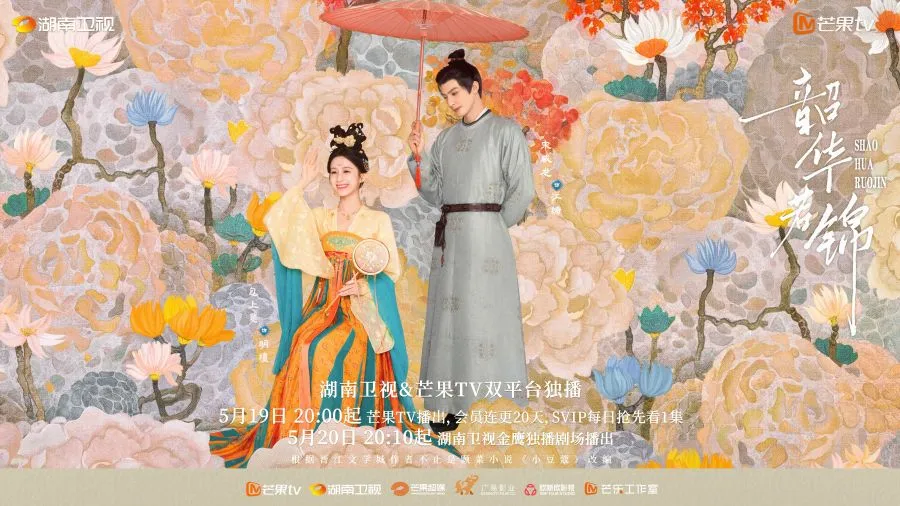
Youthful Glory Poster - Courtesy of Hunan TV

|
DetailsRATING: (6.5/10)
NATIVE TITLE: 韶华若锦 – Sháohuá ruò jǐn YEAR: 2025 EPISODES: 30 + Epilogue DURATION: 45’ DIRECTOR: Min Guo Hui, Qie Guo Wei SCREENWRITER: Zhu Yi, Liu Jia ORIGINAL CREATOR: Bu Zhi Shi Ke Cai (小豆蔻 - Young Cardamom) |


IN A NUTSHELL
- What to expect: Youthful Glory is one of those dramas that seems to promise a gripping tale of court intrigue and military strategy, only to gradually transform into a light-hearted romance filled with familiar situations. Through the marital vicissitudes of Jiang Xu and Ming Tan, the story takes the viewer on a journey of difficult choices, tested ideals, and dreams to be defended against the backdrop of a court dominated by the ambitions of the powerful Su family. While these premises create an engaging tale, they too often end up being sacrificed in favor of a narrative dominated by stereotypes. The bombastic speeches, the archetypal characterizations, and the constant emotional skirmishes between the protagonists end up taking away space and impact from the political component, which remains one of the most interesting yet least appreciated aspects of the entire drama.
- Strengths: the political storyline, the secondary love stories, the cast.
- Weaknesses: the stereotypical characterization of the characters, the lack of maturity of the main love story, the overuse of romantic clichés.
- Recommended if you like: fluffy romances, love triangles, arranged marriages that turn into real bonds, ensemble dramas, supportive emperors, happy endings.
- Would I rewatch it? No, it's not my thing.
Read on to see if you might like this drama.
From court conspiracies to arranged marriages and power struggles, Youthful Glory takes the viewer on a journey of political intrigue and romantic skirmishes. Yet, just when the political struggle seems set to take over, Youthful Glory continually draws attention to the love stories of its protagonists, prioritizing romance over intrigue and often leaving the feeling of under-exploited potential.
In this review of the drama Youthful Glory, after watching all episodes, I explore the writing, direction, and performances to determine whether the constant alternation between romantic moments and action sequences makes this series a must-see or just another love story.
Plot
After eight years of guarding the northern borders of Da Xian, Jiang Xu, Prince of Dingbei and commander of the Dingbei Army, returns to the capital to investigate a case of embezzlement of military funds involving his soldiers' wages.
On the outskirts of the city, he encounters Ming Tan, legitimate daughter of the Marquis of Jing'an, who unwittingly helps him escape the Haiyou Sect assassins who are tracking him, only to abandon him wounded in the woods for fear of compromising her own reputation.
When the two meet again, Jiang Xu, now aware of the girl's identity, helps her obtain the annulment of her engagement to Liang Zi Xuan, the husband chosen for her by her devious godfather, Su Wan Chun, the Left Prime Minister of Da Xian, thus derailing the latter's political plans.
To prevent the minister from trying to exploit again Ming Tan's marriage as a tool to seize the military power of the Marquis of Jing'an, Jiang Xu proposes to her a marriage of convenience, based on an agreement that excludes any romantic involvement. Ming Tan decides to accept, but as time passes, the relationship between the two deepens, and what was supposed to be a simple marriage of convenience takes a completely unexpected turn.
While Prime Minister Su continues to plot in the shadows to eliminate the couple and maintain control of the court, Jiang Xu and Ming Tan can count on the help of the prince's three childhood friends, her cousin, and the secret support of the Emperor. Together, they succeed in unmasking the powerful minister's plots, but their union will face a new threat with the arrival of the Crown Prince of Nanlv, who, in furthering his plan to conquer Da Xian, falls in love with Ming Tan and is determined to make her his consort.

Youthful Glory Drama Review (No Spoilers)
Plot and Narrative Pace
Youthful Glory is a classic romantic drama in which political intrigue serves as a backdrop to the daily lives and endless romantic entanglements of the protagonists and co-protagonists.
The story of the minister who holds the entire court, including the Emperor, in check, and his supporters who commit the worst atrocities to elevate their own status isn't bad; the problem is that the drama seems to treat it more as a narrative pretext than the true driving force of the story. Whenever political tensions begin to escalate or power struggles begin to produce concrete consequences, the narrative invariably deviates towards the protagonists' romantic anguish, interrupting the pace and dissipating much of the engagement built up to that point.
The romantic dynamics, for their part, are rife with the usual genre clichés: easily avoidable misunderstandings, predictable jealousies, ostentatious sacrifices, and lengthy emotional confrontations that rarely add anything new to the characters' characterizations. The result is that many scenes end up feeling repetitive and take up narrative space that could have been devoted to deepening the political conflicts.
The screenplay also struggles to capitalize on the source material. The plot often follows easily predictable patterns, and the dialogue, even at the fulcrum of the scene, comes across as excessively rhetorical and banal. Rather than emerging from the characters' personalities or the complexity of the situation, many lines seem written to directly communicate lessons about the values that drive the story to the viewer. This makes the scenes predictable and lack the dramatic tension that a courtly tale and power struggle would require.
Characters and Love Story
This problem is further exacerbated by rather weak character development. Most characters are built around recognizable archetypes and rarely break the rules of the genre. This results in a collection of characters with stereotypical behaviors, often familiar and, at times, even annoying.
The female protagonist is probably the most problematic case. Although the drama attempts to present her as a lively and spontaneous young woman, the end result is a character who is often superficial, selfish, and prone to childish behaviors that end up making her difficult to empathize with. Many of her decisions seem driven more by the need to create romantic conflict than by any real maturity.
The main relationship also suffers from this approach. While undoubtedly sweet and designed to evoke tenderness in the viewer, it struggles to convey the feeling of a relationship between two adults. The protagonist's initially overly modest and subsequently capricious attitudes combine with the constant displays of jealousy and almost obsessive attentions of the male protagonist, creating a dynamic that consistently prioritizes romantic fanservice over the couple's authentic emotional development.
Paradoxically, the secondary relationship between Bai Min Min and Zhang Huaiyu is much more enjoyable to follow. Bai Min Min's more direct and determined personality pairs well with Zhang Huaiyu's awkward and clumsy nature, creating more spontaneous and less artificially saccharine interactions.
At the other extreme is the second male protagonist, whose unconditional and almost worshipful love for the female protagonist quickly becomes repetitive and irritating.
From a romantic perspective, then, Youthful Glory will likely satisfy viewers looking for a fluffy romance built around all the genre's most popular clichés: a male protagonist completely devoted to the woman he loves, a capricious female protagonist who constantly directs his actions, and a love triangle fueled by an equally adoring second male protagonist willing to sacrifice everything for her. Those seeking a more mature, balanced, and believable love story, however, will hardly find what they're looking for in this drama.

Cast
Youthful Glory boasts an overall solid cast that often manages to make characters who on paper don't exactly shine for their depth or originality enjoyable to follow. Unfortunately, however, not even the actors' commitment can fully compensate for the weaknesses of a screenplay that tends to construct extremely stereotypical characters and sacrifice character coherence for the romantic demands of the plot.
Song Wei Long probably delivers one of his most convincing performances in recent years, aided by Zhang Fu Zheng's excellent voice acting, which gives the character a presence and authority he would otherwise have struggled to achieve. The romantic scenes work quite well thanks to the actor's undeniable charm and the natural ease with which he portrays moments of seduction and intimacy. At times, however, he tends to overemphasize the character's bewitching side with overly studied glances and smiles, which end up seeming incompatible with Jiang Xu's disciplined nature.
Bao Shang En faces a more challenging task, having to lend credibility to a protagonist who is often the victim of questionable script choices. The actress strives to make Ming Tan lively and likable, but constantly struggles with a script that turns her into a caricature and irritating figure, much more so than would be desirable. This is a shame, because she had previously demonstrated her acting chops in much better-crafted roles, such as the one that brought her to the masses in Love Behind the Melody.
Confirmation comes from Dai Lu Wa, who, once again, stands out with a spontaneous, energetic, and natural performance. As she did in Lost You Forever, brings freshness to the character and manages to make him believable without ever falling into excess or affectation, helping to make Bai Min Min one of the most likable characters in the entire series.
Less fortunate is Sun Ju Zun, who finds himself playing a character with interesting potential but is gradually reduced to the role of the second lead eternally in love with the protagonist. The actor still does his job with dignity, but the writing almost never gives him the opportunity to show nuances beyond the sentimental obsession that defines his character. This limitation is even more evident when compared to the actor's more complex and multifaceted roles in the past (including in Si Jin).
Among the surprises in the cast, Qin Xiao Xuan also deserves a mention. Besides possessing a particularly photogenic face, which will likely guarantee him further opportunities on Chinese television, he also demonstrates a more than promising stage presence and acting ability.
Finally, as is often the case, it is the veterans who provide the most solid performances. Li Hong Tao, as Ming Tan's father, and Xiu Qing, as the ambiguous and manipulative Prime Minister Su, offer measured, believable, and technically impeccable performances that help maintain a certain level of quality even when the writing shows all its limitations. Their experience clearly emerges and represents one of the most evident strengths of the entire production.
Visual Aspects and Soundtrack
From a visual point of view, Youthful Glory proves to be a solid production, even without standing out for particular artistic ambitions. The direction carries out its task with professionalism, constructing clear and easily legible sequences and using shots that adequately enhance the environments and characters. Even though it lacks particularly innovative or memorable stylistic solutions, it still manages to effectively support the narrative and ensure smooth viewing. The cinematography also contributes positively to the overall result. The choice to favor a relatively balanced color palette, free of the excessive saturations that characterize some recent productions, gives the series a visually pleasant appearance. At the same time, the lighting maintains a certain softness which, although not always completely realistic, avoids that artificial and dazzling effect that often penalizes contemporary historical dramas.
The external settings are convincing and well integrated into the story, while the sets appear rich and carefully decorated. Although the objective seems to be more to build an aesthetically pleasing context than to recreate with absolute rigor the daily life of the time, the result remains credible and contributes to giving consistency to the narrative world. The same goes for costumes and hairstyles inspired by the Tang dynasty: although they do not give the impression of pursuing extreme historical accuracy, they stand out for their manufacturing quality, stylistic coherence and attention to detail, significantly enriching the visual impact of the series.
However, one of the strong points of the production remains the action scenes. The fights are carefully choreographed and manage to convey a pleasant feeling of dynamism without sacrificing the readability of the scene. In particular, Song Wei Long proves surprisingly at ease in the kung fu sequences, giving the fights a physicality and stage presence that contribute to increasing their effectiveness. Although some sequences sometimes tend to indulge in a certain spectacular emphasis, they remain among the most visually satisfying moments of the entire drama.
The soundtrack of Youthful Glory perfectly reflects the general setting of the drama: pleasant to listen to but rarely able to stand out from the crowd of contemporary romantic productions.
In fact, a large part of the songs and accompanying music make use of extremely codified solutions, based on slow and melancholic melodies, highly sentimental arrangements and poignant vocal interpretations. The orchestrations combine Western instruments with short interventions or solos of traditional Chinese instruments, obtaining an overall harmonious but also rather predictable result. Although these pieces adequately fulfill their function of emotional accompaniment, they hardly manage to leave a lasting impression on the viewer.
More interesting is 锦画 (Brocade Painting), the instrumental song chosen as the drama's opening theme. Unlike the rest of the soundtrack, this composition manages to evoke an atmosphere with an almost wuxia flavor thanks to the balanced fusion between traditional Chinese string and wind instruments and the strings of the Western orchestra. The result is an elegant, dynamic and vaguely adventurous melody that immediately recalls the world of historical and chivalric tales. Paradoxically, this piece manages to convey that sense of intrigue that the series could have enhanced more even on a narrative level, clearly distinguishing itself from an otherwise too conventional soundtrack.

WARNING!
FROM THIS POINT ON THE SPOILER SECTION BEGINS. DO NOT CONTINUE IF YOU DO NOT WANT TO KNOW ALL THE DETAILS OF THE DRAMA.
Youthful Glory Drama Review (Spoilers)
What Works
The Premise
I believe one of the greatest strengths of Youthful Glory lies in its premise. The idea of intertwining a marriage of convenience with a tale of political corruption, power struggles, and court intrigue offers numerous interesting insights and allows for a story that alternates moments of tension, investigation, and strategy with a lighter romantic element.
The roles assigned to the protagonists are also well-conceived: Jiang Xu is not only the hero called upon to protect his beloved, but a military commander forced to confront a web of interests that threatens the stability of the entire empire, while Ming Tan finds herself caught up in a political game far bigger than herself. In the background, we see a Prime Minister willing to do anything to retain power, a court now bent on corruption, and a foreign kingdom ready to exploit Da Xian's internal divisions.
It's a premise rich in potential that, at least on paper, suggests a story focused as much on intrigue as on the development of its characters. Precisely for this reason, I regretted that the screenplay too often chose to sideline these elements, focusing almost exclusively on romantic dynamics and clichés. Rather than the premise, it is its development that represents the series' true limitation: with bolder writing and greater attention to the political component, Youthful Glory could probably have stood out much more than it actually managed to do.
The Secondary Love Stories
Another aspect I most appreciated about Youthful Glory is the secondary couples. As I've noticed in several romantic dramas in recent years, they end up being more convincing and interesting than the main couple. Despite taking up less screen time, their relationships evolve more believably and their emotional conflicts are more consistent with the plot.
In particular, I found the story between Bai Min Min and Zhang Huaiyu to be very successful. The two meet under far from amicable circumstances, and Min Min's impulsive and impetuous nature certainly doesn't facilitate the formation of a harmonious relationship. Precisely for this reason, however, their rapprochement seems gradual and realistic. The misunderstanding of the love talisman creates a series of amusing situations that allow the two to get to know each other better, and as time passes, the initial antipathy gives way to sincere affection. It's especially when Zhang Huaiyu is presumed dead that Bai Min Min realizes how important the man she'd always dismissed as a foolish dandy with a fan has become to her.
The relationship between Shu Jing Ran and Yun Yi also seemed deeper than expected. Although Shu Jing Ran is immediately captivated by the mysterious beauty she discovers eating chicken on the roof of the Jiang residence, what makes this story especially interesting is Yun Yi's perspective. Unlike many romantic heroines, her hesitations stem not from simple misunderstandings or fleeting whims, but from the wounds left by her past and from her awareness of the profound social differences that separate her from the man who courts her. Her refusal to give in to her feelings is thus justified by understandable fears and insecurities that give greater emotional depth to their relationship.
These two stories inevitably end up highlighting the limitations of the main couple. The relationship between Ming Tan and Jiang Xu, despite being the drama's fulcrum, often seemed poorly contextualized and rather superficially constructed. Beyond the numerous romantic clichés that characterize it, what I found less convincing was the speed with which the two protagonists give in to their mutual feelings. Both seem to fall in love almost suddenly, without the drama devoting sufficient attention to the journey that should lead them to change their initially negative opinion of each other. Jiang Xu, in fact, considers Ming Tan a superficial young woman obsessed with rank and appearances, while she views him as cold, arrogant, and lacking in empathy. Yet these prejudices vanish surprisingly quickly, without any real process of mutual understanding capable of justifying such a radical change.
Even after marriage, their relationship continues to progress through a succession of closenesses and separations that I often found frustrating. Many of the conflicts that separate them arise from easily avoidable misunderstandings, impulsive reactions, or immature behaviors that seem to exist more to fuel romantic tension than to reflect true character development. For this reason, I've often found the stories of the secondary couples more engaging than the main story: despite having less screen time, they give more of the sense of recounting the journey of two people truly learning to know, trust, and fall in love with each other.

What Doesn't Work
The Character Development
The main flaw of Youthful Glory lies in the mediocre and stereotypical characterization. Rather than individuals with coherent and multifaceted personalities, the protagonists seem to embody a series of typical romance archetypes, constructed to fuel certain emotional dynamics rather than to behave like believable people.
Ming Tan is the most obvious example of this. The drama attempts to present her as an intelligent, virtuous, and conventional young noblewoman, but many of her actions end up conveying the opposite impression. Her obsession with personal and family reputation reaches levels that are difficult to justify: she even abandons the injured Jiang Xu in the middle of the woods, exposed to enemies, in order to avoid potential gossip related to the presence of a man in her carriage. Likewise, she rejects Shen Yu, who sincerely loves her, primarily because her station does not meet her social expectations, only to agree to marry Jiang Xu after discovering that, in addition to being a prince, he is also charming and cultured.
Even more frustrating is the inconsistency with which her relationship with the protagonist is handled. After imposing a prenuptial agreement that excludes any intimacy between the spouses, she is the one who publicly complains that her husband does not pay enough attention to her, even going so far as to spread rumors of his supposed impotence. Situations that could be addressed through dialogue instead become occasions for public tantrums, sarcasm, and artificial misunderstandings, as demonstrated by her reaction to Yun Yi's arrival at the residence.
The problem is not that Ming Tan makes mistakes or has flaws; on the contrary, imperfect characters can be extremely interesting. The problem is that the drama never seems to acknowledge the questionable nature of her behavior and continues to treat her as if she were always right. Her lack of trust in Jiang Xu, even during the most delicate moments of the political situation, rarely produces significant consequences or pushes the character to truly mature.
Furthermore, for much of the series, she is reduced to the role of a girl in need of rescue, incapable of managing dangerous situations independently and constantly dependent on her husband's intervention. It's such a traditional and passive portrayal that it almost makes one long for the opposite excess of certain "girl boss" protagonists in more recent dramas.
Jiang Xu, for his part, does not escape the typical clichés of the romantic protagonist. In the first part of the story, he appears as a controlled man, respectful of the agreements made with his wife, but soon his personality is gradually absorbed by the role of the perfect husband. His every thought and action ends up revolving around Ming Tan. The jealousy he displays toward any man who approaches his wife is presented as a proof of love rather than a problematic trait, while his constant preoccupation with her sometimes reaches almost caricatural levels. In the final part of the drama, he seems incapable of focusing on any other matters, including political and military responsibilities, which should theoretically be his primary concern, simply because he discovers his wife is pregnant.
Even more extreme is the case of Puruo Wen Zong, perhaps the character who best embodies the drama's tendency to confuse obsession with romance. His feelings for Ming Tan are so absolute and all-encompassing that they are unintentionally grotesque. After conquering part of the enemy's territory, he continues to treat her with an almost reverential deference, walking with her as if they were the protagonists of a romantic outing rather than enemies belonging to opposing sides. He later attempts to convince her to abandon her husband to become his consort, even though she is already pregnant with Jiang Xu. The climax is reached at the end of his narrative arc: while his bodyguard desperately tries to save him by using Ming Tan as a hostage, he suddenly decides that nothing matters anymore, sacrifices his attendant, and commits suicide because life without the woman he loves would be meaningless. A conclusion that aims to appear tragic and romantic but ends up being simply absurd, especially because it requires the viewer to accept that a man would set aside all political ambition, all responsibility, and even all survival instinct for a woman who has never loved him.
Overall, then, the characters in Youthful Glory don't seem to live according to the story the drama tells, but according to the romantic clichés the script seeks to portray. For this reason, their choices often seem artificial, predictable, and unbelievable, ultimately weakening both the sentimental and political components of the narrative.
The Overuse of Clichés
Further weighing on the series' credibility is the almost incessant recourse to familiar narrative situations and dynamics. While not inconsistent, the plot often feels cobbled together from elements from other successful productions, rather than developing its own identity. The entire story unfolds with one of the most overused devices of historical dramas: the prince who, after years spent defending the empire's borders, suddenly returns to the capital to investigate a conspiracy involving the highest levels of the court. This narrative core is then given rise to a series of equally predictable developments, from the protagonist's annulment of her engagement due to her future husband's infidelity to the fake death of an important figure used as bait to force the true antagonist to reveal himself.
Not even the romantic component attempts to explore less traveled paths. The relationship between Ming Tan and Jiang Xu develops through a long succession of clichés well-known to genre fans: from the male protagonist's almost immediate crush, to his rescue by the female protagonist under fortuitous circumstances, to the constant alternation of closeness and estrangement built on easily avoidable misunderstandings, and then the inevitable jealous scenes, the presence of a second male protagonist in love, and the obsession of the female rival. Even the protagonist's kidnapping by her romantic rival, rather than introducing a real moral or psychological conflict, ends up reviving already well-established dynamics.
The problem, in reality, is not the presence of clichés themselves—almost every romantic drama uses them to a greater or lesser extent—but the way they are employed. Youthful Glory rarely attempts to rework, subvert, or enrich them with new nuances. Most of the events, in fact, appear to function solely to reproduce emotions and situations that the audience has already experienced dozens of times elsewhere. As a result, many developments feel predictable well in advance, and the narrative struggles to generate the curiosity that should drive the viewer to want to find out what happens next. Rather than telling a story of its own, the drama seems to simply faithfully retrace a repertoire of tried-and-true formulas, without adding anything particularly memorable.
Ending
Another aspect of Youthful Glory that left me rather perplexed is the ending. Emotionally, the series concludes in a satisfying way: Lingzhou is reconquered thanks to the intervention of the Marquis of Jing'an, Ming Tan is saved, Puruo Wen Zong chooses a tragic outcome by committing suicide after declaring that, just as there was no future for him without the woman he loved, Nanlv was also doomed to ruin. Meanwhile, Liu Mo finally avenges his father's death by killing Su Wan Chun and Si dage; Jiang Xu foils the plot hatched by Guo Bing Mao and the Prime Minister to assassinate the Emperor during a hunting trip and is surprised to discover that his wife is pregnant; Ming Chu comes to his senses and obtains her husband's forgiveness; Bai Min Min and Zhang Huaiyu decide to marry, and Shu Jing Ran finally finds the courage to confess her feelings to Yun Yi. The drama even devotes a short final episode to exploring the future of the main couples, revealing that Ming Tan and Jiang Xu will have two children, a boy and a girl, and that Bai Min Min and Zhang Huaiyu will also start a family.
The problem is that this meticulous care in wrapping up each individual romantic relationship contrasts with the surprising superficiality reserved for some of the plot's political mysteries. Numerous questions surrounding the main conspiracy remain unanswered or are dismissed too hastily. Who was Si Dage really? What role did Min Cong play, and why did Su Wan Chun want to eliminate him at all costs? Why had the Prime Minister chosen as his disciple the son of the man sacrificed as the scapegoat for Min Cong's death? What was Puruo Wen Zong's true goal during his stay in Lingzhou? And above all, what exactly was the plan to conquer Nanjing, and what role was the Su family supposed to play?
These questions, in my opinion, are important because they concern the very mechanisms that set the entire story in motion. The fact that they remain largely unanswered gives the impression that the screenplay emphasized the romantic component until the very end, considering it the only truly essential element. It's a choice that, while ensuring a reassuring conclusion to the love stories, inevitably ends up weakening the political plot and leaving the feeling of an ending only partially resolved.

Characters and Cast
Primary Characters
Ming Tan/A’Tan (Bao Shang En) Fourth Miss of the Residence of the Marquis of Jing’an and the only legitimate daughter of the Marquis. She grew up alone in the capital while her father was guarding Yangxi Road and could only count on the affection of her uncles and the help of her godfather Su Wen Chun. Despite this, she is very fond of her father so much that she will not be able to overcome his presumed death in prison and will bear a grudge against her husband until he reveals the truth to her. In Lingzhou she will help Jiang Xu to expose the shady dealings of the Su Family, but will be taken hostage by Puruo Wen Zong when he conquers the city.
Jiang Xu/Qi Zhi/A’Xu (Song Wei Long) Prince of Dingbei and General of the Dingbei Army. After guarding the northern borders of Da Xian for eight years, he returns to the capital to shed light on the case of embezzlement of military funds involving the wages of his soldiers. During his journey he will run into Ming Tan and, although he initially considers her haughty and superficial, he will eventually fall in love with her.
Bai Min Min (Dai Lu Wa) daughter of the Imperial Duke of Chang and cousin of Ming Tan. She is her best friend and, when the girl marries Jiang Xu, she will often find herself dealing with Zhang Huaiyu, best friend of the Prince, with whom she will eventually fall in love.
Zhang Huaiyu/A’Yu (Bai Shu) heir apparent of the Duke of Ping, younger brother of the Empress and friend of Jiang Xu. He is an idle and frivolous nobleman and manages the Beiyu and Wentao Pavilions on behalf of the Prince of Dingbei. When Jinag Xu marries Ming Tan he will often have dealings with Bai Min Min and, in the end, he will fall in love with her. On the Emperor’s orders he will go to Lingzhou to investigate the crimes of the Su Family risking his life, but in the end he will return safe and sound to the capital and ask for Min Min’s hand in marriage.
Shu Jing Ran/Shu’er (Quan Yi Lun) Second Young Lord of the Shu Residence, son of the Right Prime Minister and friend of Jiang Xu. He ranks third in the Imperial Examination and is appointed as the Extender of the Hanlin Academy. During a visit to the Residence of the Prince of Dingbei he falls in love at first sight with Yun Yi and eventually manages to take her with him when he is transferred to Lingzhou as the new Prefect.
Yun Yi (Ke Ying) Jinyun Guards agent who pretends to be the concubine of the Prince of Dingbei to protect Ming Tan. She is an orphan girl raised by Jiang Xu and when she realizes that she has fallen in love with Shu Jing Ran, she struggles to accept him because of the difference in rank between them.
Wen Zong/Puruo Wen Zong (Sun Zu Jun) the most famous middleman in the Lingzhou market who procures contraband goods from Nanlv for the Su Family. He is actually the Prince of Nanlv who has infiltrated Da Xian in search of an opportunity to invade the enemy.
Supporting Characters
Marquis of Jing'an Residence
Ming Ting Yuan (Li Hong Tao) Marquis of Jing’an, holds the military command of the Yangxi Road Army on the southern border of Da Xian. He is very fond of Ming Tan, but his absence from home for five years has caused her to become somewhat estranged from him. To save him from the death sentence imposed on him due to the collapse of the Lizhou Dam, Jiang Xu will fake his poisoning in prison, but this will cause deep pain to Ming Tan. To save the Empire from the invasion of Nanlv, he will resume command of his army and enter Lingzhou in force, conquered by the enemy, liberating it.
Bai Fei Yuan, deceased Marchioness of Jing’an and mother of Ming Tan.
Su Xin (Chen Nuo) and Lv’e (Li Jia Jia) personal maids of Ming Tan.
Nanny Zhang (Yan Jing Yao) housekeeper of the Residence of the Marquis of Jing’an who took care of Ming Tan during the years in which the Marquis was away from home.
Lady Liu (Wu Qian) Concubine of the Marquis of Jing’an and mother of Ming Chu. She is sneaky and manipulative so much that she will try to have Ming Tan kidnapped by bandits to compromise her reputation and ruin her wedding with Jiang Xu. To punish her the Prince will have her sent to a convent in Mei’an where the second brother of the Marquis lives.
Ming Chu/Chu Chu (Wang Ke) Third Miss of the Marquis of Jing’an Residence. She is so stubborn and selfish that she will try in every way to ruin her sister’s wedding so that she can marry the Prince of Dingbei with whom she has a crush. To punish her, the Prince will marry her to the third son of General Xuanwei stationed in the prefecture of Lingzhou.
Imperial Duke of Chang's Residence
Bai Jing Yuan (Peng Bo) Imperial Duke of Chang, father of Bai Min Min and uncle of Ming Tan. He is the brother of the late Marchioness and is very close to his niece.
Bai Qi (Mei Ling Zhen) Imperial Duchess of Chang, mother of Bai Min Min and aunt of Ming Tan.
Bai Hao Yu (Deng Zhi Hao) heir apparent of the Imperial Duke of Chang and older brother of Bai Min Min.
Prince of Dingbei's Residence
Jiang Ding and Jiang Kou/Kou Kou (Ruo Hui) son and daughter of Jiang Xu and Ming Tan.
Uncle Fu (Yu Qing) butler of the Residence of the Prince of Dingbei.
Chai Gui (Shangguan Yun Jie) personal valet of the Prince of Dingbei.
Shen Yu (Li Jun Jie) deputy general of the Dingbei Army and cousin of Ming Tan. He is in love with his cousin and wants to ask for her hand but she rejects him, so he asks Jiang Xu for help and the latter punishes him severely because he already plans to marry Ming Tan.
Shui Ying (Chen Xin Yu) leading courtesan of the Beiyu Pavilion entertainment house. In reality, she is an undercover agent of the Jinyun Guards, a secret military corps created by the Prince of Dingbei that has its base in the Beiyu Pavilion.
Zhui Ying (Tian Yu Wei) head of the Jinyun Guards who helps Jinag Xu in his secret investigations and acts as his bodyguard.
Zhui Yu (Xu Jun Zun) Jinyun Guards agent in charge of protecting Ming Tan in Lingzhou while Yun Yi is a prisoner of the Su.
Zhui Feng (Yu Hou Pu) Jinyun Guards agent.
General Xuanwei's Residence
Feng San Lang (Tan Jian Chang) General Xuanwei stationed in Lingzhou and father-in-law of Ming Chu.
Feng Xu Lin (Cao Jing Hao) third son of General Xuanwei. She will marry Ming Chu, but will have a lot of trouble managing her whims and recklessness.
Ling Zhi (Liu Wan Tong) Ming Chu’s personal maid at the Feng Residence.
Su Residence
Su Wen Chun (Xiu Qing) Left Prime Minister of Da Xian, elder brother of the Empress Dowager and godfather of Ming Tan. His family is very powerful and enjoys the support of many ministers and officials at court, however he will have to face the strong opposition of the Prince of Dingbei, determined to eradicate corruption from Da Xian.
Zhang Yun Ru (Li Jia Wei) wife of Su Wen Chun and godmother of Ming Tan.
Su Er Rong (An Dong) daughter of Su Wen Chun who lives in Lingzhou, fiefdom of the Su Family and controls all the maritime routes of the Prefecture. She has contacts with Nanlv and is in charge of hiding the funds stolen by her father and the corruption of officials.
Yu Bo Zhong/Hai Shen (Li Fei Yang) son-in-law of Su Wen Chun and director of the Ship Bureau of Lingzhou. In reality, he is the leader of the Haiyou Sect (Hidden Sea Sect), a sect of assassins in the pay of Su Wen Chun.
Liu Wu (Xu Nai Yu) head of the guards of the Su Residence in Lingzhou.
Liu Mo (Qin Xiao Xuan) Vice Minister of Revenue of Da Xian and disciple of Prime Minister Su. He is an orphan originally from Cen Village in Fang County of Qingzhou who, after being left alone, moved to the capital where he received the unexpected help of a certain Si dage, subordinate of Su Wen Chun.
Yan Chang Rong, father of Liu Mo. He was a scout of the Dingbei Army sent to request reinforcements during a battle. Due to the delay in delivering the message, the troops led by Prince Min Cong had perished in the clash but, following in-depth investigations, Emperor Tai Zong had discovered that he had been drugged during a stop at a post station and that his death in prison was a murder disguised as suicide.
Si Guo/Si dage (Mao Fan) assassin in the pay of Su Wen Chun who, on the orders of the Left Prime Minister, had killed Yan Chang Rong and then helped Liu Mo when he arrived in the capital, orphaned and without means.
Duke of Ling's Residence
Liang Qi Wei (He Qiang) Duke of Ling. He is one of the allies of the Left Prime Minister who promised him a position for his son in exchange for his compliance to become the father-in-law of Ming Ting Yuan.
Li Ling Yi (Zhang Yuan Yu) Duchess of Ling and mother of Liang Zi Xuan. She promises Zhu’er to become Liang Zi Xuan’s concubine after he marries Ming Tan to repay the girl’s father for helping to cover up the Duke’s crimes.
Liang Zi Xuan (Sun Zi Hang) heir apparent of the Duke of Ling. Although he is Ming Tan’s fiancé, he is expecting a child from his cousin Zhu’er, whom he would like to take as a concubine after the official marriage.
Zhu’er (Luo Yu Tian) Liang Zi Xuan’s cousin, is expecting a child from him. She hopes to become his concubine after he marries Ming Tan, but she is banished from the Residence and almost killed to prevent the Marquis of Jing’an from finding out and canceling the engagement. To ensure a future for her son, she decides to help Ming Tan annul his marriage agreement and convince her father to report the crimes committed by the Duke of Ling.
Chen Si (Fan Jia Liang) servant of the Residence of the Duke of Ling. To force Ming Tan to marry Liang Zi Xuan, he pushes the girl into the Xian River so that the Young Duke can save her, compromising her reputation. Fortunately she can swim and manages to reach a hidden point in the river where Jiang Xu saves her without being noticed.
Imperial Court
Su Xu Jin (Liang Ai Qi) Empress Dowager, younger sister of Su Wen Chun.
Zhang Huai’ai (Sha Xuan) Empress of Da Xian and sister of Zhang Huaiyu.
Jiang Heng (Edward Zhang) Emperor Chengkang of Da Xian. He is aware of the corruption that is rampant in the court and the excessive power of the Su Family and tries to fight it with the help of Jiang Xu.
Liu Yiding (Zhang Huai Gong) Palace Attendant and Chief Eunuch.
Zhai Nian Ci (Li Shu Ting) Princess of Fengzhao Commandery, granddaughter of the Empress Dowager. She is promised in marriage to Gao Chen, the vicious eldest son of the Marquis of Jiangyang, to form a marriage alliance, but she does not accept it and decides to offer her fiancé Ming Tan in her place.
Lu Ting/A’Lu (Yang Bo Xiao) Deputy Commander of the Imperial Guards and friend of Jiang Xu.
Shu Wei (Li Bo) Right Prime Minister of Da Xian and father of Shu Jing Ran. He is a very upright and prudent man and always tries to give the Emperor the best advice.
Zhang Qian (Zhong Ming) President of the Court of Judicial Review (Dali Si) of Da Xian.
Chang Yun Fu (Ding Zheng Yong) Imperial Censor of Da Xian and ally of Prime Minister Su. He tries in every way to put the Prince of Dingbei in difficulty during court meetings.
Tan Lun (Guo Dong Hai) Deputy Minister of the Secretariat and Imperial Inspector in charge of investigating the shady dealings of the Su Family in Lingzhou.
Other Characters
Wu You (Li Su) Jingji County Magistrate of Jingzhao Prefecture. He is an ally of the Marquis of Cheng’en and will try to prevent Jiang Xu from reaching the capital, but will be killed.
Guo Bing Mao (Leng Hai Ming) deputy commander of the Yangxi Road Army. He is convinced by Su Wen Chun to betray Ming Ting Yuan and to testify the latter’s involvement with the enemies of Nanlv. Once appointed commander of the Yangxi Road Army at the instigation of Su Wen Chun he will try to rebel against the Emperor, but Jiang Xu will stop him. His defection will allow Puruo Wen Zong to cross the borders of Da Xian and take over Linzhou.
Gu Jin Zhong (Chen Zhi Hui) Marquis of Cheng’en, Governor of Jingzhao. He is a supporter of Prime Minister Su, but will be framed by Jiang Xu for having bribed Hu Chang Mao, the Chief Examiner of the Imperial Examination, and having had his son illegally promoted. During the investigation it will be discovered that the money used to bribe the Chief Examiner belonged to the military funds improperly embezzled from the army.
Gu Wen Yan (Feng Jian Yu) idle heir of the Marquis of Cheng’en, son of a concubine of Gu Jin Zhong. Because of his indolence, his father is forced to bribe the Chief Examiner of the Imperial Examination to make him pass the exam, but Jiang Xu discovers this and frames them. He will be killed by the head of the Haiyou Sect in an attempt to recover the evidence in the possession of the Marquis that links Prime Minister Su to the embezzlement of military funds.
Gu Jiu Rou (He Shi) legitimate daughter of the Marquis of Cheng’en and friend of Ming Tan. To avoid the death penalty for the crimes committed by her father, she will collaborate with Jiang Xu to expose the corrupt minister hiding at court.
Gao Bin (Duan Ran) Marquis of Jiangyang. He has lived for years in the remote region of Shu, for this reason, he is chosen by Su Wen Chun to replace Gu Jin Zhong as governor of Jingzhao.
Gao Chen (Wang Cha Cha) eldest son of the Marquis of Jiangyang. He is vicious and lascivious but he is the precious heir of the Marquis and Su Wen Chun wants to exploit this fact to gain his father’s loyalty. A marriage is then arranged for him with Princess Zhai Nian Ci but she does not accept it and tries to offer him Ming Tan in her place. Fortunately, the girl is saved by Jiang Xu who, to teach him a lesson, castrates him.
Zhang Xue Jin, Prefect of Lingzhou and ally of the Su Family.
Li You, Supervisor of Lingzhou and ally of the Su Family.
Zhang Dao Yuan, Governor of Lingzhou and ally of the Su Family.
Yin Shi, Deputy Director of the Lingzhou Ship Bureau. He holds the secret records of maritime trade that record the amount of bribes paid by merchants to the Ship Bureau as well as the amount of military funds and disaster relief misappropriated by the Su Family over the past ten years.
Wang Wang and Pang You, officials of the Lingzhou Ship Bureau and associates of Yin Shi.
Zhou Bao Ping, former Deputy Director of the Lingzhou Ship Bureau killed by the Sus because he had discovered the list of officials corrupted by their family and wanted to report them
Qiu Yue (Liu Jin Yan) musician of the Muchun Pavilion who had started a relationship with Zhou Bao Ping shortly before he came into possession of the list of officials corrupted by the Su Family and was killed by the Sus.
Qing Yu (Cao Sai Ya) courtesan at the Hui Entertainment House in Lingzhou who works for Su Rong Er. He initially agrees to frame Jiang Xu for Yin Shi’s murder, but then changes his mind and decides to help the Prince expose the Su family’s crimes to the Imperial Inspector.
Shopkeeper Luo (Liu Yong Gang) he runs the Fulu Shop in Lingzhou, owned by the Su Family. He is actually a citizen of Nanlv who helps Prince Puruo Wen Zong smuggle goods from his hometown into Da Xian.
Zeng Shu (Jiang Xiao Lin) Puruo Wen Zong’s bodyguard.
Er Bao (Ke Bo Lun) head waiter of the Wentao Pavilion and assistant to Zhang Huaiyu.
Zhang Rong (Zhao Ling Han) eldest son of Zhang Huaiyu and Bai Min Min.

Favorite Character: Bai Min Min
She is undoubtedly one of the most successful characters in Youthful Glory. Outspoken, impulsive, and determined, she faces every obstacle with courage and a touch of recklessness that makes her the perfect foil to the more cautious Ming Tan.
Although she isn't particularly thoughtful and sometimes lets herself be guided by instinct, she demonstrates great loyalty towards those she cares about. For Ming Tan, she represents a constant point of reference: she is always ready to listen, support, and offer her help without ever holding back.
Endowed with a strong sense of justice, she doesn't passively accept injustices and doesn't hesitate to assert herself, even when this means confronting people of much higher rank than her own.
Behind her exuberant personality, however, lies a surprisingly sensitive girl who prefers to keep her feelings hidden rather than show them openly. This nature emerges clearly in her relationship with Zhang Huaiyu. The two meet under far from amicable circumstances, and Bai Min Min's impetuosity certainly doesn't help foster a good relationship. However, the curious misunderstanding of the love talisman ultimately brings them closer, and Zhang Huaiyu's supposed death makes her realize how much she has grown attached to the man she had always dismissed as a "foolish dandy with a fan."
Similarly, she experiences a certain embarrassment over not possessing her cousin's culture and refined artistic talents, sometimes fearing she isn't worthy of her family's prestige. These insecurities, however, never hold her back: she continues to pursue her goals with determination, without giving up the freedom to express her ideas and demonstrating that a person's worth is measured not only by erudition or elegance, but also by sincerity, courage, and strength of character.
Un-Favorite Character: Ming Chu
She is one of the most unpleasant characters in Youthful Glory. Although she doesn't formally play the antagonist and undergoes a belated change of heart in the finale, for much of the series she is characterized by boundless ambition, almost pathological selfishness, and a complete lack of empathy towards those around her. Her obsession with prestige and social advancement leads her to view people as mere tools to be used or obstacles to be eliminated, making her responsible for some of the most despicable actions in the entire drama.
Her ruthlessness is evident from the very first episodes, when, in order to gain possession of a precious ginseng root, she deliberately endangers the life of the young, obviously pregnant and defenseless Zhu'er. Even more serious is her involvement in her mother's planned attempt to kidnap Ming Tan during her return journey from Hanyan Temple, in order to compromise her honor and replace her as the future wife of the Prince of Dingbei. This behavior stems not from a moment of weakness, but from a systematic pursuit of personal gain, even to the detriment of her sister.
Even in her personal relationships, she reveals her superficiality. She despises the honest Lu Ting simply because, despite holding the prestigious post of Deputy Commander of the Imperial Guards, he still lacks a residence worthy of her ambitions. She similarly attempts to manipulate the naive Shen Yu, exploiting his feelings for Ming Tan in an attempt to thwart her sister's marriage to Jiang Xu. She values every relationship solely for the benefit it can bring her, without any consideration for the feelings of others.
What makes her particularly frustrating, however, is her inability to mature. While most of the protagonists learn from their mistakes and gradually change their behavior, she stubbornly continues to repeat the same mistakes, refusing to take responsibility for her actions and constantly blaming others. Her toxic competitiveness towards Ming Tan even ends up compromising her relationship with her family, including that with her father, who shows her sincere affection.
For this reason, her sudden final repentance is only partially convincing. The change, triggered by a simple speech from her sister, seems too sudden compared to the long path of selfishness, manipulation, and malice that had characterized the character up until that point. Rather than the natural culmination of a gradual psychological evolution, her redemption feels like a hasty solution concocted by the screenplay to end her story on a positive note.
RECOMMENDED:
- A GIRL LIKE ME
- MY SASSY PRINCESS
- ROYAL RUMORS
- LES BELLES
- SI JIN
Thanks for reading this far!
I hope you enjoyed my article. If you like my work and want to support me, buy me a coffee☕