
Within the Grip (2026): a Slow but Powerful Short Drama | Review and Cast
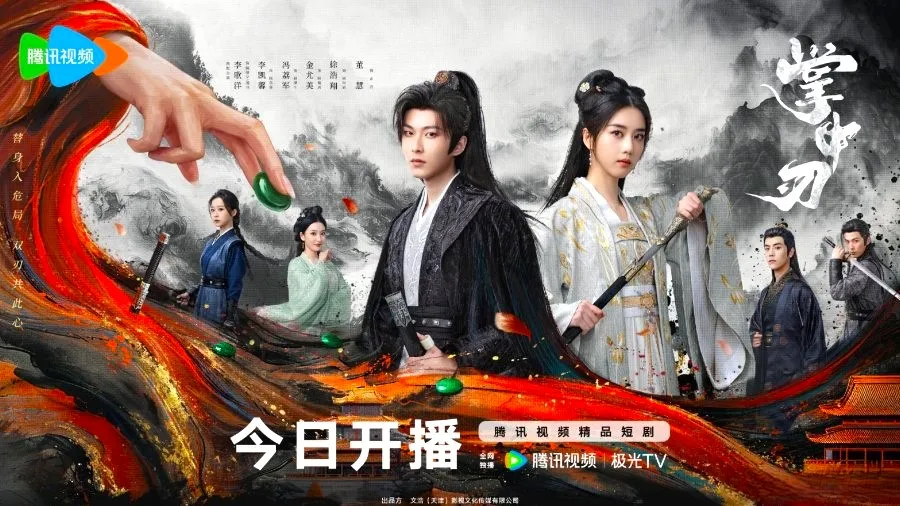
Within the Grip Poster - Courtesy of Tencent Video

|
DetailsRATING: (7/10)
NATIVE TITLE: 掌中刃 - Zhǎngzhōng rèn YEAR: 2026 EPISODES: 24 DURATION: 20’ DIRECTOR: Liu Hao Nan SCREENWRITER: Zhou Si RESPECTED CLICHÉS: 1 - 4 - 5 - 7 - 9 - 11 - 13 - 16 - 18 - 20 |


IN A NUTSHELL
- What to expect: Within the Grip is a short drama that takes itself very seriously and, above all, takes the viewer seriously: no frenetic pace, no schizophrenic editing, each scene has time to breathe and every emotion can settle before the story continues. This is a choice that distinguishes it from many other short dramas, where everything seems designed to never slacken the interest, even at the cost of sacrificing coherence and atmosphere. Here, however, the story proceeds calmly — sometimes too calmly — through investigations riddled with red herrings, lies, and fragments of the past that continually resurface to complicate the picture. Despite this, it remains surprisingly enjoyable to watch, also because the series largely avoids those overused narrative gimmicks that often transform mini-dramas into an exercise in pure chaos. Sure, the love story isn't always captivating, and the political plot remains ambiguous at times, but the drama still manages to work and entertain thanks to its lofty ambitions.
- Strengths: the calm pacing of the story, the well-crafted aesthetic, the absence of annoying narrative gimmicks.
- Weaknesses: the rather underwhelming romance, the underdeveloped political plot, the loose ends of the story.
- Recommended if you like: historical investigative dramas, stories about twins who switch roles, strong and independent female protagonists, love triangles with plotting antagonists.
- Would I rewatch it? Yes.
Read on to learn what makes this series different from the others.
Within the Grip is a drama that drags you into a fog of silences, suspicions, and suppressed feelings. It's a story that thrives on atmosphere rather than events, on glances rather than action, and for this reason, it can be both immersive and frustrating. Watching it means moving alongside the characters in a story where the truth remains constantly blurred and where even love seems to blossom under the weight of doubt, remorse, and regret.
In this review of the drama Within the Grip, after watching all episodes, I will analyze not only what the drama does so well, but also the weaknesses of a narrative that, in its attempt to slow down and breathe, sometimes ends up getting lost in its own rarefaction.
Plot
On the eve of her wedding to the third young lord of the Gu family, Gu Yu Luo, a spy at the Xuanji Pavilion, suddenly has to investigate the mysterious disappearance of her fiancé..
Determined to uncover the truth and unmask the culprits, she decides to stage the man's return using a providential lookalike she meets by chance, a lookalike who is surprisingly identical to Gu Zhao Xi.
That man is actually Yin Zhou, the Crown Prince who recently survived an assassination attempt. Convinced that the Gu family is involved in dark intrigue, Yin Zhou chooses to exploit his uncanny resemblance to the missing man to infiltrate the residence and conduct his own investigation from within.
Forced to work together amidst mutual suspicion, lies, and concealed identities, Yu Luo and Yin Zhou delve into the complex intrigues that bind the imperial court to the Gu family, attempting to expose their respective enemies.
But as the investigation progresses, the bond between the two deepens, constantly threatened by the shadow of Gu Zhao Xi's possible return and the secrets surrounding his disappearance.
Amid misdirections, mysteries, and betrayals, Yu Luo and Yin Zhou will soon discover that the conspiracy behind the affair is far more intricate than expected, and that the truth could irreparably compromise their future together.
"Instead of waiting to judge others’ intentions,
why not leave them a path to goodness?"

Within the Grip Drama Review (No Spoilers)
Plot and Screenplay
Within the Grip is a short historical drama that seems to deliberately shy away from the hysterical pace typical of the format. It doesn't rush, it doesn't compulsively pile up twists, and it doesn't try to overwhelm the viewer with constant revelations: instead, it prefers to build a slow, almost opaque mystery that gradually emerges through lies, constant red herrings, and fragmented reconstructions. On the one hand, this is a choice I greatly appreciated, because it makes the narrative more immersive and less frenetic than the average short drama—the scenes breathe, the silences have weight, and the tense moments aren't devoured by editing, avoiding that constant feeling of a "cut narrative" that often characterizes this type of format. On the other hand, however, this approach also significantly slows the narrative pace.
The screenplay leads the viewer step by step through the protagonists' investigations without giving them any advantage: we only know what they manage to piece together through small clues, fragmented confessions, and contradictory memories. In a fast-paced thriller, this approach might heighten the tension, but here the action is rather limited, and much of the narrative hinges on deductions, explanations, and constant references to the past. For this reason, as the story progressed, I repeatedly had the impression that the screenplay was deliberately stalling, as if hesitating to get too close to the heart of the mystery for fear of running out of narrative material.
The dialogue also contributes to this sense of suspended slowness: for a short drama, it's unusually philosophical, full of reflections, allusions, and an almost excessive depth. On the one hand, this is precisely what makes the drama stand out from the average for the format in terms of writing, as it strives to build atmosphere and emotional tension rather than relying solely on action; on the other, however, this detail risks making the drama even more difficult to follow for a viewer already exhausted by the slow pace of the narrative.
The "vagueness" effect is further accentuated by the constant use of flashbacks and retrospective reconstructions that are supposed to clarify events but often end up increasing the confusion, especially because the versions of events vary slightly depending on who tells them. Thus, "explanations" become inevitable to put the pieces of the puzzle back together, but at the same time, they leave the viewer with a lingering feeling of incompleteness that lasts almost until the final scene.
And ultimately, I got the impression that this constant hesitation was an intentional choice, because the screenplay seems much more interested in developing the emotional and sentimental dimension of the story than in the solidity of the investigative mystery: the evolution of the relationship between the protagonists is shown with far greater care and patience than the construction of the political conspiracy that should underpin the entire plot. The mystery thus remains in the background like a constant but blurred presence, useful primarily for supporting the relational dimension of the story rather than building a true, compact and incisive political thriller.
Characters and Love Story
Even though Within the Grip is a short drama, I found the main characters' characterizations surprisingly solid, especially in terms of their personalities and emotional dynamics. From the first episodes, it's easy enough to sense who they really are behind the half-truths, the mutual distrust, and the roles they're forced to play: the drama manages to convey the emotional weight of their choices even while continuing to hide key details of their pasts. And it's precisely here that one of the most striking contrasts in the writing emerges. The main characters' backstories are held back for a long time to keep the series' central mystery alive, but this choice also produces a persistent feeling of incompleteness. For much of the drama, it's clear that essential pieces are missing to truly understand their decisions, and only towards the end do the scattered fragments finally begin to come together more clearly.
The antagonists, on the other hand, remain much more undefined. Partly because of their secondary role within the narrative, and partly because the drama chooses to keep their identities hidden until almost the very end, relegating them to rare, often unimpressive appearances, in which they perform actions that rarely truly clarify their role in the story. Their objectives are deliberately left unclear and are connected to the broader attempt to subvert the order of succession to the throne rather superficially, leaving the feeling that the political conflict exists more as a functional backdrop to the romantic plot than as the true narrative engine of the story.
The main love story, despite being the narrative fulcrum of the series and the storyline to which the most space is devoted, never manages to become truly captivating, despite the drama's constant attempts to stoke the romantic tension. The screenplay, in fact, places great emphasis on the ambiguity between the protagonists, constructing situations characterized by physical closeness, provocations, and seductive gestures from the FL, but many of these scenes end up feeling more contrived than spontaneous. This stems partly from Eleanor Lee's performance, which isn't entirely convincing in the role of the seductress, and partly from Li Ge Yang's, who, despite making Yin Zhou intriguing, is often held back by a writing that outlines a ML that's too emotionally restrained. The result is a romance that works more through atmosphere and restrained tension than through genuine passionate intensity.

Cast
In Within the Grip, the cast plays a crucial role, perhaps even more so than the plot itself, because much of the narrative tension is built on ambiguous exchanges, suspicions, double-crosses, and betrayals rather than actual action. Therefore, the actors' ability to sustain scenes that are often slow, dialogue-heavy, and laden with subtext played a significant role in the drama's success.
Li Ge Yang, while not a top-notch actor, remains one of those faces I'd personally like to see more often: he delivers believable performances, displays good micro-expression, and, above all, manages to bring presence to the character even in the most static moments. I found the choice to pair him with semi-established Eleanor Lee particularly apt, because her experience helps make many of their exchanges, including the romantic ones, more natural and believable, despite Yin Zhou being a deliberately very controlled and unpassionate character.
Eleanor Lee, for her part, manages to be quite convincing in the role of the spy and manages to carry the character's emotional weight fairly well, but she still shows considerable room for improvement. The fight scenes aren't yet fully hers, and even her expressiveness tends to stiffen at times, especially in the seduction scenes, where many gestures appear studied rather than spontaneous (and the comparison with more experienced actresses like Chen Du Ling in Veil of Shadows makes this difference even more evident).
The rest of the supporting cast remains generally credible, though without any one performance standing out above the rest. The only one I feel like praising is Dai Shao Dong, who, in the role of the protagonist's bodyguard, manages to convey a spontaneity and stage presence that makes the character immediately more lively and confident than many of the series' supporting actors.
Visual Aspects and Soundtrack
Visually, Within the Grip immediately gave me the feeling of belonging to a very different category than many hastily assembled historical mini-dramas, where the direction seems to thrive on constant gimmicks — exaggerated close-ups, random zooms, aggressive backlighting, and CGI so crude that it constantly breaks the immersion.
The direction here is surprisingly solid, with carefully constructed shots and close-ups that truly strive to accompany the emotional weight of the scenes rather than dumping it on the viewer. Occasionally, a certain tendency toward over-emphasis typical of the format still emerges — a few too many tilted cameras, dramatic slow motion, and the usual strategic flourish that appears in the most emotionally charged moments — but overall, the drama maintains a much more controlled and professional aesthetic than average.
The cinematography also works very well: the lighting is soft, the color palette remains fairly natural, and the image has a more cinematic than TV-like look. The fact that much of the drama is set at night inevitably limits the realism of the lighting, as the scenes must be lit much more brightly than usual to remain legible, but the final result still manages to avoid the artificial effect typical of many low-budget productions.
The sets aren't very numerous, but they are coherent and believable, and it's scenically satisfying to see the Jiuxietan Scenic Area transformed into the Gu family's residence: a space that immediately lends visual depth to the drama without seeming like a simple studio backdrop.
I also found the CGI city panoramas used as a link between one sequence and the next very effective, because despite being obviously digital, they still manage to maintain a certain scenic elegance without significantly disrupting the immersion.
The martial arts scenes are carefully choreographed, although, in some cases, they err on the side of excessive spectacle and betray a certain technical imprecision on the part of Eleanor Lee, who clearly lacks the experience to be completely believable in the more elaborate fights.
The costumes, on the other hand, made a favorable impression on me: while they don't lean towards excessive ostentation, their aesthetic is consistent with the tone of the drama, and even the accessories—while not exceptional in quality—don't betray the glaringly fake look that often characterizes productions of this type.
The soundtrack also remains generally consistent with the atmosphere of the series, although at times it becomes a bit too insistent in underscoring the scenes' emotions. At times, some rather annoying technical problems emerge, such as in episode 9 during the dialogue between Yu Luo and Wen Shang, when a song is abruptly interrupted to introduce another one with a volume so high that it almost drowns out the actors' voices, making it difficult to follow the conversation.

WARNING!
FROM THIS POINT ON THE SPOILER SECTION BEGINS. DO NOT CONTINUE IF YOU DO NOT WANT TO KNOW ALL THE DETAILS OF THE DRAMA.
Within the Grip Drama Review (Spoilers)
What Works
The Visual Language
One of the aspects that struck me most about Within the Grip is its visual language, because from the very first episodes it gives the feeling of wanting to distance itself from the hysterical language typical of many short dramas.
In mini-dramas, in fact, everything is often constructed to prevent the viewer from abandoning the show: scenes become mechanical sequences of "entry into scene - information - exit scene," with no emotional buildup, no pauses, no real moments of transition. It's a rapid and functional structure, but also profoundly unnatural, because the editing ends up existing more as a tool against abandonment than as a narrative support. The result is often a hyper-fragmented and convulsive flow, almost similar to a social media fan edit, where scenes are continually truncated to maintain high stimulation.
Here, however, I had the opposite feeling. The scenes are simpler, the conflicts more real, the subplots less suffocating, and above all, the shots last long enough to truly create atmosphere. The construction feels much closer to that of standard-format dramas: there's an emotional entrance, a development, a pause that allows reactions and tensions to settle, and only then comes the exit. While attempting to create rapid immersion, the drama never descends into the visual hysteria typical of short-form dramas, and I believe the main reason is that the script here seems to have been truly conceived for the short format, rather than feeling like a long screenplay brutally cut and compressed into short episodes. The result is a drama with a controlled pace—sometimes even too much so—but also with a good aesthetic, an immersive atmosphere, and a writing that at least partially avoids the constant recourse to the genre's trashiest romantic clichés.
The relationships between the protagonists are also built with a patience and precision unusual for this type of production, helping to position the series much closer to traditional dramas than the classic mini-drama.
Even on a purely visual level, the qualitative leap is evident: the photography and direction are cleaner and more professional, the color palette has a more cinematic imprint, the costumes avoid that “cheap cosplay” effect typical of short productions and above all the editing finally stops sabotaging the narrative, truly allowing the viewer to follow the story without feeling dragged down by a constant bombardment of cuts and micro-scenes.
The Premise
Another strength of Within the Grip is undoubtedly its premise, surprisingly original for a landscape of historical short dramas now saturated with endlessly repetitive narrative gimmicks—reincarnations, transmigrations, body swaps, or protagonists catapulted into the past. Here, however, the story remains anchored to a much more "human" and believable dimension while maintaining a deliberately non-linear structure full of ambiguity.
I found particularly interesting the idea of building the entire story around the fact that the protagonist has a twin brother and that this brother is the female protagonist's fiancé. Even more intriguing is the paradox on which the entire plot hinges: Yin Zhou finds herself collaborating with Gu Yu Luo to discover who killed her brother by posing as him, unaware at first that the man whose identity she is assuming is the twin who disappeared nineteen years earlier. It's a narrative premise that immediately creates tension, overlapping identities, and emotional conflicts far more interesting than the typical clichés used haphazardly in short dramas.
I also found the internal conflict within the Gu family for control of the Xuanji Pavilion, the spy organization founded by Gu Yu Luo's mother and which has become one of the kingdom's main sources of intelligence, engaging. It's just a shame that this aspect often remains in the background and is explored far less deeply than it deserves.
The emotional connection between Gu Yu Luo, Gu Zhao Xi, and Yin Zhou also works very well precisely because it stems from a deeply distorted family history: Yu Luo is the real daughter of the founder of the Xuanji Pavilion, but her mother chose to sacrifice her childhood and affection in order to protect Gu Zhao Xi, the missing prince and Yin Zhou's twin brother. All of this creates a web of bonds, resentments, and emotional substitutions that could have given rise to a much more layered political and psychological thriller.
And it is precisely here that perhaps the greatest regret linked to the drama arises: the constant feeling that the screenplay developed a potentially excellent subject too superficially, preferring to focus almost exclusively on the romantic and investigative dimension and instead leaving in the background all the political and identity implications that made the premise of the story truly unique.

What Doesn't Work
The Inconsistencies of the Screenplay
While I greatly appreciated the choice to construct such a slow, sparse narrative — because it finally allows the scenes to breathe and the characters to exist even in silence, without the compulsive frenzy typical of so many short dramas — on the other hand, as I continued watching, I couldn't shake the feeling that this slowness also masked a certain difficulty the screenplay had in truly sustaining its plot. The more the drama focused on the atmosphere, the looks, and the emotional construction of the protagonists, the more evident the contrast with a surprisingly simplified and vague political storyline became, almost as if the story had much more to say from an emotional rather than a strictly narrative perspective.
Despite the overall attention to detail in the writing, several subplots feel dismissed too quickly or left in a state of indefiniteness that gives the impression of a certain incompleteness. This happens with the story of the Princess Royal and the Prince Consort, with that of Leng Yan and Wan Niang, but also with the relationship between the owner of Zuixian Tower and Doctor Qin, all stories introduced and then suddenly faded into the background. The same is true for some of the drama's most central mysteries: it is never made clear who sent the anonymous letters to members of the Gu family or who actually ordered the assassination of Consort Lian Yi. It also remains ambiguous who the fake Gu Zhaoxi and Xiao Qi really were, nor how they were made so similar to the originals—perhaps through the disguise techniques of the Xuanji Pavilion? And were they therefore spies for the Pavilion itself?
Even Gu Zhaoxi's fate remains shrouded in almost frustrating uncertainty: is he really dead? Did the body found really belong to him? And above all, is it possible that no one in the Gu family—except the head of the family—seems to notice the striking resemblance between him and the crown prince? But what left me most perplexed was the drama's emphasis on the emotional development of Gu Zhaoxi's character. The series repeatedly shows him, through flashbacks, as a kind, generous, caring person, deeply connected to Yu Luo, to the point of often making him more emotionally engaging than the protagonist himself. And at that point, it becomes inevitable to ask why the script chooses to make the viewer so attached to a character who is not only secondary, but who in the narrative present is presumably already dead and destined to be sidelined in favor of the "official" protagonist, who should instead be the emotional and romantic fulcrum of the story.
The Main Love Story
The love story between Gu Yu Luo and Yi Zhou is undoubtedly the true narrative engine of the series. However, despite being the storyline to which the screenplay devotes the most time, attention, and gradual buildup, it didn't seem as compelling as the drama intended.
The director and the writer clearly attempt to heighten romantic tension through a dynamic of provocation, physical closeness, and an ambiguous relationship that draws the protagonists toward each other. The female protagonist, for example, is given a certain seductive audacity, especially when she deliberately tries to destabilize Yin Zhou with gestures, glances, or more intimate allusions than expected. Yet many of these scenes, rather than being truly charged with malice or emotional tension, seemed strangely constructed, almost mechanical.
Part of the problem, in my opinion, lies in Eleanor Lee's performance, which isn't always fully convincing in the role of the seductress: her gestures often seem more guided than spontaneous, and her expressiveness sometimes sends mixed signals, oscillating between emotional detachment and a sensuality that never truly explodes.
The male lead also contributes to this sense of restrained tension. Li Ge Yang clearly does his best to infuse his Yin Zhou with the spark of vitality and charisma needed to make him an intriguing and magnetic ML, yet his character often comes across as too controlled, too composed, almost incapable of fully letting go on an emotional or passionate level—the only exception being the time he's drugged with aphrodisiac incense by the owner of the Zuixian Tower.
Thus the relationship ends up functioning more like a slow atmospheric construction made of allusions, suspicions and latent tension than like a truly incendiary romance, leaving a feeling of emotional involvement that is more tenuous than the drama seems to want to construct, which not even the love triangle outlined by Gu Wen Shuang seems able to revive.

Characters and Cast
Primary Characters
Gu Yu Luo/Qin Xiang (Eleaonor Lee) spy for the Xuanji Pavilion, the top intelligence organization serving the imperial family that gathers intelligence and carries out missions on behalf of the Emperor. In reality, she is the daughter of Left Chancellor Qin Yu Heng and Yun Sui, and Gu Jiang's adopted daughter. To allow her to take full control of the Xuanji Pavilion without arousing suspicion, Gu Jiang promises her in marriage to Gu Zhao Xi, but he disappears shortly before the wedding. Upon hearing of her fiancé's supposed death, she decides to investigate and, in the meantime, has the "double" Yin Zhou — who is actually the missing man's twin brother — impersonate Gu Zhao Xi.
Yin Zhou (Li Ge Yang) Crown Prince who was ambushed the same night as Gu Zhao Xi's disappearance. He is the son of Consort Lian Yi, killed nineteen years earlier by a group of assassins hired by her political opponents. His twin brother, Yin Ci, was miraculously saved by Gu Jiang and adopted by him as Gu Zhao Xi. He infiltrates the Gu residence as a double for the missing Gu Zhao Xi to try to uncover the identity of his assassins, but falls in love with Gu Yu Luo.
Supporting Characters
Gu Family and Xianji Pavilion
Gu Jiang (Duan Ran) head of the wealthy Gu family and a former disciple of the Tianji Sect. After his fellow disciple Yun Sui is abandoned by Qin Yu Heng, he decides to marry her despite knowing she is pregnant with the latter's child. He later rescues Prince Yin Ci and adopts him under the false name of Gu Zhao Xi, pretending he is the son his wife gave birth to. Then, to allow the woman's real daughter, Gu Yu Luo, to inherit the leadership of the Xuanji Pavilion, he arranges a wedding between her and Gu Zhao Xi, but the latter suddenly disappears.
Yun Sui, master and founder of the Xuanji Pavilion. She is a former disciple of the Tianji Sect and a fellow disciple of Gu Jiang. She was in love with Qin Yu Heng, but when he left her to marry another woman, she ended up marrying Gu Jiang. At the time, she was already pregnant with Gu Yu Luo's child, but she agreed to give her up to secretly adopt Prince Yin Ci.
Gu Chao Sheng (Feng Li Jun) first young lord of the Gu family. He is an expert merchant and manages the family business, but he also wants to gain control of Xuanji Pavilion, which is why he plans to kill Gu Zhao Xi. He eventually repents and decides to help Gu Yu Luo discover who murdered his half-brother. After his father's death, sacrificing himself to save the Emperor, he is named Marquis of Yong'an.
Zhe Zhu, member of the Xuanji Pavilion's Di Unit and Gu Chao Sheng's death guard.
Gu Xuan Ji (Jin Yo Mi) second young lady of the Gu family. She is an expert in poisons and has been very close to Zhao Xi ever since he saved her life. Therefore, she does everything she can to help Gu Yu Luo discover who killed him.
Gu Zhao Xi/Yin Ci (Li Ge Yang) third young lord of the Gu family. He is very weak and in poor health, but his father decides to marry him to Gu Yu Luo because he wants to entrust the girl with the Xuanji Pavilion, which belonged to his mother. In reality, he is the twin brother of Yin Zhou, believed to have died in an ambush nineteen years earlier. Gu Jiang rescued and adopted him, passing him off as Yun Sui's biological son. Due to sibling rivalry, he is lured into another ambush and killed.
Xiao Qi, Gu Zhao Xi's bodyguard.
Gu Wen Shuang (Xu Hao Xiang) fourth young lord of the Gu family. He is a martial arts expert and has always been in love with Gu Yu Luo, but she sees him only as a brother. Therefore, she plots to kill Gu Zhao Xi.
Xuan Qing (Dong Hui) member of the Xuan Unit of Xuanji Pavilion and Gu Yu Luo's death guard.
Gu Xuan Wu (Li Lei) member of the Xuan Unit of Xuanji Pavilion. He is involved in the struggle for the throne between Yin Huan and Yin Zhou.
Imperial Court
Yin Feng, Emperor. Twenty years earlier, against the court's wishes, he had decided to marry Lian Yi, with whom he had conceived the twins Yin Zhou and Yin Ci. However, following his marriage to the daughter of the Right Chancellor, Consort Lian became the target of political opponents and was eventually murdered. To prevent the same fate from befalling his only surviving son, Yin Zhou, he named him Crown Prince, drawing even more hatred.
He Zhong Yi, Chief eunuch and attendant to the Emperor. In reality, he is involved in the struggle for the throne between Yin Huan and Yin Zhou and falsifies the missions assigned to the Xuanji Pavilion to help eliminate Prince Rui's political opponents.
Lian Yi, late imperial consort, mother of Yin Zhou and Yin Ci. She is a former disciple of the Tianji Sect and the co-founder of the Xuanji Pavilion. Before dying at the hands of assassins hired by her political opponents, she entrusted Yin Ci to the care of her fellow disciple Gu Jiang.
Shen Zetian, general loyal to the Emperor and brother of Lian Yi. He reveals the truth about his mother's death to Yin Zhou.
Tian Lan (Dai Shao Dong) Yin Zhou's secret guard.
Yin Huan (Zhu Rong Rong) Prince Rui and half-brother of Yin Zhou and Yin Ci. He is the nephew of the devious Right Chancellor and seeks the title of Crown Prince at all costs.
Princess Sheng (Cao Xi Yue) Royal Princess. She is in league with the Right Chancellor to facilitate Yin Huan's ascension to the throne and is involved in his shady dealings.
Pei Lang, Prince Consort of the Princess Royal. To marry him, the Princess Royal forced him to leave his wife Mei Niang, whom she then imprisoned and killed. For this reason, he decided to take revenge by keeping track of all her illegal dealings in a ledger that he attempted to deliver to Gu Yu Luo.
Qin Yu Heng, Left Chancellor, former disciple of the Tianji Sect and fellow disciple of Gu Jiang. After abandoning his beloved Yun Sui to marry a woman who would help him in his political ascent, he went mad and slaughtered his entire family, only to be killed by Gu Jiang.
Other Characters
Owner of Zuixian Tower, beloved of Doctor Qin, whom he visits once a year. She is killed to prevent her from revealing what she knows about the Gu family.
Doctor Qin, famous wandering physician and brother of Qin Yu Heng. Gu Yu Luo seeks him out to uncover clues to her past.
Leng Yan, assassin hired by Gu Chao Sheng to kill Zhao Xi. He is found dead in his home by Gu Yu Luo.
Wen Niang (Wang Qiang), Leng Yang's companion. After his death, she is taken in by Gu Xuan Ji and hired at her fabric shop, the Ninchang Workshop.
Doctor Li, doctor who examines Gu Zhao Xi after his return home. In reality, he is a spy sent by Yin Huan to ensure that Gu Zhao Xi is not Yin Zhou.

Favorite Character: Yin Zhou
He is probably the most positive character in Within the Grip, also because behind his initial coldness lies a figure deeply marked by loneliness and survival.
From childhood, he was forced to grow up surrounded by enemies at court, amid assassination attempts, political intrigues, and power games that tore away not only his mother and twin brother, but even the open affection of his father, the Emperor, too fearful of attracting further hostility from his political opponents.
Growing up in that climate made him shrewd, intelligent, and incredibly skilled at reading people and situations, as well as a martial arts expert and an excellent strategist.
Yet what makes him truly interesting is the fact that, despite everything, he never completely lost his capacity for love. Beneath his mistrust and self-control, he remains a profoundly altruistic man, capable of displaying an almost disarming sweetness, especially towards Gu Yu Luo. He is understanding, protective, and incredibly patient with her, even going so far as to tolerate without reaction the constant comparisons to the late Gu Zhao Xi, the brother who seems to haunt him even after his death.
Although he almost immediately feels a strong attraction to Yu Luo, he deeply respects the fact that she was promised to his brother and never truly gives in to the provocations with which she deliberately tries to test his self-control.
During his time undercover at the residence, Gu meticulously follows Yu Luo's instructions, striving to appear as docile and peaceful as Gu Zhao Xi even when jealousy threatens to betray him—especially when faced with the attentions of Gu Chao Sheng or the complicity between Yu Luo and Gu Wen Shuang, who grew up next door to her and is clearly in love with her. And it's telling that the only real act of jealousy he allows himself in the entire drama is interrupting Yu Luo's conversations with these men simply to bring her a cloak: a small, almost restrained gesture, yet one that perfectly encapsulates all the silent and genuine care he feels for her, despite constantly feeling like he's merely a "substitute" for his brother.
The only time he truly allows himself to give in to his desires comes when, drugged with an aphrodisiac incense by the owner of Zuixian Tower, he ends up giving in to Gu Yu Luo after receiving her encouragement. And it's very telling that even after that moment, he continues to feel guilty for days, almost unable to conceive of having put his own desire before the respect due to the woman he loves.
In the end, after defeating the enemies who wanted to prevent him from inheriting the throne and even facing his father's initial opposition to his marriage, Yin Zhou finally manages to conquer not only the place that was rightfully his within the court, but also the love he had thought reserved for someone else.
Un-Favorite Character: Gu Zhao Xi
He's not a negative character at all; in fact, the problem is quite the opposite: he's so perfect it's irritating.
Everything in the drama seems designed to transform him into an idealized, almost untouchable figure — fragile but kind, altruistic, caring, beloved by the people — to the point that the script ends up bending entire narrative dynamics just to preserve his image.
And the highest price is paid by Gu Yu Luo, Yun Sui's legitimate daughter and theoretical heir to the Xuanji Pavilion. Instead, she is forced to grow up as a common disciple, deprived of her mother's affection and subjected to constant tests of strength from childhood, simply because the head of the Gu Jiang family had decided to protect him, the fragile son of the Emperor and his fellow disciple Lian Yi.
Despite being a marginal figure within the Gu family,** he has always lived in a sort of privileged bubble**: isolated, yes, but also constantly protected and free to cultivate that aura of a "pure soul" that earned him the unconditional love of Gu Xuanji and the devotion of the people, whom he treated free of charge in the clinic assigned to him by the head of the family. All this while his twin brother Yin Zhou, motherless in the imperial palace, grew up immersed in power struggles, forced to survive amid assassination attempts, plots, and manipulations, learning very early to distrust everyone and never let his guard down.
And this is perhaps the most frustrating detail about the character: even after his disappearance, he continues to emotionally dominate the story. Gu Yu Luo constantly compares Yin Zhou to her "perfect" fiancé, praising his kindness, and seemingly unconsciously demanding that the Prince inherit his ways and character, forcing him to play the role of her brother not only to make his infiltration of the Gu family believable, but also because the drama itself seems incapable of letting go of that idealized image.
This is why his death — assuming he is indeed dead, since the story never fully confirms it — almost ends up seeming narratively necessary: without his exit, Gu Yu Luo would likely have continued to love him, the perfect man to be protected, leaving Yin Zhou relegated to the role of a character destined to pine in the shadow of her "better" brother.
RECOMMENDED:
- THE SONG OF GLORY
- A FAMILIAR STRAGER
- ROMANCE OF A TWIN FLOWER
- IN BLOSSOM
- ECHOES OF THE SELF
Thanks for reading this far!
I hope you enjoyed my article. If you like my work and want to support me, buy me a coffee ☕