
Pull Strings (2026): The Funniest Drama of 2026 | Quick Verdict
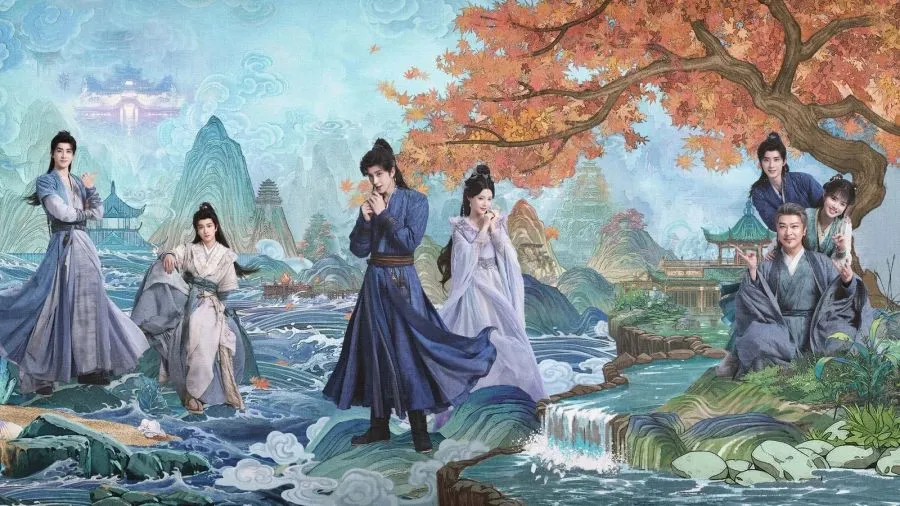
Pull Strings Poster - Courtesy of Youku

|
DetailsRATING: (8.5/10)
NATIVE TITLE: 师兄太稳健 - Shīxiōng tài wěnjiàn YEAR: 2026 TOTAL EPISODES: 30 DURATION: 45’ DIRECTOR: He Shu Pei, Han Ping, He Hong Hui SCREENWRITER: Xu Bo Xiang, Ye Fang Zhou, Zhuang Yan, Jin Rong ORIGINAL CREATOR: Yan Gui Zheng Zhuan (我师兄实在太稳健了 - My Senior Brother Is Way Too Steady) RESPECTED CLICHÉS: 1 - 4 - 8 |


IN A NUTSHELL
Short on time? Here you’ll find the quick verdict, including the drama’s main strengths, weaknesses, and key features to help you decide if it’s right for you. For a more in-depth analysis, continue with the No Spoiler Review.
- What to expect: Pull Strings is a decidedly unconventional xianxia series that takes the genre's classic ingredients and blends them with surreal, often over-the-top humor. Yet, beneath the apparent chaos lies a story far more solid than it first appears: the characters are well-developed, their relationships are engaging, and the series shifts seamlessly between comedy and serious moments without losing tension. This is complemented by high-quality visuals and a script that keeps the viewer hooked, even when the protagonist seems to have already anticipated everything. It isn't perfect — supporting character storylines often take a back seat, and the humor can veer into the absurdly zany — but overall, Pull Strings manages to turn a far-from-original premise into a surprisingly compelling and, above all, incredibly entertaining story.
- Strengths: the ability to keep viewers engaged, the great balance between comedy and drama, the hilarious cast, the polished visuals.
- Weaknesses: the lack of development of the secondary storylines, the occasionally uneven pacing, the open and all-too-conventional ending.
- Recommended if you like: Ao Ruipeng and his over-the-top acting, xianxia series with highly detailed cosmology, dramas centered on a male lead, zany comedy, transmigration stories, and fantasy shows with immersive visual effects.
- Would I rewatch it? Yes, absolutely.
Read on to find out why this series got me so excited.
Beneath the flurry of wisecracks, absurd escapades, and the constant commotion involving immortals, demons, and cultivators, Pull Strings slowly reveals a vast, unpredictable world to the viewer, capable of eliciting laughter one moment and leaving you hushed in silence the next. And just when you think you’ve glimpsed its true shape, the mist rolls back in, bringing with it the realization that Li Changshou is out there somewhere, hatching a new scheme to keep a low profile.
In this review of the drama Pull Strings, after watching all episodes, I'll attempt to explain how such an absurd story managed to emerge a coherent narrative, complex characters, and a progression capable of maintaining the viewer's curiosity, and why, despite its flaws, it managed to engage me so deeply. To do so, I've chosen the Quick Verdict format: a more streamlined format than my traditional reviews, designed to focus on the aspects I consider most significant of my viewing experience without turning my review into a forensic autopsy of the series.
Plot
Li Changshou is a xianxia enthusiast — bedridden due to a severe illness — who suddenly finds himself transmigrated into the body of a young cultivator in the Primordial World. He discovers that to survive the Great Tribulation set to strike the world in a few decades, he must gain entry into the Heavenly Court; yet, for now, he is merely a disciple of the weakest branch of Ascension sect.
To achieve his goal, Li Changshou seeks to amass power and experience while avoiding unwanted attention and, above all, leaving nothing to chance, relying on his 100% foolproof plans.
Throughout his adventure, he encounters a host of eccentric characters who end up aiding his mission: from the young Lan Ling’e, destined to become his shi mei, to Ao Yi, the second prince of the East Sea Dragon Clan, and from the Heavenly Emperor, Hao Tian to Yunxiao, the Quasi-Saint of the Seizing Sect who appears to play a role in the outbreak of the Great Tribulation.
Amidst disguises, dangers, and secret plots, Li Changshou will strive to avert the Great Tribulation and survive in the Primordial World without ever abandoning his characteristic caution. However, his collaboration with Yunxiao will end up complicating his plans in ways no calculation could have foreseen: their relationship gradually evolves into something deeper, making it far more difficult for Li Changshou to play it safe.

THIS SECTION LISTS THE DRAMA'S STRENGTHS AND WEAKNESSES WITHOUT REVEALING MAJOR PLOT DEVELOPMENTS. READ ON FOR MY PERSONAL OPINION ON THE SERIES.
What Works
- A screenplay that knows how to keep curiosity.
Although Li Changshou is extremely meticulous and appears to calculate every possible contingency before making a move, his ability to anticipate events does not make the story predictable. On the contrary, the script successfully maintains the viewer's curiosity precisely because it reveals his strategies only when the time comes to put them into action. The satisfaction, therefore, comes from watching the plan take shape and discovering — often alongside the other characters — just how accurately the protagonist has foreseen the unfolding events. - Transmigration as an element of mystery.
Transmigration — a narrative device that often risks feeling rather contrived in many dramas — is employed much more effectively here: after setting the story in motion, it becomes an element of mystery that persists to the end, without being used as a pretext to introduce modern knowledge into the fantasy world or to generate gags based on the protagonist's disorientation. - The excellent balance between comedy and drama.
The comedic scenes are highly effective and blend surprisingly well with the story's more serious aspects. Even when the drama shifts from a completely silly situation to a dramatic scene, the two tones generally manage to coexist without one undermining the tension of the other. - Hilarious characters, but far from superficial.
The series manages to make its characters hilarious without turning them into mere caricatures. Even when they behave completely absurdly, their actions are consistent with the plot and never seem forced for comic relief. Behind the gags and outrageous behavior are often personal stories that are anything but amusing, and, with a few exceptions, even the antagonists have motivations that make their actions understandable. - A cast perfectly at ease with the drama's off-kilter comedy.
The cast demonstrates excellent harmony with the lighthearted tone of the series, managing to portray even the most absurd situations with the right balance of exaggerated comedy and dramatic seriousness. I especially loved Ao Ruipeng, Ai Mi, and Yu Yi, while Sun Zhen Ni seemed a little too composed for such an overtly zany comedy. - An extremely refined visual section.
The visual effects are generally excellent: from the fantastical environments to the spells, from the green screen to the magical artifacts, even the mythological animals, which in fantasy dramas are often one of the weak points of CGI and which here are surprisingly well crafted. Even the physically created sets are realistic and well integrated with the digital environments, while the costumes, while less eccentric than those of many other xianxia, are aesthetically pleasing, evocative, and well-suited to the characters' personalities and natures. - An eclectic and engaging soundtrack.
The soundtrack for Pull Strings is, in my opinion, one of the most eclectic and original of the season. It alternates epic, light, and romantic melodies, ranging from modern sounds to references to tradition, creating an extremely varied musical accompaniment without being incoherent. The result is a set of songs that are pleasant to listen to and capable of naturally enhancing the different registers that appear in the series.
What Doesn't Work
- The little space dedicated to the storylines of supporting characters.
The world of Pull Strings is full of potentially interesting characters and conflicts, but the story tends to filter them through Li Changshou's personal journey, leaving less room for the independent development of secondary characters. Yunxiao herself, despite being the female protagonist, doesn't receive the same narrative space as Li Changshou: her storyline is often subordinated to that of the male protagonist, and the drama spends relatively little time delving into her past and motivations, ultimately sacrificing some of the character's complexity. - The narrative's at times uneven pace.
The strong focus on Li Changshou's mission means that some subplots are temporarily put on hold and only resumed when they become relevant to the main story, occasionally creating a feeling of stalemate. - The comedy sometimes too crazy.
The series unequivocally embraces a surreal and over-the-top sense of comedy, which I personally find one of its greatest strengths, but which others might find excessive or even too childish. - The open and all-too-conventional ending.
For much of its running time, Pull Strings gives the impression of wanting to distance itself from the typical canons of xianxia, so it's particularly disappointing that, in the final episodes, the series returns to the genre's most classic clichés to offer us a "traditional" conclusion, while also leaving us with an open ending. The problem isn't so much that the epilogue becomes more serious, but rather the feeling that, right at the finish line, the drama has decided to return to the traditional tracks of xianxia after having spent much of the story demonstrating that it can do without those rules.

Characters and Cast
Primary Characters
Li Changshou/Chang Geng (Ao Ruipeng) modern-day guy bedridden by a serious illness, who suddenly finds himself transmigrated into the body of the first disciple of Jade Division.
Yunxiao Xianzi (Sun Zhen Ni) (云霄仙子) Quasi-Saint of the Seizing Sect, born from the first cloud of the Primordial World and a disciple of Master Tongtian Jiaozhu.
Supporting Characters
Ascension Sect
Venerable Master Wangqing (Eddie Ko) Grand Master of the Ascension Sect and leader of Griefbane Division.
Jiu Wu (Tian Zhong) Fifth disciple of Griefbane Division, elder of the Ascension Sect and head of Baifan Palace.
Jiu Jiu (Seng Ke Ni) Ninth disciple of Griefbane Division.
Qi Yuan (Yu Yi) leader of Jade Division, elder of the Ascension Sect and shifu of Li Changshou and Lan Ling'e. His division is the weakest in the entire sect because its foundations were ruined during one of the Sect's Trial Assembly, and his cultivation suffered as a result.
Wan Jiangyu (Zhou Jing Yi) Qi Yuan's fellow disciple and his shi jie. She disappears while in the Northern Lands searching for a cure to restore the foundations of her shi di.
Lan Ling'e (Ai Mi) former disciple of Mistveil Division who is adopted by Jade Division, becoming Li Changshou's shi mei.
Kuai Si (Ma Jing Han) shady leader of Mistveil Division, elder of the Ascension Sect, and Yuan Qing's shifu.
Yuan Qing (Wang Jia Mao) ambitious first disciple of Mistveil Division. He disappears during the Sect's Trial Assembly after attempting to eliminate Li Changshou.
Jiang Jingshan (Xu Shu Ying) leader of Skirend Division, elder of the Ascension Sect and shifu of Youqin Xuanya.
Youqin Xuanya (Zhang Chang Ning) first disciple of Skirend Division and sixth princess of the Donglin Kingdom.
Wang Qi (Zhou Zhao Yuan) and Liu Si Zhe (Xu Hao Xiang) disciples of Spiritkin Division.
Seizing Sect
Tongtian Jiaozhu/Heavenreach Master, (通天教主) founder of the Seizing Sect (截教) and shifu of Yunxiao.
Zhao Gongming (He Wen Jun) first disciple of the Seizing Sect and shixiong of Yunxiao.
Qiong Xiao (Xuan Yi Qian) and Bi Xiao (Zhang Ruo Nan) disciples of the Seizing Sect and fellow disciples of Yunxiao.
Yuan Ze (Li Ming Ming) Lord of Turtle Island, Great Immortal of the Seizing Sect.
Han Zhi (Song Xin Ran) Yuan Ze's first disciple.
Can Sheng (Wang Jiao Mao) mysterious disciple welcomed by Yuan Ze.
Elucidating Sect
Yuanshi Tianzun, (元始天尊) Primeval Lord of Heaven, founder of the Elucidating Sect (阐教).
Yun Zhong Zi/Cloudlink Hermit (Peng Bo) (云中子) Grand Immortal of the Jadevoid Palace of the Elucidating Sect.
Human Sect
Taishang Laojun, (太上老君) founder of the Human Sect (人教).
Xuandu Dafashi/Grand Mage of Voidcity (Sun Zi Hang) (玄都大法师) first disciple of the Three Taoist Schools (Human, Elucidating and Seizing) and the first disciple of Taishang Laojun. Through his intervention, he quelled the Deity-Demon War, ending the Great Tribulation of a thousand years earlier.
Westdawn Sect
Jieyin Daoren, (接引道人) Saint of the Westdawn Sect (西方教).
Zhunti Daoren, (准提道人) Saint of the Westdawn Sect.
Wen Jing (Xu Xiao Han) disciple of the Westdawn Sect belonging to the Blood Gnat Clan (血蚊一族).
Bian Zhuang (Cui Shao Yang) Lord of Horizon Hall (天涯阁) of the Westdawn Sect and henchman of Jin Chan.
Lao Dao (Liu Han Yang) master of the Westdawn Sect and henchman of Bian Zhuang.
Wang Cai (Zhang Chu Yi) disciple of Lao Dao.
East Sea Dragon Clan
Ao Guang (He Qiang) leader of the East Sea Dragon Clan, ruler of the Four Seas, and father of Ao Jia and Ao Yi.
Ao Jia (Zhao Yi Xin) crown prince of the East Sea Dragon Clan.
Jiang Si'er (Han Jia Rong) princess of the Mermaids, commander of the Pearl Elites (明珠锐士) and fiancée of Ao Jia.
Ao Yi/Ke Le Er (Ao Zi Yi) second prince of the East Sea Dragon Clan.
Jin Chan (Zhang Ya Qi) dignitary guest of the East Sea Dragon Palace and master of the Westdawn Sect.
Chancellor Turtle (Li Bao Er) prime minister of the East Sea Dragon Clan.
Yecha (Zhu Xiang) Dragon General of the East Sea Dragon Clan and right-hand man of Ao Jia.
Jinli (Alan Tam) Dragon General of the East Sea Dragon Clan.
Grand General Frog (Liang Liang) and Eel Warrior (Wu Cheng) guardians of Baolian Hall, the treasure hall of the East Sea Dragon Clan.
Bear Island
Xiong Da (Du Guo Xing) and Xiong Er (Tang Gio Zhong) dwellers of Bear Island and older brothers of Xiong Ling Li.
Xiong Ling Li (Zhang Zhang) dweller of Bear Island and daughter of Elder Lao San. She finds Li Changshou and Ao Yi inside the bellies of two enormous fish and brings them to Bear Island.
Xiong Lao San (Xie Ning) Ling Li’s father and an elder of Bear Island.
Celestial Court
Hao Tian/Hua Ri Tian (Li Zhe Hao) Celestial Emperor and Lord of the Celestial Court.
Dong Mu Gong/Eastwood Duke (Zong Feng Yan) Second-Rank deity and supervisor of the Celestial Court.
Yue Lao/Moon Elder (Da Suo) Moon Deity and administrator of the Office of Matrimonial Destinies.
Other Characters
Yuwen Ling, general of the Donglin Kingdom who attempts to kill Li Changshou.
Xiaotian, AI that Li Changshou uses to survive in the Primordial World.
Demon Emperor Taiyi, Lord of the Ancient Demon Court. He was imprisoned beneath the Sea-Claming Pillar by the Grand Mage of Voidcity during the Deity-Demon War.

WARNING!
IN THIS SECTION, I SHARE MY PERSONAL OPINION ON THE DRAMA, AND THERE MAY BE SPOILERS. DO NOT CONTINUE IF YOU DO NOT WANT TO KNOW ALL THE DETAILS OF THE SERIES
The Watching Experience
I really enjoyed Pull Strings, and all things considered, it's probably the drama I've enjoyed the most this year. It's one of those series that manages to captivate you precisely because it seems to have no intention of behaving as you'd expect from a xianxia: it's zany, absurd, and often completely out of this world, but behind this facade, it manages to construct a compelling story, characters that are anything but superficial, and a narrative that constantly keeps you curious. Furthermore, the comedy isn't treated as a separate element from the story: the comic scenes are written with great care and integrate surprisingly well with the more serious events, while the cast perfectly manages to follow this constant shift between comedy and drama.
Even the worldbuilding, which I've seen criticized several times as incomplete, seemed adequate to me: it's just not very didactic. Pull Strings doesn't use xianxia aesthetics simply as decoration: it's well-versed in the cosmology it's playing with and assumes a certain familiarity with that world, not bothering to explain every single cultural and literary reference. The series introduces its cosmology through dialogue, allusions, and events, and the characters speak of their reality as people who live within it, not as tour guides tasked with explaining it to the audience. For Chinese viewers, accustomed to recognizing at least some of these references, this approach can feel much more natural, while for those unfamiliar with this tradition, the result can effectively be a fantasy nightmare lacking instructions. It's a bit like being catapulted into the Marvel Cinematic Universe straight from Avengers: Endgame and being asked, "That? It's obvious, right?" This is also why I wouldn't recommend Pull Strings as a first introduction to xianxia: the series isn't designed to accompany those approaching the genre for the first time, as it presupposes knowledge of many concepts that a neophyte might not understand.
The only element that, in my opinion, really penalizes the viewing experience are the subtitles provided by the platforms: the often imprecise rendering of terminology and elements related to worldbuilding, in fact, sometimes prevents a full appreciation of the complexity of the narrative universe.
The drama's enjoyment is ensured by excellent visuals, making it particularly enjoyable to immerse yourself in the series' world even when some of its references are overlooked. This is an aspect I also found in The Immortal Ascension, although in that case the quality of the visual effects was more uneven. It therefore came naturally to make a comparison between the two series, which are similar for another reason as well: both tell the long journey towards immortality of a young, unheroic cultivator more interested in self-preservation than in gaining fame and prestige among the immortal sects. Yet, the very way this premise is developed makes the two series profoundly different and also explains why Pull Strings engaged me so much more.
The difference isn't just in tone — The Immortal Ascension is decidedly more serious and realistic, while Pull Strings is more comical and fantastical — but in the way the story makes us perceive the protagonist. Han Li and Li Changshou are both cautious, calculating, and reluctant to sacrifice themselves for lofty ideals. But while Han Li tends to avoid any emotional involvement that might distract him from his goal, often appearing selfish and ungrateful, Li Changshou, while equally cautious and pragmatic, develops deep bonds with the people around him.
The narrative progression also gave me mixed feelings: The Immortal Ascension seemed almost like a video game in which Han Li had to accumulate resources and powers to get to the next level, while Pull Strings manages to transform the same path into a more engaging story, thanks in part to the character relationships and a script that pays much more attention to their characterization. This is probably why, despite its flaws, I loved Pull Strings much more than The Immortal Ascension: because beneath its silliness, the series manages to make the audience fond of the characters, make them curious about what will happen, and make the protagonist's evolution satisfying.
And let's be honest: Ao Ruipeng is so believable as Li Changshou that at a certain point I seriously began to wonder if he was acting or if the director had simply decided to film him behaving normally.

RECOMMENDED:
- ONCE UPON A TIME IN LINGJIAN MOUNTAIN
- BACK FROM THE BRINK
- GUARDIANS OF THE DAFENG
- THE IMMORTAL ASCENSION
- WHEN DESTINY BRINGS THE DEMON
Thank you for reading all the way to the end!
I hope you enjoyed this article and found it helpful.
🈷️ Did you come across a term you weren't familiar with? Check out my Chinese Historical Drama Glossary, where you'll find explanations of official titles, government institutions, religion, myths, and many other aspects of Chinese culture.
☕ If you enjoy my content and would like to support Red Taotie, you can buy me a coffee on Ko-fi. Every contribution helps me continue creating reviews and in-depth articles.