
Back From the Brink (2023): When Imperfect CGI Becomes a Strength | Retro Drama Talk
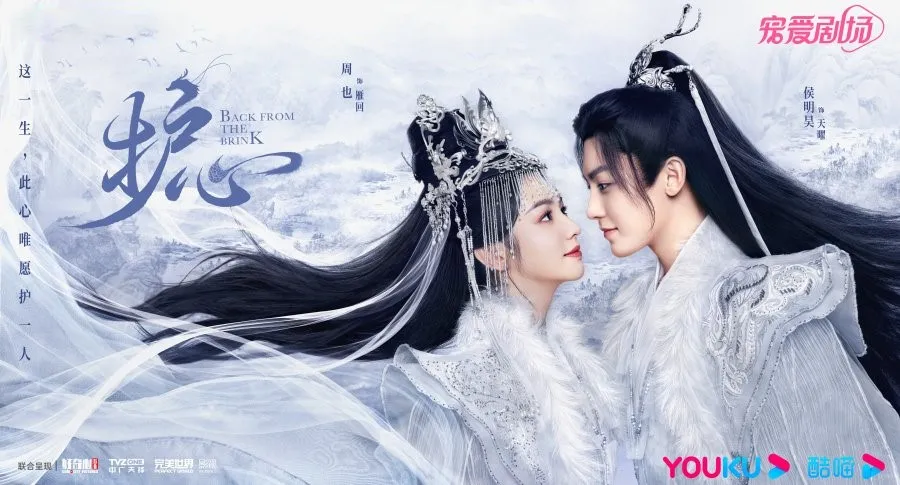
Back From the Brink Poster - Courtesy of Youku

|
DetailsRATING: (7/10)
NATIVE TITLE: 护心 – Hù xīn YEAR: 2023 EPISODES: 40 DURATION: 45’ DIRECTOR: He Shu Pei, Zeng Xiao Yu, Han Ping, Cheng Lu SCREENWRITER: Jiu Lu Fei Xiang, Wang Rou Ke, Wen Yan, Liu Bao Chen ORIGINAL CREATOR: Jiu Lu Fei Xiang (护心 - Heart Protection) |


IN A NUTSHELL
- What to expect: Adventure, revenge, and age-old legends intertwine in Back From the Brink, a fantasy that captivates above all for its ability to combine the charm of fairy tales with typical elements of xianxia. Although it unfolds within a fantasy framework rich in supernatural creatures, magic, and ancient rivalries, the drama favors an adventure tone over the epic solemnity that characterizes many contemporary xianxia. The frequent comedy, the almost itinerant structure of the narrative, and the at times fairytale-like atmosphere contribute to creating a light-hearted tale that is not without dramatic moments. The result is a story with a romantic and melancholic flavor, in which a naive and troubled relationship develops against the backdrop of age-old hatreds, forgotten secrets, and legends that seem to hail from a distant past.
- Strengths: the strong comedic focus, the realistic portrayal of the characters, the road-trip-style narrative.
- Weaknesses: the weak romantic chemistry, the unconvincing CGI, the uneven handling of some subplots
- Recommended if you like: Hou Ming Hao, Zhou Ye and Wang Yi Lun, fantastic journeys, enemies to lovers with naive love stories, cartoonish fantastic aesthetics, pronounced humor.
- Would I rewatch it? Yes.
Read on to find out if the story of Dragon Spirit Tian Yao and cultivator Yan Hui is one that will enchant you.
Back From the Brink takes a different path than classic xianxia, which seek to impress the viewer with grand battles, tormented love affairs, and sacrifices destined to change the fate of the world. From the very first episodes, in fact, one gets the impression of being faced with a fantasy tale populated by magical creatures, ancient legends, evocative landscapes, and mysteries waiting to be unraveled, where comedy and a sense of wonder are as important as the more dramatic moments.
In this review of the drama Back From the Brink, after watching all episodes, I will attempt to analyze the series' main strengths and weaknesses, to understand whether this unusual "xianxia on the road" truly stands out within a genre often dominated by solemn tones and overwhelming passion.
Plot
On his wedding day, the powerful Millenial Dragon Spirit Tian Yao is betrayed by his betrothed, the Taoist Master Su Ying, who attempts to possess the precious Heart-Protecting Scale and tears his immortal body to pieces, scattering and sealing its various parts in different locations so that he can never return to life.
Before succumbing, the demon manages to throw his precious scale into the Dark River, where it is absorbed by a newborn baby girl named Yan Hui. She has just been abandoned by her mother because she suffers from a rare heart disease that will lead to her death within a few years. Thanks to the power of the Heart-Protecting Scale, Yan Hui is miraculously healed and grows up unaware of the bond that unites her to the legendary Dragon Spirit.
About ten years later, the little girl unknowingly uses the scale's powers to defend herself from a demon, freeing Tian Yao's spirit from the seal that trapped it. Yan Hui is then adopted by the Head of the Chenxing Mountain Taoist Sect, but her rebellious nature and unusual closeness to demons ultimately lead to her expulsion.
Left alone and forced to fend for herself in the secular world, Yan Hui once again crosses paths with Tian Yao. Although their first meeting is anything but friendly, the two soon realize that their destinies are inextricably intertwined. They decide to work together to recover the lost parts of the dragon's immortal body and allow him to once again become the powerful guardian of Dragon Valley.
Their journey will lead them through hostile environments and settings populated by supernatural creatures, forging new friendships, including the enigmatic Shadow Demon Bai Xiao Sheng, and confronting increasingly dangerous adversaries, such as Su Ying and the Lord of the Dark Aura.
Through adventures, battles, secrets from the past, and a bond destined to grow ever deeper, Tian Yao and Yan Hui will face a fate that seems determined to tear them apart and continually test their resolve to pursue good.

Back From the Brink Drama Review (No Spoilers)
Plot and Narrative Pace
Back From the Brink is a fantasy story in the truest sense of the word: it's a true fairy tale that doesn't skimp on magical creatures, spells, mysterious artifacts, and fabulous locations immersed in an atmosphere suspended between the mystical and the dreamlike. CGI reigns supreme, and while it's not particularly refined, it still manages to do its job admirably: its almost cartoonish style helps give the series a fairy-tale, childlike feel.
I admit that this stylistic choice initially left me a little perplexed, but as the episodes went on, I ended up appreciating it precisely because it perfectly reflects the spirit of the drama. Not only the visuals, but also the narrative itself embraces a lighter, more adventurous dimension than many other xianxia.
In this sense, the plot of Back From the Brink stands out for its originality, distancing itself from some of the genre's most overused tropes. We are not faced with the classic story of a demon and an immortal falling in love and then forced to fight for the greater good, as in Till the End of the Moon, nor the usual story of a demon in love who waits for centuries or even multiple reincarnations for the woman he loves, as in Miss the Dragon. While retaining all the elements that make the genre fascinating — magic, supernatural creatures, spiritual cultivation, and ancient rivalries — Back From the Brink takes a different path, crafting a story that relies heavily on the journey formula, turning each new stop into an opportunity to expand the narrative world, introduce new characters, and deepen the relationships between the protagonists.
The narrative moves at a good pace, and the story flows without any significant dead spots, managing to keep the viewer's curiosity aroused through constant twists and mysteries that are gradually revealed.
Another distinctive element of Back From the Brink is the extensive use of comedy. Although there is no shortage of dramatic and emotionally charged moments, the drama often chooses to lighten the tone with gags and humorous situations. In some cases, this lightheartedness works very well and contributes to a pleasant and lighthearted viewing experience; in others, however, it takes on overly cartoonish overtones and risks seeming a little too forced, ending up breaking the emotional tension created by the most important scenes.
Characters and Love Stories
Compared to many other xianxia — and even more so considering the genre's more classic tradition — Back From the Brink stands out for its decidedly less idealized characterization. While in traditional xianxia, protagonists are often heroic figures, embodiments of absolute virtue or martyrs ready to sacrifice everything for the greater good, here the characters appear decidedly more human and imperfect.
Their actions are not guided by a rigid distinction between good and evil, but by emotions, desires, fears, and personal wounds that continually influence their choices. Even the most positive characters, including Tian Yao and Yan Hui, can be selfish, impulsive, or driven by resentment, sometimes acting in less than blameless ways to protect themselves or those they care about. It is precisely this distance from traditional heroic archetypes that makes the characterization particularly interesting. More than symbols of justice or righteousness, the characters in Back From the Brink are fallible individuals who make mistakes, contradict themselves, mature, and learn from their experiences. This choice lends greater spontaneity to the narrative and makes it easier for the viewer to empathize with their frailties and internal conflicts.
As for the love stories, I have to admit that they were probably the aspect of the drama that I found least convincing. Despite the presence of several couples, none of them managed to convey any particular chemistry or fully engage me emotionally. I often felt that the bond between the characters developed more on paper than on screen, and that the spark that would truly make you root for a relationship was missing.
Even the main couple, despite sharing numerous adventures and meaningful moments, didn't strike me as particularly close—in fact, their first real kiss didn't come until episode 38. This choice perfectly reflects the series' priorities: Back From the Brink seems to focus more on adventure, character growth, and the exploration of its fantasy world than on the romance component. For this reason, those who approach the drama looking for an intense and overwhelming love story would do well to moderate their expectations: despite being a constant presence within the narrative, the relationship between the protagonists develops gradually over the course of the episodes, but never reaches the heights of passion, romantic tension and emotional torment that characterize many of the most famous romantic xianxia.

Cast
As for the cast, I found the performances overall convincing and the casting particularly well-chosen: all the actors effectively embody the youthful, adventurous, and carefree spirit that characterizes the series. The characters convey that mix of enthusiasm, impulsiveness, and inexperience that accompanies their journey of growth and is one of the drama's defining elements.
That said, I can't say I was completely sold on the lead couple. While they worked well individually in their roles, Hou Ming Hao and Zhou Ye failed to convey a particularly intense chemistry, and this inevitably ends up penalizing a romantic component that, in itself, isn't the series' strong point.
As is often the case, I found Hou Ming Hao's expressiveness rather limited, especially in terms of microexpressions. This is a characteristic that suits, at least in part, Tian Yao, a Dragon Spirit who for much of the story appears distant from human emotions and logic. However, this very controlled acting sometimes creates a certain emotional distance between the character and the viewer, making it more difficult to empathize with his feelings. I also had the impression that in the more intimate scenes with the protagonist, he seemed rather awkward, I don't know whether due to a specific acting choice or simply due to a lack of chemistry with his co-star.
Zhou Ye, for her part, has a fresh and youthful appearance that makes her perfect for the role of Yan Hui, a young farmer who approaches the world with curiosity and recklessness. I really appreciated her spontaneity and the energy she conveys to the character, but I felt that her acting was at times a bit too emphatic, especially in scenes that required more subtle and nuanced emotions. Even in her case, the romantic sequences with Hou Ming Hao seemed slightly awkward, contributing to the sense of incomplete chemistry I perceived between the two protagonists.
I really appreciated Wang Yi Lun's lighthearted performance. Although some of his expressions occasionally clashed with the atmosphere of the scenes in which they were used, his character almost always managed to be funny and memorable. Even in the more serious moments, the natural lightness that characterizes his acting emerges, a quality that on the one hand limits the character's dramatic potential but on the other contributes to his immense likability.
Among the actors who most impressed me were Chen Xin Yue, Kwan Chi Bun, and Chen Ji. Despite adopting a much more restrained acting style than other cast members, they managed to convey intense emotions with great ease, imbuing some of the series' more dramatic moments with a sincerity that I found particularly engaging.
Finally, a special mention goes to Ding Hui Yu as the affectionate snake demon A'Cha. Thanks to his simple yet heartfelt acting, he managed to make the character incredibly tender and human, so much so that I grew fond of him from his first appearances. His scenes were among the most moving for me throughout the entire viewing.
Visual Aspects and Soundtrack
Visually, Back From the Brink is overall quite believable thanks to solid, professional direction and cinematography that makes consistent and thoughtful use of color. Although the world depicted is extremely vibrant and rich in color, this choice never feels out of place, fitting well into the fairytale nature of the story, actually helping to strengthen its visual identity. More controversial, however, is the handling of the lighting, often very bright and uniform, which sometimes slightly flattens the depth of the scenes.
A definite plus for the production is the costumes, which clearly bear the signature of costume designer Huang Wei: while not overly eccentric, they are meticulously crafted, well-crafted, and consistent with both the series' fantastical imagery and the characterizations. Makeup and hairstyling also contribute to strengthening the visual credibility of the protagonists, carefully following their different narrative evolutions.
The main limitation of the production remains the CGI, which proves to be the weakest point of the technical system. While the magical combat is generally acceptable, some visual effects appear decidedly unconvincing, while the digital creatures often take on an almost cartoonish appearance that, at times, appears excessively unrealistic. Even the sets, though meticulously reconstructed, sometimes tend to betray an overly intense use of fantastical elements that end up appearing artificial, creating a visually coherent but not always fully immersive world.
The soundtrack of Back From the Brink is primarily characterized by its romantic and melancholic atmospheres, constructed through slow-paced songs and modern orchestrations that emphasize Western-style instruments, particularly strings. The use of traditional Chinese instruments is rather limited and appears in a truly recognizable way only in the song 飘雪 (Falling Snow), which is almost an exception within the overall soundtrack.
Overall, the soundtrack doesn't contain any particularly impactful pieces: the songs tend to flow without truly making an impression, with a musical style that's more functional than memorable. Among the songs, the only one that stands out more clearly is 当歌 (As A Song), performed by Estelle Chen, which departs from the overall tone of the soundtrack with a lighter, almost childish feel, taking on the character of a little song with a playful and carefree feel.
The impact of the music is partially heightened by the vocal performances, often entrusted to singers with intense and multifaceted voices, including Liu Yu Ning and Hou Ming Hao himself. It is precisely thanks to this interpretative delivery, capable of alternating more powerful tones with delicate passages, that some songs still manage to gain a certain emotional depth, partially compensating for an otherwise rather conventional musical composition.

WARNING!
FROM THIS POINT ON THE SPOILER SECTION BEGINS. DO NOT CONTINUE IF YOU DO NOT WANT TO KNOW ALL THE DETAILS OF THE DRAMA.
Back From the Brink Drama Review (Spoilers)
What Works
The Premise
What makes Back From the Brink a compelling and, in some ways, original drama is undoubtedly its subject matter. Upon closer inspection, the series begins with extremely classic premises: a powerful supernatural being betrayed and rendered powerless by the very person he loved, the long journey to recover his powers, the allies he meets along the way, and a final battle against the forces of evil to restore order. In other words, all the typical ingredients of the heroic tale and traditional xianxia.
What differs, however, is the way these elements are developed. Rather than telling the epic tale of a hero destined to save the world, Back From the Brink chooses to construct a sort of "xianxia on the road," in which the journey takes on an equal, if not greater, importance than the final destination. Tian Yao and Yan Hui are bound from the very beginning by an unbreakable bond: the Dragon Spirit's Heart-Protecting Scale, now fused with the protagonist's body, is both what allows her to survive and what he must inevitably recover to be whole again. From this premise, a forced collaboration is born, gradually transforming into a shared journey through which the two protagonists traverse the kingdom in search of the various parts of Tian Yao's immortal body, scattered by the vengeful Su Ying.
It is precisely this itinerant structure that gives the series much of its charm. Each new stage introduces different settings, characters, and conflicts, allowing the story to continually renew itself without losing sight of its main objective. Throughout their journey, the protagonists forge friendships, face ever-new enemies, uncover secrets from the past, and repeatedly find themselves having to defy a fate that seems stubbornly opposed to them. The result is a dynamic, adventurous, and constantly evolving narrative that focuses more on discovery and exploration than on the epic grandeur typical of many contemporary xianxia.
Adding to the uniqueness of the story are the strong comedy and deliberately cartoonish CGI, which, while not always technically flawless, ultimately define a distinct aesthetic identity. Far from the solemn, tragic, and almost sacred tones that characterize many productions of the genre, Back From the Brink embraces a lighter, fairytale-like dimension. For this reason, rather than a great heroic legend or a founding myth, the series often resembles a fantastical fairy tale with dark overtones, populated by magical creatures, daring adventures, and seemingly insurmountable obstacles, yet animated by an optimistic spirit that accompanies the viewer to the happy ending.
The Comedy
If there's one aspect where Back From the Brink almost always succeeds, it's comedy. Although often very strong and sometimes even excessive, with gags, exaggerated expressions, and situations that seem straight out of a cartoon, humor is probably one of the drama's greatest strengths. Moreover, this type of comedy fits perfectly with the light-hearted tone that characterizes much of the series.
The episode that amused me the most was undoubtedly episode 33, when Tian Yao, newly reborn from the dragon egg, behaves in every way like a small child despite being a grown man. His childish reactions, tantrums, and sudden bursts of fire give rise to a series of irresistibly absurd situations that manage to elicit more than a few laughs without feeling out of place within the context of the story.
The real comic relief of the drama, however, is Bai Xiao Sheng. Although the character is initially presented as an ambiguous and potentially hostile presence towards the protagonists, he quickly becomes one of the main comic drivers of the narrative. His improbable antics, his outlandish plans, and his over-the-top attitude provide some of the most memorable and entertaining moments of the series, helping to lighten even the most tense situations.
I also thoroughly enjoyed the duo of Zhu Li and Huan Xiao Yan, whose constant bickering, their characteristic stubbornness, and the numerous asides generated by their impulsive and stubborn personalities provide some of the funniest moments of the entire drama.
That said, not all the comic choices convinced me equally. In some moments, I felt like the writers were overly insistent on gags and farcical situations, almost as if trying to create a stark contrast with the more dramatic scenes. While this device does indeed highlight moments of suffering and emotional tension, the comedy sometimes feels a little forced and risks interrupting the natural flow of the narrative. Fortunately, for the most part, humor remains one of the most enjoyable elements of the series and significantly contributes to the lightheartedness and sense of wonder that distinguish it from many other contemporary xianxia.

The Characterization
Another positive aspect of Back From the Brink is that it offers less idealized characterizations and is closer to modern sensibilities. In traditional xianxia, the main characters often tend to be portrayed as heroic or sacred: impeccable heroes, martyrs willing to make absolute sacrifices, or almost abstract embodiments of justice and righteousness. In this drama, however, the characters are brought back to a more human and concrete dimension. They are never rigidly pigeonholed into defined moral roles, but appear as complex individuals, driven by authentic and often contradictory emotions. Their choices are not born from an absolute idea of good or evil, but from personal desires, unresolved wounds, and emotional survival instincts that make them more relatable and understandable.
The character of Bai Xiao Sheng represents perhaps the most obvious example of this approach. Sacrificed by his clan as a child because he was deemed too powerful and destined to become a tool in the hands of the Master of Dark Energy, he spends much of his life in service to the latter, contributing to his plans and providing him with part of his own power. Yet he never becomes a completely evil figure: behind his shady and opportunistic behavior, a desire to help Tian Yao and Yan Hui constantly emerges, even to the point of openly opposing his own master.
The same is true for many other characters. Chang Lan chooses to serve the dark side because the laws of his kingdom condemned him to a life of imprisonment and blindness simply for being born minutes after his destined twin brother. Even the Dark Specter, the very embodiment of a corrupt and destructive power, has shown a desire for change in the past under Xue Lin's guidance. Likewise, Su Ying's cruelty stems not from malice as an end in itself, but from her fanatical devotion to the cause of the immortals and her deep attachment to Lu Mu Sheng.
Even seemingly "positive" figures, including the protagonists, are not free from shadows: they are often selfish, impulsive, or driven by resentment, and they do not always act according to impeccable moral principles. Tian Yao himself, who for much of the story appears altruistic and self-sacrificing, comes to make a profoundly selfish choice when Su Ying blackmails him, endangering the inhabitants of Dragon Valley and forcing him to choose between the lives of his subjects and that of Yan Hui. At that moment, like many other characters in the series, he does not act according to absolute moral principles, but is driven by affection, fear of loss, and the desire to protect what he considers most important.
It's precisely this shift from the genre's typical idealization that makes their characterizations fresher and more engaging: not heroic symbols, but people who make mistakes, react, contradict themselves, and grow along the way. This approach helps make the narrative more alive and credible, because it allows the viewer to identify, at least in part, with the characters' frailties, motivations, and internal conflicts.
What Doesn't Work
The melodramatic nature of the love story between Tian Yao and Yan Hui
One of the aspects that least convinced me about Back From the Brink is probably the handling of the love stories, and in particular that between Tian Yao and Yan Hui. For much of the series, their relationship is built through collaboration, mutual trust, and surprisingly sincere communication by the standards of the genre. Precisely for this reason some narrative twists seemed particularly forced, almost as if they were introduced to artificially increase the melodramatic component of a romance that, in itself, tends to maintain a rather measured tone.
The most obvious example is Tian Yao's recovery of the Heart-Protecting Scale. Up until that point, the protagonists seemed to have overcome their initial mistrust and established a relationship based on dialogue and mutual trust. This is why I found it rather difficult to accept that, in episode 16, Tian Yao suddenly decided to stab Yan Hui in the back to get her scale back without offering any explanation, leaving her in agony and deeply traumatized. This choice seems even more problematic considering it forces Bai Xiao Sheng to contaminate her with dark energy in order to save her life, triggering a long series of consequences that seem to stem more from the demands of the romantic drama than from natural character development.
The subsequent developments also left me rather perplexed. On the one hand, Yan Hui, after her betrayal, develops a genuine panic reaction towards Tian Yao, accompanied by continuous disturbing flashbacks every time he tries to approach her. On the other hand, we witness what appears to be a genuine case of selective mutism on the part of the male protagonist, who systematically misses every opportunity to explain his reasons and clarify what happened. It's one of those plot devices that can work to prolong romantic tension, but inevitably ends up frustrating when the conflict could be resolved with a simple conversation. In this regard, I was a bit disappointed to see the writers once again resort to one of the genre's most overused clichés: instead of letting Tian Yao himself tell Yan Hui the truth, the task is entrusted to Huan Xiao Yan. The result is that the clarification between the protagonists is further postponed, not because there are any real obstacles to communication, but simply because the script needs to keep the conflict alive for a few more episodes.
The subplot involving Bai Xiao Sheng also seemed, at times, overly contrived. His stubborn attempts to foster the relationship between Tian Yao and Yan Hui initially find a rather convincing narrative justification in the desire to obtain the Spectral Praise, which requires a couple composed of a demon and a Taoist capable of passing the tests imposed by the Brush Spirit. As long as his actions are motivated by this goal, they maintain an internal coherence and even contribute to some amusing situations.
Things get complicated, however, when Bai Xiao Sheng himself suddenly develops feelings for Yan Hui. While it's understandable that a character marked by maternal abandonment might become attached to someone who shows him kindness and understanding, I found the speed with which this bond transforms into a love interest unconvincing. Rather than a natural evolution of their friendship, this twist feels like it was introduced to further impede the relationship between the protagonists and add a new element of emotional tension to the plot.
For this reason, the entire subplot ends up feeling slightly contrived. I felt like the writers were trying to insert a hint of a love triangle into a story that, in reality, seems to thrive when it focuses on the adventure, the protagonists' journey, and their personal growth rather than on romantic misunderstandings and romantic rivalries.

The Managing Some Subplots
Even the handling of some subplots sometimes leaves the impression of a certain tendency on the part of the writers, to introduce an excessive number of events for the sole purpose of creating new tension within the plot. Several times throughout the series, I had the feeling that certain narrative threads were introduced and then resolved too quickly, without the time necessary to develop real emotional engagement on the part of the viewer. In these cases, their purpose seems more to generate momentary peaks of drama or to prolong the narrative than to truly delve into the characters or the world of the story.
The episode that gave me this feeling the most is the story of Pu Fang and Xi Feng. Their love story is introduced only in episode 29 and is essentially exhausted in the space of about twenty minutes, leaving very little room for the viewer to grow fond of the couple or emotionally invest in their fate. Making the situation even more curious is the fact that Pu Fang herself, when telling Yan Hui how she and Xi Feng met, defines their relationship as "a well-known stereotype," a joke that unintentionally highlights the extremely conventional and superficial nature of their relationship.
The information we are given about their past further weakens the emotional impact of the story. After their first meeting, the two have virtually never seen each other again, and Pu Fang herself admits she doesn't even know whether Xi Feng reciprocates her feelings. For this reason, it's difficult to perceive their bond as particularly deep or comparable to that of couples who have shared years of life, sacrifices, and hardships together.
Not even their reunion in episode 30 really strengthens the credibility of their story. When the two meet again, Xi Feng doesn't seem particularly happy to see Pu Fang again, nor does he seem willing to sacrifice himself to save her when she is captured by Ling Fei. Consequently, when he later decides to join her in the afterlife after discovering she died from torture at the hands of her fellow disciples, the moment struggles to evoke the emotion the screenwriters had likely intended. Rather than a tragedy constructed and prepared over time, their story ends up feeling like a melodramatic interlude inserted at the last minute, making it difficult to truly empathize with the fate of the two characters.
The CGI
The most controversial aspect of the entire production, however, is the CGI. Many visual effects are unrealistic, and some digitally generated creatures seem more like animation than live-action. Several magical effects also appear artificial and don't always integrate convincingly with the environments and actors.
A similar feeling emerges when observing the sets. While generally meticulously crafted and richly detailed, many environments make extremely abundant use of fantastical elements, decorations, and supernatural structures, sometimes appearing more constructed than lived-in. The result is an aesthetic that rarely strives for realism and often exposes its artificial nature.
Paradoxically, however, it is precisely this evident artificiality that constitutes one of the most distinctive aspects of the drama. Rather than seeking a believable and immersive representation of the supernatural world, Back From the Brink seems to embrace an almost fairytale dimension, in which verisimilitude takes second place to the sense of wonder. The cartoonish creatures, the deliberately flashy special effects, and the saturated landscapes contribute to an atmosphere more reminiscent of a fantastical fairy tale than a mythological legend.
For this reason, although the CGI is objectively one of the series' weakest points from a technical standpoint, I never felt it was a real detriment to the viewing experience. After an initial sense of alienation, I actually ended up considering it an integral part of the drama's identity. Its artificial and almost childlike aesthetic pairs surprisingly well with the light, adventurous, and at times playful tone of the narrative, helping to give the series that modern fairy tale feel that distinguishes it from many other contemporary xianxia.

Characters and Cast
Primary Characters
Tian Yao (Hou Ming Hao) Millennial Dragon Spirit who lives in the Dragon Valley of Luochuan. His magical power is the Dragon Fire and his sword, the Flaming Dragon Fang, is able to dispel Dark Energy. On the day of his wedding to the Taoist Master Su Ying, she betrays him and tries to steal his Heart-Protecting Scale but, failing, she tears his body to pieces and seals his Spirit in a tree in the Dragon Valley. After Yan Hui frees his soul from the Soul-Blocking Wood, he lives in the Tongluo Village under the guise of A’Fu, grandson of the old Mrs. Xiao (Li Wen Ling).
Yan Hui (Zhou Ye) girl with a rare heart disease who is abandoned by her mother when she is still a baby in the waters of the Dark River that is said to cure all illnesses. When Tian Yao throws away the Heart-Protecting Scale to prevent Su Ying from taking it, she receives it providentially and heals. After a few years of wandering she finds herself at the Dragon Valley where, to defend herself from a demon, she uses Tian Yao’s Dragon Fire and frees the Demon’s spirit from the Soul-Blocking Wood. She is later adopted by the Chenxing Mountain Taoist Sect Leader and becomes his disciple.
Bai Xiao Sheng (Wang Yi Lun) Shadow Demon descendant of the Shadow Clan and dark practitioner. As a child, he was the most gifted child of the Shadow Clan. Feeling threatened by him, Clan Chief Ying Cheng (Zhu Peng Cheng) made a pact with the Lord of the Dark Aura to hand him over and convinced his mother to abandon him in the forest, telling her that he is the evil child of which an ancient prophecy of theirs speaks. Once in the hands of Fu Yin, he uses his essence to make a shadow cloak to protect him from Tian Yao’s power. Later, the Dark Phantom will task him with finding the Ghostly Eulogy, the manuscript from the Taoist Master Xue Lin that explains how to eliminate dark energy from the world.
Fu Yin/Dark Phantom (Pema Jyad) Lord of the Dark Aura born from the chaos and evil of the world. In his youth he was a disciple of the Taoist Master Xue Lin who wanted to help him control his dark energy through cultivation. However, he is consumed by his obsession with her and when he discovers that the woman is in love with the King of Qingqiu he transforms into an evil spirit.
Supporting Characters
Guanghan Taoist Sect
Su Ying (Yang Rong) leader of the Guanghan Taoist Sect and Tian Yao's fiancée. On their wedding day, she betrays him and attempts to steal the Heart-Protecting Scale, but fails, dismembering him and sealing his body parts in various locations throughout the kingdom. With his scales, she creates a suit of armor to protect and prolong the life of her true love, the mortal general Lu Mu Sheng. Without the Heart-Protecting Scale, however, the armor is incomplete, so she attempts to steal it by all means, attempting to lure Tian Yao into a trap.
Yun Meng (Zhang Xin Yan) immortal of the Guanghan Taoist Sect and subordinate of Su Ying. In reality, she is a dark practitioner under the orders of the Lord of Dark Aura.
Mount Chenxing Taoist Sect
Ling Xiao (Chang Zhi Yao) Leader of the Chenxing Mountain Taoist Sect who finds and adopts Yan Hui and raises her for ten years.
Zi Chen (Liu Feng) chief disciple of the Chenxing Mountain Taoist Sect and Yan Hui’s da shixion (senior male fellow disciple).
Zi Yue (Zhang Wan Fang) disciple of the Chenxing Mountain Taoist Sect and Yan Hui’s shijie (senior female fellow disciple).
Taoist Master Qing Guang (Tan Jian Chang) former Leader of the Chenxing Mountain Taoist Sect and Ling Xiao’s shifu (teacher). With the help of Chen Yi and Xue Lin, he sealed the Lord of Dark Aura’s power within himself, but ultimately became subjugated by it, allowing Fu Yin to use him to spread evil throughout the world.
Ling Fei (Long Zheng Xuan) Master Taoist Supervisor of the Chenxing Mountain Hall of Discipline in charge of capturing and imprisoning evil demons and Su Ying’s meimei (younger sister). She is the one who captures and kills Yun Xi at Su Ying’s request because she dared to fall in love with Lu Mu Sheng.
Yongzhou City
Xian Ge (Chen Xin Yu) Yan Hui’s friend and owner of the Forgotten Words Establishment, which actually serves as a refuge for the persecuted demons of Yongzhou, whom she registers as her familiars. Her fight on behalf of the demons, despite being a mortal, stems from her being the adopted daughter of the King of Qingqiu.
Yu Li (Ye Si Wei) Xian Ge’s main familiar who is part of his twelve gongzi group.
Feng Ming (Yi Mu) owner of the Tianxiang fragrance and incense production laboratory in Yongzhou and uncle of Feng Chan Shuo. In reality, he works for Su Ying, distilling the energy of demons to create an elixir that restores Lu Mu Sheng’s memory.
Feng Chan Shuo (Zuo Ye) nephew of Feng Ming, owner of the Qijue Agencies and publisher of the magical review The Chronicles of Flowers. He has always been in love with Xian Ge and, after much persuasion, he finally manages to marry her.
Wang Peng Yuan (Chen Guo) Young Lord of the Wang Family. He is the richest man in Yongzhou and Yan Hui wants to extort from him the sum of money needed to buy an information from the Qijue Agency. He is willing to do anything for her since she saved him from a group of demons that attacked him on his way to the Huguo Temple.
Kingdom of Qingqiu
Chen Yi (Kwan Chi Bun) king of Qingqiu, the Demon Kingdom, and father of Yun Xi and Zhu Li. He belongs to the Nine-Tailed Fox lineage and has a twin brother named Chang Lan.
Xue Lin (Qi Yi) Taoist Master of the Chenxing Mountain Sect who falls in love with and marries the king of Qingqiu. Throughout her entire life she searches for a way to eliminate the Dark Energy from the world and, to do so, she practices the techniques of Ghoslty Eulogy which, however, drain her energy, leading to her death.
Yun Xi (Du An Qi) Princess of the Nine-Tailed Fox lineage of Qingqiu, daughter of Xue Lin and Chen Yi. She saves Lu Mu Sheng and falls in love with him so much that she decides to marry him while keeping her true identity a secret. She dies killed by Su Ying who wants to create an elixir with her demonic essence to restore the memory of her beloved General.
Zhu Li (Liu Yao Yuan) Crown Prince of the Nine-Tailed Fox lineage of Qingqiu and son of Xue Lin and Chen Yi. He will fall in love with Huan Xiao Yan and, after many adventures, he will marry her.
Chang Lan (Kwan Chi Bun) twin brother of King Chen Yi, governs Qingqiu when the sovereign disappears. According to the laws of Qingqiu, he was blinded as a child to prevent him from usurping the throne and lived for years in the royal prisons until his brother freed him. To try to counter his grim fate, he becomes a dark practitioner in the service of the Dark Phantom and is known as the Visual Spell Master.
Zhao Yu (Xia Tian) Chief of the Qingqiu Guards. He is Chang Lan's godfather and helped him during his time in the royal prison. During his reign, he supported him and covered up his misdeeds.
Pu Fang (Guo Yang) Five-Tailed Fox Demon and Chang Lan’s doctor. She is secretly in love with Taoist disciple Xi Feng (Zhao Rui) and secretly follows Yan Hui to Mount Chenxing to see her beloved again, but is killed by Xi Feng's fellow sect members because of their forbidden romance.
Yan Buhuo (Yang Guang) Paintbrush Spirit, guardian of the Ghostly Eulogy and tutor to the Crown Prince. Before dying, Xue Lin entrusts him with the custody of her manuscript by sealing it in a screen in the royal palace of Qingqiu. For the manuscript to be revealed, a couple formed by a Taoist and a Demon must enter the screen and pass three tests (disturbing techniques). The first consists of correctly answering questions posed by Yan Buhuo. The second consists of walking to the end of a dark tunnel without being persuaded to turn back by the spirit of Xue Lin. The third consists of breaking an illusion by deciding to save the loved one at the expense of the rest of the world.
Other Characters
Huan Xiao Yan (Zhang Kai Ying) Demon of Illusions who lives in the Mystifying Fog Forest near the city of Fengya. After the death of the King of the Clan of Illusions (Fu Hong Sheng), she is the sole survivor of the Illusion Clan and is determined to find the Master of Visual Spells to avenge the extermination of her Clan. She will fall in love with Zhu Li.
Lu Mu Sheng (Ji Chen) human general demon hunter loved by Su Ying. After losing his memory, he falls in love with and marries the Demon Princess Yun Xi and, after she is killed by Su Ying, decides to take care of his beloved's burial in Qingqiu forever.
A'Cha (Ding Hui Yu) snake demon whom Yan Hui wants to capture to redeem his bounty and earn some money. He is wanted for stealing the Flame Orb needed to heal the Taoist Master Qi Yun. He was fascinated by her when she saved him from demon hunters, but she later fell victim to the Frost Blossom Technique and has been gravely ill for years now.
Qi Yun (He Xin Lin) Taoist Master and Head of the Qiyun Monastery. About twenty years before the events of the story, she saved the Demon Serpent A'Cha from a group of demon hunters, and he fell in love with her. Some time later, following the dark energy into the Mystifying Fog Forest, she entered the mind's eye of the Dark Phantom, where she attempted to help Master Qing Guang eliminate Su Yin. During the battle, however, the dark energy contaminated her, and to save her, the Taoist Master used the Frost Blossom Technique on her, altering her mind and damaging her body. When A'Cha finds her, she is gravely ill, so he steals the Flame Orb in the hopes of curing her.
Wu Jin (Rong Er Bo) dark practitioner who controls a Shebishi (mythological creature). He attempts to kill Tian Yao to absorb his spiritual energy but is defeated by the Dragon Spirit with the help of Yan Hui.

Favorite Character: Xian Ge
She is one of the most positive and trustworthy characters in Back From the Brink. Calm-hearted, thoughtful, and endowed with great common sense, she often represents a balancing voice in a story populated by impulsive, tormented, or obsessive figures.
Despite being mortal, she is deeply connected to the world of demons thanks to her relationship with the King of Qingqiu, who raised her as a daughter, and she develops a sincere empathy for them that leads her to openly challenge prejudice and injustice.
Her courage is especially evident in concrete actions: she doesn't hesitate to risk her position to help the demons persecuted by the Feng Family, even going so far as to dig secret tunnels beneath her Circle to allow them to smuggle out of the city.
Similarly, she proves herself a loyal and generous friend to Yan Hui, repeatedly intervening to help her and offering protection to both her and Tian Yao in times of greatest difficulty.
While she's neither an extraordinary fighter nor a central figure in the series' major supernatural events, she faces even the most dangerous situations with determination, even fighting alongside the protagonists against the Dark Spectre.
Her strength lies not so much in her powers as in her moral integrity, the ability to act according to her conscience, and the will to do what she believes is right even when it would be easier to turn away. For this reason, despite often staying out of the spotlight, she ends up being one of the most authentic, admirable, and courageous characters in the entire drama.
Un-Favorite Character: Su Ying
She is undoubtedly one of the most controversial characters in Back From the Brink. Behind the apparent rectitude and moral rigor of the respected Taoist Master lies a woman consumed by her own obsessions, willing to sacrifice anyone to pursue what she believes is right or achieve what she desires. Her every word seems carefully calibrated to gain an advantage, and her every action appears driven by self-interest and distorted moral principles.
Her coldness and constant self-control make her difficult to contextualize within traditional categories of good and evil. She often acts in the name of seemingly noble ideals, but is willing to exploit, deceive, and sacrifice anyone to achieve her goals. She doesn't hesitate to manipulate even those closest to her, using their trust as a tool and showing little empathy for the suffering she causes.
What drives her above all is her obsession for Lu Mu Sheng, a feeling that transcends love and gradually takes on the form of a morbid obsession. In pursuing this goal, she commits increasingly questionable actions without ever truly questioning the consequences of her choices.
What makes her particularly disturbing is precisely her lack of genuine internal conflict: until the very end, she shows no remorse for the pain she has caused others, nor does she seem to question her own beliefs.
For this reason, she ends up embodying one of the most interesting forms of moral ambiguity in the drama. She is not simply a villainous antagonist, but a woman who has subordinated every principle, affection, and sense of humanity to her own desires, gradually transforming her love into a justification for every action. And, unlike many villains of the genre, she finds no true redemption, not even in the face of death.
RECOMMENDED:
- MISS THE DRAGON
- LOVE BETWEEN FAIRY AND DEVIL
- THE BLUE WHISPER
- LOVE YOU SEVEN TIMES
- TILL THE END OF THE MOON
Thanks for reading this far!
I hope you enjoyed my article. If you like my work and want to support me, buy me a coffee☕