
Love and Crown (2025): When the Script Does Everything It Can to Sabotage the Love Story | Dropped Drama Club
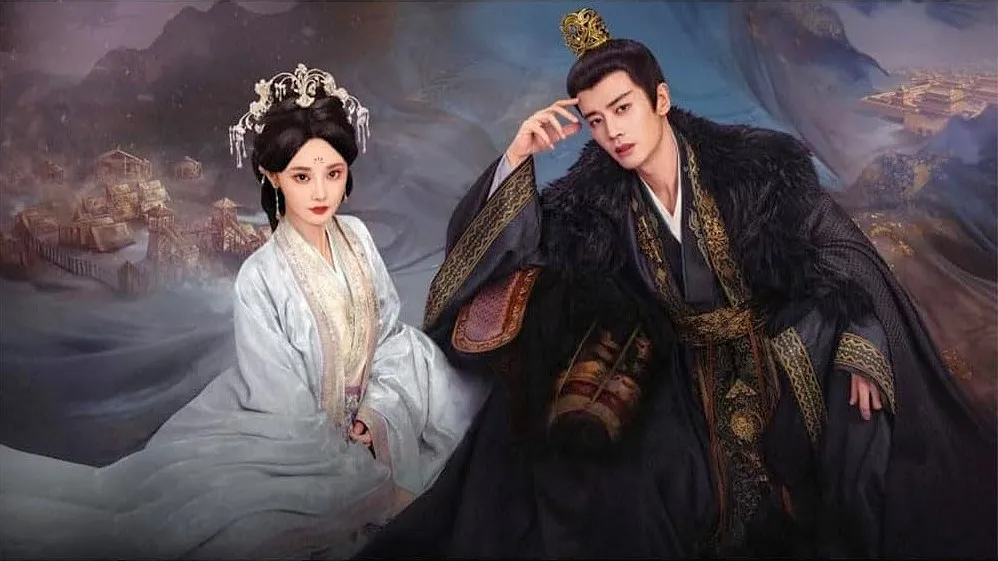
Love and Crown Poster - Courtesy of Youku

|
DetailsRATING OF EPISODES WATCHED: (4.5/10)
NATIVE TITLE: 凤凰台上 - Fènghuáng tái shàng YEAR: 2025 TOTAL EPISODES: 35 WATCHED EPISODES: 10 DURATION: 45’ DIRECTOR: Lin Feng, Zhao Xia SCREENWRITER: Miao Wen Jing, Wang Chen, Ding Ya ORIGINAL CREATOR: Xie Lou Nan (我的皇后 - My Empress) STATUS: 🔴 (permanently dropped) |


Disclaimer: the opinions expressed in this review refer exclusively to the drama. As I have not read the original work, I cannot say with certainty whether the issues identified can be attributed to the screenplay or to the source material. For this reason, my comments on the writing should be understood as an assessment of the adaptation rather than a judgment on the original work.
IN A NUTSHELL
Short on time? Here you’ll find the quick verdict, including the drama’s main strengths, weaknesses, and key features to help you decide if it’s right for you. For a more in-depth analysis, continue with the No Spoiler Review.
- What to expect: Love and Crown is a historical drama that combines court intrigue, political conflict, jianghu, and romance, with an interesting premise and a solid narrative foundation represented by the contrast between the political and martial worlds. However, the plot accumulates numerous subplots without managing to develop them organically, while the pace alternates between excessively rapid passages and moments where the story seems to artificially slow down. The relationship between the protagonists is also fraught with misunderstandings and misunderstandings that end up making it unbearably oppressive. The result is a story with good premises, but too uneven writing to fully exploit them.
- Strengths: the narrative premise.
- Weaknesses: The chaotic plot, the uneven pacing, the excessive romantic angst.
- Who might like it anyway: anyone who is a big fan of Ren Jia Lun and Peng Xiao Ran, anyone who loves difficult and tormented love stories, anyone who prefers plots full of twists and turns that alternate the frenzy of political events with the suffering of the protagonists.
Continue reading to understand why this drama disappointed me so much.
Love and Crown initially seemed like a very promising drama: a story set between the imperial court and the jianghu, two compelling protagonists, and a relationship that seemed to be able to evolve alongside the political intrigue surrounding it. The problem is that, instead of exploiting this potential, the script ends up turning the bond between Xiao Huan and Ling Cang Cang into a constant conflict, reducing a potentially passionate love story to a series of increasingly artificial and frustrating misunderstandings.
It is precisely this inability to let the protagonists' relationship evolve without having to constantly sabotage it that pushed me to abandon Love and Crown and place it squarely in the Dropped Drama Club – the column dedicated to dramas that, despite promising promises, failed to convince me to see the end.
Plot
After secretly leaving the palace in disguise, the young Emperor Xiao Huan attempts to approach Ling Cang Cang, the daughter of the Grand Tutor and heroine of the jianghu, whom he is destined to marry to consolidate his power at court. The two find themselves working together and, amidst investigations and dangers, become involved in a relationship far more complex than expected.
When circumstances inevitably lead them to marriage, Xiao Huan and Cang Cang are forced to confront shadowy forces, secrets from the past, political rivalries, and old grudges that repeatedly test their relationship.
Amid plots, revenges, and feelings increasingly difficult to ignore, for Xiao Huan and Ling Cang Cang, the real challenge will not only be unmasking their enemies, but also understanding whether they can truly trust each other.

THIS SECTION TAKES A CLOSER LOOK AT THE SCRIPT, CHARACTERS, CAST, AND TECHNICAL ASPECTS WITHOUT REVEALING MAJOR PLOT DEVELOPMENTS. FOR A COMPLETE ANALYSIS OF THE DRAMA, CONTINUE WITH THE SPOILER REVIEW.
Love and Crown Drama Review (No Spoiler)
Why I Started
The main reason that pushed me to start Love and Crown was the desire to see Peng Xiao Ran again in a leading role within a story set in the imperial court and characterized by political intrigue, power struggles and factional conflicts. After Goodbye My Princess, I was curious to see her again dealing with a character immersed in the dynamics of power and with an equally "royal" love story, but built on different assumptions.
The presence of Ren Jia Lun also contributed to fueling rather high expectations: his involvement, combined with a premise that seemed to offer a good balance between court politics, jianghu and romance, made me think that Love and Crown could be an ambitious drama and above all capable of convincingly developing both the narrative and sentimental components.
In short, given the premises — "interesting subject + two protagonists of this caliber" — I thought I had every reason to expect an interesting and good quality drama.
Finally, there was one last curiosity, decidedly more frivolous: to find out if what I have renamed the "curse of Ren Jia Lun" — i.e. the tendency of his characters not to reach the conclusion of the story alive — would recur this time too.
Review of Episodes Watched
Love and Crown starts with an idea that on paper has a lot of potential: an emperor who disguises himself as a commoner to investigate the kingdom's problems, a martial heroine protagonist caught up in court intrigue, and a forced marriage that brings together two people who, at least initially, belong to seemingly incompatible worlds. The problem is that the drama seems afraid to choose a direction and ends up throwing too many irons in the fire: political intrigue, family vendettas, factional struggles, jianghu sects, secret identities, court conspiracies, illnesses, poisons, sacrifices, and romantic tragedies. Every time a storyline could finally delve into a character, a relationship, or a political conflict, a new twist comes along to demand the viewer's attention. The result is an overburdened plot, in which some ideas are developed too hastily or abandoned before they can truly produce anything.
The pacing also suffers from this overabundance of ideas: Love and Crown manages the curious feat of being simultaneously too fast and too slow. In the first few episodes, practically everything happens — the protagonists meet, collaborate, fall in love, discover they're destined to marry, argue over the murder of Cang Cang's master, and end up getting married — but the story jumps so quickly from one event to the next that it feels like a succession of twists and turns rather than a true narrative progression. And when the drama slows down, it's often through misunderstandings, shocking revelations, or danger, rather than letting the characters coherently move the story forward. It's a paradoxical situation: things are constantly happening, but it often feels like the story isn't really going anywhere.
As for the characters, Xiao Huan and Ling Cang Cang could have been protagonists capable of carrying a complex story: he is a wise emperor who wants to take concrete care of his kingdom; she is an idealistic, independent woman, equally determined to protect the weak. The problem is that the script seems more interested in constantly putting them in dramatic situations than in truly developing their personalities. The same goes for several supporting characters: some are introduced with traits and conflicts that seem to promise interesting story arcs, only to be relegated to the role of mere supporters of the protagonists.
Even the antagonists end up falling victim to the same problem. Love and Crown features antagonists who could have worked very well, because they have personal motivations, political interests, or complex relationships with the protagonists. Yet the script rarely manages to transform them into a truly convincing threat: instead of progressively building their strategies and letting their actions clash with the protagonists' goals, the writers tend to increase their conflict whenever the story requires new contrasts.
And now we come to the love story. Xiao Huan and Ling Cang Cang have, at least potentially, all the ingredients to be an interesting couple, but instead of exploiting their similarities to build a relationship that evolves along with the plot, the writers seem to constantly maintain a distance between them. Secrets, half-truths, and misunderstandings thus become an indispensable component of the relationship. And this is precisely what makes it frustrating: the couple would work perfectly if the script stopped interfering for a moment. This dynamic may perhaps satisfy those who enjoy emotional torment and romantic angst, but if you're looking for a true sentimental payoff, Love and Crown is unlikely to meet this need: in the long run, the misunderstandings end up suffocating the relationship, leaving a latent sense of dissatisfaction.
The cast, overall, gave a decent performance, especially considering the less-than-stellar script they worked with.
Peng Xiao Ran is a particularly expressive actress, suited to both spontaneous, light-hearted roles and more serious, dramatic performances (such as Jun Jiu Ling). In this drama, however, I got the impression she's not yet fully comfortable with martial arts roles, so much so that some of her action scenes felt less natural than the rest of her performance. During the drama's broadcast, Peng Xiao Ran was also unwittingly embroiled in a controversy on Chinese social media with the author of the original novel, who blamed her for the profound differences between the drama's protagonist and the one in the source material. Personally, I find it hard to believe that Peng Xiao Ran has the bargaining power to independently decide on such substantial changes to her character, especially in a production of this caliber.
Ren Jia Lun is undoubtedly a talented actor, but his acting style continues to leave me perplexed: I often find his face too stiff and his microexpressions too limited. I understand that his typical character is often that of the serious, cold, and impassive aristocrat, but a little more emotional nuance in his face would have been appreciated. What struck me most, however, was his physical transformation. Since Xiao Huan is ill, weight loss that would have given him a more emaciated appearance could certainly have helped highlight the character's fragility; the result, however, is so drastic that it made me wonder if it was really necessary to go that far. I can understand the professional dedication, but I wonder how much it was worth considering that Love and Crown was announced as his last project with Huanyu Century, his previous agency, and that rumors later circulated that he had even waived his fee, considering it a sort of "separation fee" to the company.
Among the supporting actors, I found Wang Zhuo Cheng to be quite convincing as the skilled swordsman determined to protect the woman he grew up with at all costs: he manages to make his character believable, even if, like his other colleagues, he doesn't particularly shine in terms of expressiveness. I also appreciated Liu Meng Rui as Princess Xiao Ying, whose psychological instability is portrayed quite convincingly despite a few minor flaws. I was less convinced, however, by He Nan in the role of Cang Cang's swordswoman friend and Zhang Yao in the role of Prince Xiao Qian Qing, both characterised by an acting that at times seemed almost caricatural to me, even if, in this case, part of the blame could depend on the characterisation of their characters themselves.

From a technical standpoint, Love and Crown combines elements of a rather uneven quality. The direction I didn't dislike: some shots are interesting and help give a certain dynamism to the scenes, although during the dialogues the constant switching between interlocutors can be at times alienating. The cinematography, on the other hand, isn't among the production's most successful aspects: firstly because it uses an extremely saturated palette, giving the drama an almost donghua look; and secondly because it consistently uses such bright lighting that it appears almost theatrical.
On the visual effects front, Love and Crown surprised me quite positively. The green screens are integrated discreetly, and even the CGI cityscapes used as transitions are realistic enough not to break the illusion. The landscapes built by the production team and snow scenes are also convincing and, at least visually, don't convey the artificial feel that often plagues these types of scenes. The costumes, which are aesthetically pleasing, follow the same trend: the materials and cuts are sumptuous and elegant, contributing to the characters' refined appearance, especially in the scenes set at court. I'm a bit more perplexed by the hair ornaments, which in some cases betray their modern craftsmanship a bit too much and risk ruining the historical illusion.
The audio, unfortunately, is more questionable: the dubbing often sounds muffled and, in some places, asynchronous, with voices that seem to come from a distance and at times take on an almost distorted quality.
Then there's an editing choice that I personally always find difficult to accept: starting a story from an advanced point in the story, then interrupting it with a long flashback intended to explain what would have been much simpler to tell chronologically. I understand the desire to hook the viewer by opening the drama at the height of tension, but that doesn't necessarily make the story more compelling. When entire episodes of flashbacks are needed to bring the viewer back to where the series began, the impression that the narrative structure is sacrificing clarity simply for the sake of a more dramatic opening becomes very strong.
The soundtrack, on the other hand, is one of the aspects that most positively surprised me. Although the songs are almost all characterized by slow and melancholic atmospheres, with the exceptions of the more epic 绛唇劫 (Crimson Lips’ Curse) and the almost lullaby 梨花簪 (Pear Blossom Hairpin), the arrangements are notable for their variety and, above all, for not adhering too closely to the usual sonic canons of romantic historical dramas. The instrumentation is predominantly Western, with occasional forays into Eastern instruments, but what really makes the soundtrack unique is the alternation of voices: the different performers give the songs very different personalities, preventing them from ending up too similar despite sharing similar atmospheres and emotional tones. It's a detail that I found pleasantly surprising and that makes the soundtrack decidedly more distinctive than I would have expected from this drama.
WARNING!
SPOILERS AHEAD. IN THIS SECTION I GIVE MY PERSONAL OPINION ON THE DRAMA AND SPECIFICALLY ANALYZE SOME ASPECTS OF THE SERIES. DO NOT CONTINUE IF YOU DON’T WANT TO KNOW ALL THE DETAILS OF THE DRAMA
Love and Crown Drama Review (Spoiler)
Breaking Point
My breaking point with Love and Crown came in the tenth episode, when Xiao Huan decides to give Ling Cang Cang a contraceptive infusion without clearly telling her what he's giving her and, more importantly, without explaining why. It was the moment I realized the drama was going down a path I personally detest: that of "I know something you don't know, so instead of explaining it to you, I'll do something questionable for your own good and then be surprised when you get angry."
Because the problem isn't just the gesture itself, but the way the script turns it into yet another misunderstanding generated by the protagonists' inability to communicate. Once again, the ML makes a decision "to protect" the FL and deliberately chooses to keep her in the dark, leaving her to interpret his intentions based on the little information she has.
At that point, I began to wonder how much longer Love and Crown intended to use misunderstandings as fuel for the relationship: because if a couple continues to grow closer, trust, drift apart, and repeatedly fall into the same pattern simply because one of them doesn't want to share information with the other, at a certain point we're no longer faced with a romantic conflict, but with a narrative device destined to become exhausting. And that's precisely where I lost patience: not because I expect the protagonists to have a conflict-free relationship, but because their relationship seems built on the curious belief that communication is a form of weakness.
The most frustrating thing, though, is that up until that point, I was still willing to give it a chance: Xiao Huan and Ling Cang Cang had chemistry, they worked well together, and, when they weren't constantly hiding things from each other, they were even enjoyable to follow. But after yet another misunderstanding that could have been avoided with a thirty-second conversation, I simply realized I no longer wanted to invest my time in a drama that tries to advance the protagonists' relationship through misunderstandings rather than through adult, sincere communication.
Why I Dropped It
This episode made me realize that in Love and Crown, misunderstandings aren't simply obstacles to test the protagonists' feelings or complicate an otherwise linear relationship. They become the main driving force of the story, systematically accompanied by secrets, half-truths, and deliberately withheld information. The problem becomes evident precisely when the relationship between Xiao Huan and Ling Cang Cang begins to develop into something more concrete: instead of allowing their relationship to evolve through trust and communication, the screenplay seems to constantly need to introduce new conflict.
The case of the contraceptive infusion is the most striking example: although Xiao Huan administers it to prevent Ling Cang Cang's potential pregnancy from being exploited politically by her family, he doesn't adequately explain his reasons, and she inevitably ends up interpreting this gesture as proof that he doesn't truly love her. It's exactly the same mechanism that already occurred in the episode of her master's death: Xiao Huan kills him, but chooses not to reveal crucial information about the circumstances of his death that could have justified his behavior. Cang Cang, for her part, sees only a man who killed someone she loved and who continues to behave ambiguously, so she ends up interpreting his intentions in the worst possible way, even going so far as to convince herself that Xiao Huan approached her only to eliminate her master.
And here, in my opinion, lies the real problem with Love and Crown: the conflict arises not so much from an incompatibility between the protagonists as from the screenplay's inability to manage a couple who collaborate and communicate constructively. Every time Xiao Huan and Ling Cang Cang seem to have reached a point of equilibrium, something comes along that calls everything into question, not because their feelings or goals are necessarily at odds, but because one of them has information the other doesn't know and chooses not to reveal it. This tendency is particularly evident in Xiao Huan's behavior: when there's something important to know, especially something directly concerning her, the ML tends to decide for herself how much detail the FL should know. His intentions are often protective, but the result inevitably seems a bit manipulative, because he makes decisions for her, convinced that she, somehow (no one knows how), will be able to discern the good intentions behind his actions.
And in the long run, this becomes frustrating: it's possible to accept that two people make bad decisions, that they're afraid to trust, or that they hurt each other; but it's much harder to accept that a relationship is constantly derailed because talking openly and honestly seems to be the one thing the protagonists aren't allowed to do. At that point, the misunderstanding ceases to be a tool for telling their story and simply becomes the screenplay's way of preventing it from evolving.

Characters and Cast
Primary Characters
Xiao Huan/Bai Chi Fan (Ren Jia Lun) Emperor of Da Qi, son of the late Empress He. He is caught in the grip of opposing forces vying for control of the court, and his only chance to maintain power is to marry Ling Cang Cang. Unfortunately, he falls deeply in love with her, so his wife becomes another of his weaknesses in the fight against his enemies.
Ling Cang Cang (Peng Xiao Ran) daughter of Grand Tutor Ling, heroine of the jianghu and leader of the Fenglai Pavilion. To maintain control of the court, her father forces her to marry Xiao Huan and repeatedly uses her to blackmail the Emperor, leading her to develop a natural distrust of her husband despite their sincere feelings for each other.
Du Ting Xin (Chen Yi Han) Imperial Preceptor of Da Qi, oversees the Nanrong Palace. She is the illegitimate daughter of the previous Preceptor who was saved from death by Xiao Huan, with whom she remains secretly infatuated.
Supporting Characters
Ling Clan
Ling Xue Feng (Gao Shu Guang) Grand Tutor of the Da Qi and father of Ling Cang Cang.
Luo Xian Xue (Wang Zhuo Cheng) Adopted son of Grand Tutor Ling and his right-hand man.
Ling Jue Ding (Wei Ran) Brother of Ling Cang Cang. He is the young general stationed in Jiangzhou.
Li Lu (Yan Jie) Famous swordsman and shifu of Cang Cang who saved her when she was kidnapped by child traffickers as a child. He is also the Ghost King, leader of the Lingbi Sect.
Li Xiao Tang Late daughter of Li Lu who died after being kidnapped by child traffickers.
Imperial Court
Empress Dowager Liu (Karina Zhao) Mother of Xiao Qian Qing. She wants to prevent Xiao Huan from gaining complete control of the court and therefore tries every way to hinder him.
Nanny Chan (Wu Ye) Personal maid to the Empress Dowager.
Xiao Qian Qing (Zhang Yao) Prince Yuzhang, ninth prince and governor of the Nanchu region. He is the son of Empress Dowager Liu and is tasked by his mother to seduce Cang Cang to thwart Xiao Huan's plans.
Xiao Ying (Liu Meng Rui) Adopted daughter of the Empress Dowager, who voluntarily locked herself away in the Cold Palace after a devastating fire in the palace that left a profound mark on her.
Liu Bao (Lin Kai) Personal servant of Prince Yuzhang.
Feng Wu Fu (Xue Yi Lun) Chief eunuch and attendant to the Emperor.
Li Hong Qing (Luo Ming Jia) Commander of the imperial guards and Xiao Huan's confidant.
Shi Yan (Wang Yi Chang) Head of the Xiaoxing Guards, the Emperor's secret guards.
Xiao Shan (Zhong Yu Wei) maid assigned to Ling Cang Cang after entering the Palace.
Xiao Yue (Ju Ke Er) maid assigned to Ling Cang Cang after entering the Palace. She is actually a spy for Empress Dowager Liu.
Minister Xing (Lu Jian Min) political opponent of Ling Xue Feng.
Xing Yi Yi (Lu Ting Yu) daughter of Minister Xing.
Other Characters
Zhong Lin (He Nan) Deputy head of the Fenglai Pavilion and friend of Ling Cang Cang.
Jin Hai Tang, Director of the floating pleasure house Botang, which serves as a front for the Lingbi Sect's sordid dealings.
Imperial Physician Li, the physician in charge of touring the jianghu to find a cure for the Emperor's poisoning.
RECOMMENDED:
- GOODBYE MY PRINCESS
- LOVE OF NIRVANA
- EVERLASTING LONGING
- THE PRINCESS'S GAMBIT
- THE PRISONER OF BEAUTY
Thank you for reading all the way to the end!
I hope you enjoyed this article and found it helpful.
🈷️ Did you come across a term you weren't familiar with? Check out my Chinese Historical Drama Glossary, where you'll find explanations of official titles, government institutions, religion, myths, and many other aspects of Chinese culture.
☕ If you enjoy my content and would like to support Red Taotie, you can buy me a coffee on Ko-fi. Every contribution helps me continue creating reviews and in-depth articles.