
Abyss (2026): Ren Jialun Shines in This Complex Urban Crime Drama | Quick Verdict
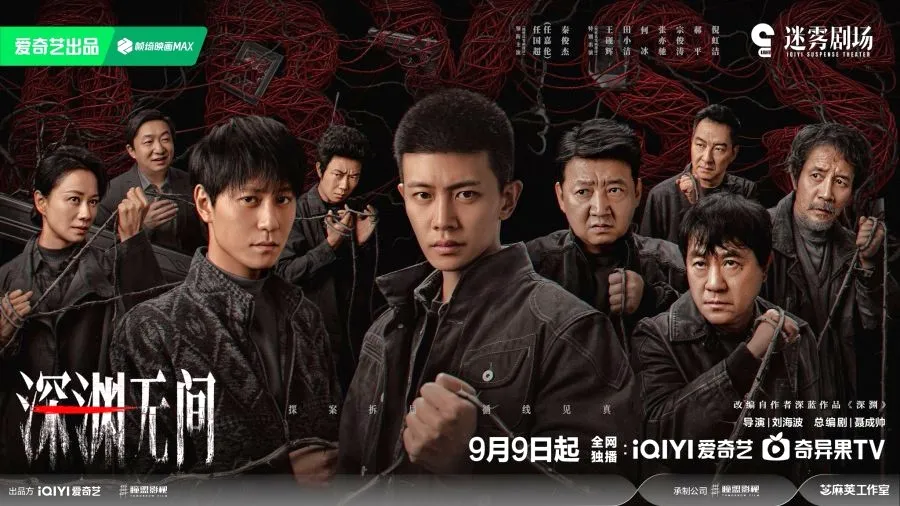
Abyss Poster - Courtesy of iQIYI

|
DetailsRATING: (8/10)
NATIVE TITLE: 深渊无间 - Shēnyuān wújiàn YEAR: 2026 TOTAL EPISODES: 16 DURATION: 36’ DIRECTOR: Liu Hai Bo SCREENWRITER: Nie Cheng Shuai, Xiao Shi Yao, Guo Kai Xu, Luo Ding Yi ORIGINAL CREATOR: Shen Lan (深渊 - Abyss) |


Disclaimer: the opinions expressed in this review refer exclusively to the drama. As I have not read the original work, I cannot say with certainty whether the issues identified can be attributed to the screenplay or to the source material. For this reason, my comments on the writing should be understood as an assessment of the adaptation rather than a judgment on the original work.
IN A NUTSHELL
Short on time? Here you’ll find the quick verdict, including the drama’s main strengths, weaknesses, and key features to help you decide if it’s right for you. For a more in-depth analysis, continue with the No Spoiler Review.
- What to expect: Abyss is a crime drama in which the mystery slowly unfolds, starting with an old serial murder case and then gradually delving into a much more complex story. This very structure is one of its greatest strengths: the investigation is generally well-constructed, the deductions follow logical lines, and each new discovery challenges what the viewer thought they understood. Supporting this is a compelling cast and a realistic, immersive atmosphere, which help maintain curiosity even when the pace slows. The problem is that, by constantly adding new layers to the story, the complexity ends up becoming excessive: reconstructing the case becomes increasingly slow and difficult, and when all the pieces finally come together, the solution seems perhaps too perfect for a story built on so many coincidences. Abyss remains a drama capable of engaging and surprising, but it would probably have benefited from a little more linearity.
- Strengths: an engaging story, a realistic investigation, an immersive atmosphere.
- Weaknesses: an overly complicated plot, the slow pacing, the sometimes incomplete reconstruction of the past.
- Recommended if you like: Ren Jialun, urban crime series set in the recent past, dramas without romance but with a strong camaraderie, complex mysteries that reveal themselves little by little, serial murders, brilliant antagonists.
- Would I rewatch it? Yes, despite the slowness.
Read on to find out why this drama is worth watching.
Abyss is a drama in which every answer seems to hide the next question. It's like an abyss: the more you try to get to the bottom of it, the more you realize how profound it is. And what emerges to the surface is only the first layer of a story that, little by little, reveals new connections, old guilt, and responsibilities that are difficult to erase. It's a story that constantly calls the truth into question, to the point of transforming the initial question — «Who is guilty?» —into a much more complex one: «What really happened?»
In this review of the drama Abyss, after watching all episodes, I will focus on the elements that most influenced my viewing experience: the way the investigation is constructed, the atmosphere, the work of the cast, and, above all, the balance between a plot capable of maintaining curiosity and a complexity that sometimes ends up working against it. This is why I chose the Quick Verdict format: to give a clear idea of what to expect from Abyss without turning the review into the reconstruction of an entire investigative file and leaving the reader to decide whether it is worth delving into the abyss.
Plot
Huangshui County, 2012. Li Cheng returns to his hometown after attending the police academy and winning the provincial competitive exam to join the county police's criminal investigation unit.
Even before his official appointment, he is introduced to Captain Zhao Qianzhe, who is privately investigating a serial murder case that occurred eight years earlier. Li Cheng's talent doesn't go unnoticed, and Zhao decides to use it to approach one of the suspects at the time, Han Pinmu, the owner of an internet café and the stepson of one of the victims.
During the investigation, Li Cheng also comes into contact with Xin Jiran, a former colleague of Zhao Qianzhe, who has been trying to shed light on the case for years because it is linked to his family's downfall.
Between stakeouts, red herrings, and new clues, the three find themselves delving into a story far more intricate than initially thought, one in which more and more people seem to have something to hide.
Thanks to his intuition and the help of his new boss, Li Cheng manages to secure official assignment to the case and complete an investigation that will forever change his life.

THIS SECTION LISTS THE DRAMA'S STRENGTHS AND WEAKNESSES WITHOUT REVEALING MAJOR PLOT DEVELOPMENTS. READ ON FOR MY PERSONAL OPINION ON THE SERIES.
What Works
- A realistic investigation. The investigative plot is constructed in a logical and realistic manner: the investigation proceeds following the reasoning a detective might use when faced with a complex case, moving from one hypothesis to another, verifying clues, discarding unfounded leads, and revising its conclusions when new elements emerge. The twists and turns, therefore, do not appear out of nowhere to keep the mystery going, but arise from the developments of the investigation and from the events that the characters manage to reconstruct from time to time. The interesting point is that the investigators are not simply trying to discover who the culprit is: they must reconstruct a complex story spanning many years. Consequently, many of the hypotheses formulated during the investigation are not necessarily wrong: they are simply incomplete, because they concern only one part of the story.
- A narrative that manages to keep the viewer's curiosity aroused. Its complex structure makes Abyss genuinely engaging. When it seems we've finally figured out who the culprit is, a new element emerges, forcing us to reconsider what happened and fit the newly discovered events into the bigger picture. The result is a mystery that isn't just about the question "who did it?", but above all about the need to understand what really happened and how all the events are connected. This is why, even when the matryoshka ends up becoming far too large, it continues to work precisely because it leaves enough open questions to push us to continue watching in search of the answers.
- A cast worthy of the story. The cast proved fully capable of the complexity of the story, with Ren Jialun in top form, well supported by two excellent supporting actors like Wang Yan Hui and Tian Xiao Jie and by equally convincing antagonists like Qin Jun Jie. I also found the rest of the supporting cast very good, starting with Wang Lan, spontaneous and natural in the role of the protagonist's mother, and Ni Hong Jie, whom I had already appreciated in Yummy, Yummy? Yummy! for her ability to switch effortlessly from one acting register to another without losing credibility.
- A believable and immersive atmosphere. The series creates a believable atmosphere through cinematography with cold, desaturated colors, natural-looking lighting, and often dark and mysterious crime scenes. The direction is fluid and uses immersive shots, managing to enhance even the city views and panoramic views. Also interesting is the choice to forgo the use of image stabilization in some of the more dynamic scenes, maintaining a slightly blurry image that conveys a more immediate and realistic sense of movement. The soundtrack also contributes to the atmosphere, featuring songs with mysterious and dark sounds that range from pop-rock to more theatrical and melancholic compositions, reinforcing the tension and sense of unease that accompany the investigation.
What Doesn't Work
- An overly complex plot. The plot of Abyss is extremely interesting, the problem is that, by constantly adding new layers to the story, the mystery ends up becoming more complicated than necessary. What initially seemed like an old serial murder case gradually reveals itself to be a story of overlapping personal relationships, old grudges, and red herrings. The reconstruction remains largely understandable, but requires the viewer to keep in mind an ever-increasing number of people, events, and connections. The problem, therefore, is not that the series has chosen a complex investigation: it's that the story becomes so complex that its own reconstruction is difficult to follow.
- The slowness of the investigation. The complexity of the story is directly reflected in the pacing. Abyss doesn't take narrative shortcuts to reach a solution: it devotes a lot of time to interrogations, flashbacks, and reconstructions of past events, because the investigators must establish not only who committed the murders, but also the various motives and the roles of the various people involved. The slowness, therefore, has a specific reason identifiable in the difficulty of the investigation, but this doesn't mean it's always a virtue. It's the amount of material to reconstruct that slows down the investigation, which makes me think that the story would probably have benefited from a few less layers of complexity.
- An unrealistically perfect solution for such a convoluted story. Abyss claims to reconstruct practically the entire criminal story that unfolded over many years, composed of several episodes and involving numerous people. The problem is that, as the levels of the matryoshka increase, so too does the number of coincidences necessary for all the pieces to fall into place and the investigators to finally be able to attribute their responsibilities. Nearly every person encountered along the way ends up having a role in explaining the events, and almost every pre-existing relationship retroactively finds a place in the criminal chain. The result is a very satisfying solution from the investigative standpoint, because it allows for practically the entire story to be reconstructed, but also far too tidy for a narrative built on so many independent and distant events.
- Some questions remain unanswered. The series is generally successful in explaining how events unfolded, but is less effective in clarifying why some characters made certain choices. In fact, there remain several points in which the reconstruction of the motivations or some fundamental connections is not very thorough. And it's a problem because the more complex the plot becomes, the more important it is to precisely explain the motivations that hold the different passages together. When these explanations are missing, the risk is that the viewer is able to reconstruct the sequence of events but has the impression that the characters sometimes behave inconsistently.

Characters and Cast
Primary Characters
Li Cheng/Xiao Li/Gao Cai Sheng (Ren Jialun) boy born and raised in the Youxin Chemical Plant barracks in Huangshui County. After attending the police academy and winning the provincial competitive exam, he returns to his hometown to join the county police force. There he meets Captain Zhao Qianzhe, who asks him to approach Han Pinmu, a suspect in an old series of murder cases, in exchange for a recommendation to join the criminal investigation unit.
Supporting Characters
County Police Criminal Investigation Unit
Commander Tu (Shi Liang) Head of the Huangshui County Police Criminal Investigation Unit.
Captain Fan Jie/Kuai Tui Er (He Bing) Deputy Chief of the Huangshui County Police Criminal Investigation Unit.
Captain Zhao Qianzhe/Lao Chihuo (Wang Yan Hui) Deputy Chief of the Huangshui County Police Criminal Investigation Unit.
Xin Jiran/Da Hong Zao (Tian Xiao Jie) Former Deputy Chief of the Huangshui County Police Criminal Investigation Unit in charge of Case 3/12 and a friend of Zhao Qianzhe.
Li Guangwen (Hao Ping) is an officer in the Huangshui County Police Criminal Investigation Unit and a friend of Li Cheng's mother. He introduces him to Captain Zhao.
Luo Jinsong (Dong Hai) is a laboratory examiner in the Huangshui County Police Criminal Investigation Unit.
Hu Sen (Rong Fei), Wang Tao (Li Tian Nuo), Yang Feng (Peng Hao Sen), and Xu Ling (Li Zhi Xia) are officers in the Huangshui County Police Criminal Investigation Unit.
Hunagzhiyuan Hotel
Li Zhengbin (Zhang Fan) owner of the Hunagzhiyuan Hotel in Xihai and the upscale restaurant Homesickness, and a former colleague of Han Pinmu's father.
Zhang Chengguo (Zong Jun Tao) manager of the Hunagzhiyuan Hotel.
Sun Yuhua (Wang Lan) maid at the Hunagzhiyuan Hotel and mother of Li Cheng.
Chen Chunli (Ni Hong Jie) maid at the Hunagzhiyuan Hotel, the fifth victim and sole survivor of Case 3/12. She was attacked along the national highway on April 25, 2004, and despite being stabbed three times, she managed to attract the attention of a passing truck driver.
Song Laifu/Mr. San/Guo Sanjun (Li Xiao Qiang) parking attendant of the Hunagzhiyuan hotel.
Benteng Internet Café
Han Pinmu (Qin Jun Jie) owner of Benteng Internet Café and Du Juan's stepson.
Hu Xiaofei/Feiyang (Ma Jia Chun) childhood friend of Han Pinmu and member of his online gaming group.
Sun Qiang/SN (Zhang Yi Chi) customer of Benteng Internet Café and member of Han Pinmu's online gaming group. He has long been at odds with Han Pinmu and wants to open his own internet café but is still looking for backers.
A'Wei network administrator of Benteng Internet Café.
Xiao Yu receptionist at Benteng Internet Café.
Other Characters
Liu Min (Lu Ling) wife of Zhao Qianzhe.
Zhao Ying (Liu Si Ying) daughter of Zhao Qianzhe.
Qiu Yufen mother of Hu Xiaofei.
Hu Songhua Hu Xiaofei's father.
Han Sheng father of Han Pinmu and former colleague of Li Zhengbin.
Fang Meng truck driver who hit and killed Han Pinmu's mother.
Guo Pengfei (Jiang Guan Nan) son of Chen Chunli and childhood friend of Han Pinmu and Hu Xiaofei.
Xin Xiaoliang (Guo Cheng) late son of Xin Jiran and childhood friend of Han Pinmu and Hu Xiaofei.
Bi Dehua (Li Min Cheng), a young worker at the Youxin Chemical Plant in Huangshui. In October 2004, he was found hanged in the company dormitory and became the prime suspect in the 3/12 case because his blood was found at one of the crime scenes.
Lin Guizhi (Wang Hong Mei), Bi Dehua's mother.
Song Jindi (Tian Ling), Song Laifu's sister.
Chen Wanji (Zhang Xi Qian), Chen Chunli's cousin, who lives in Xidu and hosted Guo Pengfei during his senior year of high school.
Li Yaoming and Li Fang, the first victims of the 3/12 case, were found dead on March 12, 2004, in the suburbs of Huangshui County.
Zhang Lina and Wang Ping, the second victims of Case 3/12, were found dead on March 20, 2004, in the warehouse of the Huangshui pharmaceutical company.
Liu Xiaohua, the third victim of Case 3/12, was found dead on April 5, 2004, at the Youxin Chemical Plant.
Du Juan, the fourth victim of Case 3/12, was found dead on April 17, 2004, in the dormitory of the Huangshui Technical School where she worked. She was Han Pinmu's stepmother.

WARNING!
IN THIS SECTION, I SHARE MY PERSONAL OPINION ON THE DRAMA, AND THERE MAY BE SPOILERS. DO NOT CONTINUE IF YOU DO NOT WANT TO KNOW ALL THE DETAILS OF THE SERIES
The Watching Experience
Abyss is a drama that slowly won me over: I liked it precisely because it was so layered that at first I couldn't figure out where it was going, but in the long run it was precisely this complexity that penalized it, although not excessively. Although I immediately found its pace rather slow, I realized that the problem wasn't the investigation itself: on the contrary, the deductions were coherent and the investigative process generally well-constructed. The real problem was that, with each step forward, I discovered that I wasn't simply getting closer to solving the case, but that I first needed to understand the true structure of the case the protagonists were investigating. What initially appeared to be an old case of serial murders committed by two misfits gradually transformed into the reconstruction of a much broader story: the figures of Zhang Chengguo and Guo Sanjun, the involvement of Hu Xiaofei, the copycat murders, the death of Du Juan, Chen Chunli's attempt to protect her son by creating a false lead, Bi Dehua's faked suicide, Xin Xiao Lian's involuntary death, and the return of the original killers, who begin eliminating their blackmailers. At a certain point, what began as an investigation into two serial killers practically turns into a war between two groups of killers: the originals and the copycats.
This is where an element I've frequently encountered in Chinese crime novels comes into play: the tendency to construct responsibility as a sort of diffuse guilt, in which a crime is rarely traced back to the actions of a single person, but arises from the intertwining choices and responsibilities of multiple individuals. On the one hand, I find this approach realistic, because in reality, it's not uncommon for shared responsibility for a crime. On the other hand, however, when taken to its extreme, it creates that peculiar feeling where everyone seems guilty and, at the same time, innocent: everyone is responsible for something, but no one is truly guilty of the crime. It's a mechanism that can make the investigation more interesting and nuanced, but it only works up to a certain point, because it further multiplies the layers of the story and makes it increasingly difficult to determine who is to blame and who is not.
Abyss thus becomes a veritable criminal matryoshka doll, in which each new element belongs to a different layer of the story and each responsibility is distributed among multiple people: the more the investigation progresses, the more new layers are added, making it difficult to hold the entire picture together. This also explains why the drama seemed simultaneously logically constructed and terribly convoluted: the investigators waste time not because they don't know where to go, but because they have to reconstruct a disproportionate amount of overlapping events, identities, relationships, and responsibilities. And perhaps it is precisely its complexity that accentuated the feeling of slowness.
On the other hand, however, it is precisely this complexity that kept me from giving up: I didn't simply want to know who the culprit was, I wanted to understand what had really happened and how all those threads could eventually come together. Perhaps what helped me overcome the slowness was also the talent of the cast, which made me grow fond of the characters and experience the investigation with greater involvement. Ren Jialun, in particular, was a real surprise: this role made me reevaluate his acting a lot because, as a brilliant and stubborn young policeman, he seemed much more spontaneous and natural than in many of his previous roles. Here, he doesn't have to constantly maintain the aura of the charismatic and tormented hero: he can simply be a young man who wants to solve a case at all costs; he commits himself, asks questions, makes mistakes, but doesn't give up. And it works. Qin Jun Jie also impressed me greatly: I didn't know him well enough to expect such a performance, and I found him particularly convincing in giving his character a disturbing yet fascinating presence, without reducing him to a mere one-dimensional antagonist.
In the end, therefore, looking back, I'm left with more of a sense of satisfaction from reconstructing the investigation than with the fatigue of the pacing. The slow pace was certainly a source of friction during the viewing, but it didn't define my overall experience: what I was left with was above all a sense of curiosity to understand what new piece of the matryoshka doll would emerge and how it would fit together with the rest of the story to lead to the solution of the case. In short, did I enjoy the drama? Yes. Could it have been less complex without losing interest? Probably yes.

Ending and Chronological Reconstruction of the Story
If you felt like you missed something while watching, you're not alone. The story of Abyss is told through a series of successive revelations that make it difficult to follow the narrative in a linear fashion. Therefore, before concluding the review, I decided to reconstruct the entire story in chronological order, listing the events in the order in which they occurred rather than in the order in which they are discovered during the investigation.
- Guo Sanjun becomes Song Laifu. Guo Sanjun works at Zhang Quan's construction site, alongside the real Song Laifu. He discovers that the man is alone in the world and decides to kill him to steal his identity, even paying the man's sister, his only surviving relative, to confirm his false identity.
- Guo Sanjun meets Zhang Chengguo. Some time later, under the new identity of Song Laifu, Guo Sanjun ends up working at Wang Long's construction site, where he meets and befriends Zhang Chengguo.
- Guo Sanjun and Zhang Chengguo begin killing. The two, sharing a violent nature, begin committing random murders, torturing and raping their victims before killing and robbing them. The first are Li Yaoming and Li Fang, a couple killed in the suburbs of Huangshui County on March 12, 2004.
- Hu Xiaofei's involvement. On March 20, 2004, at the scene of their second murder, the Huangshui Pharmaceutical Company, Guo Sanjun and Zhang Chengguo surprised Hu Xiaofei and forced him to witness the rape and murder of Zhang Lina and her daughter Wang Ping. To prevent him from reporting them, they force him to become their accomplice and begin blackmailing him.
- The murders continue. On April 5, 2004, Guo Sanjun and Zhang Chengguo implicate Hu Xiaofei in another murder, that of Liu Xiaohua, a worker at the Youxin Chemical Plant.
- The death of Du Juan. On April 17, 2004, Hu Xiaofei and his friends Xin Xiao Lian and Guo Pengfei go to the dormitories of the technical school where Du Juan, Han Pinmu's stepmother, works. The three want to force her to confess to instigating the murder of Pinmu's mother, who was hit by a truck driven by an acquaintance of the woman. Before she can confess, however, Du Juan dies of a heart attack. Hu Xiaofei then decides to cover up the death by staging a murder similar to those committed by Guo Sanjun and Zhang Chengguo.
- Chen Chunli’s false lead. When she learns of Du Juan's death, Guo Pengfei's mother, Chen Chunli, decides to protect her son. She then organizes a fake attack on herself, modeled on the murders in Case 3/12, and convinces Han Pinmu and Hu Xiaofei to stab her three times in the abdomen with the same knife used by the original killers, leaving her in agony on the side of the road.
- Bi Dehua's suicide. To identify one of the perpetrators of Chen Chunli's attack, Han Pinmu and the others identify Bi Dehua, a young worker at the Youxin Chemical Plant and a childhood friend of Li Cheng. After staging a fight with him, Han Pinmu hits him on the head with a rock and brings it to the scene of the attack, using Bi Dehua's blood to link him to Case 3/12. A few months later, in October 2004, Han Pinmu reaches Bi Dehua in the dormitory of the chemical plant, kills him, and stages his suicide to definitively pin the blame for the murders on him.
- The death of Xin Xiao Lian. Suspicious of his son's behavior and the wound to his forehead he sustained during the fight with Bi Dehua, Xin Jiran decides to have Xin Xiao Lian's blood tested to determine his possible involvement in the attack on Chen Chunli. In the meantime, however, he leaves him handcuffed at home, and the boy dies of an asthma attack. His son's death devastates Xin Jiran's wife, who commits suicide a few days after the funeral. Xin Jiran takes responsibility for his son's death and serves six years in prison.
- Hu Xiaofei publishes the online novel Abyss. Tired of being blackmailed by Guo Sanjun and Zhang Chengguo, Hu Xiaofei decides to recount the details of the murders he and the two committed together in a novel. The text is serialized by Han Pinmu on a dedicated website, attracting the attention of Zhao Ganzhe, Xin Jiran, and Guo Sanjun and Zhang Chengguo themselves.
- Li Cheng is involved in the investigation. Li Cheng returns to his hometown after attending the police academy and winning the provincial competitive exam to join the county police's criminal investigation unit. His goal is to shed light on the death of his friend Bi Dehua, and thanks to a meeting with Zhao Qianzhe, he manages to join the investigation into Case 3/12, initially to clarify Han Pinmu's role.
- Guo Sanjun and Zhang Chengguo make the first moves. Guo Sanjun decides to kill Hu Xiaofei, triggering a reaction from Han Pinmu, who in turn kills Guo Sanjun, trying to pin the blame on Xin Jiran. Meanwhile, Zhang Chengguo, suspicious of Li Cheng's interest in Song Laifu/Guo Sanjun, pays Sun Qiang to kill him. However, Sun Qiang plays a double game and alerts Han Pinmu, who manages to save Li Cheng. Zhao Qianzhe, who had gone to the rendezvous in Li Cheng's place, is thus killed.
- Zhang Chengguo tries to eliminate the last witnesses. After Zhao Qianzhe's death, Zhang Chengguo decides to get rid of the last witnesses to his crimes. He lures Sun Qiang into a trap, promising him payment for the policeman's murder, and stabs him. Zhang Chengguo, however, is unaware that Han Pinmu has followed Sun Qiang and has also fallen victim to him.
- Guo Sanjun's true identity comes to light. The discovery of Song Laifu's false identity allows the criminal investigation unit to reconstruct Guo Sanjun's true identity and his connection to Zhang Chengguo and the 3/12 case. At this point, however, Li Cheng formulates a hypothesis that will once again change the direction of the investigation: Guo Sanjun and Zhang Chengguo may not be responsible for either Du Juan's death or the attack on Chen Chunli.
- Chen Chunli gives herself away. After the death of the original assassins, Chen Chunli, worried about her son's fate, decides to confront Han Pinmu and attacks him, striking him on the head. Due to a series of circumstances, suspicion falls on Xin Jiran, who had recently gone to Han Pinmu to return the money he had received as compensation for Xin Xiao Lian's death.
- The case is solved. Following the attack on Han Pinmu, investigators realize that Chen Chunli is trying to protect someone involved in the 3/12 case. Investigating the woman's bank account, they discover that in 2004, she had received a large sum from Hu Songhua, Hu Xiaofei's father. Following Xin Jiran's revelation about her son's involvement in Du Jian's murder, the police realize that the last person involved in Du Jian's death may be Chen Chunli's son. By questioning him, they finally uncover the truth: Du Jian was mistakenly killed by Han Pinmu's friends in an attempt to extract a confession from her regarding the boy's mother's death, while Chen Chunli's attack was a set-up to cover up her son's involvement in the murder.
RECOMMENDED:
- MOBIUS
- THE TRUTH WITHIN
- LIGHT OF DAWN
- EIGHT HUNDRED
- LIGHT TO THE NIGHT
Thank you for reading all the way to the end!
I hope you enjoyed this article and found it helpful.
🈷️ Did you come across a term you weren't familiar with? Check out my Chinese Historical Drama Glossary, where you'll find explanations of official titles, government institutions, religion, myths, and many other aspects of Chinese culture.
☕ If you enjoy my content and would like to support Red Taotie, you can buy me a coffee on Ko-fi. Every contribution helps me continue creating reviews and in-depth articles.