
Yummy, Yummy? Yummy! (2025): Chaos, Laughter, and an Ending You Won't Expect | Review & Explanation of the Ending
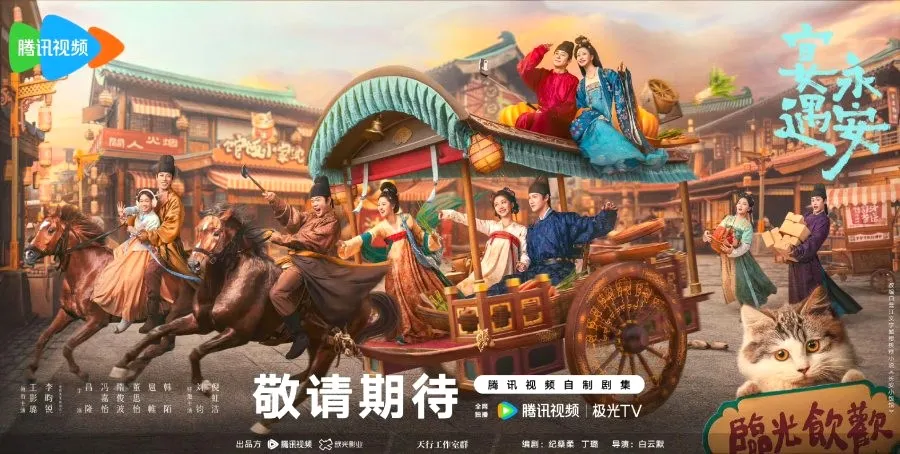
Yummy, Yummy? Yummy! Poster - Courtesy of Tencent Video

|
DetailsRATING: (7.5/10)
NATIVE TITLE: 宴遇永安 – Yàn yù yǒng’ān YEAR: 2025 EPISODES: 32 DURATION: 45’ DIRECTOR: Bai Yun Mo SCREENWRITER: Ji Sang Rou, Ding Lu ORIGINAL CREATOR: Ying Tao Gao (长安小饭馆 – Chang’an Small Restaurant) RESPECTED CLICHÉS: 2 - 4 - 5 - 6 - 7 - 8 - 9 - 10 - 11 - 15 |


IN A NUTSHELL
- What to expect: Yummy, Yummy? Yummy! is a surprisingly funny food comedy, enriched by the misunderstandings of time travel. Beyond its lighthearted tone, the series sensitively addresses profound themes such as family love in its most authentic and imperfect forms, the ability to appreciate what is outside the box and conventions, the value of community and solidarity towards those less fortunate. A mix of irony, human warmth, and reflection that makes it a richer experience than the title suggests.
- Strengths: the interesting focus on the Chinese culinary universe, the exaltation of family bonds, the brilliant comic moments.
- Weaknesses: the romantic push and pull, the bittersweet ending.
- Recommended if you like: Li Yun Rui and Wang Ying Lu, time travel, slow burn romance, family sagas, aesthetically pleasing dishes.
- Would I rewatch it? Yes, although I would have preferred a different ending.
If you want to know why I recommend watching this drama, keep reading.
In a season filled with dramas, Yummy, Yummy? Yummy! comes as a refreshing change of pace: bright, unpredictable, and deliberately over-the-top. From kitchens overflowing with tempting dishes to hilarious situations, Yummy, Yummy? Yummy! tells the story of the encounter (and clash) of two opposing worlds — the pragmatic one of a staid imperial official and the chaotic one of a self-taught chef and her eccentric family.
In this *review of the drama Yummy, Yummy? Yummy!, after watching all episodes,* I’ll analyze the plot, characters, and all the elements that make this series light-hearted yet not banal, and that make me recommend it.
Plot
To revive the fortunes of the family restaurant, Shen Shao Guang convinces her parents, brother, and niece to shoot a hanfu video in their ancestral home, now a museum, to advertise the establishment.
Once they arrive, however, a strange fog envelops the residence, and the five are forced to flee, finding themselves in Tang Dynasty Yong’an.
There, they encounter their ancestor, the virtuous Deputy Prefect Lin Yan, whom they try everything they can to convince to let them enter the residence so they can find a way back to the present.
However, their plans fail one after another, and as a last resort, Shen Shao Guang decides to pose as the fiancé of her ancestor, with whom he had lost contact after the tragedy that befell his family.
Lin Yan is actually Cui Che, son of the late Prefect of Jingzhao, accused of corruption and dead in prison seventeen years earlier, whose name the guy is trying to clear.
Temporarily trapped in the past, the Shens decide to use their modern knowledge to enter the Yong’an restaurant business and open a family-run restaurant, attracting many customers but also the envy of Yunlai Tavern, one of the city’s most popular restaurants.
Living in close proximity to Lin Yan, the Shen family grows very fond of him, especially Shen Shao Guang, who, at a certain point, discovers she is in love with her ancestor — and he loves her back.
Amidst misunderstandings, ambiguous and dangerous situations, the Shens try their best to survive in a reality very different from their own, where any mistake could cause an unexpected alteration of the future.
Focus: The Three Departments (三省 – Sān Shěng) of the Tang Dynasty

Yummy, Yummy? Yummy! Drama Review (No Spoilers)
Yummy, Yummy? Yummy! is a lighthearted drama that manages to combine comedy, time travel, the comforting power of food, and palace intrigue in a rather enjoyable way, without (almost) ever appearing overly over-the-top or overly serious.
One of the drama’s most interesting elements is undoubtedly the central role of food as a true emotional thread. Cooking is the language through which the characters connect, clash, and reconcile. It’s fun — and even fascinating — to watch the preparation of traditional Chinese dishes, rendered with care and visual flair, and observe how each dish carries with it a fragment of personal history, a gesture of affection, or the resolution of a minor conflict. Food, in this drama, is memory, unity, and identity: an ingredient as essential as the protagonists themselves.
Another highly distinctive aspect is the focus on family bonds rather than romantic love. The series truly manages to convey the warmth of a real family, contrasting with the forced solitude the protagonist experienced in the past. Watching him gradually open up to the Shens’ sincere affection is one of the drama’s most touching moments: natural, intimate, and told with a sensitivity that warms without ever descending into overt sentimentality.
Plot and Characters
Plot-wise, I must admit that Yummy, Yummy? Yummy! won me over with its lightheartedness: lively episodes, touching moments, and spontaneous humor make the story surprisingly enjoyable. The Shens’ family dynamics are authentic and warm, and the drama conveys a rare sense of everyday life and affection.
Unfortunately, in the second half, the tone shifts radically: Shen Shao Guang’s realization that she loves Lin Yan — and that she can’t — transforms the narrative into a melodrama filled with hesitation and torment. Added to this are some somewhat misleading subplots that end up tarnishing the initial brilliance, while still leaving the story’s emotional appeal intact.
As often happens in pseudo-romantic dramas, the political intrigue subplot ends up being somewhat neglected, only truly developed in the final six episodes. In the first half of the series, this absence doesn’t weigh heavily, as the focus is on the Shen family’s adjustment to life in the past and the deepening of their family bond with Lin Yan. However, towards the end, the pace picks up sharply: the revelations and the final act arrive a bit rushed, leaving the feeling that not enough time has been spent clarifying all the steps that led to the discovery of the secrets of the past.
As for the characterization, I really appreciated the fact that all the characters in the story are well-defined and have multifaceted personalities. Each of the protagonists reacts to time travel differently and consistently with their own personalities: some with a practical spirit, some with fear, some with curiosity. There are no truly flat characters or mere narrative devices — even the secondary characters display subtle nuances, human traits, fragilities, and contradictions that make them believable. It's also this attention to character details that pushes me to recommend watching the drama: thanks to it, the story becomes solid and engaging, allowing the viewer to grow fond of the characters (or hate them).

Love Story and Ending
On the romantic front, don’t expect moments of overwhelming passion or intense emotional involvement because, especially in the first twenty-eight episodes, they are almost completely absent. The love story between the protagonists develops extremely slowly — certainly naturally, but never represents the high point of the narrative. The theme of time travel and the encounter between descendants and ancestors adds a curious and original element, but at the same time introduces a certain complexity that ultimately weighs down the love story. This dynamic seems, at times, more like a narrative device to lengthen the narrative than a genuine device to make the bond that develops between the two protagonists more interesting.
Unfortunately, the ending left me a little perplexed. Some details remain difficult to explain if we take everything we've been told throughout the narrative at face value. The Shen's return to the present, in fact, led the writers to introduce somewhat forced narrative devices to offer viewers a romantically evocative epilogue, which, however, creates some inconsistencies that are difficult to explain.
Cast
I would like to praise the ensemble cast, which created a harmonious and coherent ensemble, conveying a natural and complicit connection.
Wang Ying Lu confirms her ability to make each character lovable, highlighting their strengths and weaknesses in a charming and natural way. I’ve absolutely loved her in every drama she’s appeared in this year, from When Destiny Brings the Demon to Twelve Letters, and I hope she continues her upward trajectory, which could lead her to become the next Zhao Lu Si.
Li Yun Rui balances severity with self-deprecation, transforming the typical “enemies-lovers” story into a comedy with a naively romantic flavor. His character is the typical handsome, intelligent, and capable ML, and like all his characters, he gives me the impression of being too perfect to be true (I had the same impression in Blossom). His acting is certainly good, although in this drama, he’s voiced by the excellent Wen Wen, so my rating is somewhat influenced by this.
I reiterate my appreciation for the performances of Chang Long and Sui Jun Bo (equally excellent in A Dream Within a Dream and Brocade Odyssey, respectively), but above all, I’d like to praise the young Han Mo, who gave an excellent performance as Yang Yang.
A final shout-out goes to veterans Ni Hong Jie and Liu Jun (the hateful Emperor in Jun Jiu Ling and Guardians of the Dafeng) as well as the talented Hu Wei, whom I hope to see in a leading role soon.
Visual Aspects and Soundtrack
Aesthetically, Yummy, Yummy? Yummy! struck me as a drama with great attention to detail: the sets are well-crafted, and the settings are believable, even when they indulge in a few eccentric touches. This balance helps create a vivid, rarely artificial, period atmosphere.
The direction doesn't aim to dazzle at all costs, but it works thanks to a careful management of scenes and lighting, building a world that feels solid and pleasantly immersive without needing excess.
I particularly appreciated Huang Wei's Tang-style costumes, which for me are one of the series' true strengths: in addition to being visually pleasing, they manage to convey something about the characters, their status, and their personalities. The quality of the fabrics and the attention to detail are evident, and contribute to the overall visual coherence.
The soundtrack follows the typical coordinates of romantic dramas quite closely, with many love songs with soft and melancholic sounds, which discreetly accompany the more emotional moments. What really stands out, however, is 喜宴开 (Feast Begins), a choral piece dedicated to food and conviviality, built on folk sounds: here the protagonists' voices alternate and intertwine, giving life to a joyful moment of sharing. This piece is also the one that best conveys the lighter and more playful side of the drama.

WARNING!
FROM THIS POINT ON THE SPOILER SECTION BEGINS. DO NOT CONTINUE IF YOU DO NOT WANT TO KNOW ALL THE DETAILS OF THE DRAMA.
Yummy, Yummy? Yummy! Drama Review (Spoilers)
What Works
Family Relationships
One of the aspects I most appreciated in Yummy, Yummy? Yummy! was the choice — far from obvious in a period drama — to give more space to family affection than to romantic love.
The series truly succeeds in conveying the feeling of “family” — not just as a blood bond, but as shared warmth, presence, and mutual acceptance. In this sense, the contrast between Lin Yan’s initial loneliness, accustomed to living in a world of coldness and isolation, and the affectionate vitality of the Shen family, where every daily gesture becomes an expression of care, is striking.
It is deeply touching to watch Lin Yan slowly open up to this new warmth: an intimate and gradual journey that leads him to rediscover a sense of belonging and the value of sincere familial affection. The way the series narrates this transition — with delicacy, but without sentimentality — is among its most authentic and comforting elements.
The bond Lin Yan develops with the Shen family takes on an even deeper meaning when compared to his relationship with Prince Zhao. A man who was a role model, a mentor, and a source of support for Lin Yan after the loss of her father, a person she truly respected and admired. This trust, however, turns out to be misplaced, as it was Prince Zhao himself who framed Lin Yan’s father, leading a virtuous man to his death. His act of adopting him, seemingly motivated by noble sentiments, is actually rooted in a disturbing motif—his striking resemblance to his deceased firstborn—and it is never clear whether the man truly loved his adopted son or simply kept him close as a substitute, a living reminder of what he had lost.
This also explains Lin Yan’s initial distrust of any form of emotional bond: for him, love and trust have always been subordinated to the ability to fulfill others’ expectations of him. And this is precisely why the encounter with the Shen family takes on such a touching significance: their affection is selfless, authentic, free from ulterior motives. Where Prince Zhao had imposed a conditional and illusory love, the members of the Shen family offer a sincere warmth, demanding nothing in return.
It is in this contrast that Lin Yan’s true emotional growth is measured — a man who, after being reduced to a reflection of others, finally manages to rediscover himself in the simplest and purest feeling: that of family.

The Screenplay
I found the sense of coherence that pervades much of the story very satisfying.
The Shen family, catapulted back to a distant era, must truly deal with the practical difficulties of daily life: this isn’t a pleasure trip, but a struggle for survival in an unfamiliar world. The scene in which Li Feng Xia is forced to sell her last pieces of gold jewelry — precious mementos of her modern life — to feed her family perfectly conveys the reality of the situation and the characters’ struggles.
The dialogue also remains logical and believable: such as when A’Ji scolds Lin Yan for mistaking them for spies («Who among us looks capable of opposing you?»), or when the Shens hesitate to accept the cooking duties for the Princess Royal’s literary gathering, fearing they’ll be sentenced to death for even the slightest mistake, as happens in dramas. Everything contributes to the story’s realism and poignancy.
At times, however, the incorporation of modern knowledge into the plot feels a bit forced, as in the scene where A’Ji explains to Lin Yan how a dishwasher works and he ends up building one for her: a touching episode, but one that slightly undermines the drama’s overall historical plausibility.
Another aspect I really appreciated about Yummy, Yummy? Yummy! is how it manages to play with the typical clichés of romantic dramas without falling into the absurd or forced. There’s no shortage of “textbook” scenes, but instead of seeming like gimmicks thrown in to create unnecessary drama, they fit seamlessly into the narrative, almost seeming natural. A small miracle, considering how often this genre has accustomed us to improbable situations and predictable plot twists.
What Doesn't Work: Irregular Narrative Pacing
As mentioned, *one of the most detrimental aspects of Yummy, Yummy? Yummy!‘s narrative is its uneven pacing*.
In the first half, the drama manages to capture the attention thanks to a captivating and surprisingly light-hearted story, made up of funny, comforting, and at times moving episodes. The comedy, despite some justifiable excesses, is well-balanced and functional to the narrative, while the family dynamics are spontaneous and enjoyable, giving the viewer the pleasant sensation of observing a real family, with its imperfections and dynamics.
As the episodes progress, however, the tone of the series shifts significantly: Shen Shao Guang realizes that she has truly fallen in love with Lin Yan — and that he, too, feels equally deeply for her. The realization of their “impossible” situation (after all, they are linked by a blood bond, however distant) throws her into an emotional conflict that marks a clear shift in the narrative’s pace. From that moment, the initial lightheartedness gives way to a tormented melodrama, in which Shen Shao Guang alternates tears, hesitations, and attempts to reject Lin Yan in the most painful way possible.
To further complicate matters, a series of chaotic and uninteresting subplots emerge: the constant (and frankly incomprehensible) bickering between Shen Jian She and Li Feng Xia, the sudden (and equally inexplicable) departure of Shen Shao Jie, and the arrival of Yu San, the restaurant’s new chef, who turns out to be a spy for Prince Zhao, further confounding an already hectic plot.
In essence, the second half of the series loses its initial appeal and freshness, sacrificing the light-hearted, familiar tone that had made it so enjoyable to the characters’ internal conflicts, which ultimately proved unnecessary.

Interpretation of the Ending
The element that left me most perplexed, however, was the series’ ending.
First of all, the revelation that Lin Yan isn’t actually the true ancestor of the Shen family, but that their ancestor is instead the censor Pei Fei, is a curious and somewhat disconcerting narrative choice, especially because it creates inconsistencies that aren’t easy to explain. First of all, it’s hard to believe the coincidence that both men married a woman with the surname Shen, as if it were the most common surname in Yong’an — and indeed, it could be, given that Vice Chancellor Meng’s niece also has it!
Furthermore, the fact that in both cases the man enters the bride’s family and takes her surname seems plausible for Lin Yan—who does so to avoid the death penalty and benefit from the imperial pardon granted to the Shen — but decidedly less justifiable in the case of Pei Fei, whom history leads us to believe has remained celibate for life — unless he simply wanted to take advantage of his hypothetical wife’s prestige and wealth.
Overall, this revelation, although intended to offer us an episode dedicated to the marriage between the two protagonists, risks subverting the entire internal logic of the plot, leaving the viewer with a feeling of dissonance rather than satisfaction. Furthermore, it appears so late in the narrative that it almost seems like an attempt by the writers to make amends for the emotional tug-of-war they’ve inflicted upon us over the course of the previous twenty-eight episodes.
Another element of inconsistency is the narrative device that reduces the entire story of the Shen family’s time travel to a dream of Shen Shao Guang.
This explanation would render the entire story of a return to the past almost meaningless and would appear contradictory to what is shown in the drama itself: in the ancient world, history would have continued even after the Shens’ return to the present, and Lin Yan would have been the only one to remember them until his death. If it were all just a dream, how would one explain his memory of them or his escape from capital punishment—obtained, according to the story, by taking advantage of the imperial pardon granted to the Shens?
The family history passed down by grandfather, as well as the portraits of Lin Yan and Shen Shao Guang displayed in the Yunshui residence, would also be meaningless, since according to this theory, Lin Yan would never have married a Miss Shen (or rather he would never have married).
Finally, the introduction of the modern guy who claims to have had the same dream as A’Ji — but from Lin Yan’s point of view — seems like a somewhat forced attempt to end the story with a romantic twist, which nevertheless opens up more than a few logical flaws.

Characters and Cast
Primary Characters
Lin Yan/Lin An Ran/Cui Che (Li Yun Rui) Deputy Prefect of Jingzhao (the capital prefecture) during the Tang Dynasty. When he was only eight years old, his father was accused of corruption and sentenced to death, while he miraculously escaped the massacre of his family in his ancestral home in Qingyang County. He was later adopted by Prince Zhao, his father’s friend and confidant, who raised and educated him. After passing the imperial examination and solving a long-standing embezzlement case in Huaiyuan County, he was appointed deputy prefect of the capital by the Emperor.
Shen Shao Guang/Jicai/A’Ji (Wang Ying Lu) modern-day girl, daughter of restaurateurs, who, to revive the fortunes of her family restaurant, decides to publicize it on social media by filming a video in hanfu with her parents, brother, and niece in their ancestral home. By a strange twist of fate, she finds herself catapulted back to the Tang Dynasty, where she meets and falls in love with the man she believes to be her ancestor, the Deputy Prefect of Jingzhao, Lin Yan.
Shen Jian She (Feng Jia Yi) father of Shen Shao Guang and Shen Shao Jie, is a mediocre man and an equally modest cook. However, after traveling back in time, his modern culinary knowledge earns him fame and fortune, fueling his ego and his bickering with his wife.
Li Feng Xia (Sui Jun Bo) wife of Shen Jian She and mother of Shen Shao Guang and Shen Shao Jie, is a strong and tenacious woman who has managed to make ends meet for years despite her husband’s meager income, but has never made time for herself. Once back in the past, she continues to devote herself diligently to caring for her children and the family business, but her husband’s superior attitude will undermine her confidence and their marriage.
Shen Shao Jie/Gongcai (Chang Long) Shen Shao Guang’s older brother and Yang Yang’s father. He is a good-for-nothing slacker who takes little interest in the family business but demonstrates unconditional love for his daughter. His modern ideas about romantic relationships and the role of women in a couple earn him the admiration of the women of the Tang Dynasty, so much so that he is nicknamed “Handsome Shen” and becomes Yong’an’s first love advisor.
Shen Yang Yang (Han Mo) Shen Shao Jie’s daughter and Shen Shao Guang’s granddaughter. She is a bright and lively girl who helps her grandparents and aunt at the restaurant and earns a prominent place as the only female student at Hongwen Academy, the most prestigious school in Yong’an attended by the Crown Prince.
Supporting Characters
Cui Rang Zhi/Cui Ning (Yu Ming Xuan) Lin Yan’s father and former Prefect of Jingzhao. Seventeen years earlier, he was accused of selling public office and died in prison when Lin Yan was only eight years old. To clear his name, Lin Yan will have himself appointed Deputy Prefect of the capital and will search for clues to his innocence in the offices and among officials of Yong’an, but justice will not be easy.
Lady Lu (Zhang Jing Tong) Lin Yan’s mother, a member of the Lu family of Xiuzhou. She died seventeen years earlier during the massacre perpetrated at the family residence in Qingyang County.
Liu Chang (Hu Wei) Lin Yan’s childhood friend and his attendant.
Cheng Hu (Jin Jia) superintendent of the prefectural office and Lin Yan’s subordinate.
Second Master Xu, Lin Yan’s subordinate at the prefectural office.
Pei Fei/Shi Er Lang (Liu Jun) imperial censor who befriends Lin Yan on the day of his inauguration at the Prefecture. He is the fourteenth son of a cadet branch of the prestigious Pei family and is not held in high esteem within his clan, but has always worked hard to support his mother following his father’s death. For this reason, he is reluctant to marry and start a family of his own.
Superintendent Meng (Yu Yang) Left Deputy Director of the State Affairs Department (Shàngshū Shěng) and Deputy Chancellor. He wants to marry his granddaughter to Lin Yan, but he refuses because he is in love with Shen Shao Guang.
Shen Jing Wen (Li Shu Man) Superintendent Meng’s granddaughter. She is passionate about vegetarian cuisine and often goes to cook for the nuns at the Xingjiao Convent. Thanks to her culinary skills, she wins the Culinary Masters Competition organized by Councilor Kang, becoming the most renowned chef in Yong’an.
Councilor Kang (Shi Yu) Deputy Official of the Ministry of Rites. He is the owner of the the commercial space that the Shen family rents in Juxian Alley, and is the organizer of the Yong’an Culinary Masters Competition.
Cao Rong (Wei Zi Xin) Deputy Minister of Justice who adjudicates the poisoning case involving the Shen Restaurant. Seventeen years earlier, he held the position of Administrative Assistant at the Court Chancellery (Ménxià Shěng) and was a close friend of Cui Rang Zhi. When Cui Rang Zhi was accused of corruption, he was demoted and sent to Lingnan for speaking on his behalf, but he never stopped searching for proof of his friend’s innocence.
Zhao Xun Zhi (Wang Xing Han) Grand Tutor to the Crown Prince and rector of Hongwen Academy, the most prestigious academy in the capital. He was a disciple and friend of Cui Rang Zhi, but at the time of his conviction, he testified against him. In reality, he has been blackmailed by Prince Zhao for years, who exploits him to appoint trusted men to court.
Li Yuan Feng (Gao Shu Guang) Emperor. A just ruler, attentive to the needs of the people, he recognizes Lin Yan’s talents and appoints him Vice Prefect of Jingzhao to help him maintain order in the capital.
Eunuch Qin, palace attendant and secretary to the Emperor.
Li Xu (Zhu Jun Zheng) Crown Prince. He is a very studious and diligent boy and forms a strong friendship with Yang Yang at Hongwen Academy.
Li Ru Xin/Royal Princess Fuhui (Ni Hong Jie) the Emperor’s younger sister and wife of the Fifth Lord of the Xiao family. She is very free-spirited and unconventional, but also has a strong bond with her brother and nephew. She falls in love with Pei Fei, but despite her insistence, she cannot convince him to accept her feelings.
Fifth Lord Xiao, husband of Li Ru Xin. He was the head of the investigation into the Cui Rang Zhi corruption case, but before presenting his evidence in court, he fell from his horse and entered a coma.
Li Ji/Prince Zhao (Zhang Lei) the Emperor’s sixth brother, whose fiefdom is the city of Sushui. He is Lin Yan’s benefactor, having adopted him after the massacre of his family. However, when Lin Yan becomes Deputy Prefect of Jingzhao, his behavior changes. In reality, he has been plotting a coup to overthrow his brother for years.
Li Sheng, the eldest son of Prince Zhao, who died young, bears a striking resemblance to Lin Yan.
Li Ang (Ma Hao), the fourth son of Prince Zhao. He was always neglected by his father, who favored first Li Sheng and then Lin Yan. This has led to a strong resentment toward the latter, which drives him to do everything he can to eliminate him and everyone he cares about.
Feng Li (Xue Yu Bin), manager of the Yunlai Tavern. He is a devious and mean man who will not spare the Shen clan any low blows to maintain the reputation of his restaurant.
Liu Mo, purveyor of the Yunlai Tavern. On Feng Li’s orders, he replaces the mushrooms intended for the Shen restaurant with poisonous ones in an attempt to frame them.
Lu Yun (Guan Yun Peng), owner of the Yunlai Tavern, is in league with Prince Zhao, for whom he transports and stores illegal weapons for his underground army.
Liu Feng (Zhao Shun Ran), Third Young Lord of the Feng family and owner of the Guixiang Tavern, is a simple and honest man who genuinely admires Shen Shao Guang’s creativity and resourcefulness. Therefore, despite their engagement failing, he decides to invest in the Shen restaurant business anyway.
Liu Weng (Shen Bao Ping), patriarch of the Liu family and Liu Feng’s grandfather. After meeting Shen Shao Guang and realizing her talent, he tries to marry her off to his grandson, but she refuses.
Chun Yan/A’Yuan (Dong Si Yi) girl who dives into the river to save A’Ji when she accidentally slips into the water while contemplating her feelings for Lin Yan. She is an orphan from Shu, forced by Feng Li to sign a slave contract that ties her to the Yunlai Tavern. Thanks to Shen Shao Guang, she regains her freedom and is hired at the Shen Diner.
Yu San (Li Dian Zun) talented chef hired by the Shens to help in the kitchen after the restaurant’s expansion. He is actually a spy for Prince Zhao, but the Shens’ warmth redeems him, and he decides to collaborate with them to thwart the Prince’s plans.
Magistrate Dou, magistrate of Huaiyuan County, whom Lin Yan has convicted for embezzling reconstruction funds, obtaining the position of Deputy Prefect of Jingzhao. He is a relative of Noble Consort Dou.
Noble Consort Dou, Emperor Li’s concubine, is in league with Prince Zhao, who wants to help carry out his coup.
Dou Shi Ba, former military administrative assistant for the Jinwu Guards, originally from Fengling. Declared dead of illness six years earlier, he is actually in league with Prince Zhao, training a clandestine army for him to use in his future revolt.
Lady Zheng (Zhang Ke Ai) Cui Che’s former fiancée, who, following Prefect Cui’s conviction, severed all ties with the Cui clan and moved with her family to Shi’an County. She is married to the county magistrate and agrees to work with Lin Yan to clear Cui Rang Zhi’s name. She reveals to the Deputy Prefect that Prince Zhao is in contact with the Dou clan, despite pretending to be on bad terms with Noble Consort Dou.
Mrs. Du (Zhi Mei Ji) real estate agent from Yong’an who closely resembles Xiao Mei, Shen Shao Jie’s ex-wife. She runs a real estate business where she scams unsuspecting people by stealing their deposits and disappearing. After defrauding Shen Shao Jie, she is arrested by Lin Yan, but Gongcai and Yang Yang plead for her pardon, saving her from prison.

Favorite Character: Li Ru Xin
She is a carefree, eccentric, and unconventional woman.
She always says what she thinks and does what she wants, regardless of the opinions and disapproval of others, so much so that she is known as a very casual and, at times, libertine woman.
She loves to surround herself with interesting and talented people, regardless of their origins or social class, and has a weakness for handsome men.
She appears frivolous and foolish, but in reality she is a very wise and far-sighted woman, capable of picking up on the subtlest clues (such as when she realizes that Lin Yan is investigating the death of Cui Rang Zhi) and offering sage advice (such as when she suggests A’Ji use the imperial pardon granted to the Shen family to save Lin Yan).
She is a support for her brother and an excellent guide for her nephew, so much so that both are very close to her and consult her frequently.
She is, against her will, trapped in a loveless marriage and, after her husband’s accident, forced to care for him for years, unable to free herself from that now merely formal bond and having to forever give up the possibility of having someone who truly loves her by her side.
However, she is very understanding towards Pei Fei, so much so that she accepts his refusals to meet her and his final refusal to be with her.
She proves to be very courageous when, during Prince Zhao’s revolt, she is taken hostage by Li Ang along with the Crown Prince and tries to defend her nephew, and when, together with Pei Fei, she creates a diversion to allow Lin Yan to reach the court and stop Li Ji.
Un-Favorite Character: Li Ji
He’s a terrible father, friend, and brother.
His obsession with the death of his beloved son leads him to save Lin Yan’s life because of his striking resemblance to Li Sheng. However, he seems to view him more as a substitute, a living reminder of what he can never have again, than as a fully fledged individual with thoughts, feelings, and emotions.
It’s no coincidence that he never asks him what he wants for himself and dotes on him as long as he’s an obedient son and does what he’s told, but he abandons him, albeit reluctantly, when he opposes his plans.
He behaves despicably toward Ji Ang, neglecting him, belittling him, and making him insanely jealous of his older brother and Lin Yan because of the attention and appreciation he shows exclusively toward them.
He has no qualms about betraying and condemning to death a friend and an honest official like Cui Rang Zhi, simply to satisfy his thirst for power and revenge against his imperial brother.
He uses threats and blackmail as a means to gain the loyalty and silence of those he serves, and during his attempted rebellion, he does not refrain from using the lives of his nephews as leverage to force the Emperor to abdicate the throne.
Not even his ultimate sacrifice in allowing his son to escape the palace after the failed revolt and his final gesture of affection towards Lin Yan redeem him from all the evil he has done in the past.
Focus:
The Three Departments (三省 – Sān Shěng) of the Tang Dynasty
| Chinese Name | Translation | Function | Chief Official |
|---|---|---|---|
中书省 |
Central Secretariat (or Imperial Secretariat) |
It drafted imperial edicts, transforming the Emperor's will into formal texts. |
中书令 |
门下省 |
Imperial Court Chancellery (or Secretariat of the Imperial Gate) |
It reviewed and countersigned edicts from the 中书省. |
侍中 |
尚书省 |
Council of State Affairs |
It carried out the approved acts and decisions. It supervised the Six Ministries (六部). |
尚书令 |
| Chinese Name | 中书省 |
|---|---|
| Translation | Central Secretariat |
| Function | It drafted imperial edicts, transforming the Emperor's will into formal texts. |
| Chief Official | 中书令 |
| Chinese Name | 门下省 |
| Translation | Imperial Court Chancellery |
| Function | It reviewed and countersigned edicts from the 中书省. |
| Chief Official | 侍中 |
| Chinese Name | 尚书省 |
| Translation | Council of State Affairs |
| Function | It carried out the approved acts and decisions. It supervised the Six Ministries (六部). |
| Chief Official | 尚书令 |
RECOMMENDED:
- A DREAM OF SPLENDOR
- LOVE BEHIND THE MELODY
- AN ACIENT LOVE SONG
- BLOSSOM
- FLOURISHED PEONY/IN THE NAME OF BLOSSOM
Thanks for reading this far!
I hope you enjoyed my article. If you like my work and want to support me, buy me a coffee☕