
Rebirth (2026): Does the Sequel Live Up to Princess Agents? | Review & Ending
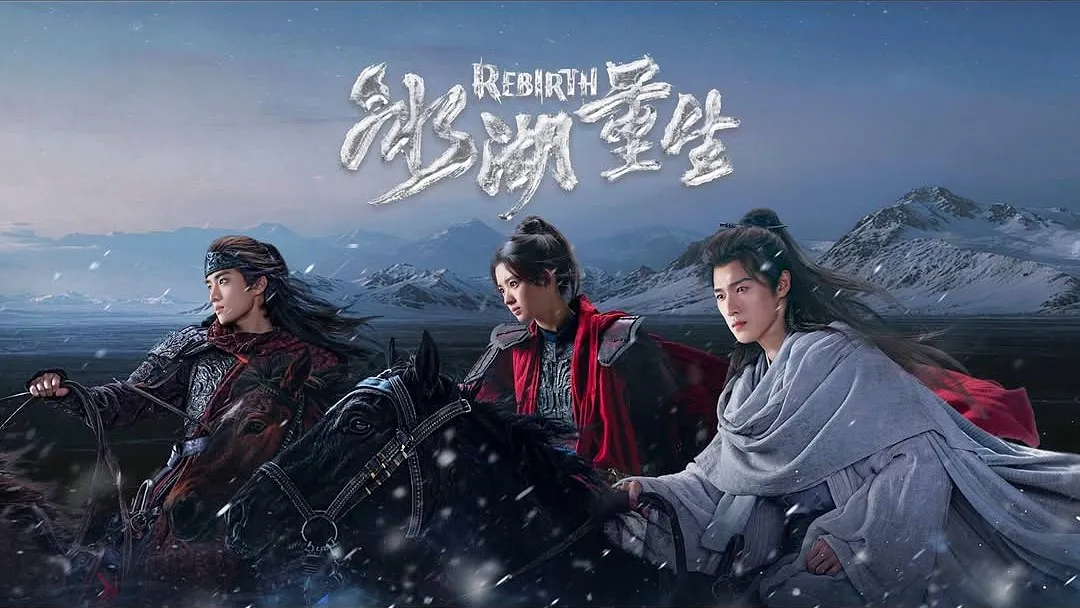
Rebirth Poster - Courtesy of Tencent Video

|
DetailsRATING: (6.5/10)
NATIVE TITLE: 冰湖重生 - Bīng hú chóngshēng YEAR: 2026 EPISODES: 40 DURATION: 45’ DIRECTOR: Lv Hao Ji Ji SCREENWRITER: Wei Yi ORIGINAL CREATOR: Xiao Xiang Dong Er (11处特工皇妃 - The Legend of Chu Qiao: Division 11's Princess Agent) RESPECTED CLICHÉS: 1 - 3 - 4 - 6 - 7 - 8 - 9 - 13 - 14 - 15 - 18 |


IN A NUTSHELL
- What to expect: Rebirth is an ambitious drama, but it struggles to sustain its premise when it premieres. The political plot, built on an almost "leveled" structure like that of a video game, is initially slow and repetitive, only to transform, in the second half, into a more frenetic but also less clear narrative. At the center remains a protagonist around whom everything seems to revolve: her choices end up becoming the main driving force of events, inheriting the highly centralized construction already seen in Princess Agents. The series makes rather casual use of references to the prequel which, instead of strengthening continuity, sometimes end up being misleading. While on the one hand the series finally brings Chu Qiao's journey to completion, on the other it does so through an uneven narrative, with a sacrificed romantic dimension and more than one internal inconsistency.
- Strengths: the realistic aesthetic, the engaging political storyline, the long-awaited conclusion to Chu Qiao’s story.
- Weaknesses: the uneven pacing, the overly protagonist-centered characterization, the video game-like narrative structure.
- Recommended if you like: Li Yun Rui, dramas with lots of action and little romance, strong love triangles, political plots involving multiple states, breathtaking natural landscapes.
- Would I rewatch it? Probably not, given my poor predilection for this saga.
If you want to know the specific weak points of this drama, keep reading.
Rebirth presents itself as a return to a world we already know, but one that is no longer the same. It carries echoes of Princess Agents — in the names, the unresolved relationships, the unfulfilled promises — and seems to want to reconnect those loose ends, offering the viewer the chance to revisit that story with a fresh perspective. The story alternates tension and melancholy, intrigue and long-repressed feelings, attempting to construct a path that is both familiar and different, capable of expanding the narrative world of the prequel without completely losing its connection to what came before.
In my review, after the series has ended, of the drama Rebirth, I will try to understand what remains of the Princess Agents universe and what, instead, has changed direction, evaluating narrative choices, characters, and atmosphere to convey an overall impression that highlights what works and what, instead, struggles to find a balance.
Plot
After reuniting and plunging together into the icy waters of Qianzhang Lake, Chu Qiao and Zhuge Yue are separated once again by fate: he miraculously survives, saved by the king of Ximeng who, recognizing him, decides to exploit his abilities and make him his alter ego; she, however, is rescued by Yan Xun, determined to keep her and make her the queen of Yanbei. Chu Qiao, however, refuses the marriage and, during the ceremony, escapes, finding herself once again swallowed up by the waters of Qianzhang Lake, from which she is secretly rescued by Zhuge Yue, now believed to be dead.
Hunted by Yanbei soldiers, her path crosses that of Li Ce, the eccentric Crown Prince of Biantang and an old acquaintance of hers, who offers her refuge. Convinced that she has lost Zhuge Yue forever, Chu Qiao decides to follow Li Ce to Biantang, unaware that there too her enemies will give her no respite. Soon, she is drawn into a dense web of court intrigue, power games, and interstate tensions, while the weight of her identity once again weighs on her every decision.
Amid fragile alliances and sudden betrayals, Chu Qiao rediscovers faces from the past, but is also forced to let go of others, on a journey marked by constant farewells. And while her bond with Zhuge Yue frays between brief encounters and inevitable separations, her path becomes increasingly intertwined with the conflicts that plague the various kingdoms.
It is precisely through this perilous journey, filled with losses, conflicts, and difficult choices, that Chu Qiao approaches her greatest goal step by step: to build a world finally free from slavery.
"Since this is the path you have chosen, even if its’a laden with corpses and blood, you’ll walk it to the bitter end.
But the day comes when you cannot take another step forward, you should know the way back to Qingshan Court.
And if one day you do turn back, I shall be just behind you."

Rebirth Drama Review (No Spoilers)
Arriving after years of anticipation and carrying the burden of a legacy like Princess Agents, Rebirth was poised to capture audiences' attention in 2026 even before it aired, supported by hype fueled both by curiosity for the "sequel" and the promise of expanding the narrative universe of the original series.
Expectations, at least on paper, were for a drama capable of satisfying a broad and diverse audience, and at least initially, interest was not lacking: viewership benefited from the series' extensive advertising campaign, and online discussions quickly ignited. However, as the episodes progressed, enthusiasm gradually cooled: while the opening numbers proved good thanks to the curiosity factor, the overall reception gradually became more lukewarm, giving way to increasingly perplexed reactions. Many viewers began to raise concerns about the writing — perceived as uneven — the weakness of the political component, and the unconvincing handling of character relationships. The result was a rather divided reception, where initial interest lacked lasting engagement.
Added to this, in the months leading up to the show's broadcast, was the so-called "earring controversy", which involved Huangyang Tian Tian following alleged irregularities attributed to her father, a former civil servant. The affair fueled rumors of the actress's possible dismissal from the series and of her face being replaced using digital technologies, further heightening the drama's attention—but for the wrong reasons.
Plot and Screenplay
Rebirth is a drama with a wealth of ideas, but, for my money, it struggles to truly sustain them when it comes to the screen. The plot brings together several ambitious elements that, however, end up feeling uncoordinated and, above all, lacking a clear direction: the series aims to be both a sequel and a soft reboot of Princess Agents, expanding its universe with new kingdoms and characters, preserving its emotional tension while, at the same time, lightening its tone with comic relief. On paper, it's a rich and layered project; in practice, I often felt like I was faced with a jumble of poorly developed intentions—the protagonists' fickle personal goals, a lackluster romance, an at times confusing political dimension, and inconsistent comedic moments—that coexist without truly integrating. Each element is present, but none manages to become the true axis of the story, which thus ends up fluctuating, as if it never manages to find a clear direction.
This fragility, in my opinion, emerges already in the first episodes, where the series relies heavily on an atmosphere of mystery to capture attention, but builds an ambiguity that rests on a still too undefined plot. The idea that suspense can arise simply by revealing almost nothing—limiting itself to scattering small hints of intrigue—seemed rather naive to me: rather than sparking curiosity, it ends up generating confusion. For the mystery to truly work, it's necessary to at least offer some points of reference, outline the context, and give the viewer a direction to move within. Without these elements, the narrative becomes lost in an opaqueness that doesn't build tension, but simply leaves a feeling of disorientation.
The project's hybrid nature further complicates matters: despite presenting itself as a "sequel-not-sequel," Rebirth often implicitly references the plot of Princess Agents, inserting elements that are truly comprehensible only to those already familiar with the original drama. It's true that the series attempts to bridge this gap through a series of flashbacks throughout the first few episodes, but the effect, at least for me, is counterproductive: instead of clarifying, they end up further fragmenting the narrative and concentrating too much information in a short amount of time, failing to truly make it accessible to those starting from scratch.
Even on the political level — which, considering the source material, should be one of the series' pillars — I had the feeling that Rebirth exhibits more than one weakness. Rather than developing a layered plot, the story seems to follow an almost "leveled" structure, like a video game: a rather linear and mechanical progression of actions that repeats virtually the same way until the drama's conclusion. A setting that, in the long run, gives the impression of a narrative that proceeds in stages rather than through organic development, until it ends when the protagonists' final objective is reached.
Added to this is a presentation of political conflicts that I found rather confusing. In the first half of the drama, the screenplay seems to rely on an "implicit" narrative of factions and the balance of power between states: political actors remain passive, as if waiting for the right moment to act, and political maneuvers—especially those that don't directly involve the main antagonists—rarely translate into structured conflicts or truly impactful actions. The result is a noticeable slowdown in the narrative pace, with rivalries that remain on paper but struggle to take concrete form on screen.
Curiously, this approach changes drastically in the second half of the drama, where political conflicts become much more evident: events accelerate, alliances are intertwined, betrayals and rivalries between states come into play, making the narrative denser and, undoubtedly, more engaging. At the same time, however, this change of pace introduces a new type of difficulty: many of these dynamics feel frenetic and not always consistent with the motivations and balances established in the first half. The result is a rather destabilizing change of pace: from the relatively linear initial pace, we transition into a frenzy of events that ultimately overwhelms both the characters and the viewer, making the second half more intense, but also more difficult to follow with full awareness.

Characters and Love Story
Regarding character development, I had the feeling that Rebirth directly inherits from Princess Agents a construction of the protagonist based on the idea of a "gravitational" figure: Chu Qiao is the center around which everything — characters, conflicts, events, and ideals — inevitably revolves. The problem, at least for me, is that this centrality seems more presupposed than actually constructed by the narrative context, and that events seem to organize around her person rather than emerge from a coherent system of cause and effect (it's not the world that generates the conflict, but the world reacts to the presence of an overly "cumbersome" protagonist). This ends up giving the impression that the narrative dynamics "arise" from the FL rather than being developed organically by the screenwriters.
This approach is accompanied by a rather weak management of secondary characters, often introduced through generic titles — "Emperor of X," "Chief of Tribe Y" — or inserted into the narrative without a real introduction. While this choice may seem useful in orienting the viewer in a context rich with factions and intrigue, it also ends up flattening the characters into simple narrative functions, making them difficult to perceive as individuals. Unlike other dramas that construct roles and hierarchies through dialogue, relationships, and subtext, Rebirth uses explicit labels — that appear in overlay — prioritizing an immediate but superficial clarity, sacrificing immersion and depth.
Furthermore, in an attempt to maintain a superficial narrative continuity with the prequel, the series ends up reassigning titles and identities to the characters without fully respecting the internal coherence of Princess Agents, forcing those who have watched the original series to independently reconstruct writing choices that were never truly made explicit. This is the case, for example, of the Thirteenth Prince of Da Yong, here associated with a character much younger than the original Yuan Song: this creates not only a discrepancy that the narrative does not bother to clarify, but also an inconsistency in the flashbacks where a character called Zhao Song is introduced who shares part of his background with Yuan Song, despite not being the Thirteenth Prince of Da Yong.
On the romantic front, the series makes frequent use of typically romantic devices — sudden glances, strategic physical contact, and subtle gestures which effectively create tension and sustain interest. What I found less convincing is the way this tension is handled, especially in the main relationship: instead of resulting in progressive development, it tends to result in repeated declarations of intent from the main character and restrained displays of affection—perhaps also due to the protagonist's young age. The feeling is that the relationship between the two is deliberately held back, avoiding overly marked development, resulting in an emotional "stagnation" that can be frustrating at times. Therefore, if you're looking for a captivating love story or a clearly defined romantic arc, Rebirth is unlikely to meet your expectations.
Almost in contrast to the main couple's composure, the series occasionally indulges in overtly melodramatic scenes, constructed through emphatic shots and dialogue laden with romantic rhetoric. These sequences, in theory, should intensify the viewer's emotional involvement, but in my case, they often had the opposite effect: instead of drawing me closer to the characters, they made me want to move past them as quickly as possible, more out of impatience than genuine disinterest. It's a very "old-school" type of construction, which may certainly appeal to those nostalgic for that style, but which I personally found difficult to digest. On more than one occasion, I found myself fast-forwarding, precisely because the involvement gave way to embarrassment. For those who appreciate this emphatic style, it can be a familiar and appreciable element; for those accustomed to more modern and less hyperbolic writing, it risks becoming one of the most tiring aspects of the viewing experience.
This context also includes the rather insistent use of typical romantic drama clichés, evidently used to artificially heighten the romantic tension of a story that appears more politically oriented. Devices such as the rescue from drowning, the fall from a cliff, or the protagonist's amnesia are so forcefully inserted into the narrative that they often give the impression of a poorly integrated use of tropes. Rather than reinforcing the dramatic bond between the protagonists, they almost end up generating a sense of déjà vu, accentuating the sense of accumulation and lack of direction that pervades the entire series.

Cast
Overall, the cast of Rebirth, despite being largely composed of rather young actors, proved adequately worthy of the production.
Li Yun Rui seemed to me to be a perfectly fitting choice for Zhuge Yue, as he managed to portray both his more resolute and combative side and his more protective and emotionally involved one. At the same time, however, I felt that the script ended up squandering some of his potential, relegating him to a more secondary role compared to the female protagonist.
The female protagonist, Huangyang Tian Tian — despite being a visually credible alternative to Zhao Li Ying — was much less convincing from an acting perspective: her performance often comes across as stiff and inexpressive, even in the most intense moments, so much so that one almost wonders if her supposed digital replacement would have been such a disaster.
More interesting, albeit with some limitations, is Zhang Kang Le's performance, which creates a fairly nuanced Yan Xun, even if the writing, which focuses heavily on his obsession with Chu Qiao, doesn't give him much room to explore a broader emotional spectrum.
I found the casting of Charles Lin, on the other hand, particularly apt. He's perfectly at ease in the role of the ambiguous and ruthless official serving the Empress of Biantang: a role that, in my opinion, suits him much better than certain more naive characterizations seen elsewhere (such as in Les Belles).
Further confirmation comes from Zhou Lu La, who manages to give his general Cheng Yuan a convincing balance between toughness and humanity, avoiding the expressive rigidity that often characterizes some of his colleagues and instead creating a more nuanced character—as already seen in The Prisoner of Beauty.
Among the most memorable performances, for me, is that of Li Xiao Qian as the crown prince of Biantang: a light-hearted characterization, at times deliberately over the top, but capable of making the character one of the most unforgettable in the series.
Less convincing is Xia Meng's Chun'er, which comes across as rather dull, especially when compared to Li Qin's more nuanced performance in Princess Agents.
Finally, I particularly appreciated Kuang Yu Ting's acting, which portrays a determined and combative Huan Huan, almost harsh at times, but capable of displaying, when necessary, a more empathetic side.
Visual Aspects and Soundtrack
The aesthetic of Rebirth is probably one of the aspects that most convinced me about the drama.
The direction appears solid and professional, capable of making the most of the natural settings chosen for filming: the vast, wild landscapes in which some scenes are set are believable and immersive, and contribute significantly to the construction of a broad and varied narrative world. The photography also works very well, especially in the exterior sequences, where a palette tied to the colors of the earth and nature dominates, while in the interiors and backlots, more subdued and realistic hues are chosen, avoiding excessive saturation. I particularly appreciated the use of light, which is generally consistent and natural: the transition from the full, almost blinding sunlight of the daytime battle scenes to the nights illuminated by fires and torches, with a believable and well-calibrated visual effect.
That said, there are moments (almost certainly dictated by scripting needs) in which the direction also slips into more naive and rather stereotypical solutions — slow motion, artificial wind, dramatic framing, unnaturally positioned lighting — intended to heighten the drama of certain scenes, but which ultimately break the immersiveness and weaken, at least in part, the visual coherence built up to that point. Despite these stumbles, however, the overall impact remains positive: the visual aspect remains one of the pillars on which the drama rests and is, all things considered, one of its most successful elements.
Less convincing, however, was the editing, which on more than one occasion penalizes the fluidity of the narrative — already complex in itself, considering that the events unfold across four different realms. At times, one gets the impression that connecting scenes are missing; in other cases, sequences set in earlier times are inserted after later events without any real justification. There are also inserts that seem disconnected from the narrative flow of the moment and whose sole purpose is to heighten the romantic tension, such as the scene in episode 11 in which Chu Qiao suddenly finds herself at a folk festival, spots Zhuge Yue in the crowd, and tries to reach him before he disappears: a suggestive moment, but poorly integrated into the progression of the story.
Among the elements I appreciated most, however, are the traditional dances, inserted at various points in the series, which help to give color to the story and enrich the cultural identity of the various contexts.
The costumes, while not deviating too much in style from those of Princess Agents, also show greater attention to materials and ethnic details, particularly in the hair ornaments. The makeup, on the other hand, is striking, but not always in a positive way: on more than one occasion, I had the feeling that the men's makeup was even more refined than the women's, so much so that it rightfully places Rebirth among the series that perfectly embodies the "foundation general" logic already highlighted in Pursuit of Jade.
As for the soundtrack, it proves overall effective and well-balanced with the drama's tone.
I particularly appreciated the variety of the tracks, which effortlessly alternate between slow, romantic melodies like 重生 (Rebirth), more epic and powerful pieces like 追风 (Chasing the Wind), and more melancholic and nostalgic sounds like 翩翩花落去 (Flowers Drift Away). This alternation helps sustain the series' diverse souls, accompanying both the most intimate and the most spectacular moments. At the same time, the compositions are quite distinctive, thanks in part to a sound choice that departs from the tradition of historical dramas: instead of relying heavily on Eastern instruments, the soundtrack favors orchestrations closer to Western culture, creating an atmosphere that feels familiar yet slightly atypical for the genre.
As usual, Liu Yuning's voice stands out, a now almost inevitable presence in the soundtracks of Chinese dramas. His contribution here fits perfectly into the series' heroic tone: while not offering anything particularly innovative sonically, his song stands out for its incisive melody and intense, impactful performance.

WARNING!
FROM THIS POINT ON THE SPOILER SECTION BEGINS. DO NOT CONTINUE IF YOU DO NOT WANT TO KNOW ALL THE DETAILS OF THE DRAMA.
Rebirth Drama Review (Spoilers)
What Works
The Premise and the General Characterization of the Characters
Among the elements that, at least on paper, represent the true strength of Rebirth is undoubtedly its plot.
Expanding the Princess Agents universe through the introduction of new states is not only a sensible operation, but potentially very fertile, especially given a geopolitical construction that, in its essential features, appears well-defined: Biantang is a prosperous and self-sufficient power, Ximeng is a harsh and wild territory but rich in resources, in contrast to the already known structures of Yanbei, fragmented, hostile and indomitable, and Da Yong, rigidly hierarchical and devoted to expansion. Together, these elements define a broad and potentially dynamic narrative map within which the protagonists move.
Even some fundamental choices are consistent with the idea of a sequel: the realization of Chu Qiao's dream of a world without slavery, the happy ending granted to the protagonists, their continued involvement in interstate rivalries before they manage to reunite, as well as the widespread presence of court intrigues that threaten to derail their plans, contribute to the development of the story's internal logic and provide continuity to the original plot. The problem is that these good premises are often undermined by a repetitive narrative structure, an excessive focus on the protagonist, and the presence of characters — like Chun'er — who, rather than credible antagonists, seem like functional tools to prolong the story and end up gradually undermining its initial potential.
More interesting, at least in its intentions, is the handling of the characters' moral dimension, which avoids a simplistic opposition between good and evil and instead navigates more ambiguous terrain. Rebirth attempts to construct a system in which loyalty is not an absolute value, but subordinated to higher priorities, be they political or ideological. In this context, we see decisions such as those of Cheng Yuan and Huan Huan, willing to betray Yan Xun — and sacrifice their emotional ties with Helian Ling and Zhao Che — in the name of safeguarding the state, or that of Zhuge Yue, who abandons Chu Qiao to protect his men, as well as that of Yan Xun, who sacrifices his feelings to secure control of Ximeng's resources. These are turning points that enrich the series' moral framework and contribute to its complexity, even if the writing doesn't always manage to sustain them with the necessary coherence, at times resulting in overly illogical characterizations.
What Doesn't Work
The Protagonists and the Logic of Some Characters
One of the strongest objections I had after watching Rebirth (and which, in part, seems rooted in Xiao Xiang Dong Er's source material) concerns the handling of Chu Qiao's character and the way the series tends to mythologize her narrative centrality, partly through the construction of a deliberately vague and ambiguous identity, which makes her almost a "predestined" figure in the most fantasy sense of the term. On a personal level, I perceived a character construction that insists on the idea of a "gravitational" figure, around whom people and events inevitably revolve, as if her importance derived more from a pre-existing narrative aura than from her, albeit evident, individual abilities. This approach, while partly consistent with the protagonist's background — a survivor of an oppressive system based on the elimination of the weakest and the conditioning of loyalty, which pushed her to develop resilience, martial skills, and independent thinking — ends up finding it unconvincing to me.
In other similar dramas, even when the protagonists are exceptional figures (assassins or highly trained agents), their centrality emerges more organically from the story, through missions, constraints, and operational dynamics that gradually build their narrative weight. In Chu Qiao's case, however, I perceived a more pronounced and almost "preventive" mythologization, which makes the character less credible precisely because she seems already placed at the center of the narrative world before her actions fully justify her.
Added to this is a conflict management that goes in the same direction: the narrative world seems to react selectively, focusing attention and hostility on her, while equally dangerous figures — such as Zhuge Yue, a high-ranking military figure of the Da Yong — can move with surprising freedom even in enemy states. This asymmetry ends up appearing less like a coherent worldbuilding choice and more like a functional mechanism to keep Chu Qiao always at the center of the conflict, thus weakening the overall credibility of the narrative system.
This same centrality also affects the sense of danger conveyed by the story. I've often had the impression that events aren't triggered by a truly looming external pressure, but are instead triggered by the protagonist's initiatives, resulting in the danger being perceived as self-generated and therefore less urgent. This type of approach undermines the sense of inevitability that makes every choice necessary. Personally, I prefer dramas like i>The Song of Glory and A Journey to Love, in which the conflict is "reactive": the protagonists navigate unstable systems with missions that impose immediate constraints and risks, thus creating a more continuous and perceptible tension. I recognize, however, that a more proactive narrative, in which the characters generate events, can be interesting for those who appreciate stories in which the action stems from strong protagonists rather than constant external pressure.
Along with these elements of continuity with Princess Agents, the characterization of the characters combines details that are quite distinct from the prequel. The character of Yan Xun, for example, in the original series emerged as a complex figure, deeply marked by political trauma and driven by the goals of revenge and reconquest of power, whose bond with Chu Qiao was an important but not exclusive component of her life. In Rebirth, however, I perceived a clear shift in her motivational axis: the political dimension seems to recede in favor of the relationship with Chu Qiao, to the point of giving the impression that many of her actions are guided almost exclusively by this obsession. This change in perspective, while making the character more immediate and increasing the audience's "direct" emotional involvement, simplifies a figure that in the prequel found its strength precisely in the tension between the political and the personal sphere, reducing its complexity and, in part, even its tragic significance.
A similar argument applies to Chu Qiao herself, whose relationship with Zhuge Yue appears more emotionally charged here than in Princess Agents, where it coexists with a broader narrative of survival, political choices, and ideological tensions. The result is an overall shift in the narrative axis from the political-ideological complexity that characterized Princess Agents to a construction more strongly centered on romantic dynamics, which certainly makes the story more immediate and emotionally accessible but, at least for me, attenuates the tension between the individual and the system that was one of the most interesting elements of the original work.
Chun'er's arc in Princess Agents was also much more impactful, because it was constructed as a progressive loss of identity: from a protected and idealistic princess, she goes through a sequence of traumatic events that transform her irreversibly, making each of her subsequent choices the direct consequence of a well-defined emotional and social fracture. In Rebirth, however, the character seems reduced to an echo of his own past: traumatic experiences are recalled more as background elements than as true turning points, and his evolution loses the necessary chain of consequences that made him truly impactful, falling victim to a writing style that prioritizes immediate narrative function over progressive psychological construction. The result is a clear gap between a character shaped by pain and one who simply recalls it without ever giving it tangible weight.
Finally, a further limitation that contributes to the screenplay's sense of inconsistency concerns the justification for some characters' choices, which are often inconsistent and difficult to decipher. I often had the impression that some secondary characters operate within a sort of motivational ambiguity that, rather than enriching their psychological complexity, ends up weakening the readability of their choices. Their decisions, in fact, seem more functional to the needs of the plot than the result of a coherent internal journey.
I'm referring, for example, to Cheng Yuan's sudden shift toward Chu Qiao, from wanting to kill her to offering to help her escape. This shift in perspective would be justified by his desire to tone down Yan Xun's arrogance and cruelty, but on closer inspection, the loss of his beloved should have the same effect on Yan Xun, whether it stems from her death or her escape. A more coherent explanation might be that Cheng Yuan has realized he has feelings for Helian Ling and fears he will no longer be able to protect her if he is sent away or, worse, sentenced to death if he attempts to kill Chu Qiao again.
Similarly, it is not clear why Zhan Zi Ming, a cunning and devious character, who has become a very important pawn for the Empress because she is pregnant with Li Ce, simply out of envy towards Chun'er tries to frame his benefactress, ending up punished. Furthermore, despite being extremely fond of Zhan Zi Yu, she decides to betray him by telling the emperor of his affair with the Empress, thus risking his death. The result is that, rather than building a solid and coherent character structure, the series often ends up assigning secondary characters such illogical choices that they elevate Chu Qiao by subtraction, indirectly contributing to strengthening the protagonist's centrality, but at the expense of the overall coherence of the narrative world.

Some Writing Choices
As already mentioned, one of the aspects that, in my opinion, most impacts the solidity of the writing and the plausibility of Rebirth's worldbuilding concerns the handling of the political plot.
Rather than creating a layered narrative, the series seems to adopt an almost "mission-based" progression, very similar to the logic of a video game: a linear sequence of events that tends to repeat the same pattern until the end of the drama. In the first half of the story, the plot remains almost entirely confined to Biantang, where the unexpected death of all the heirs to the throne leads the ministers to appoint Chu Qiao as Empress Dowager, guardian of the Crown Prince — Li Ce and Zhan Zi Ming's newborn son — and provisional regent of the kingdom.
In the second half of the drama, the pace quickens, but the narrative structure remains largely unchanged. The protagonists begin to move between Ximeng and Da Yong, following a pattern that over time seems rather repetitive: they arrive in a kingdom, find themselves faced with an oppressive ruler, intervene to save the population, eliminate the king, temporarily take control of the situation, and then set off again for the next stop. It's a pattern that repeats itself regularly until all the main figures of power are systematically removed, and which, over time, feels more like a succession of "levels" to be overcome than the narrative evolution of a novel's plot.
What left me perplexed was not only the absurdity of the dynamic, but also the ease with which the protagonists succeed each time. In Ximeng, for example, Chu Qiao and Zhuge Yue arrive with the goal of obtaining the antidote to the "Blood on the Snow" poison, but end up killing the king, convincing an important general to cover for them, and becoming the new rulers themselves. In Da Yong, Zhuge Yue returns to save the Moon Guards, but his presence quickly turns into direct intervention in power dynamics: he helps Zhao Che ascend to the throne and then eliminates him, thus annihilating the entire imperial family and deposing the four main clans involved in the slave trade. All this contributes to giving the narrative a rather artificial quality: rather than developing as a complex political system, the world seems to bend from time to time to the will of the protagonists and the demands of the plot, creating "false" obstacles only to make reaching a happy ending seem more difficult.
This is also connected to information management, which in a story like this should be an expensive and exclusive element. The prequel, in fact, places great emphasis on the prestige of the Qingshan Court, one of Da Yong's most important espionage organizations, yet at various points I had the feeling that, in the Rebirth universe, information circulates far too easily. Characters outside that environment seem to know crucial events, identities, and secrets without it being truly shown, or at least explained, how they came by them. Even important revelations thus emerge without adequate buildup, depriving the plot of the sense of risk and progression that should sustain it. In a context where information should be a rare and precious resource, this apparent accessibility ends up weakening the tension, often giving the impression that some characters "know" certain things simply because the plot needs them to know them in order to progress.
Another element that made me turn up my nose a bit concerns the overall tone of the narrative. Considering the centrality of political dynamics — with all their weight of revenge, moral ambiguity, and power struggles — one would expect a more coherent and cohesive atmosphere. Rebirth, however, nonchalantly inserts comic moments and lighthearted asides that, while making the viewing experience more accessible, often feel dissonant with the main plot. The problem isn't so much the presence of humor, but rather the way it's integrated: the alternation between registers isn't always balanced, and the lighthearted moments end up interrupting the flow just when the story demands greater intensity, contributing to an overall sense of disjointedness.
The most obvious example, for me, remains the Crown Prince of Biantang. Li Ce works well as an ironic and unconventional figure and, on paper, represents an interesting counterpoint to the more tense sequences; however, this choice is rarely contained or balanced by the context. Indeed, even his surroundings — including his collaborators — often adopt the same caricatured tone, producing an effect that's more grotesque than truly effective. This is clearly evident in the sequence of his army's escape from Tianjing Prison: a scene that would have all the makings of a tense and dangerous one is lightened by a comic staging, resulting in a weakening of the perception of risk and compromising narrative coherence. In this sense, rather than a true contrast, a dissonance is created that's difficult to justify.
Finally, even on a romantic level, I had the feeling that the writing remains, in some ways, superficial. As already mentioned, the series consciously employs typically romantic devices — languid glances, strategic physical contact, indirect displays of desire — that work to maintain the reader's attention, but rarely find a proportionate and coherent conclusion.
In some cases, I really had the impression that emotional dynamics were treated more as plot devices than as true narrative paths. A significant example is the relationship between Li Yan and Zhao Chun'er: despite starting with a powerful and symbolically charged event — him rescuing her — there is a complete lack of any intermediate development that would justify its evolution. The transition from first meeting to a deep attachment occurs abruptly, giving the impression that the feeling responds more to the narrative need to quickly activate their storyline than to a real shared journey. It's a choice that can work if read as a way to build the foundations for the final showdown between Chu Qiao and Chun'er, but at the same time, it ends up weakening the engagement, precisely because it deprives the relationship of the graduality necessary to make it truly credible and meaningful.
Ending
The way I interpreted it, the ending of Rebirth is crafted with those who were disappointed by Princess Agents in mind, almost as an attempt at "emotional compensation". Chu Qiao and Zhuge Yue, despite their last meeting being marked by his apparent death — stabbed in the heart by her — survive, reunite, and end up building a life together in Ximeng as king and queen, even having two children. Meanwhile, after Cheng Yuan's death, Yan Xun and Helian Ling also find a sort of balance, growing fond of each other and sharing their lives in Yanbei until her death. It's an epilogue that certainly gives all the protagonists of Princess Agents (except Chun'er) a more satisfying conclusion, but for this very reason, it seemed almost tailor-made to offer the kind of satisfaction that had previously been missing.
What left me most perplexed, however, was the insistent use of the "return from the dead" device, which here reaches excessive levels. Zhuge Yue's case is emblematic — brought back to life twice by the screenwriter — but it's far from isolated: the same mechanism is repeated with Huan Huan, Zhao Chun'er, Zhuge Mu Qing, and General Meng. Over time, the repeated use of this device ends up draining the characters' deaths of their narrative weight: deaths lose meaning to the point that it's natural to expect that any deceased character will reappear sooner or later. Rather than creating surprise or relief, this choice induces a sort of apathy in the viewer that ends up depriving the deaths of their real emotional charge.
Similarly, I found the sequences in which the living "see" the dead as if they were still present rather unnecessary — and, in part, even excessively melodramatic. It's a solution that can have an emotional impact if used occasionally, but here it's reiterated to the point of losing its effectiveness. The highlight is probably the finale, with that sort of alternate vision in which all the deceased characters are shown in a hypothetical "what if", imagining the lives they could have had. An idea that clearly aims to close the circle on an emotional level, but which, at least for me, ends up further accentuating that feeling of artifice: more than a true epilogue, it seems like an attempt to sweeten the story's ending, which, however, fails to repay the viewer for the disappointment felt at the deaths of some characters.

Characters and Cast
Primary Characters
Chu Qiao/Xing'er/A'Chu/Qiao Qiao/Princess Fu (Huangyang Tian Tian) slave of Da Yong and a spy for the Qingshan Court. She escaped seven years earlier with Yan Xun after the Emperor of Da Yong massacred his family for fear of a rebellion. She later fought alongside Yan Xun for the freedom of Yanbei at the head of the Xiuli Army, but abandoned him when she realized his ambition was leading him to betray even his friends. She later fled her marriage to Yan Xun and found Li Ce, Crown Prince of Biantang, who offered her refuge. After helping her friend conquer the Biantang throne, she succeeded him as Empress Dowager Xiuli to allow his newborn son to inherit the throne. She then helped Zhuge Yue liberate Ximeng and became queen, electing it as her new homeland.
Zhuge Yue (Li Yun Rui) fourth young lord of the Zhuge clan of Da Yong and heir to the Qingshan Court, Da Yong's most notorious spy organization. His organization trains slaves as men of sacrifice for the Emperor of Da Yong, and that is how he meets Chu Qiao. When she decides to support Yan Xun's cause, the two separate and are reunited only at Lake Qianzhang, where they make peace but disappear, swallowed up by its waters. Once reunited, they free Ximeng from its oppressive ruler and become its king and queen.
Yan Xun (Zhang Kang Le) heir apparent to the Marquis of Dingbei and the last survivor of the Yan family, exterminated by the Emperor of Da Yong. With Chu Qiao's help, he manages to escape from Da Yong and become ruler of Yanbei, but his ambition pushes him too far and he sets a deadly trap for Zhuge Yue, his old friend, at Lake Qianzhang. During Chu Qiao's escape from the wedding, he too falls into the frozen lake and remains in a coma for days until the priestess of Wunan takes him to the summit of Black Mountain and awakens him. From that moment on, his obsession with Chu Qiao combines with his thirst for revenge and begins a journey that repeatedly leads him to jeopardize his authority and the survival of his people.
Zhao Chun'er (Xia Meng) deposed princess of Da Yong, is the daughter of Consort Wei and sister of Prince Zhao Che. During her wedding to Yan Xun, he starts his rebellion and she is overwhelmed by events: betrayed by the man she loves and outraged by enemy soldiers, her only goal becomes revenge against Chu Qiao and all those who humiliated her.
Supporting Characters
Da Yong
Zhuge Mu Qing (Wang Zhi Gang) Lord of the Qingshan Court and Zhuge Yue's grandfather. He is a stubborn man and deeply obsessed with the clan's honor, so he will do anything to bring the reluctant Zhuge Yue back to Da Yong, even going so far as to fake his death.
Zhan Fu (Li Jia Xiang) spy for the Qingshan Court and Zhuge Mu Qing's attendant.
Zhuge Xi, Third Lord of the Zhuge family and Zhuge Huai's grandfather. He is the Lord of the Hongshan Court and is a lustful and sadistic man who kills his slaves for pleasure.
Zhuge Huai (Deng Ze Ming) cousin of Zhuge Yue and Young Lord of the Hongshan Court. He is cruel and perverse, and his favorite pastime is torturing his slaves for fun.
Yun Niang (Kyulkyung) slave of the Hongshan Court and Chu Qiao's first martial arts master. She sacrifices her life in an attempt to kill Zhuge Xi.
Yue Qi (Ting Xuan Huang) member of the Qingshan Court Moon Guards and Zhuge Yue's attendant.
Yue Shi Yi (Li Jia Nan) member of the Qingshan Court Moon Guards and Zhuge Yue's subordinate.
Yue Da (Dan Jing Yao) member of the Qingshan Court Moon Guards and Zhuge Yue's subordinate.
Zhao Che (Sheng Yi Lun) Prince Xiang, Seventh Prince and general of the Da Yong. He has been in the army since he was 13 and, despite his diligent and loyal behavior, is disdained by his father, who prefers the capricious Thirteenth Prince.
Zhao Yang (Wu Jia Kai) Thirteenth Prince of Da Yong. He is cynical and vicious and tries in every way to undermine his seventh brother in his bid to inherit the throne.
Zhao Kuo, Da Yong's envoy to Biantang who reveals Chu Qiao's true identity to the Empress of Biantang.
Muhe Lie, head of the Muhe clan. His family supports Zhao Yang in his rise to power.
Muhe Xi Feng (Yang Qi Yuan) son of the Muhe clan killed by Chu Qiao and Yan Xun during their rebellion seven years earlier.
Mu Shen (Huang Hai) head of the Mu clan. His family supports Zhao Che in his rise to power.
Wei Guang, head of the Wei clan. His family is loyal to the Emperor of Da Yong.
General Meng (Liu Chan) general of the Southwestern Army, killed by Zhao Che after the coup to consolidate his power.
Prince Jing (Wang Jing) supporter of the Seventh Prince, is given command of the Southwestern Army after the presumed death of General Meng.
General Xing Le (Miao Yi Lun) general of the Southeastern Army, whom Zhao Che attempts to kill after the coup to consolidate his power, but is saved by Yan Xun and Chu Qiao.
Jia Meng (Fu Dong Nuan) priestess of the Faceless God, belongs to the wild Quanrong tribe. Her goal is to help her people conquer the Central Plains, and to do so, she deceives Chun'er into believing she wants to help her exact her revenge.
Jing Xiao Ba (Xu Dong Yi) former slave of the Qingshan Court and Chu Qiao's younger sister. Her desire for revenge against the Zhuge family is exploited by Zhuge Mu Qing in an attempt to bring his nephew back to Da Yong.
Yanbei
Yan Shi Cheng Marquis of Dingbei, Grand Marshal of the Northwest Army of Da Yong, Zhenxi ruler of Yanbei, and father of Yan Xun. He is murdered along with his entire family by the Emperor of Da Yong, fearful of his possible revolt: this event will trigger Yan Xun's revenge.
Bai Sheng (Zhang Ping Juan) wife of the Marquis of Dingbei and mother of Yan Xun, killed along with her husband by the Emperor of Da Yong.
A'Jing (Huang Zu Xin) soldier of the Black Eagle Army of Yanbei and attendant of Yan Xun.
General Cheng Yuan (Zhou Lu La) Guard of the Black Eagle Army of Yanbei. He is Yan Xun's right-hand man and, despite his hostile attitude towards Chu Qiao, always remains loyal to his commander. Despite discovering his love for Helian Ling, he always respects her position and her official relationship with Yan Xun.
General Shi Yan (Bai Hai Long) Commander of the Yanbei Black Eagle Army and subordinate to Yan Xun.
General Huan Huan (Kuang Yu Ting) Chief of the Yanbei Snow Lands Tribe, general of the Black Eagle Army and cousin of Yan Xun. She is accused of high treason for taking command of the Yanbei army during Yan Xun's coma and miraculously escapes death by taking refuge in a small village. Once reinstated, she helps Zhao Che escape an assassination attempt by his brother, but falls victim to her generosity when she later confronts Zhao Che to allow Yan Xun to escape from Da Yong.
An Luo (Zhou Wen Qi) Huan Huan's younger brother, a soldier in the Black Eagle Army and the new leader of the Yanbei Snowlands Tribe after Huan Huan's disappearance.
Helian Ling (Hu Jia Xin) Lady of the Helian Tribe, the smallest of the thirteen Yanbei tribes. She collaborates with Cheng Yuan to kill Chu Qiao and become queen of Yanbei. In reality, she hopes to gain the ruler's favor to revive her tribe's fortunes and avoid a forced marriage to Tu Bo, the elder chief of the Hongchuan tribe.
A'Su (Wang Yi Meng) personal maid to Chu Qiao and later to Helian Ling, who dies defending the latter.
Helian Chuan (Bai Na Ri Su) Chief of the Helian Tribe and cousin of Helian Ling. He is a vicious gambler and womanizer who, to gain favor from the other tribal leaders, supports their plan to rebel against Yan Xun and tries to please them by offering them his cousin.
Tu Bo (Han Dong) Chief of the Hongchuan tribe. He makes a deal with Helian Chuan to take Helian Ling as a concubine, but she manages to obtain the title of Yan Xun's consort. Later, in revenge, he attempts to rape her, and she kills him with the help of Cheng Yuan. Together with the leaders of the Pale, Jinhui, and Lanchuan tribes, he tries to organize a revolt against Yan Xun, but Yan Xun manages to thwart it.
Ha Qi, Tu Bo's brother, who inherits the title of chieftain after his brother's death.
Elder Lanchuan Chief of the Lanchuan tribe. Together with the leaders of the Pale, Jinhui, and Hongchuan tribes, he tries to organize a revolt against Yan Xun, but Yan Xun manages to thwart it.
Elder Pale (Zhao Cheng Zhe) Chief of the Pale tribe. Along with the leaders of the Lanchuan, Jinhui, and Hongchuan tribes, he attempts to organize a revolt against Yan Xun, but Yan Xun manages to thwart them.
Ka Tuo (Li Jing Mu) Chief of the Jinhui tribe. Along with the leaders of the Lanchuan, Pale, and Hongchuan tribes, he attempts to organize a revolt against Yan Xun, but Yan Xun manages to thwart them.
Huo Sang (Si Li Geng) Chief of the Baichuan tribe. He is one of the few tribal leaders loyal to Yan Xun.
Wunan Priestess (Horne Davika) A healer introduced by Helian Ling to Cheng Yuan to heal Yan Xun and awaken him from the coma induced by his fall into the icy waters of Qianzhang Lake.
Zhong Yu (Hu Yi Xuan) A member of the Datong Guild, the secret organization that Yan Xun and Chu Qiao belonged to and whose goal was to abolish slavery. She was killed by Cheng Yuan while trying to draw Chu Qiao out into the open.
He Xiao (Chen Kang) Deputy Commander of the Xiuli Army, whom Chu Qiao frees during the prisoner exchange between Da Yong and Yanbei.
Lin Mu (Liu Hao Ze) member of the Xiuli Army and Chu Qiao's subordinate, whom Chu Qiao frees during the prisoner exchange between Da Yong and Yanbei.
Ximeng
King of Ximeng/Su Gu Lin (Jin Han) saves Zhuge Yue from freezing with Chegu grass after fishing him from the frozen lake to use as his alter ego on dangerous missions. He is actually a slave of Ximeng who managed to free himself from his master by becoming the king of Ximeng, but had to pay for his freedom with a horrific facial scar that forces him to wear a mask.
Qiu Lin (Ling Zi Tong) Left General of Ximeng. After the king of Ximeng is killed by Zhuge Yue and Chu Qiao, he is removed from the capital and sent to the northern garrison.
Meng En (Zhu Jun Lin) Right General of Ximeng. He covers for Zhuge Yue and Chu Qiao after they kill Su Gu Lin.
King of the Ling Yue (Wu Nien Hsuan) King of the Ling Yue tribe. To prevent his people from being massacred by Su Gu Lin, he reveals to him how to enter his territory through a secret path. He is later held in Su Gu Lin's prison and poisoned with the Blood on the Snow, causing him to go mad.
Queen of the Ling Yue/A'Li (Wang Zi Xuan) Queen of the Ling Yue tribe who became a slave to Su Gu Lin after he conquered her people. She is tasked with guarding Zhuge Yue during his missions as Su Gu Lin's alter ego.
Ba Ze (Zhao Qing He) Warrior of the Ling Yue tribe, the Queen's right-hand man.
Zhuge Yun Zhou (Wen Jia Rui) and Zhuge Yun Sheng (Wang Zi Han) sons of Zhuge Yue and Chu Qiao.
Biantang
Li Jiao (Jiang Yi) Emperor of Biantang. Fearing his brother, Crown Prince Mao Cheng (Sui Yong Liang), he eliminated him by usurping the throne and married his wife. He then exiled his other brother, Prince Chang, to Jin. He entrusted him the Empress's son to his care.
Eunuch Fang (Zhu Xuan Yi) the Emperor's attendant.
Empress of Biantang (Li Meng) former consort of the late Crown Prince Mao Cheng. After killing her husband, the current Emperor had promised her protection and to spare the son she was carrying, but then he had him secretly killed. For this reason, she has always harbored a strong resentment toward the Emperor, which has led her to attempt to undermine his health with women and alcohol, as well as toward his son.
Yan Qing (Long Xin Yue) the Empress's personal maid.
Zhan Zi Yu (Charles Lin) Grand Minister of Ceremonies, attendant and paramour of the Empress. In reality, he is one of the few survivors of the massacre of the Nanxi tribe perpetrated by General Sun on the Empress's orders. However, he is unaware of this and agrees to serve the Empress, secretly training the survivors of his tribe as spies for her.
Li Ce/Ce'er (Li Xiao Qian) son of the Empress and the current Emperor of Biantang, and heir apparent of the Biantang. Because of the events that led to his birth, the Empress hates him and tries in every way to prevent him from participating in the kingdom's politics, to the point of accusing him of attempted regicide and exiling him. Thanks to Chu Qiao, he eventually manages to prevail over his mother and obtain the throne.
Song Cheng (Shao Jun Ze) Li Ce's bodyguard. After Li Ce's accession to the throne, he is appointed commander of the Imperial Guards.
Zhan Zi Ming (Ma Li Ya) Li Ce's concubine, whom he ransomed years earlier from a brothel, thinking she was a girl reduced to slavery after her family's fall. In reality, she is one of the few survivors of the Nanxi tribe and the sister of Zhan Zi Yu, also working for the Empress. After becoming pregnant with Li Ce's child, she is named Consort Hu and is welcomed into the palace by the Empress.
Li Xiu Yi, son of Li Ce and Zi Ming. After his father's death, he was adopted by Chu Qiao, who was named Empress Dowager Xiuli, and later ruled Biantang as Emperor Changzhao.
Ming Lu (Shi Xin Tong) head of the maids at the Crown Prince's Residence. In reality, she is the daughter of the late commander of the Imperial Guard of Zhenhuang (capital of Da Yong), who died during Yan Xun and Chu Qiao's revolt. She attempted to take advantage of Chu Qiao's stay at the Crown Prince's residence to kill her. However, she later reappraised Chu Qiao and became her most trusted aide.
Mu Zheng, father of Ming Lu and late commander of the Imperial Guard of Zhenhuang.
Li Yan (Lu Mi Le) Prince Luo. He is the only son of Prince Chang, the Emperor's younger brother, exiled to Jin City after the Emperor's accession to the throne because he was the biological brother of the deceased Crown Prince. In reality, he is the son of Mao Cheng and the Empress, whom the latter secretly entrusted to her brother-in-law for safekeeping. Before returning to the capital, he finds Chun'er unconscious along the river and takes her with him, determined to marry her. Following his mother's death and his half-brother's accession to the throne, he enacts his plan of revenge and kills Li Ce, but is ultimately eliminated by Chu Qiao.
Mo Zhan (Jin Cheng) and Chun Xing (Li Yi), servants of Prince Luo's residence They are in love with each other.
Xu Su, minister of Biantang who colludes with Li Yan to dethrone Li Ce.
Pei Jian (Fan Yi Ning) minister of Biantang who colludes with Li Yan to dethrone Li Ce.
Grand Councilor Liu (Wang Bo Qing) senior minister of Biantang and father-in-law of Sun Di. He is wise and prudent, but does not hesitate to help Chu Qiao falsify the imperial edict granting her the title Empress Dowager so she can adopt Li Ce's son and ensure a lineage for the Biantang imperial family.
Sun Di (Liang Da Wei) Great General of the Biantang Left Valorous Cavalry. He is an irreproachable and loyal minister and does not hesitate to help Chu Qiao falsify the imperial edict by granting her the title of Empress Dowager so she can adopt Li Ce's son and ensure a lineage for the Biantang imperial family.
Li Qi (Cheng Tao) Great General of the Biantang Right Valiant Cavalry. He is treacherously mutilated by Yan Xun to pressure the Biantang into handing over Chu Qiao.
Wang Shi'er (Guo Han) grave robber held in Tangjing Prison for desecrating five tombs from the previous dynasty. He is awaiting deportation, and Chu Qiao decides to free him to recruit him into the army she is raising for Li Ce.
Xiao Ran (Yan Yu Chen) wandering healer specializing in poisons, is falsely accused of murder by the family of a patient of his held in Tangjing Prison. He is awaiting a retrial, and Chu Qiao decides to free him to recruit him into the army she is raising for Li Ce.
Fang Miao Miao (Chen Xi Xi) known as Swift Hand, is a thief held in Tangjing Prison. Chu Qiao decides to free her to recruit her into the army he is raising for Li Ce.
Zhang Qing Zhao, administrator of the Ministry of Works and employee of the Production Department of a secret government office responsible for overseeing the palace reconstruction, the fortifications of Tangjing, and the maintenance of the canal network connecting the Biantang to other states. He is in possession of the Skywork Drawing, a metallurgical manual that the King of Ximeng wants to obtain to exploit the black gold mines in his territory.

Favorite Character: Li Ce
He is one of the most luminous and, at the same time, most tragic characters in Rebirth: a spontaneous, cheerful, and profoundly optimistic young man, capable of maintaining an almost disarming lightheartedness despite the weight of a personal history marked by intrigue and family wounds.
His life has in fact been shaped from the beginning by the consequences of his father's rebellion, which triggered a chain of devastating events within the Biantang imperial family: from the death of the legitimate Crown Prince Mao Cheng — his father's brother and beloved consort of the current Empress — to the murder of their son. In this context, he grows up as a presence tolerated rather than welcomed, deprived of maternal affection, and perceived by the Empress not as a son, but as the price to pay for the survival granted to her by the current Emperor.
Despite the title of Crown Prince, his path to the throne is constantly hindered by the very woman who should support him. The Empress, in fact, confines him to a role of apparent idleness and superficiality, surrounding him with concubines and depriving him of any real political influence, deliberately transforming him into a marginal figure.
Yet, behind this constructed mask, he retains a keen sensitivity and surprising resilience that pushes him to bide his time. Even when he discovers he is constantly being watched and betrayed — even by the concubine to whom he is closest — he chooses not to openly resist, seemingly resigned to a fate that seems already written.
It is his encounter with Chu Qiao that finally gives him the opportunity to act. Already fascinated by her in the past, when they met in Da Yong, Li Ce finds in this strong and determined woman a spark that rekindles his hope: beside her, the seemingly frivolous prince reveals a desire to reclaim his place and his dignity.
However, fate does not grant him the time necessary to truly enjoy the result he has achieved. His journey is tragically interrupted just when it seems his life is turning positive, swept away by the return of a half-brother believed dead who returns to claim the throne.
Li Ce is thus left a victim of a power he never truly desired and of family ties devoid of any affection, and dies awaiting the return of Chu Qiao, the same woman he never managed to conquer, but whom he continued to love with a discretion and sincerity that make him, perhaps, one of the most human and touching characters in the entire series.
Un-Favorite Character: Zhao Chun’er
She is perhaps the character who most embodies the most destructive side of revenge, demonstrating how an initially legitimate pain can transform into an obsession capable of consuming every vestige of sanity.
Already in Princess Agents, she emerges as a deeply scarred figure: crushed by the political decisions of her father, Emperor of Da Yong, and by an absolute, unrequited love for Yan Xun, a man now irremediably distant and an enemy of her own family. However, while the events that lead to her downfall and the loss of her title as princess are undoubtedly tragic and unjust, what is striking in Rebirth is the way she chooses to react to that trauma, gradually allowing herself to be consumed by a spiral of resentment and obsession.
Her revenge focuses almost obsessively on Chu Qiao, who has become the primary target of a hatred that, in reality, has its roots elsewhere—in her father's choices and the power dynamics that sacrificed her. This shift in responsibility reveals a profound inability to process her own pain, which translates into increasingly cruel plots and a growing distrust of everyone around her. Even her relationship with Li Yan, the prince of Biantang who offers her protection and a chance at redemption, develops within this ambiguity: she constantly oscillates between a need for affection and suspicion, incapable of truly trusting him, to the point of transforming even that bond into a tool to regain power and status.
Her story continues along an increasingly extreme trajectory: after failing to establish herself in Biantang, she returns to Da Yong without abandoning her own purpose, exploiting the cult of the Faceless God and the vicious nature of the Thirteenth Prince to regain control of the center of power.
At the same time, her amorous obsession shifts without ever abating: from Yan Xun, she moves to the deceased Li Yan, whom she continues to "meet" through the use of hallucinogenic incense, in a drift that marks her definitive detachment from reality. Not even the failure of yet another plan, resulting in the loss of her unborn child, can stop her; on the contrary, it further fuels an out-of-control desire for revenge.
The point of no return comes when, in order to acquire an army and annihilate Chu Qiao, she is willing to sacrifice herself and her country, agreeing to a strategic marriage with the Quanrong leader and effectively opening the doors to Da Yong's invasion. It is the moment when revenge ceases to be a personal motivation and becomes an indiscriminate force of destruction, capable of destroying even that which it was supposed to protect.
Her final suicide, to reunite with Li Yan, appears less as a romantic gesture than as the inevitable epilogue of a trajectory marked by the inability to let go: an end that closes the circle of a tragic character, but also profoundly prisoner of his own obsessions.
RECOMMENDED:
- PRINCESS AGENTS
- A JOURNEY TO LOVE
- WONDERLAND OF LOVE
- FIGHT FOR LOVE
- SHADOW LOVE
Thanks for reading this far!
I hope you enjoyed my article. If you like my work and want to support me, buy me a coffee ☕