
Whispers of Fate (2025): the Infinite Sufferings of Luo Yun Xi | Review & Cast
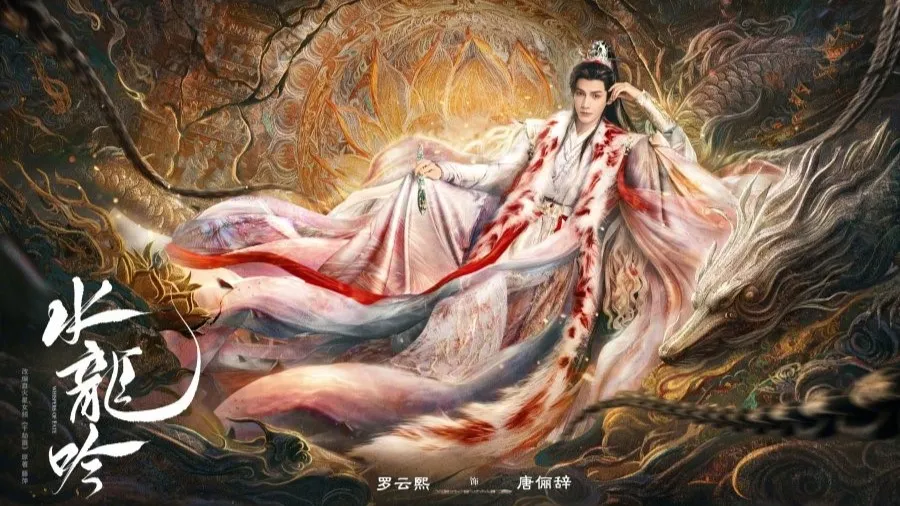
Poster of Whispers of Fate - Courtesy of Hunan TV

|
DetailsRATING: (6/10)
NATIVE TITLE: 水龙吟 – Shuǐlóng yín YEAR: 2025 EPISODES: 40 DURATION: 45’ DIRECTOR: Chen Zhou Fei, Qian Jing Wu SCREENWRITER: Zhuang Xiu, Lin Cong He, Wang Xiao Lou, Yan Mo Yiv ORIGINAL CREATOR: Teng Ping (千劫眉- Enduring a Thousand Tribulations) RESPECTED CLICHÉS: 1 - 2 - 3 – 4 – 6 – 10 - 11 – 14 - 15 |


IN A NUTSHELL
- What to expect: Whispers of Fate is a wuxia with fantasy elements and a solemn narrative. The story focuses on the protagonist’s journey to uncover his cumbersome past, which leads him to understand the purpose of his existence.
- Strengths: evocative atmosphere, impeccable performance by Luo Yun Xi, original and sumptuous costumes and accessories, grandiose soundtrack.
- Weaknesses: poor contextualization of the story, slow plot, pompous and moralizing dialogues, poorly characterized secondary characters, poor CGI.
- Recommended if you like: wuxia with fantastic atmospheres, dramas mainly focused on the protagonist, stories like Till the End of the Moon but without too much romance.
- Would I rewatch it? I barely made it to the end, so no.
If you want to know why I didn’t like this drama, keep reading.
Steeped in mystery and sacredness, Whispers of Fate presents itself as a wuxia with monumental ambitions: a story of intertwined destinies, arcane powers, and spiritual battles fought on the boundary between myth and reality. It’s a work that aims high, attempting to blend tradition with modern spectacularity, but the result is more ambiguous than it seems.
In this Whispers of Fate drama review, I will attempt to explore its lights and shadows: what enchants, what jars, and what, despite its imperfections and visual daring, makes Whispers of Fate an experiment as fascinating as it is questionable.
" 人之初,性本善。"
[Men at their birth are naturally good.]
Plot
After seemingly causing the death of his mentor Fang Zhou, Tang Li Ci finds himself hunted by his former shixiong, Liu Yan, who is determined to avenge his beloved master’s death at all costs. Blinded by grief, Liu Yan decides to ally himself with the sinister Fengliudian Sect to end his former friend’s life, but Tang Li Ci has a special constitution that allows him not to be killed.
So Liu Yan decides to adopt a more subtle strategy: undermine his reputation, pass him off as a murderer, instill suspicion in the wulin that he is involved in the deaths of illustrious figures in the martial world, and, above all, reveal to the world his alleged connection to Yi Que Yin Yang, the enigmatic former Imperial Preceptor, responsible for the downfall of the previous dynasty and a sworn enemy of the martial sects, who mysteriously disappeared from the jianghu years earlier.
As he seeks to clear his name, Tang Li Ci learns to grapple with the complexity of human emotions and find unexpected allies in the heroic martial artist Chi Yun, the tormented assassin Shen Lang Hun, and the young orphan A’Shei, for whom he develops a tender affection. It is thanks to their help that he will overcome the wulin‘s distrust and escape the traps set by Liu Yan.
But as he tries to survive and foil the Fengliudian Sect’s plans for conquest, Tang Li Ci discovers a dark truth: behind his master’s death and the trials he was subjected to in the previous years lies the dark shadow of Yi Que Yin Yang and the hand of the mysterious Gui Mudan, the leader of Fengliudian.
Thus, Tang Li Ci ultimately realizes that he cannot escape his destiny, and to fulfill it, he will be forced to confront his past, the truth about his identity, and the purpose of his very existence.

Whispers of Fate Drama Review (No Spoilers)
Whispers of Fate is a drama that raised expectations even before its debut: on Mango TV and Weibo alone, it surpassed two million pre-orders, and its international distribution reached over 110 countries and regions across Asia-Pacific, Europe, and the Americas. These figures testify to immense anticipation, but, as is often the case, impressive numbers don’t necessarily equate to actual narrative and artistic success.
The drama immediately strikes with its visual elegance and solemn atmosphere, which, however, leaves the feeling of hiding more emptiness than mystery. Behind the patina of epicness and dazzling effects lies a story that, while ambitious, struggles to find a balance between aesthetics, pacing, and substance. It’s a beautiful show to watch, but at times it seems more interested in impressing than telling a story.
Narrative Pace
As the story progresses, that same aura of mystery turns into fog: the narrative becomes sluggish, the characters move like pawns in a game whose rules we don’t understand. Whispers of Fate is captivating, but it does so from a distance—like a dream that, upon awakening, is only half-remembered. Everything, from the monumental sets to the solemnity of the dialogue, seems to scream “masterpiece,” yet behind the formal elegance lies a story that struggles to come to life.
The pace of this drama is almost ceremonial: the viewer follows Tang Li Ci step by step, without truly understanding his objective or his adversaries’ moves. The plot remains shrouded in constant mystery, giving the impression of an infinite wait rather than a true narrative.
Often, one gets the feeling that the story is more described than truly experienced: the characters’ actions are not justified in advance and are only clarified afterwards, with lengthy explanations that weigh down the narrative and kill the tension. Ambiguity here risks turning into stasis, and the viewer’s patience is tested more than it deserves.
Characters and Romance
As for the characters, in Whispers of Fate everything revolves around the protagonist Tang Li Ci. He is the absolute center of the story: a being of unparalleled intelligence, capable of replicating any martial technique he encounters, and immune to death. This invincibility, however, seems to drain the narrative of tension rather than making it more epic: a perfect protagonist leaves no room for doubt or risk, and so the story ends up losing depth.
The characters around him appear faded, peripheral figures defined more by what the screenwriters tell us about them than by any real personality. The result is a world that lives in its hero’s shadow, populated by individuals who exist only for the protagonist and never manage to be perceived as real people.
As often happens in wuxia, romance is lacking in Whispers of Fate: hinted at, whispered, but never truly present. This in itself wouldn’t be a flaw—not all stories need a love story to work, especially those set in the martial world—if it weren’t for the constant feeling that an intense relationship, à la Till the End of the Moon, would have been the only thing capable of giving the plot some emotional depth. Instead, what remains is a narrative freeze devoid of that spark of passion that not even the protagonist’s spiritual flames can ignite.

Cast
The cast, despite being relatively young on average, delivers a good performance, but the film’s major structural flaws undermine any attempt to improve its fortunes.
Luo Yun Xi delivers, as usual, a performance of remarkable intensity, combining restraint and naturalness with an innate stage presence. His Tang Li Ci does not make us regret the Tantai Jin from Till the End of the Moon, though it perhaps lacks the passion and inner torment that made the Devil Lord unforgettable.
Ao Zi Yi proves himself to be a very promising young actor (whom we already appreciated this year in The Prisoner of Beauty): his acting is spontaneous, lively, and perfectly in tune with the lighthearted lightness of Chi Yun’s character.
Particularly magnetic is the presence of Yang Shi Ze, who imbues his Pu Zhu with an aura of mystery and almost tangible spirituality. His rigorous and captivating performance reveals nuances of emotional delicacy that make me long for a romantic evolution with Tang Li Ci.
Bao Shang En, Cheng Yao, and Xiao Shun Yao also deliver solid and consistent performances, while Bai Shu‘s Xue Xian Zi stands out for his vivacity and irony, confirming the actor as a highly versatile screen presence (also appreciated in Youthful Glory).
Alen Fang, on the other hand, is less convincing: his acting, too affected, failing to give depth to his antagonist. His performance is inevitably overshadowed by the excellent Xu Zheng Xi, who, returning to the stage after his rumored departure announced in the spring of 2024, brings a complexity and magnetism to the character of Gui Mudan that captures attention, even in a marginal role.
I cannot help but criticize Jelly Lin (already unconvincing in Les Belles) for her persistent lack of expressiveness. Her character, not particularly interesting even on paper, might have been redeemed with more sincere and passionate acting, but the actress limits herself to a pathetic and childish portrayal.
In closing, a note of merit to the casting director for choosing Li Fei as the immortal Yi Mo: his ethereal, harmonious face and his almost supernatural presence coherently embody the ideal of a pure and perfect divinity.
Visual Aspects and Soundtrack
Unfortunately, in this disastrous production, not even the visual effects are up to scratch. The fantastical settings appear fake and flat, more like digital backdrops than real places, and even the fights suffer from this artificiality: the magical techniques are unbelievable and lack three-dimensionality. Only the wire maneuvers performed by Luo Yun Xi and the other actors are a welcome addition, but otherwise the CGI adds nothing to the scenes; in fact, it makes them more unrealistic, compromising the visual quality of a drama that, being a fantasy wuxia, relies heavily on computer graphics.
From an aesthetic standpoint, some viewers criticized the makeup, costumes, and hair accessories, judging them excessive or even too feminine for the male characters. On the contrary, I find this to be the drama’s most successful aspect: being a wuxia with a strongly fantastical tone, the opulence of the costumes and the eccentricity of some makeup is perfectly in keeping with the atmosphere of the story and gives the visuals a touch of originality and added character.
As always, costume designer Huang Wei demonstrated an impeccable eye, combining sophisticated fabrics, elegant cuts, and details that accurately reflect each character’s personality and role. Makeup artist Zeng Ming Hui followed the same logic, creating a unique aesthetic that still resonates with the story.
The series’ soundtrack is, paradoxically, one of the most appreciated and, at the same time, most underappreciated elements of the drama. It’s a rich, expansive, and surprisingly varied work: it ranges from epic melodies to more romantic themes, from fairytale atmospheres to moments of pure heroism, all enhanced by a variety of voices that imbue the songs with remarkable emotional and narrative depth.
It would be an ideal accompaniment—if only it were used sparingly. Unfortunately, during dramatic moments, the music bursts in with such force that it drowns out the jokes, shatters the intensity, and transforms potentially touching scenes into a grueling exercise in acoustic survival. A quality soundtrack, in short, but sacrificed by a sound editing that does not understand the meaning of the word “moderation”.

WARNING!
FROM THIS POINT ON THE SPOILER SECTION BEGINS. DO NOT CONTINUE IF YOU DO NOT WANT TO KNOW ALL THE DETAILS OF THE DRAMA.
Whispers of Fate Drama Review (Spoilers)
What Works
Atmosphere and Worldbuilding
Whispers of Fate unfolds within a highly original fantasy universe, where every event seems imbued with a greater meaning and every choice seems part of a divine plan that transcends the conception of individual individuals. It is an ambitious drama driven by the desire to tell a story that intertwines predestination, ancestral forces, and conflicts that are not only physical, but also symbolic and spiritual. It is a wuxia that combines Chinese cultural imagery with a contemporary visual sensibility, creating a world that captivates and captivates.
Its true strength lies precisely in its evocative dimension, which represents the most solid element of the entire drama: a meticulously crafted and layered worldbuilding, the refined aesthetic of fairy-tale-inspired costumes and accessories, and an enveloping soundtrack that accompanies the story with solemnity and epic scope.
From this point of view, Whispers of Fate is a work that dares, that aims high and that, at least on an aesthetic and evocative level, manages to leave a recognizable and fascinating mark.
What Doesn't Work
The Narrative Pace
One of this drama’s main flaws is the lethargic pace of the narrative, which rations out twists and dilutes the suspense. The viewer finds himself following Tang Li Ci’s moves step by step without ever truly understanding his objective or his opponent’s countermoves. The plot remains shrouded in constant mystery, so rather than following the events, one feels constantly waiting for the story to — finally — reach a conclusion.
Compounding this sense of immobility is the fact that the story, rather than being acted out, seems explained: the characters do things whose purpose is never made explicit or suggested a priori by the writers, and which must be clarified later through lengthy explanations that slow the pace and sap the drama.
This series could be compared to Tarantino movies: you watch it with confidence, trusting that in the end everything will make sense and that the destination will be worth the journey. But while in Tarantino, in the end, all the pieces of the puzzle fall into place perfectly, and even the anticipation is imbued with charm and tension, in Whispers of Fate the script leaves a little more to be desired.
Dialogue
The main dialogues often feel solemn and verbose. Those involving Tang Li Ci, in particular, tend to occupy substantial portions of the episodes, but despite their desire to appear profound, they end up limited to long, rhetorical exchanges. The main characters repeatedly repeat the same philosophical concepts of righteousness, altruism, and justice, so much so that the conversations gradually lose any emotional or moral force.
Furthermore, the systematic use of this paternalistic tone is not only redundant but also slightly annoying, as if the script were trying to convince the viewer of the characters’ nobility (or pettiness) rather than allowing them to perceive it through their actions. This feeling is evident, for example, in the dialogues between Tang Li Ci and Pu Zhu in episodes 8 and 12, in the one between the protagonist and Cheng Yun Pao in episode 21, or in the various exchanges between Tang Li Ci and Liu Yan.

Secondary Characters and, in Particular, Female Characters
The characterization is another aspect that left me a bit perplexed. Unlike classic historical dramas, here the story focuses almost exclusively on the protagonist Tang Li Ci. Everything revolves around him, an extremely intelligent figure, skilled in combat, capable of absorbing and replicating any martial technique used against him, and essentially immortal. Such a protagonist is certainly interesting — especially when played by Luo Yun Xi — but he proves to be a double-edged sword for the narrative: how can the story of an invincible character truly evolve? His perfection defuses the tension, detracts from the challenges, and consequently deprives the story of any real sense of growth.
Worse still, Tang Li Ci’s cumbersome aura ends up swallowing up everything around him. The other characters, no matter how much the writers try to introduce them and make them sympathetic through flashbacks that recount their personal dramas, remain essentially extras: sketchy figures whose fragmented and incomplete memories only give us glimpses of their inner selves, never conveying their complexity.
And the problem is exacerbated by those characters who initially seemed crucial to the plot but who, after a few episodes, disappear into thin air, only to reappear occasionally, perform an action useful to the story — often detrimental to Tang Li Ci — and vanish again, without us being allowed to truly understand their motivations, internal conflicts, or state of mind (I’m thinking, for example, of Zhong Chun Ji, Fang Ping Zhai, and Yu Fu Ren).
The result is a narrative mosaic populated by shadows, flat figures defined more by their recounted experiences than by their demonstrated personalities, and intermittent presences who never manage to establish themselves as true protagonists of the world they inhabit.
In this respect, I find the weakest character in the entire story to be A’Shei, the supposed female protagonist. For much of the drama, she fails to stand out or arouse any real interest, merely embodying the oldest of stereotypes: the damsel in distress. Every time she appears, she’s either in a risky situation or waiting for Tang Li Ci to tell her what to do — and of course, she obeys without batting an eyelid, following him everywhere like a faithful shadow, obsessively worrying about him and caring for him with dedication even when he gets a mere scratch.
The problem is that behind such self-sacrifice, there’s not a shred of personality: A’Shei is an inconsistent character, whose presence is entirely subordinate to the protagonist — as she herself admits — and whose sole narrative function is to remind us, again and again, how extraordinary he is.
The revelation that A’Shei is Fang Zhou’s long-lost sister further compounds the character development. A twist that, in theory, should add tension and drama to the story, but in practice, it produces nothing. She spends more than half the series without any memories of her brother, and once the memories are recovered, the revelation has no impact on events: it doesn’t generate significant conflict, it doesn’t substantially change her character, and it doesn’t alter the course of the plot.
Jelly Lin’s performance, moreover, doesn’t help lift the character: that perpetually scowling expression and that vacant stare end up making A’Shei not only pathetic, but downright useless — yet another heroine trapped by her own fate, far from the multifaceted protagonist a story like this deserved. The director was likely counting on the actress’s charisma and flair to give the character depth, but it turned out to be a losing proposition from the start.
Judging by their characterizations, one might almost think the author harbors a subtle antipathy toward her female characters. Of all the women who populate the story, not a single one can be considered truly charismatic or even interesting (with the sole exception, perhaps, of Xi Fang Tao). And it’s not a matter of psychological complexity or moral ambiguity: it’s simply that each seems crafted to be unpleasant, useless, or foolish.
There’s something deeply irritating about them all: the heroines are submissive and annoying or stubborn and selfish; the antagonists are revenge-seeking, insensitive, and absurdly unreasonable. In a world where even NPCs (non-player characters) have more emotional depth than female characters, it’s hard not to wonder whether this is a conscious choice or the reflection of a writing style that pays little attention to character development.

Visual Effects
The visual effects are another weak point of the drama. The fantastical settings (such as Shisan Tower) appear far too artificial and suffer from flat, two-dimensional CGI that saps depth from the scenes instead of making them more vivid.
The fights also suffer from this unrealistic execution: magical martial arts techniques reveal their artificiality, partly due to a painful lack of three-dimensionality. A prime example of this is Tang Li Ci’s Fluttering Crimson Silk Technique, which aims to be spectacular but ends up looking artificial when compared to Zhao Shi Rong’s Flowing Cloud Sleeve Technique in The Journey of Legend.
So, with the exception of the actors’ wire maneuvers—which I could watch for hours without tiring, especially Luo Yun Xi’s—I struggled to enjoy the fights between opponents using supernatural techniques due to their poor graphics. Unfortunately, this is a major flaw for a wuxia fantasy that relies heavily on CGI.
Furthermore, this drama seems to be nodding to the great Western fantasy and sci-fi productions, but it does so with a somewhat naive enthusiasm. The result is a visual mix that’s more disorienting than original: flying vehicles that look like something out of Star Wars, robotic animals worthy of Transformers, and even a fiery eye that seems like an all-too-explicit homage to The Lord of the Rings.
The intent to modernize wuxia is understandable, but here it borders on involuntary parody: more than a tribute to fantasy, it feels like a crossover event. All these elements, rather than broadening the series’ imagery, end up distorting it, casting it in an aesthetic hybrid that doesn’t quite mesh with classical Eastern elegance. Even in a fantasy context, coherence matters, and here the desire to amaze seems far superior to the desire to tell the story.
Ending
As for the ending, it’s so convoluted that it seems to have been created by randomly shuffling the last pages of the script. Suddenly, we discover that all of Tang Li Ci’s suffering was part of Ye Mo’s elaborate plan to obtain a “perfect celestial body”: an idea meant to evoke the classic “tribulations” of the xianxia, but which here only leads to confusion, as the series clarifies nothing—neither the purpose of the plan, nor Ye Mo’s past, nor Ajibaner Tang Jia’s childhood, all elements hinted at so vaguely and fragmentarily that they are more opaque than illuminating.
Further complicating the narrative chaos is Gui Mudan’s rebellion, who suddenly decides to stop working to resurrect Yi Que Yin Yang and instead wants to take possession of Tang Li Ci’s body himself. The plan, already nebulous, culminates in a trap orchestrated during the journey into the past that he himself helps Tang Li Ci undertake at the Celestial Pillar—a twist that is more disorienting than surprising, adding another layer of incoherence to an ending that would be an understatement to call convoluted.
In essence, the epilogue of Whispers of Fate aspires to grandeur, but ends up feeling like a puzzle assembled from pieces from different boxes.

Characters and Cast
Primary Characters
Tang Li Ci/Ajibaner Tang Jia/A’Li (Luo Yun Xi), disciple of Master Fang Zhou of the Zhoudi Tower of Jiangnan, imperial brother-in-law and Master of the House of the Arcana. After being accused of killing his master, he is disliked by the Wulin and hunted by his former shixion Liu Yan. In reality, Ajibaner Tang Jia is the chosen one of the Celestial Realm. However, like his predecessor Ye Mo, he had decided to leave the immortal world and found himself on the Divine Continent, where he was welcomed by Fang Zhou. Although he recognized his immortal nature, he decided to hide it from the world, hoping that under his guidance, his disciple would pursue a virtuous path.
A’Shei/Fang Ci (Jelly Lin), young street performer who is suspected of complicity in the death of her powerful husband, being the sole survivor of the massacre perpetrated by a mysterious pipa player during their wedding celebration. In reality, she is Fang Zhou’s sister, who agrees to collaborate with Gui Mudan to avenge her brother’s death. She presents herself before Tang Li Ci with no memories, but unexpectedly falls in love with him.
Zhong Chun Ji/Lang Ya (Bao Shang En), leader of the Shanfeng Hall of the Sword Alliance and disciple of Master Shao Yan Ping, has a strong desire for revenge because she is underestimated by everyone in the sect, but thanks to Liu Yan, she obtains her revenge by being recognized as Princess Lang Ya, the Emperor’s lost daughter. She falls in love with Tang Li Ci and, to gain his attention, agrees to damage his meridians with the Thousand Gu Needle prepared by Liu Yan.
Chi Yun (Ao Zi Yi), known as the Cloudrider, is Tang Li Ci’s bodyguard. He agrees to work for him after he repays his debt to the Shisan Tower, incurred for seeking information on his missing fiancée.
Shen Lang Hun (Xiao Shun Yao), known as The Severer of Mortal Bonds, is an assassin from the Shisan Tower whom Tang Li Ci recruits to fight Liu Yan. In the past, Liu Yan had destroyed the precious medicine that could have saved his beloved fiancée, causing her to die in his arms. For this, he had sworn to kill Liu Yan.
Liu Yan/A’Yan (Alen Fang), disciple of Master Fang Zhou of the Zhoudi Tower and Tang Li Ci’s shixiong. He is an excellent physician and a skilled pipa player. After Fang Zhou’s death, he joins the Fengliudian Sect, seeking revenge and becoming one of its leaders.
Xi Fang Tao (Chen Yao), known as the Three-Colored Peach, is the Head of the Western Palace of Fengliudian. She is devious and calculating, and with her complacent attitude, she manages to gain Pu Zhu’s trust, gaining admission to the Sword Alliance.
Supporting Characters
Yi Que Yin Yang/Ye Mo (Li Fei) Imperial Preceptor of the previous dynasty and leader of the Jile Cult. Ten years earlier, at Tiandu Peak, he had fought against the seven strongest martial masters in the world, only to disappear after the battle. In reality, he was Ye Mo, the Chosen One of the Heavenly Realm, who had decided to escape and found himself on the Divine Continent. There, he was welcomed by the ruler of the Gumo Kingdom who, following a plague, had asked him to activate the Sky-Reaving Weel to absorb the miasma. In reality, the king wanted to take possession of the immortal’s body, but he had retaliated by killing him. This had unleashed the wrath of the people, and to save himself, Ye Mo had destroyed Gumo.
Fang Zhou (Zhang Jun Ning) known as the Sevenfold True Tone, leader of the Zhoudi Tower of Jiangnan, whose martial art was the Deadly Melody. During the Battle of Tiandu Peak, he was seriously wounded by Yi Que Yin Yang, and to heal him, Tang Li Ci proposed using the Energy Exchange technique from the Tome of Samsara. However, due to Gui Mudan, the plan failed, and Tang Li Ci decided to preserve his body in the immortal crystal coffin of the Biluo Palace and his heart within his own body, hoping to one day resurrect him.
Fu Zhu Mei (Xia Zhi Guang), disciple of the Zhoudi Tower and shixiong of Tang Li Ci, was an excellent cook but disappeared after Fang Zhou’s death.
Shao Yan Ping (Qiu Xin Zhi), leader of the Central Plains Sword Alliance based on Mount Haoyun and disciple of the famous martial artist Jiang Nan Feng. His weapon is the Tai’e sword and he is the master of Zhong Chun Ji. He aids Tang Li Ci in his battle against Fangliudian.
Xiao Shi (Zhu Jun Zheng), boy saved by Shao Yan Ping, is the sole survivor of the massacre perpetrated by Fengliudian members in his village. He is very distrustful of everyone, and the only one who manages to get close to him is Tang Li Ci. For this reason, he becomes his disciple.
Cheng Yun Pao (Wang Zi Rui), member of the Heaven-Earth-Man Triad, a disciple of Master Wei Bei Yin, and master of the Sword Alliance. His weapon is the Earth Sword. He is the High Magistrate of Chahua Isle, where the survivors of the Jile Cult are imprisoned. He is Gu Xi Tan’s shixion and a friend of Fang Zhou.
Gu Xi Tan (Li Jia Hao), disciple of Chahua Isle and a member of the Sword Alliance. He is secretly in love with Zhong Chun Ji and assists her in her investigations into the Fengliudian Sect.
Xiao Qi Lan (Wang Yi Jun), leader of the Iron Peak Brush, master of the Sword Alliance
Ji Wu You (Deng Jing Hong), known as the Enlightened Heart, is the leader of the Qingming Sword Sect, a disciple of the Grand Healing Daoist, and the sixth master of the Sword Alliance.
Shang Guan Fei (Cheng Tao), leader of the Ninefold Divine Arrows and third master of the Sword Alliance.
Pu Xu Sheng, known as Lord Snake, is the second master of the Sword Alliance.
Jiang Wen Bo (Zhong Ming), known as the Eastern Cloudmaster, is one of the masters of the Sword Alliance.
Shang Yun Qi (Mu Le En), leader of the Qinghong Sword Sect, is one of the masters of the Sword Alliance.
Pu Zhu/Chai Zong Xun (Yang Shi Ze), lay disciple and future leader. of the Tianjing Temple Sect. He is a friend of Master Shao Yan Ping and will help the Sword Alliance fight against Fengliudian. In reality, he is the Crown Prince of the previous dynasty and cousin of the current emperor. To atone for his sins, he has decided to become an oblate and dedicate his life to protecting the weak.
Fang Ping Zhai/Fang Zhou/Chai Xi Jin (Wang Yi Lun), known as the Sublime Multifold Splendor, masters the Shadowless Technique and is the leader of the Shisan Tower, an organization that collects and sells secret information in the jianghu. In reality, he is the sixth prince of the previous dynasty who, to regain power, is trying by all means to obtain the Tome of Samsara from Tang Li Ci.
Shui Duo Po/Xi Ya (Ai Mi), divine physician of Mirror Mountain. In reality, she is Xi Ya, Princess of the Gumo Kingdom, the sole survivor of the divine fire unleashed by Ye Mo on her kingdom. Despite her distrust of immortals, she agrees to heal Tang Li Ci and follows him to the Sword Alliance.
Xue Xian Zi (Bai Shu), known as Snow Returning to Dust, a powerful martial artist whom Tang Li Ci recruits to aid him in the fight against Fengliudian.
Jiang Fei Yu (Zhong Lei), leader of the Yanmen Sect, a sect known for its uprightness and its messenger geese training techniques.
Jiang Cheng (Deng Xiao Ci), son of the leader of the Yanmen Sect. He is a close friend of Feng Chaun Xiang, so much so that the two are known as the Twin Heroes of Huaxi. Following a disagreement with his father, he goes to live with his friend at the Huaxi Mountain Cabin, but after discovering that he is mixing the Scarlet Ghost Pill with his food, he argues with him and he disappears.
Feng Chuan Xiang (Xue Ba Yi), renowned martial artist and Jiang Cheng’s sworn brother. He disappears from the Huaxi Mountain Lodge after an altercation with Jiang Cheng. Following Jiang Cheng’s death, Tang Li Ci discovers that he too has fallen victim to Fengliudian’s machinations.
Jiang Qing Yu (Lu Xing Yu), brother of Jiang Fei Yu and deputy leader of the Yanmen Sect. He is in league with the Fengliudian Sect, which promises him the title of sect leader in exchange for his complicity in distributing the Scarlet Ghost Pill.
Yu Xuan Qing (Du Yu Chen), known as Phoenix Sword, is the late matriarch of the Yu Clan and former ruler of the Sword King City. She was one of the seven masters who faced Yi Que Yin Yang at Tiandu Peak.
Yu Qi Feng (Xiu Qing), descendant of Yu Xian Qing, the current Sword King and Lord of the Sword King City. His technique is the West Wind Wild Fire. For ten generations, his clan has ruled the Sword King City and the Heavenly Flame Cliff. He is in league with the Fengliudian Sect, for which he distributes the Scarlet Ghost Pill through his naval transport network.
Yu Fu Ren (Xie Bin Bin) Commander of the Sword King City guards and Yu Qi Feng’s secret son. After the latter’s death, he becomes acting Lord of the Sword King City and supports the Sword Alliance in the fight against Fengliudian.
Gui Mudan (Xu Zheng Xi) leader of Fengliudian, known as the troupe leader due to his obsession with traditional Chinese opera. In reality, he is Yi Que Yin Yang’s puppet whose task is to ensure that Tang Li Ci faces the tribulations that will allow him to develop a perfect celestial body capable of housing the immortal’s soul.
Hua Hu Yan/Cao Wu Fang (Liu Yu Han) disciple of Fengliudian, taken in by Liu Yan after he was expelled from his village. His body, in fact, houses two distinct souls, which is why he was considered a monster.
Xiao Hong (Jiang Zhen Yu), Fengliudian’s disciple and Liu Yan’s attendant.
Mei Hua (Yu San), former top-ranked assassin of the Shisan Tower, is transformed into a puppet by Xiao Hong after his death.
Kuang Lan Wu Xing (Wang Yi Jun), one of the seven masters who faced Yi Que Yin Yang at Tiandu Peak. After the battle, his body is stolen and transformed into a puppet by Xiao Hong.
Fu Cui (Wang Bo Wen), Head of the East Palace of Fengliudian. He is a crude and unintelligent man whose only asset is his physical prowess.
Qing Chan (Wang Dan Wei), Fengliudian’s disciple and Fu Cui’s subordinate.
Bai Su Che (Li Mu Yan), the unparalleled beauty of Jiangnane, daughter of Bai Yu Ming. After Chi Yun saved her family, her father promised her in marriage to him, but following the extermination of her clan, she disappeared without a trace. In reality, she had been saved by Tang Li Ci, who asked her to infiltrate the Fengliudian Sect as his informant, allowing her to avenge her family.
Bai Yu Ming, descendant of the Sage of Calligraphy and father of Bai Su Che, who died at the hands of the Fengliudian Sect. After Chi Yun saved his family, he promised his daughter in marriage to him.
Gui Fu Sheng, first in the list of the best hidden mechanism builders, created the defense mechanisms of the Shisan Tower and the Biluo Palace.
Qiao Yi Qian Kun (Jin Long), fourth of the Seven Wanderers and second in the list of the best hidden mechanism builders. To tarnish Gui Fu Sheng’s fame and become number one on the list, he decides to aid Fengliudian in the fight against the Sword Alliance.
Wan Yu Yue Dan (Chang Hua Sen), son of Wan Yu Mo Ru, leader of the Wan Yu clan and head of the Biluo Palace. During the previous dynasty, his clan was second only to the imperial house, and thanks to its members’ excellent astronomical skills, it provided imperial advisors to the court for 200 years. Following his father’s example, he had always remained secluded in the Biluo Palace, remaining neutral in the conflicts of the Wulin. Tang Li Ci exploited his desire to return to court to secure his aid in the fight against Fengliudian. When Zhong Chun Ji became Princess, he was appointed Diviner at the Department of Celestial Surveillance.
Wan Yu Mo Ru, late leader of the Wan Yu clan and founder of the Biluo Palace on the Luo River. It was he who suggested to the Emperor that Yi Que Yin Yang be appointed imperial advisor, leading to his rise to power, only to be accused of high treason. For this reason, he retreated to the impenetrable Biluo Palace, completely ignoring the conflicts of the Wulin and remaining neutral at all times. After his death, an immortal crystal coffin was prepared for him, which Tang Li Ci had stolen to house Fang Zhou’s body while he sought a way to resurrect him.
Bi Lian Yi (Qin Xiao Xuan) superintendent of the Biluo Palace.
Yu Chi Hu (Kudousi Jiang Ainiwaer) General of the Imperial Guard and bodyguard assigned to Zhong Chun Ji when she was recognized as a princess.
Noble Tang (Zhang Lei) Imperial father-in-law and adoptive father of Tang Li Ci. It is thanks to him that Tang Li Ci obtains the title of Master of the House of Arcana.
Tang Sen (Xie Chun Yi) superintendent of the House of Arcana.
Tang Bing (Zhang Zi Han), young servant of the House of Arcana.
Hao Wen Hou (Bai Hai Tao), prominent figure from Yan City, was killed along with his guests during the celebrations for his wedding to A’Shei by a mysterious pipa player resembling Tang Li Ci. In reality, he was poisoned by Yang Shang Qing with the Hundred-Step Death Poison, and his death was exploited by Liu Yan to frame Tang Li Ci as a murderer.
Yang Shang Qing (Cui Peng), Lord of Yan City and friend of Hao Wen Hou. To investigate his friend’s death, he has A’Shei, the sole survivor of the massacre, arrested and tortured. In reality, he is the true murderer of Hao Wen Hou, but agrees to indulge Liu Yan by creating a scene to frame Tang Li Ci.

Favorite Character: Chi Yun
Sunny to the point of irreverence, naive almost to the point of foolishness, he embodies a vitality that never wanes, even in the face of the most daunting difficulties.
He is direct to the point of sometimes seeming reckless, yet this very disarming sincerity makes him one of the most genuinely human characters in the entire story.
His trust in Tang Li Ci is absolute, almost touching, and arises not from blind admiration, but from a deep belief in the protagonist’s goodness and integrity.
He is stubbornly loyal to his fiancée Bai Su Che and is willing to do anything to find her and free her from Fengliudian’s control.
His determination, though sometimes stubborn and impetuous, reveals a pure, unwavering courage without ulterior motives.
He is an excellent fighter, a precious companion, and the beating heart of the group.
It’s a breath of fresh air in a story dominated by shadows and conspiracies, a ray of light that, though faltering, never goes out, that rare presence capable of illuminating the entire story even in its darkest moments.
Un-Favorite Character: Zhong Chun Ji
She is a character who, despite having been humiliated and deceived by her family, struggles to transform her pain into maturity.
Insecure to the point of self-sabotage, stubborn to an almost obtuse degree, and fueled by a resentment that never truly leaves her, she spends most of her time battling the shadow of a betrayed and abandoned child, yet is unable to overcome it.
Her obsession with personal affirmation, that desperate urge to rise within the ranks of the Sword Alliance and prove she is not the fragile girl everyone thinks she is, leads her to always choose the quickest and inevitably most questionable path.
For fear of being ignored or belittled, she allows herself to be manipulated with surprising ease: first by Liu Yan, then by Xi Fang Tao, incapable of seeing the real threats while stubbornly distrustful of those who, on the contrary, only want to help her.
While respecting her teacher and feeling sincere affection for him, she reciprocates with constant worry, ignoring his wise teachings and allowing herself to be guided more by a wounded ego than by reason.
Her stubbornness, combined with subtle selfishness and often flawed logic, even pushes her to harm those she loves just to gain a shred of consideration, affection, perhaps that approval that, she says, no one has ever truly granted her.
The result is a confused character, trapped in an internal conflict that should inspire closeness, but rarely manages to attract genuine sympathy.
Every time she could redeem herself, she chooses the wrong path, despite everyone around her continuing to demonstrate their belief in her responsibility and capability.
In short, a complex human figure who ends up being more silly than heartbreaking.
RECOMMENDED:
- A JOURNEY TO LOVE
- TILL THE END OF THE MOON
- GUARDIANS OF THE DAFENG
- THE JOURNEY OF LEGEND
- WHEN DESTINY BRINGS THE DEMON
Thanks for reading this far!
I hope you enjoyed my article. If you like my work and want to support me, buy me a coffee ☕