
Twelve Letters (2025) Chinese Drama Review | Plot & Interpretation of the Ending
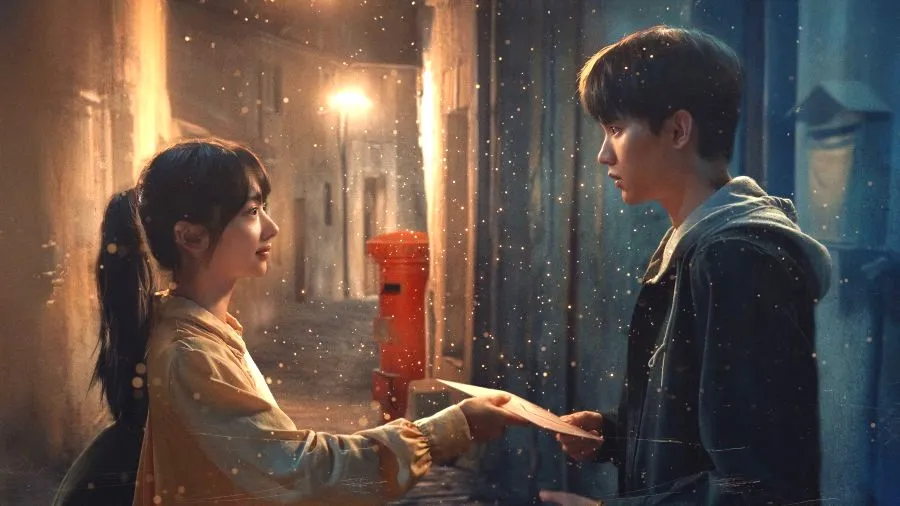
Twelve Letters Poster - Courtesy of Tencent Video

|
DetailsRATING: (9/10)
NATIVE TITLE: 十二封信 – Shí’èr fēng xìn YEAR: 2025 EPISODES: 12 DURATION: 45’ DIRECTOR: Sha Wei Qi SCREENWRITER: Cheng Xiao Mao, Cheng Meng Yan, Shen Si Ji |


IN A NUTSHELL
- What to expect: a gripping 35-year love story suspended between memory and reality, told through a mysterious exchange of letters between parents and children, connecting 1991 to 2026.
- Strengths: a naive and touching love story, an excellent screenplay, a convincing setting.
- Weaknesses: the frequent time jumps, the at times trying emotions, the open ending.
- Recommended if you like: realistic dramas where you can truly identify with the protagonists, authentic and touching love stories, and dual-timeline dramas.
- Would I rewatch it? Absolutely — with a box of tissues handy.
If you want to know my answers to some of the unanswered questions from the series, keep reading.
With Twelve Letters, Tencent Video brings to the screen a drama that blends nostalgia, hopes for the future, and regrets about the past in a surprisingly delicate and moving way. The story unfolds on a dual timeline, intertwining past and present through twelve letters that become the common thread of a love story suspended between memory and reality. It’s not simply a sentimental melodrama, but an emotional journey about growth, mistakes, and second chances.
In this Twelve Letters review, I’ll explain why this short series truly deserves to be watched and savored with the mind of someone who has felt nostalgia at least once in their life.
“Why are there so many unfortunate people in the world? Living like weeds, easy to be crushed underfoot.”
Plot
Meiwan Town, Fu’an County, 1991. Tang Yi Xun is an orphan who works odd jobs to survive, including collecting debts for the gang of the ruthless Bao Ge, along with his two associates Li Chan Dong and Zhang Hao,
At the home of Ye Yi Bo, a debtor, he meets Ye Hai Tang, the latter’s resolute nineteen-year-old daughter, and is surprised to find her the next day in his class at Meiwan High School, unjustly accusing him of writing her a love letter.
Ye Hai Tang finds the letter in question in the red mailbox that mysteriously appeared outside the bookstore where she works, which her boss suggested she use for the promotional event “Write a Letter to Your Future Self.”
The message was actually written in 2026 by a certain Yu Zhi Hong, who, after posting it in the mailbox of the former Beixian shipyards, disappears into thin air, leaving his daughter Yu Nian in a state of deep concern.
During her research, Yu Nian makes some disconcerting discoveries about her beloved father: he isn’t who he claims to be and has had a turbulent past, leading to the name of a certain Ye Hai Tang.
Following this lead, the girl encounters Shen Cheng, the woman’s unaware son, who is also searching for his mother, who disappeared a few days earlier. Together, the two discover that the mailbox from which Yu Zhi Hong sent his letter is actually a dimensional portal through which it is possible to communicate with the year 1991.
The guys then decide to begin a correspondence with the past, but the two timelines appear not to be perfectly synchronized, and communication proves difficult.
Thus, while in 2026, Yu Nian and Shen Cheng learn unknown details about their parents’ lives and their youthful relationship, in the past, Ye Hai Tang and Tang Yi Xun navigate the perils of their daily existence, leaning increasingly on each other, eventually finding themselves sharing joys and sorrows.
The exchange of messages between 1991 and 2026 continues with ups and downs until Yu Nian and Shen Cheng realize that to avoid the tragedy of the present, they must sacrifice their current reality and reveal to their parents a detail that can help them change their future.

Twelve Letters Review (No Spoilers)
In a year when the drama industry has produced very few works of any narrative depth, Twelve Letters stands out for its originality, effectiveness, and the intriguing themes it addresses.
Plot
The fact that it is based on an original story and is not a standard adaptation of an existing work is noteworthy because it means the screenwriters had to build the entire emotional cosmology, characters, and mystery from scratch, without being able to rely on pre-existing material. This certainly gave them greater creative freedom, but it also presented a challenge that forced them to work harder to make the plot, pacing, and characterization work—a challenge that the young writers of this drama easily mastered.
Twelve Letters is a “dual-time” series or a “dual-timeline drama”. The story takes place in two distinct eras (1991 and 2026), connected by letters that somehow mark the alternation and dictate the narrative’s pace. This type of structure requires temporal coherence and a script that pays attention to the setting details of both eras, and this series has managed this admirably.
Although the constant time jumps are a bit disorienting (also because the past timeline sometimes jumps back and forth to accommodate the discoveries made by Yu Nian and Shen Cheng in the present), they are nevertheless handled very well from a technical standpoint, as the scenes always open in a familiar location or with a familiar character, immediately establishing the era.
Nostalgic Suggestions
Watching Twelve Letters, one cannot help but feel the subtle melancholy that arises when past and present intertwine in the same story. The drama, in fact, not only tells a 35-year love story, but is also a mirror in which each of us can glimpse our own youth, our missed opportunities, and the emotions that, over time, have been lost.
This is a deeply felt topic in China, as it reflects a cultural and emotional tension that has affected society over the last 30-40 years. In the 1980s, the People’s Republic of China was still very rural and traditional, whereas today it is one of the most modern and technologically advanced countries in the world. This rapid leap has created a generational and cultural divide: those born in the ’70s, ’80s, and ’90s are nostalgic for the “simple things” of the past.
In a competitive and frenetic society, audiences seek emotional refuge in narratives that hark back to the “slow time” of adolescence or a more naive era. At the same time, the dual timeframe becomes a way to compare what has been lost (simplicity, spontaneity, naivety) and what has been gained (opportunity and individual freedom).
Furthermore, in Asia, historical and family memory holds enormous weight. For audiences, seeing stories that intertwine past and present means reconnecting with values that risk being lost in modernity.
Similarly, this series manages to touch the hearts of Western viewers (it has the "Stranger Things effect"): everyone has a part of themselves that would like to go back at least for an instant, to see a face again, relive a day, pick up a letter never written.
Twelve Letters was able to transform this melancholy into a story, inviting us to cherish memories as a living and present part of us because it is the past that has made us what we are today.

Love Story
The love story between the protagonists is the underlying theme of the entire story, linking the events of 1991 to those of 2026, guiding us through the entire narrative until the final epilogue.
The love between Ye Hai Tang and Tang Yi Xun is naive, authentic, and selfless, overcoming the challenges of time and space and remaining unshakeable despite the obstacles they face.
It’s a pleasure to listen to the innocent yet meaningful dialogues between these two young people. Despite the adversity and suffering they endure, they remain pure and sincere, preserving their dreams and their most genuine feelings, trying to shield them from the harshness of the world.
Throughout the narrative, the two protect and comfort each other with touching delicacy and simplicity, and they manage to move forward in the darkest moments because they know they can always count on each other.
Cast
The cast did a truly excellent job, and despite a few minor flaws, perhaps due to the inexperience of some actors, the result is extremely believable and moving.
Zhou Yi Ran is a very promising actor, and his sweet and passionate expression had already struck me in the drama The Legend of Zhouhua (in which he played the Crown Prince). In this series, he brought to life a deeply touching character, and despite the limited physical interaction with his co-star, he managed to convey a truly profound and poignant emotional involvement.
Wang Ying Lu, fresh off the success of When Destiny Brings the Demon, gave a remarkable performance as the courageous and determined, yet fragile and defenseless, protagonist. Even in this case, her acting seemed a little over the top in some scenes (even though they called for it), however, I found her to be very authentic and believable, even in her exchanges with her co-star.
I adore Zheng He Hui Zi‘s acting, which always appears very genuine and spontaneous in any role, whether period or modern. I really loved her Yu Nian and hope she gets more starring roles because it’s a shame we can’t enjoy her acting more often and for longer.
Li Yi Xiang is suitably disturbing as Ye Yi Bo, one of the main “villains” of the series, perhaps the one who manages to earn the audience’s genuine dislike the most.
Special mention goes to the hilarious duo of Zhang Bai Qiao and Cao Yi Xin, who provide comic relief in a drama where the tension is often very high.
Visual Aspects and Soundtrack
Most of the series’ filming took place in Meizhou (梅州), with photo sessions taking place in the ancient town of Songkou (松口古镇, in the Meixian district). The production said it chose Meizhou and the Meixian area as its primary locations, partly to seize the opportunity to promote the local image and cultural heritage.
The setting is meticulously crafted and faithful to the period, alternating between school atmospheres and darker, more violent scenes, creating a striking contrast that makes the narrative interesting and accessible to a wide audience, capable of recognizing itself in moments of youthful carefreeness and the inevitable challenges that adulthood presents.
Visually, the drama appears very believable, with interesting shots and color choices appropriate to the context. The settings are absolutely fitting, and the photography is well-crafted.
The 1991 costumes are appropriate for the era (for the “I was there” series), and those from 2026 are appropriate for the narrative and characters involved. As an Italian, I’d add that I found the atmosphere vaguely similar to that of the 2015 Italian film They Call Me Jeeg (which I highly recommend watching).
The soundtrack is also very consistent with the drama’s time period (the 1990s) and the series’ main themes of love and nostalgia. My favorite song is 月光光 (Bright Moonlight) sung by Hai Weiba, almost a lullaby that soothes and brings us back to childhood.

WARNING!
FROM THIS POINT ON THE SPOILER SECTION BEGINS. DO NOT CONTINUE IF YOU DO NOT WANT TO KNOW ALL THE DETAILS OF THE DRAMA.
Twelve Letters Review (Spoilers)
What Works: The Love Story and the Screenplay
The interactions between the protagonists are so tender that they create an at times unbearable contrast with the violence and squalor that surrounds them.
I was moved to tears when A’Xun went to save A’Tang before Ye Yi Bo committed her to the psychiatric hospital; when the two talked in front of his house before he left for his last job for Bao Ge; when A’Xun found A’Tang waiting for him outside the detention center where he had been held after Shen Xiao Jun’s kidnapping; when A’Xun, released from prison, went to visit Hao Zi; when A’Xun decided to take care of Nian Nian; when A’Xun brought home the boxes of Danish Cookies to make A’Tang happy; when she decided to celebrate his birthday by promising him that they would celebrate together every year.
The unexpected happy ending that crowns their dream of love is a fitting conclusion to a journey that can touch even the coldest hearts.
I also found the clear contrast highlighted by the drama between Tang Yi Xun and Ye Yi Bo, from a parental point of view, very interesting. The sweet and spontaneous way in which A’Xun decided to care for little Yu Nian even though she wasn’t his daughter, and the attentive and caring care he gave her over time to ensure she felt loved and never lacked the affection of a family, are in stark contrast to the mistreatment and psychological abuse Ye Yi Bo inflicted on his legitimate daughter.
Finally, I would like to praise the depth and emotional depth of this series’ writing, which manages to create moments of pure sweetness and moments of pure suffering simply by recounting the lives of two ordinary kids living in a small town in provincial China. Some of the scenes and dialogue in the story are incredibly delicate, while others are so heartbreakingly painful that it’s impossible to hold back tears.
What Doesn't Work: Time Jumps
The handling of the constant time jumps, from a technical standpoint, is well-calibrated: each transition opens onto a familiar setting or a recognizable character, allowing the viewer to orient themselves and understand the era they are in.
However, this fragmented structure still ends up being disorienting at times, especially in the drama's second half. The narrative line of the past, in fact, does not proceed linearly but alternates between advances and regresses to follow the discoveries Yu Nian and Shen Cheng make in the present. This choice is consistent with the story's investigative structure, but it makes the timeline more complex to follow and sometimes weighs it down.
Unanswered Questions and Interpretation of the Ending
The plot of Twelve Letters unfolds across three timelines, identified by the three red mailboxes the characters encounter throughout the narrative. These represent “dimensional portals” through which they can communicate with other eras. The mailboxes are placed by an elderly man, apparently a waste picker, who transports them on his cart, which also houses a ginger tabby cat. The cat appears to act as a “messenger,” and at the stroke of midnight, it jumps from one timeline to the other to deliver messages written on a special type of stationery bearing a postmark depicting an anchor.
The first timeline of the story is represented by mailbox number 2, the one initially located in Meiwan Town, next to the Yangguang Bookstore, in the year 1991.
The second timeline is marked by mailbox number 3, located in the former Beixing shipyards, accessible in 2026.
The third timeline is identified by mailbox number 4, which appears only in the twelfth episode of the drama and identifies the alternate 2026 belonging to the reality altered by the message from Yu Nian and Shen Cheng. It is here that the last letter sent by Ye Hai Tang and Tang Yi Xun from the past arrives, received by Shen Cheng (recognizable by his glasses and watch), who, although no longer the same man Yu Ning knew (and perhaps no longer aware of what happened in the previous timeline of 2026), is still the son of Ye Hai Tang and, most likely, of Tang Yi Xun.
In this alternate reality, Yu Ning wakes up with all her memories from the second timeline in a house that is presumably her own, but which she doesn’t recognize. When she checks her phone’s address book, she finds no entry named “Dad” or “Shen Cheng,” thus realizing she’s ended up in a different time dimension than the one she knew.

This drama leaves many unanswered questions, and in my own small way, I’ve tried to answer some of the questions that seem to be the most popular among viewers after watching the series.
First of all, whose son is Shen Cheng really? In the scene where A’Xun tries to contact A’Tang after being released from prison in 2005, we see a young Shen Cheng (who must have been 6 years old at the time, given that in 2026 he claims to be 27) answering the phone and then passing the receiver to a no longer young Ye Hai Tang, whom he calls “mom.”
Many (including Tang Yi Xun) were puzzled by the fact that the boy’s last name is “Shen,” like Shen Xiao Jun, the high school classmate with whom the two protagonists eventually become friends, and speculated that he might be his son. This is possible, given that A’Tang appears to have lived her entire life (except for his college years) in Meiwan Town (later Pushui), and that Shen Xiao Jun may have wanted to repay her for saving him on the night of his kidnapping, and perhaps even to work with her to overcome his (supposed) unrequited love for Wang Man Yu.
Furthermore, Shen Cheng was born in 1999 and may have been conceived by Ye Hai Tang and Shen Xiao Jun after she returned to Meiwan Town after finishing university (having taken the university entrance exam in 1993, she would have graduated around 1997-1998, thus in time to return to Meiwan, marry Shen Xiao Jun, and conceive Shen Cheng, assuming she put aside her love for A’Xun and agreed to give herself to another man).
Alternatively, the mysterious Mr. Shen could be any other suitor of Ye Hai Tang’s whom she met after 1996 (the year Zhang Hao informed her of Tang Yi Xun’s death).
I’m also almost certain that in the new timeline, Shen Cheng is the son of Ye Hai Tang and Tang Yi Xun, since, despite the space-time alteration, he knows how the magical mailbox works and reads the letter sent by Ye Hai Tang and Tang Yi Xun from the past. (Furthermore, the fact that Yu Ning doesn’t find any “Shen Cheng” in her phone’s address book could also mean that his last name is now “Tang.”)
The only thing that doesn’t make sense to me about this new timeline is that Yu Ning doesn’t have a “dad” entry on her smartphone. If, as already happened, her mother died in 2002 while giving birth to her, her real father died in prison in 2004 and her grandmother died about two years later (when A’Xun went to visit her in 2005 she was already seriously ill) the child must have been given up for adoption and I imagine that in China too adoptions are only allowed to couples, so she should have had a father anyway (unless he died before 2026 or some relative, not introduced to us in the narrative, adopted her).
As for why Tang Yi Xun/Yu Zhi Hong waited for about two months for a letter from mailbox number 3 in the original timeline of 2026, it could be because in his timeline he had already experienced exchanging correspondence with the future. Perhaps he was in contact with the mysterious mailbox number 1, the only one never featured in the drama, and in that timeline, the first letter he and A’Tang received in the past might not have been the love letter/will he sent in the first episode.
I simply can’t explain why, after mailing the love letter/will, he disappeared into thin air (according to Zhang Quan’s testimony) and was found days later in the Meiwan Town Cemetery (honestly, at first I thought he’d been swallowed up by the folds of space-time!).
Another unanswered question is how Tang Yi Xun managed to pass himself off as Yu Zhi Hong for years without anyone ever discovering and reporting him. How did he manage to rent a house, send Yu Nian to school, and get a job at the shipyard, assuming I doubt he had a fake ID given his reluctance to show it to his daughter?

Characters and Cast
Primary Characters
Ye Hai Tang/’A Tang/Ye Wan Ru (Wang Ying Lu | Fang Xiao Li) a girl from Meiwan Town who lives alone with her father in the modest house left to her by her grandmother. She is in her final year of high school and hopes to get into college so she can leave her small town and her abusive, gambling father. To earn some money, she works part-time at the Yangguang Bookstore (Sunshine Bookstore), and it is during an event organized by the store that she discovers she can exchange letters with the future through a red mailbox that mysteriously appears in front of the store.
Tang Yi Xun/A’Xun/Yu Zhi Hong/A’Yong (Zhou Yi Ran | Zhang Qi) an orphan who grew up in the orphanage run by Pang Ayi, Tan Xin’s mother. At 16, he joined Li Chan Dong, becoming his and Zhang Hao’s business partners. When Cha Ge is tasked by Bao Ge to collect Ye Yi Bo’s debt, he meets Ye Hai Tang and the next day finds her in his class at Meiwan High School. The two initially dislike each other, but he begins to feel for her when he discovers her father beats her and steals the meager earnings from his part-time job. He eventually grows very fond of her, being the only one who has considered him family.
Yu Nian/Nian Nian (Zheng He Hui Zi) daughter of Yu Zhi Hong. When her father suddenly disappears after posting a letter in the mailbox of the former Beixing shipyard, she sets out in a desperate search for him and makes some disconcerting discoveries: her beloved father is not who he claims to be and has had a turbulent past, from which the figure of a certain Ye Hai Tang emerges. While investigating, she encounters Shen Cheng, Ye Hai Tang’s son, and together they embark on a journey to uncover their parents’ secrets, culminating in the identification of the possibility of communicating with the past through the mysterious red mailbox.
Shen Cheng (Ren You Lun) Ye Wan Ru’s son. He has lived in England with his father since his parents separated. In 2026, he returns to China to reconnect with his mother and discovers that she has disappeared and that her car was found abandoned in the mountains by the police. During his investigation, he encounters Yu Nian, who is also searching for her father, and the two are surprised to discover that their parents knew each other and that their past is more mysterious than they thought.
Supporting Characters
Chen Qing Fang, Yu Nian’s mother, died giving birth to her in 2002.
Sun Miao Miao (Cao Yi Xin) Yu Nian’s friend, helps her keep track of correspondence with 1991.
Zhang Quan (Zhang Bai Qiao), security guard at the former Beixing Shipyard, where the mailbox linked to the past is located. He helps Yu Nian keep track of correspondence with 1991.
Ye Yi Bo (Li Yi Xiang), Ye Hai Tang’s father. He works at the Fenghua Sugar Factory but is an inveterate gambler and gambles away all his winnings. He is also extremely jealous, beating his wife whenever he sees her with another man. After incurring a large debt to Bao Ge‘s gang, he is hunted by Bao Ge‘s men until they show up at his door, only to find Ye Hai Tang in his place.
Wu Feng Ying (Lu Yuan Yuan), Ye Hai Tang’s mother. She was an accountant at the Fenghua Sugar Factory, but due to constant beatings from her husband, she decided to run away with her daughter. Unfortunately, on the day of their departure, her husband found out and secretly killed her, revealing that she had run off with another man.
Li Chan Dong/Cha Ge (Jia Hong Xiao), owner of the Xiongdi (Buddies) Billiards, is a member of Bao Ge‘s criminal gang, where he works as a debt collector. He wants to buy a boat so he can run an import-export business with Tang Yi Xun and Zhang Hao, but he can’t break free from Bao Ge. He has always been in love with Tan Xin, but she no longer wants to see him since he joined Bao Ge‘s gang. Following the kidnapping of Shen Xiao Jun, he is charged with kidnapping and attempted murder and receives a five-year prison sentence.
Zhang Hao/Hao Zi (Zhao Run Nan | Jiang Bai Xuan) Li Chan Dong’s subordinate and Tang Yi Xun’s friend. He is in love with Zhen Zhu and would like to secure her future, but he and his companions are unable to free themselves from Bao Ge. Following Shen Xiao Jun’s kidnapping, he is charged with kidnapping and attempted murder and serves five years in prison, but eventually manages to settle down and marry Zhen Zhu, with whom he has a son, A’Teng.
Zhen Zhu (Huang Er Chun) crippled girl who manages the small screening room on the upper floor of the Xiongdi Billiards and, in her spare time, helps her grandmother with the tong sui banquet. She is in love with Zhang Hao and, after he is released from prison, will marry him and have a child with him.
A Qiang (Chen Tian Ming) member of Bao Ge’s criminal gang and rival of Li Chan Dong. He does everything he can to provoke Cha Ge and his boys, but is ultimately sentenced to a long prison term for the kidnapping of Shen Xiao Jun.
Bao Ge, leader of the Meiwan Town criminal gang that employs Li Chan Dong, Tang Yi Xun, and Zhang Hao. He is ruthless and despotic, and will not let anyone escape his control. He even involves Li Chan Dong in Shen Xiao Jun’s kidnapping in order to blackmail him.
Tan Xin/Xin Jie (Chen Hao Lan | Song Xiao Ying) English teacher who teaches at Meiwan High School, in Tang Yi Xun and Ye Hai Tang’s class. Her mother was the director of the orphanage where Tang Yi Xun grew up, and she grows very fond of the two unfortunate boys, whom she wants to help graduate. She was formerly engaged to Li Chan Dong, but they broke up after he began working for Bao Ge.
Shen Xiao Jun (Wang Shuo) classmate of Tang Yi Xun and Ye Hai Tang. He is arrogant and pretentious, targeting the two guys for their humble origins. After the couple saves him from the fire set at the Sihai Wine Factory following his kidnapping, he comes to his senses and becomes their friend.
Shen Da Shan (Zhang Yi Man) Shen Xiao Jun’s father. He was once a petty criminal whom Wu Feng Ying saved from prison, for which he is very grateful and treats her with extreme kindness, sparking Ye Yi Bo’s jealousy. After the opening of his nightclub, Bao Ge targets him and kidnaps his son, but Tang Yi Xun and Ye Hai Tang save him.
Gao Xiao Cui (Feng Yun Zhi) Shen Xiao Jun’s mother. She comes from a wealthy family and is the one in charge in the family.
Wang Man Yu (Lin Xin Yi) Tang Yi Xun and Ye Hai Tang’s classmate, and Shen Xiao Jun love interest.
Officer Hu (Han De Xiao) police officer investigating the disappearance of Yu Zhi Hong.
Captain Wang Meng (Xue Yu Bin) detective investigating the death of Ye Wan Ru.

Favorite Character: Ye Hai Tang
She is a strong, courageous, and resolute girl.
She appears fragile and defenseless, but nothing scares her and she doesn’t back down when it comes to fighting for her freedom, her future, or to protect the ones she loves.
She doesn’t give up on anything, and even when obstacles seem insurmountable, she manages to never lose heart and persevere in her goals to achieve what she desires.
Despite the physical and psychological abuse her father subjected her to as a child, she has never lost faith in others and still believes in people’s sincerity and enjoys the little things.
She doesn’t care what people and her classmates say about her, but she can’t stand it when they speak badly of A’Xun and always supports him.
She grows very fond of A’Xun, and to repay him for the attention he shows her, she decides to become the family he never had, sharing with him the joys and sorrows of life. She treats him when he’s injured, waits for him when he’s in prison, saves him from the fire set by Bao Ge‘s men at the Sihai Wine Factory, and is always by his side in every situation.
After Zhang Hao tells her that A’Xun has died, she never stops thinking about him and every year she visits his grave on his birthday to bring him the cake she promised him the first year they spent together.
She will never accept the death of her beloved companion, with whom she faced the greatest challenges of her youth, and it’s comforting that, in the end, fate decides to give them a second chance.
Un-Favorite Character: Ye Yi Bo
He is violent, obsessive, and a control freak.
He cannot admit that his wife is having contact with other men and frequently argues with her about it, even brutally beating her in front of their daughter.
He is an inveterate gambler and squanders his entire salary in gambling halls, then complains to his wife about his small purchases.
He does everything he can to appear honest and respectable to his neighbors and co-workers, while in the privacy of his home he constantly beats his wife, insulting and belittling her. When, at the height of his madness, he kills her, he manages to convince everyone that her disappearance is due to his licentious and irresponsible behavior, appearing even more pathetic and virtuous.
Following his mother’s death, to pay off his debts to loan sharks, he attempts to seize the deed to the house she left to her niece. He systematically steals his daughter’s meager earnings from her part-time job at the Yangguang Bookstore, beating her when she resists.
He almost gets A’Xun arrested for solicitation to murder after an exasperated A’Tang attacks him at the gambling den, and later attempts to have her committed for mental illness.
It is because of him that A’Xun ends up in prison in 1991, and it is he who causes A’Tang’s death in 2026, after meeting her again by chance and confessing without a shred of remorse that he had killed her mother forty-five years earlier.
RECOMMENDED:
- METEOR GARDEN
- AN ANCIENT LOVE SONG
- FELL UPON ME
- REBORN
- WHEN DESTINY BRINGS THE DEMON
Thanks for reading this far!
I hope you enjoyed my article. If you like my work and want to support me, buy me a coffee ☕