
The Company (2025) Chinese Drama Review | Plot & Interpretation of the Ending
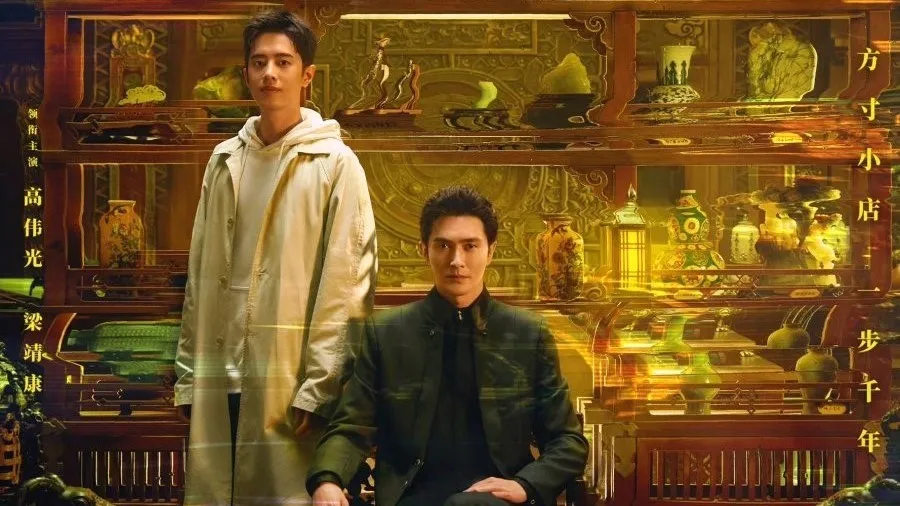
The Company Poster - Courtesy of Tencent Video

|
DetailsRATING: (7/10)
NATIVE TITLE: 哑舍 – Yǎ shě YEAR: 2025 EPISODES: 30 DURATION: 45’ DIRECTOR: Zhao Qi Chen SCREENWRITER: Wu Zhimo ORIGINAL CREATOR: Xuan Se (哑舍 – Ya She) |


IN A NUTSHELL
- What to expect: The Company is a drama that blends time travel, mystery, and historical adventure, following the protagonists as they investigate lost relics. With melancholic atmospheres, ambiguous clues, and tangled temporal threads, the series builds a rich world, with stories that balance tension, emotion, and lightheartedness.
- Strengths: historical accuracy, refined aesthetics, well-developed characters.
- Weaknesses: constantly melancholic atmosphere, slow narration, rhetorical dialogues.
- Recommended if you like: Gao Wei Guang and Liang Jing Kang, time travel, dark atmospheres and melancholic characters.
- Would I rewatch it? Yes.
Read on if you want to know my interpretation of the ending.
The Company‘s story unfolds like a suspended time, made up of eras brushing against each other, objects charged with memories, and predestined encounters. Between melancholy and wonder, the series constructs a journey that is not merely temporal, but profoundly emotional, questioning the meaning of life, memory, and the bonds that endure over time.
In this The Company drama review, I will guide you through its stories with a critical and attentive eye, focusing both on the aspects that work and the weaknesses that limit their impact. The goal is to understand whether this series truly succeeds in shaping time and feelings, leaving a positive and lasting impression on the viewer.
" 岂曰无衣?与子同袍。"
[How could I say I have no clothes? I share them with you; we wear the same cloak.]
Plot
Bi Zhi, a city planner from 3078, accidentally discovers an abandoned “Time Elevator”, a device capable of transporting people to any era, and decides to use it to escape the loneliness that oppresses him.
Thanks to the Elevator, he meets Qin Zi Yi, a young man from the Qin era, with whom he develops a deep friendship, but who soon dies in a fire sparked by internal family power struggles. Devastated by the loss, Bi Zhi attempts to use the Elevator to save him, but ends up creating space-time rifts that scatter the treasures Qin Zi Yi had collected across different eras.
To remedy this, Bi Zhi decides to recover the relics by posing as an antique dealer and use the Elevator to neutralize the energy anomalies they have developed. During his research, he meets Su Bei Lu, a young 21st-century vet who bears a striking resemblance to the deceased Qin Zi Yi.
Initially troubled, Bi Zhi tries to understand if there is a connection between the two, and in the process, he grows fond of the guy, agreeing to be accompanied by him in the search for the lost objects.
After facing numerous time travels and just as many dangers with him, it is time for Bi Zhi to return to his own time. However, the reappearance in 3078 of one of Qin Zi Yi’s heirlooms at the Fusheng Hall Auction House, suddenly throws the game back into perspective, prompting him to resume his investigation.

The Company Drama Review (No Spoilers)
The Company is a drama that blends mystery, adventure, and time travel, offering viewers a fascinating glimpse into vastly different eras and characters. The series blends melancholic tones with lighter moments, creating a narrative rich with emotional stories and immersive atmospheres that captivate and entertain, even if they can be a bit too dark at times.
Plot and Narrative Pace
The plot is permeated by a vague sense of sadness that defines the series’ emotional identity from the very first scenes. The narrative, especially in the first half of the drama, moves in a dark and restrained tone, building an atmosphere of loss that runs through each episode and leaves little room for tonal variation. The frequent recollections of the past, through emotionally charged memories, further reinforce this feeling of lingering melancholy, transforming it from a mere backdrop to a dominant element of the series. The result is a series that consciously chooses melancholy as a narrative theme, but in doing so, envelops the story in a uniform and consistently subdued tone.
In this context, the rare moments of lightheartedness and hilarity end up clashing significantly with the overall atmosphere, appearing more like artificial pauses inserted to provide a respite from the oppressive melancholy than as organic narrative developments.
This stylistic signature is also directly reflected in the narrative’s pace, which progresses at a slow and almost contemplative pace, making the drama at times tedious.
The protagonists traverse eras, encountering figures rich in stories, wounds, and emotions, but everything seems to pass without leaving a profound mark. Adventures follow one another, the characters recount their pasts with confessions filled with regrets, desires, and hopes, yet the narrative remains surprisingly flat, suffocated by a slowness that never becomes engaging and by a writing that struggles to give real weight to the events and feelings depicted, rarely offering genuine food for thought.
Even when the narrative addresses universal themes such as selfless love, resilience, hope for the future, or self-determination, the dialogues are rhetorical and full of clichés that cloak the narrative in a didactic tone. Each story thus arrives at a moralizing conclusion, devoid of the complexity capable of truly questioning the viewer. The result is a series that seems to observe human feelings and desires from afar, without ever truly delving into them, leaving the viewer with the feeling of having heard many stories but not being truly touched by any of them.
The drama’s episodic narrative structure, which betrays the original nature of the work by echoing the self-contained arcs typical of manhua and at times accentuating the sense of fragmentation typical of illustrated books, also proves to be one of the series’ strengths.
The stories set in different eras are distinguished by surprising variety, narrative realism, and a historical accuracy that lends them a certain solidity. The personal stories, though developed within limited narrative spaces, are consistent with the period and anchored in recognizable social and cultural dynamics, offering surprisingly realistic snapshots of life. In this sense, The Company succeeds in translating the logic of manhua to the screen, offering stories that, despite their brevity, maintain a strong sense of authenticity and verisimilitude.

Relationship Between the Protagonists and Script
Throughout the series, several clues are introduced about the connection between the protagonists, suggesting a deeper bond between them. However, these clues lack any real narrative weight and contribute to maintaining the two’s relationship ambiguous until the very end.
This, combined with the lack of any real emotional development between Bi Zhi and Su Bei Lu, prevents their relationship from truly taking on a central role, resulting in a narrative that progresses without fully exploiting the couple’s emotional potential.
The indecisiveness of the writing is also reflected in the overall flow of the story, which struggles to find a coherent balance between its various phases. A linear and rather banal beginning is followed by an overly dense and chaotic ending, which attempts to concentrate numerous events without managing to develop them coherently. While maintaining a slow pace, the story becomes progressively more confusing, with overlapping temporal and narrative threads that ultimately undermine the previously established order. The conclusion, while representing a happy ending, leaves a feeling of a hasty resolution and misleading compared to the initial direction of the drama.
Cast
Overall, the cast delivered a solid and balanced performance.
The naive and spontaneous performances of Liang Jing Kang, Zhang Chen Xiao, Dai Ya Qi and Zhang Miao Yi were particularly noteworthy, infusing a sense of lightness and freshness into an often overly melancholic story.
On the other hand, Gao Wei Guang‘s performance was far too restrained (almost more so than in Eternal Love of Dream), which slightly limited the emotional strength of his character.
Veteran actors Wei Zi Xin (extraordinary in The Prisoner of Beauty) and Yue Yang (memorable in Guardians of the Da Feng) delivered, as always, impeccable, ironic, and realistic performances, providing the audience with truly funny and comforting scenes.
Special praise goes to Dai Xiang Yu, an actor capable of seamlessly transitioning from antagonistic roles, as in Eternal Love of Dream, to more positive ones, as in When Destiny Brings the Demon, making his character compelling and believable in every nuance.
Finally, a special mention goes to the young Gu Zi Cheng, whose natural and poignant performance confirms the talent he already demonstrated this year in Flourished Peony, making him one of the most promising members of the cast.
Visual Aspects and Soundtrack
Visually, The Company‘s attention to aesthetics is evident and consistent. The cinematography employs a palette of desaturated colors and cool tones that envelop the narrative in a dark and subdued atmosphere. The historical settings, often marked by a sense of decadence and desolation, only reinforce this sense of pervasive melancholy, transforming the stage space into a visual reflection of the emotional state of the story.
Added to this is considerable sophistication in the construction of the sets and the selection of props, characterized by a believable historical coherence. This aesthetic congruence, while enriching the viewing experience, also helps to crystallize the evocative tone of the series, making sadness not only a narrative theme but a constant presence in every frame.
The soundtrack accompanies the narrative with a varied and engaging rhythm, alternating melodic and romantic pieces with more childlike, anime-esque pieces that cheer and capture the attention. The vocals of Yuning Song and Curley Gao add a touch of originality and personality, giving each musical theme a distinctive character that resonates with the viewer’s emotions. The result is a soundscape that manages to be fresh and engaging, perfectly in keeping with the genre of the original work.

WARNING!
FROM THIS POINT ON THE SPOILER SECTION BEGINS. DO NOT CONTINUE IF YOU DO NOT WANT TO KNOW ALL THE DETAILS OF THE DRAMA.
The Company Drama Review (Spoilers)
What Works: the Subplots
Among the most remarkable aspects of The Company is the quality of its stories set in the past, distinguished by a surprising realism and a historical accuracy that lends them depth and narrative consistency. Despite moving within short narrative arcs, the personal stories are profoundly relevant to the period and reflect the social and cultural dynamics of the time, offering the viewer authentic, believable, and immersive glimpses of life.
Making this mosaic even more effective is the refined interconnection between the various stories, which do not remain isolated episodes but interact with each other over time: the quest for the Wu and Kun blades intertwines the lives of Lu Feng and Xia Ze Lan, presented first in their youth and then in their adulthood, and is a prime example of how the drama builds a shared narrative logic.
This sense of continuity is further strengthened by the underlying theme of the Tianguang Market Warden, a coherent and carefully developed core arc that successfully ties together the independent stories, transforming them into a layered and surprisingly harmonious narrative universe.
What Doesn't Work: the Script and the Pace of the Narrative
As is often the case with science fiction, the drama’s main weakness is the vague and sometimes inconsistent contextualization of its sci-fi elements. First, the workings of the Time Elevator are never clarified: the series offers no plausible explanation for how an entire building can travel between different eras, nor how it could have physical locations in historical periods when the technology it relies on did not exist (and thus, who developed the dedicated arrival points remains a mystery).
Similarly, the ease with which Bi Zhi gains possession of it raises several questions: is it possible that the Temporal Bureau lacks time travel detection systems or sufficient controls to prevent the construction or use of “illegal” Time Elevators?
The Elevator’s function in neutralizing the energy anomalies of the objects recovered by Bi Zhi also remains ambiguous, as it is never made clear whether it is pre-existing technology or developed later to repair the damage caused by Bi Zhi. Added to this uncertainty is the very nature of the anomalies: while it’s understandable to imagine that the attempt to change the past has generated space-time fractures capable of dispersing Qin Zi Yi’s objects across different eras, it’s more difficult to explain why these objects have developed what are effectively “magical” powers.
Finally, the narrative also suffers from a certain temporal vagueness: it’s often unclear how much time the characters spend in the eras visited, nor how they manage to stay there without documents or local currency. All these elements, left unclear, ultimately weaken the internal coherence of the worldbuilding, giving the impression of a loosely constructed narrative universe that asks the viewer to accept pre-established rules without ever offering a true justification.
Throughout the narrative, the screenwriters scatter numerous clues about the possible connection between Bi Zhi and Su Bei Lu and their previous encounter, repeatedly suggesting the existence of a bond that will prove pivotal. These elements, seemingly intended to guide the viewer toward a hidden truth, are reiterated at the end, when the story is finally reconstructed in its entirety, and take on a completely different meaning than initially suggested. Precisely for this reason, over the course of the narrative, these cues end up proving more misleading than functional: instead of gradually bringing the protagonists—and the viewer—closer to the truth, they distance them, creating expectations that are then completely subverted.
The result is that the story would likely have worked better without these hints, since the final revelation not only renders them superfluous but retroactively downplays their value, transforming them into narrative detours rather than real tools for constructing the mystery.
Adding to this ambiguity is the lack of a decisive evolution in the relationship between the two protagonists: despite the constant expectation of the development of a strong feeling throughout the episodes, Bi Zhi and Su Bei Lu remain linked by interactions that are always rather tepid and static. Beyond their often-verbalized affection, the series fails to transform the scenes of emotional involvement between them into a true focal point of the story, once again leaving the feeling of narrative potential only partially exploited.
Another questionable aspect of the series is the choice to build an emotional identity strongly marked by sadness and regret from the beginning. Bi Zhi’s character is marked by a constant sense of grief that profoundly defines him and sets the pace of the drama.
His existence, marked by isolation and desolation before the discovery of the Time Elevator, gives the story a certain emotional weight, further aggravated by the perpetually melancholic and sorrowful attitude that accompanies him after the death of his friend Qin Zi Yi. In the initial episodes, this unresolved grief permeates every scene, dampening the overall mood of the narrative and leaving little room for a real shift in tone. Not even Su Bei Lu’s positive and dreamy energy can dent this opaque atmosphere: his optimism remains an isolated element, incapable of rebalancing a story that remains subdued for a long time, constantly moving in dark and subdued tones.
The feeling of loss is further heightened by the frequent flashbacks, in which Bi Zhi relives emotionally charged fragments of his friendship with Qin Zi Yi. These moments, designed to deepen the bond between the two, ultimately reiterate, scene after scene, a grief that has never been resolved. Likewise, Su Bei Lu’s constant regret for the loss of his parents and for not having been more understanding towards his late grandmother contribute to the story’s sad tone, making melancholy the dominant theme.

In this now-established atmosphere, in episode 16 the series introduces a sudden and bizarre shift in tone, unexpectedly shifting the focus to Chun Ge, Su Bei Lu’s childhood friend. Through his memories, we discover a character marked by a profound sense of inferiority toward his friend, born from the belief that he is weaker and less free. Thanks to Bi Zhi, this perspective shifts, as Chun Ge experiences a dreamlike adventure of wuxia inspiration, in which he becomes the hero capable of saving the jianghu. However, while this narrative arc contributes to Chun Ge’s character’s development, it also struggles to fit into the overall fabric of the series, appearing poorly aligned with the main narrative thread of the search for Qin Zi Yi’s relics.
This episode, along with similar ones like episode 25, in which Bi Zhi spends time with little Su Bei Lu to create happy childhood memories, conveys a marked sense of fragmentation: stories that, while functioning as autonomous units, struggle to connect with the central plot and end up feeling like filler episodes, inserted more to lengthen the running time than to significantly enrich the overall development of the central story.
Furthermore, the almost predictable linearity of the initial episodes is sharply contrasted by the chaotic nature of the final five, which seem to try to condense more events than the narrative can actually support. While maintaining its phlegmatic pace, the story suddenly becomes more confusing than engaging: events and timelines intertwine in a whirlwind of leaps between past, present, and future, in which Bi Zhi’s investigations end up overlapping with the memories of his antagonist Ye Liang Yin, while the reconstruction of the numerous temporal crimes at the Fusheng Hall Auction House gets lost in the stories presented in previous episodes.
The result is a finale that struggles to hold its narrative threads together, relying on a quick and almost hasty resolution that seems to ignore the “time travel” factor. The timelines are eventually restored and the lives shattered by the actions of Fusheng Hall are restored (including those of Su Bei Lu’s parents), but the outcome for Bi Zhi remains unchanged: the revelation that Qin Zi Yi did not die because of Fusheng Hall but poisoned himself to protect those dear to him, and that there was no real connection between him and Su Bei Lu, retroactively empties much of the story of meaning, leaving the feeling of a dissonant ending that is inconsistent with the story’s premises.
Interpretation of the ending
The finale of The Company ends on a happy note, revealing a finally bright present: Su Bei Lu is at peace, fulfilled, surrounded by his lifelong friends, and his life seems to have found its balance. A scene charged with emotion bursts into this reassuring daily routine: a chance encounter with Bi Zhi, who asks him for directions right outside the bar where they first met. The two don’t recognize each other, they have no memory of what they shared, but an invisible connection hovers between them, as if something deeper continues to draw them together.
The meaning of this epilogue remains open to various interpretations, which I have attempted to articulate more or less coherently. The final scene of episode 30 could suggest that, as a reward for his contribution in dismantling Fusheng Hall, the Temporal Bureau has allowed Bi Zhi to continue using the Time Elevator, or even to join the organization as an agent; Or, conversely, that the bond between Bi Zhi and Su Bei Lu is so strong and predestined that it has resisted even the restoration of temporal order, pushing Bi Zhi to once again take possession of the Elevator, eluding all control, and find himself in the very era and city of Su Bei Lu.
However, a sense of incompleteness remains linked to the event that gave rise to the entire story: Qin Zi Yi’s death was dismissed with surprising swiftness, without offering the viewer any explanation or clear clues as to a possible real connection between him and Su Bei Lu. This narrative silence is perplexing, especially considering that, if Bi Zhi had actually used the Elevator after his memory was erased, nothing would have prevented him from meeting Qin Zi Yi again and attempting to save him again, unaware of the consequences such an act could have on the continuity of space and time.
This leads me to conclude that Bi Zhi did not actually have his memory completely erased and that he most likely became an agent of the Temporal Bureau.

Characters and Cast
Primary Characters
Bi Zhi/Bai Qiong Yu (Gao Wei Guang) antiques dealer and owner of the Ya She shop (The Antique Shop). He is actually a city planner from 3078 who, by chance, discovers an abandoned “Time Elevator,” a device capable of transporting people to any era, and decides to use it to escape the loneliness of his days. Following the death of his friend Qin Zi Yi, he uses the Elevator to try to save him, but ends up creating space-time rifts that scatter his friend’s treasures across different eras. The Temporal Bureau then tasks him with traveling through time to find the lost relics, and thus he meets Su Bei Lu. In the Magic Sword Sky arc, he is the Sword Immortal.
Su Bei Lu/Qin Zi Yi/Liujian Hermit (Liang Jing Kang), 21st-century doctor working at the Chongle Pet Hospital in Ninghai. He bears a striking resemblance to Qin Zi Yi, a young scholar from the Qin era, who tragically died in a fire caused by internal power struggles within his clan. In the Magic Sword Sky arc, he is the da shixiong of the Cangqiong Sect.
Miao Tong (Zhang Miao Yi) Warden of the Tianguang Market, a place located in a temporal rift where the concept of time no longer exists. She was originally a dweller of the Miao Village during the Wanqi era. After accidentally entering the Tianguang Market, she managed to escape thanks to her ability to see temporal portals due to her rare temporal calculation talent. For this reason, she was recruited by the Temporal Bureau and convinced to become the Warden of the Tianguang Market.
Chun Ge (Zhang Chen Xiao) Su Bei Lu’s childhood friend who works with him at the Chongle Pet Hospital. In the Magic Sword arc, Sky is the shidi of Su Bei Lu and Min.
Ren Xiao Min/Min (Dai Ya Qi) friend of Su Bei Lu and Chun Ge who works with them at the Chongle Pet Hospital. In the Magic Sword Sky arc, che is the daughter of Tang Yan Sheng and the da shijie of the Cangqiong Sect.
Supporting Characters
Doctor Su Hua Bin (Li Jin Rong), renowned surgeon and father of Su Bei Lu, who died in a car accident in 2005.
Fang Lin Lin (Sun Shuang), nurse, mother of Su Bei Lu, who died in a car accident in 2005.
Chen Feng Ying (Xu Mei Ling), Su Bei Lu’s grandmother and owner of the small Fengyin convenience store. She took care of her nephew after his parents died in a car accident in 2005.
Manager Bao/Bao Wu Ji (Yao Yi Qi), director of the Changle Pet Hospital. In the Magic Sword Sky arc, he is the guardian of the Tianlong Sect and his secret technique is the Purple Toad Skill.
Doctor Tang/Tang Yan Sheng (Wei Zi Xin), Su Bei Lu’s mentor at the Chongle Pet Hospital. In the Magic Sword Sky arc, he is the leader of the Cangqiong Sect, one of the five major sects in the game.
Chu Qiu (Wang You Jun) Chief Guard of the Luoxia Mansion in the Tianguang Market. He is actually a supervisor of the Temporal Bureau, tasked with providing support to the Warden.
Cai Wei (Tan Xiao Fan) Qin Zi Yi’s personal maid.
Huo Shu (Fu Lei) servant of the Qin family.
Mr. Dong (Yue Yang) antiques dealer from Ninghai who sells Bi Zhi the Nameless Sword forged by Ou Ye Zi for the King of Yue, Gou Jian.
Li Yan Sheng (Gu Zi Cheng), known as the Wind-Chasing General, is the general of the elite cavalry who commands the Wind-Chaser Battalion and protects the city of Mo. The heart-protecting mirror that is part of his armor is the Yuwen Mirror, an object capable of connecting him to the 21st century.
He Yi Yao/Yao Yao (Tang Meng Jia), paraplegic girl from the 21st century, communicates with Li Yan Sheng through the mirror Yuwen and, with his help, overcomes her depression.
Mrs. He (Chen Yi Sha), Yao Yao’s mother.
Xia Ze Lan/A’Lan (He Yu Hong), young woman from the Qinglong era who worked as a cook at the Guangling Mansion in Lin’an before being transported to the Tianguang Market. During her stay, she meets Lu Feng and the two fall in love. Before returning to her era, she gives him the Wu Blade as a token of love, keeping the Kun Blade for herself. However, things do not go well in her era, and she ends up poor and forgotten in the mountains until Bi Zhi, Su Bei Lu, and Lu Feng appear to reclaim the Kun Blade.
Lu Feng/A’Feng (Dai Xiang Yu), 21st-century art student who, in 2009, inexplicably finds himself in the Tianguan Market. During his stay, he meets Xia Ze Lan and falls in love with her, so he decides to return with her. To do so, he hijacks a barge carrying Su Bei Lu and attempts to cross the fog of the Wangchuan River, which is said to have the power to connect the Tianguan Market to the outside world. His plan fails, and Xia Ze Lan disappears. When he returns to his own time, he remembers nothing of the Tianguan Market, but thanks to the Wu Blade given to him by A’Lan, he becomes a successful sculptor. When his career declines, he recalls the time he spent at the Tianguan Market with A’Lan, so he decides to retreat to where it all began, hoping to relive those moments.
Na Na (Zhang Ying Bing) 21st-century influencer and girlfriend of Lu Feng who, after being snubbed by him, decides to take revenge by ruining his career.
Chan Er (Peng Si Qi | Li Jia Qi), orphaned girl who lived in the town of Dongting during the Tiancheng Era. She finds the Renyu Candle and, by lighting it, frees A’Nuan. Thanks to the woman’s help, the little girl manages to reach adulthood and is hired as a washerwoman at the Zuichun Pavilion, where she meets Jiang Ling.
A’Nuan (Zhu Da Dan Er), spirit of a thousand-year-old mermaid from Dongting Lake imprisoned in the Renyu Candle. Chan Er frees her by lighting the candle. In reality, she is the personification of the girl’s hope and resilience, helping her overcome adversity and reach adulthood.
Jiang Ling (Zhu Zhi Ling), young nobleman who saves Chang Er from a sexual assault and invites her to the Liuyun Poetry Gathering at Dongting Lake. He is actually the owner of several brothels, including the Zuichun Pavilion, and Chang Er discovers he is particularly cruel to the girls and servants who work for him.
Yan Yan (Han Jia Hui), courtesan at the Zuichun Pavilion, who tries to escape Jiang Ling’s control by running away with her lover. After a few days, however, she is tracked down and her hands are chopped off.
Gu Huai Jin (Ding Xiao Ying), daughter of the owner of the Gu Escort Agency in Qinghe, murdered by a group of bandits during an escort service. In reality, it is her older brother who is killed in the ambush, and she assumes his identity using the Liuqing comb.
Gu Bing Yu (Peng Chu Yue), Gu Huai Jin’s older brother, who took over the escort agency after the death of his father, Gu Xuan Tong. In reality, he dies during an escort service and, before passing away, entrusts his sister with the Liuqing comb, which can reverse yin and yang, allowing her to impersonate him and take over the family business.
Pu Jing Tang (Ji Xiao Fei), scholar, guest of the Gu family and Gu Huai Jin’s teacher. He is secretly in love with her.
Du Wen Hua (Wang Jian Guo), former prefect of Changzhou. While in charge, he had embezzled relief funds, but the imperial authorities, suspicious of him, demanded he produce the prefect’s accounting books. He entrusted the books to the Gu escort agency and, en route, had them attacked by a group of assassins, resulting in the death of Gu Bing Yu.
Du Xun Fu (Li Bo), Du Wen Hua’s adopted son. Gu Huai Jin infiltrates the Du Residence for his son Lian’s wedding and, posing as the bride, manages to kill Du Wen Hua.
Xiao Zhao (Liu Ya Peng), Prince Guangling.
Sun Zhi Yun, Prince Guangling’s first wife, killed by her sister to take her place.
Sun Zhi Xuan (Liang Ai Qi), Sun Zhi Yun’s younger sister and second wife of the Prince of Guangling.
Yan Rong (Lv Xiao Yu), Sun Zhi Xuan’s granddaughter, appointed County Princess by the Emperor to marry the ruler of Da Wu in place of one of his daughters. In reality, she is the granddaughter of Xia Ze Lan, daughter of Xia Ze Lan’s late son, who was adopted by Prince Guangling after the death of his true heir.
Long Zhen Tian (Liang Liang), leader of the evil Tianlong Sect in the Magic Sword Sky arc
Master Shi (Natas Asoka), leader of the Linglong Sect, one of the five major sects in the Magic Sword Sky game.
Master Qiao (Cui Li Ming), leader of the Youyou Sect, one of the five major sects in the Magic Sword Sky game.
Master Lu (Guo Ye), leader of the Langya Sect, one of the five major sects in the Magic Sword Sky game.
Master Ye, leader of the Qinghe Sect, one of the five major sects in the Magic Sword Sky game.
Yu Benxiao/Yu Lao (Zhang Qi), elderly owner of the Yuzhuang art gallery, with whom Bi Zhi had contact in the past and which he had financed.
Wu Yu Nong (Wang Yi Yao), singer from 1920s Yuzhou and goddaughter of Yu Benxiao.
Wei Zhuo Ran (Song Han Yu), doctor and Wu Yu Nong’s husband.
Pan Jing Ting (Luo Er Yang), Yuzhou textile tycoon and longtime friend of Yu Benxiao.
Pan Yun Zhe (Shen Hao), inept son of Pan Jing Ting.
Hong Chi (Zhang Jia Hang) and Hong Lie (Du Yi Heng), the sons of Yu Benxiao’s late cousin, run the Hong School, the largest martial arts school in the Yuzhou area.
Yu Xiu Yun (He Tian Tian), Yu Benxiao’s daughter, died in a shipwreck while fleeing to the West with her lover Zhou Ming Xuan. Although she knew that Ming Xuan was married with a son, she decided to accept his advances and set out with him for the West.
Zhou Ming Xuan (Zhang Xiang), Pan Jing Ting’s business partner, he fell in love at first sight with Yu Xiu Yun. Despite being married and having a son, he had fallen madly in love with Yu Xiu Yun and decided to leave China and flee with her to the West. Unfortunately, the ship on which he and his lover were traveling sank, leaving his son orphaned and his wife in financial difficulty.
Chong Yang/Xiao Ta Pi, son of Zhou Ming Xuan, adopted by Yu Benxiao after his father’s death due to his family’s financial difficulties.
Cao A’Ning (Wen Xi), new housekeeper of the Yu Residence. In reality, her identity was assumed by Ye Liang Yin on a mission in the 1920s to recover an item to sell at the auction house.
Gu Zhi Qian (Fei Qi Ming), author of the painting “Autumn Clearing,” painted on a piece of Liangzhu plain silk that belonged to Qin Zi Yi. He was the heir to the wealthy Gu family of Gusu, who suddenly found himself in financial difficulty after the collapse of his family and died of depression after failing to pass the imperial examination. His paintings were very refined, but because of his sad history, they were considered unlucky, so no one of his time wanted to buy them.
Wei Wei (Li Shu Man), courtesan whom Gu Zhi Qian meets by chance while trying to escape his father and who falls in love with him at first sight.
Zhao Wan Li (Yu Jin Wei), scholar who lived 100 years after Gu Zhi Qian, and comes into possession of an unfinished “Autumn Clearing”. Through the painting, he begins to communicate with the original painter, forming a deep friendship with him.
Ran Zhou Er (Liu Meng Meng), owner of the Sanqianzui Tavern, who has always been in love with Zhao Wan Li and takes care of him.
Lin Zhong (Ma Xiao Qian), artist whom Bi Zhi, Su Bei Lu, Chun Ge, Ren Xiao Min, and Mr. Dong met during their vacation on Xiasha Island and who hosted them at his seaside guesthouse.
Ye Liang Yin (Mao Xiao Hui) Chief Auctioneer at Fusheng Hall Auction House.
Li Yun (Xu Ling Ruo), specialist at Fusheng Hall Auction House. She is Ye Liang Yin’s assistant.
Li specialist on the Fusheng Hall operations team. He assists Ye Liang Yin in recovering artworks from various historical periods.
Shi Yi (Roy Wang), Operations Team Leaderof the Fusheng Hall when Ye Liang Yin was hired (10 years earlier). He seduced Ye Liang Yin into revealing the location of the 2005 warehouse so he could steal Qin Zi Yi’s Dushan jade, which he then attempted to resell at various times.
Tuan Zi, Labrador puppy adopted by Su Bei Lu at the veterinary hospital because he was mistreated by his owner.

Favorite Character: Su Bei Lu
He is a young man with a profoundly optimistic, cheerful, and resilient personality.
Despite a childhood marked by the premature death of his parents and difficulties that could have led him to withdraw or become resentful, he manages to maintain a contagious spontaneity and a sincere faith in life. In the face of obstacles, he neither gives up nor takes refuge in self-pity, preferring to seek concrete solutions and look forward with determination.
His most vulnerable side emerges in his memories of the grandmother who raised him: he often reproaches himself for not having been affectionate and understanding enough with her, realizing only now that her absences were the price she paid to run the small convenience store that ensured their survival and his college education. This sense of regret contributes to his character being perceived as extremely human and deeply empathetic.
Generous and sensitive, he demonstrates his worth both through his actions and his relationships: he saves the Labrador puppy Tuan Zi from an abusive owner and proves himself a loyal friend, offering his friendship to the shy and awkward Chun Ge when no one else would, which helped his friend grow and believe in himself.
For Bi Zhi, too, he represents a precious presence, capable of broadening his emotional horizons, alleviating his disillusionment, and guiding him out of the profound state of loss into which he had sunk after Qin Zi Yi’s death.
Un-Favorite Character: Manager Bao
He is an authoritarian and unpleasant figure, characterized by a marked obsession with control and a punctilious, narrow-minded attitude that renders him incapable of empathy. Obsessed with rules and discipline, he systematically punishes the protagonists even for minor infractions such as slight tardiness, demonstrating a rigid and punitive management of the veterinary hospital.
His pettiness is evident when he fires Su Bei Lu, guilty solely of being excessively forthright in reporting the mistreatment inflicted on Tuan Zi by her former owner, preferring to uphold apparent formal correctness over justice or animal welfare.
Even faced with an unsustainable workload, which overwhelms the entire medical staff, he proves incapable of assuming real responsibility: instead of offering concrete solutions, he shifts the burden onto vets and collaborators, and when forced to rehire Su Bei Lu, he attempts to negotiate down his salary in the sole interest of the hospital.
His opportunistic and servile nature emerges even more clearly in the Magic Sword Sky story arc, where he appears as a member of the evil Tianlong Sect: here, after attempting to eliminate the protagonists, he immediately bows to Chun Ge’s superiority, abandoning all arrogance and acting with deference, revealing himself to be a character devoid of true moral strength and driven solely by convenience.
RECOMMENDED:
- CROSS FIRE
- AN ANCIENT LOVE SONG
- MOBIUS
- THE SEVEN RELIC OF ILL OMEN
- TWELVE LETTERS
Thanks for reading this far!
I hope you enjoyed my article. If you like my work and want to support me, buy me a coffee ☕