
Seeds of Scarlet Longing (2026) Chinese Drama Review | Plot & Cast
Seeds of Scarlet Longing Poster - Courtesy of Hunan TV

|
DetailsRATING: (7/10)
NATIVE TITLE: 在你眉梢种红豆 – Zài nǐ méishāo zhǒng hóngdòu YEAR: 2026 EPISODES: 24 DURATION: 20’ DIRECTOR: Deng Zhan Neng SCREENWRITER: Zhao Lin RESPECTED CLICHÉS: 1 - 3 – 4 – 5 – 6 – 7 – 8 – 9 – 11 |


IN A NUTSHELL
- What to expect: Seeds of Scarlet Longing is a fantasy drama in which passion and desire are not just side elements, but become the true fulcrum of the story. The protagonists share the burden of a curse that forces them to get closer every time the full moon rises, and it is precisely this imposition that leads them to truly get to know each other, breaking down a prejudice that has held them prisoners of mutual hatred for twelve years and slowly making room for the birth of a genuine and profound feeling. Acting as a counterpoint to this captivating love story is a gripping plot of political intrigue, betrayal, and deception that helps make the series engaging to follow, as well as beautiful to watch.
- Strengths: the characterization of the female protagonist, the love stories, the very refined aesthetics.
- Weaknesses: the characterization of the male protagonist, the small inconsistencies typical of short dramas.
- Recommended if you like:Zheng Ye Cheng's martial arts skills and striking physique, naive yet seductive female protagonists, enemy to lovers dramas, stories of female empowerment.
- Would I rewatch it? Yes, as a little indulgent watch between between longer dramas.
Read on, to find out if this drama is right for you.
Seeds of Scarlet Longing is a story where passion does not arise spontaneously, but originates from a bond, a legacy, a necessity that makes it both irresistible and disturbing. The story between Liang Jiang Zhu and Shen Mui constantly treads a delicate balance, oscillating between the sweetness of a feeling seeking space to exist and the almost tragic urgency that condemns it to haste, transforming every encounter into something feverish, every choice into a gamble.
In this review of the drama Seeds of Scarlet Longing, I will attempt to analyze precisely this emotional tension, in an attempt to understand its narrative effectiveness and to understand how this series is capable of engaging the viewer in a sensorial experience, capable of leaving a lasting impression even beyond its inevitable technical limitations.
" 红豆生南国,春来发几枝。
愿君多采撷,此物最相思。"
[Red beans grow in the southern lands, and in spring, how many branches will sprout.
I hope you harvest many of them: they are the symbol of nostalgia.]
Plot
Liang Jiang Zhu is a Jade Waist Slave who lives with her thirteen "aunts" and their husbands in the Hundred Illusions Realm, hidden deep within the Luoxia Forest.
On the eve of her eighteenth birthday, she is still searching for the child who saved her life twelve years earlier. Only by finding him and making him her Jade Gentleman will she survive the first full moon, when the Bone-Freezing Curse, which threatens to kill her, will be activated.
During this search, however, she encounters Shen Miu, Prince and General of Yan, who has been searching for years for the Jade Waist Slaves: his goal is to exterminate them because they're believed to be responsible for the Crown Prince's death.
After a violent clash, Jiang Zhu unwittingly infects him with the Love Sickness Gu, a parasite that binds the infected person to the one who infected them, ultimately leading to death unless they share the same feelings.
Determined to exploit the situation, Jiang Zhu forces him to spend the night of the full moon with her. Finding a symbol identical to her savior's on his body, she is convinced she has finally found her "little auspicious cloud". Therefore she follows him to the capital, unaware that Shen Miu only wants to rid herself of the Gu.
At the Prince's residence, Jiang Zhu meets the kindly Qin Zhao Hua and her shady Crown Nephew Shen Yu Heng, who attempts to expose her to embarrass his uncle, and whom she recognizes as her true savior.
Over time, Jiang Zhu wins everyone's affection, especially Shen Miu's, who ends up falling in love with her, shortly before her aunts find her and erase all memories of him.
Despite this, Shen Miu manages to find her and, to win her back, he agrees to help her clear the name of the Jade Waist Slaves, who not only had nothing to do with his brother's death but actually fought for the kingdom.
Together with Jiang Zhu, Zhao Hua, and Yu Heng, Shen Miu uncovers uncomfortable truths about a mystery that someone at court seems determined to keep hidden, and finally brings justice to Jiang Zhu's mother.

Seeds of Scarlet Longing Drama Review (No Spoilers)
Plot and Narrative Pace
Seeds of Scarlet Longing is a drama with a rather engaging plot, even if it takes shape in a narrative context with blurred contours, where the political dimension remains distant and summarized by a few essential signs—an Emperor consumed by illness, a prince fighting wars against a people whose customs evoke a generic "Northern." In this world that cannot be fully grasped, the narrative is therefore forced to veer elsewhere: towards family entanglements, court alliances, the sudden rifts that reshape the relationships between the characters. Completing everything is the supernatural element, which does not simply intervene, but gives the story an inevitable direction, like a silent force that guides everything.
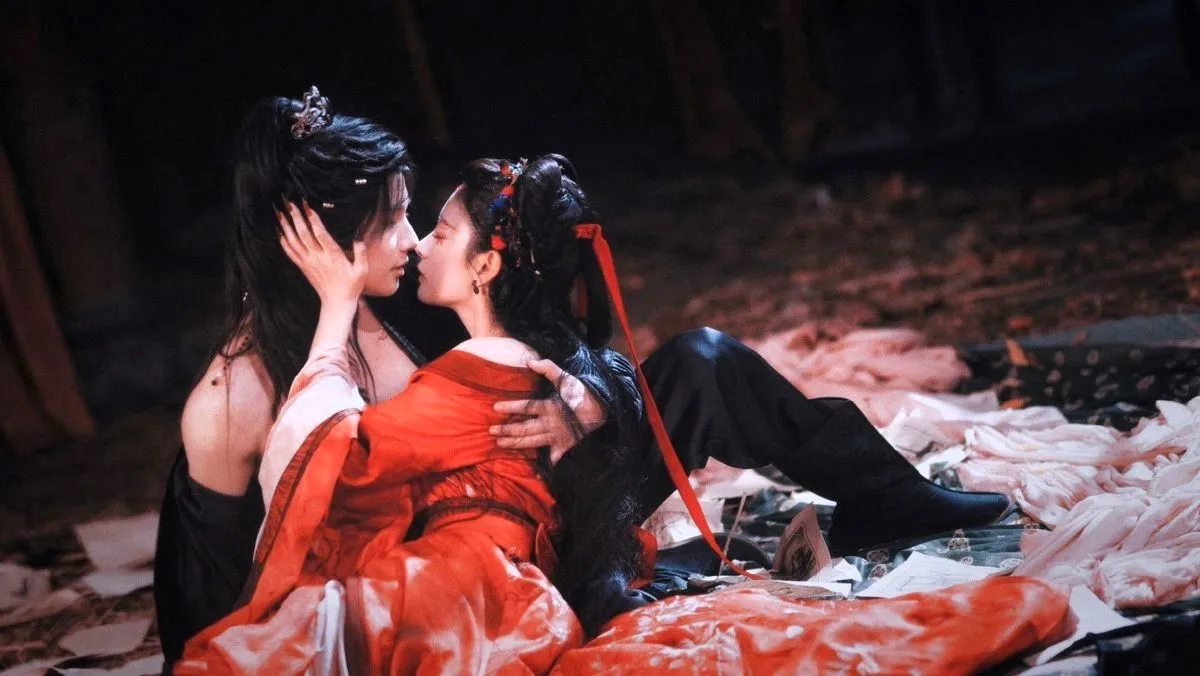
At the heart of the story remains, undoubtedly, the curse: a bond that forces the two protagonists to seek each other out, to draw closer, to repel each other, transforming desire into necessity and contact into something ambiguous, never fully chosen. It's in the restrained tension between attraction and rejection, effortlessly conveyed by two actors capable of making that constant oscillation tangible, that the series finds its most convincing balance.
Around them, the story moves quickly, even if some passages feel rushed, at times almost sacrificed, but without truly compromising the overall flow, which remains solid and free of obvious gaps. This structure represents the classic limitation of the short format, but also, at times, its hallmark: what's missing is suggested, or left to the viewer's imagination.
The dialogues follow this same pattern: they don't seek refinement and avoid emphasis, maintaining a tone that accompanies without weighing down, leaving room for what remains to be said. And, beyond a surface that might suggest yet another fantasy story of passion and curses, the drama also attempts to construct a discourse of female empowerment: here, women not only support and protect each other, but even take on the responsibility of defending the kingdom when the men become lost in fruitless power struggles.
In this complex scenario, however, the constructed tension doesn't always find a fully coherent form: the narrative sometimes indulges in naive idealism, in conciliatory solutions, in sudden softenings, in reconciliations that arrive too quickly. However, given the nature of the project and the absence of a major literary reference work, these are almost inevitable compromises, which don't prevent the story from remaining enjoyable and, at times, surprisingly effective. It is also from these cracks that the essence of the story emerges, which doesn't aspire to complexity but rather to immediate, emotional, almost instinctive engagement.
Characters
The characters are perhaps the strongest element of Seeds of Scarlet Longing: well-defined figures, recognizable in their precise identities, who become the true driving force behind the plots and tensions that run through the story.
I particularly appreciated the way the drama builds their internal contrasts: Shen Miu, with her unwavering integrity and military coolness, occasionally allows an unexpected tenderness to filter through; Jiang Zhu, seemingly driven by a naive, almost disarming spontaneity, instead reveals a clear and fierce determination when it comes to protecting those she loves.
Even the most ambiguous characters maintain their emotional coherence: Yu Heng, with his malice and calculated intelligence, is never stopped being guided by his genuine and profound feelings for Zhao Hua, who, in turn, embodies a simple and luminous form of loyalty, capable of attracting and disarming anyone who approaches her. Around them, the world is populated by presences that are rarely decorative: Jiang Zhu's combative "aunts", lively and supportive; Shen Miu's housekeeper —both a figure of authority and a maternal refuge — and even the antagonists, never entirely gratuitous in their actions, but driven by understandable, if not always noble, reasons.
It is precisely in this chorus that the drama builds credible relationships and tensions that, even when the plot accelerates, continue to leave an impression of coherence and balance.

Cast
As for the cast, Seeds of Scarlet Longing ranks, in my opinion, at an average to high level for a minidrama, thanks in large part to a talented and professional cast of protagonists.
Cheng Ye Zheng, a wuxia veteran, remains a top choice for period action dramas, and his screen presence is hard to ignore, both in terms of his martial arts skills and his physical prowess. Despite the progress he's made since his debut, his acting is still not entirely refined, especially his diction, and I still sense a slight dissonance in his portrayal of the soldier, too prone to emotional surrender, as I had already noted in Brocade Odyssey.
On the other hand, Zhao Qing captivates with a charm and disarming naturalness (which I already appreciated in Les Belles): her Jiang Zhu is both naive and subtly seductive, a combination that works surprisingly well, although I can't help but note with some surprise her choice to return to a role so openly based on seduction after her recent involvement in the Xu Kai scandal.
Deng Xiao Ci, for his part, confirms an almost natural predisposition for ambiguous characters: there's something in his presence that perfectly suits Yu Heng's controlled malice, and even in his journey of redemption, he manages to maintain a certain coherence.
A pleasant surprise was newcomer Fu Dong Nuan, who imbues Zhao Hua with a composed grace and an acting style that never slips into obscurity.
Around them, the supporting cast helps give depth to the story: Lily Wang portrays a solid and reliable Qing Niang, while the actresses playing Jiang Zhu's "aunts" convey with energy and conviction a sense of femininity that is both combative and supportive.
Finally, Zhao Chang Ke, as Shen Yu Heng's servant, becomes a sort of ironic mirror for the viewer with his awkward reactions and embarrassed silences in the face of the protagonists' nonchalant behavior.
Visual Aspects and Soundtrack
Visually, the drama surprises with a care rarely expected from a minidrama: the direction displays clear cinematic ambition, and some shots—through composition and spatial management—truly convey the sense of a broader language, uncommon in short films. The use of the 16:9 aspect ratio is not just a technical choice, but a decidedly aesthetic one: it broadens the view, provides depth, and betrays a clear desire to transcend the limited "serial" dimension. This tension is supported by particularly inspired cinematography, featuring soft lighting and evocative color palettes that at times recall productions with much higher budgets.
The costumes also contribute to building a broader imagery: without relying on highly valuable materials, they manage to be highly scenographic, almost designed to etch themselves into the memory rather than adhere to historical realism. The makeup, especially Zhao Qing's, works in the same direction, with a refinement that suggests a magical, almost fairytale dimension. The women's hairdos, elaborate and harmonious, complete this visual construction with a certain elegance, while the men's hairdos—though fascinating in their lines and style—at times betray the more economical nature of the production: the wigs, in particular, reveal their artificiality, barely breaking the illusion that the rest of the staging manages to sustain with surprising coherence.
Musically, the soundtrack for Seeds of Scarlet Longing doesn't stray far from the now-codified soundscape of romantic dramas: slow, enveloping melodies, crafted to accompany and amplify the emotional intensity of the most gripping scenes. It's a choice that works, but it rarely leaves a truly recognizable mark: even in this case, in fact, it's the quality of the performers that stands out more than the originality of the compositions.
I must confess that, of all the songs, the one that convinced me the least was 暗香浮動 (A Faint Fragrance Wafts) performed by Zheng Ye Cheng: although it fits perfectly into the emotional register of the series, I found it too predictable and his interpretation, although technically correct, seemed less engaging than the others.

WARNING!
FROM THIS POINT ON THE SPOILER SECTION BEGINS. DO NOT CONTINUE IF YOU DO NOT WANT TO KNOW ALL THE DETAILS OF THE DRAMA.
Seeds of Scarlet Longing Drama Review (Spoilers)
What Works
The Love Stories
If there's one aspect that defines the stylistic hallmark of Seeds of Scarlet Longing, it's undoubtedly the sentimental one: while it's not the drama's only compelling element, the love stories between the two main couples remain, predictably, the true focus of the story.
The relationship between Chen Miu and Jiang Zhu is the one that captures the most immediately, sustained by a palpable chemistry and a passion that, though born under duress, ends up overwhelming them both with an almost uncontrollable force. It's difficult, as a viewer, to remain indifferent to the passion with which he abandons himself to her in episode 2, as well as the more affectionate but no less intense sweetness with which, in episode 11, he reassures her that he doesn't desire anyone else during the night the bone-freezing curse manifests itself: these are moments in which the series seems to find an emotional truth that represents its highest point.
At the same time, the dynamic between Shen Yu Heng and Qin Zhao Hua operates on a different, yet equally engaging, register: less overwhelming, perhaps, but more subtle, constructed through the malice, strategies, and petty deceptions with which he attempts to get closer to her. Despite the misunderstandings generated by his obsessive comparisons with his uncle, the bond between the two is clear from the beginning, rooted in a shared past that lends credibility to the depth of Zhao Hua's feelings, which are never truly shattered even when faced with the prince's more ambiguous sides. Even when the narrative introduces confusing elements—such as the revelation identifying him as Jiang Zhu's savior, or the momentary, more toxic decline in their relationship in episode 12—their interactions maintain a lively, almost magnetic tension, which inevitably pushes one to take their side.
It is in these relationships that the drama truly manages to hold the gaze and build an engagement that, however casual, remains difficult to ignore.
The Character of Liang Jiang Zhu
In the narrative mosaic of Seeds of Scarlet Longing, the character of Jiang Zhu turns out to be the pivot around which everything ultimately revolves.
Her presence doesn't simply occupy center stage: it sets the tone, lending credibility to a story that constantly oscillates between the fantastical, the sensual, and the lighthearted. Her characterization — naive, spontaneous, almost disarming in its total absence of malice — becomes the key that allows the story to never truly slip into excess, to temper a plot that, given its premise, could easily risk being too explicit. It is precisely this innocence, presented as a form of childlike purity, that creates a breathing space—at times even comical—within the narrative.
What is most interesting about her is the way her trust in others acts as a transformative force: Jiang Zhu doesn't just evolve personally, she changes those around her. It is through her open, unsuspecting gaze that the other characters find a chance for growth — rigidities are broken down, resentments are eased, and glimpses of redemption appear that would otherwise remain closed, stifled by family and moral constraints.
In this sense, the theme of female empowerment also takes on greater depth. This is evident in her relationship with Zhao Hua, which effortlessly overcomes romantic rivalry to transform into a bond of respect and support. It is further strengthened in the story of the Jade Life Slaves and Jiang Zhu's mother, which conveys a female cosmology of resistance and sacrifice. It is a narrative thread that, while not developed with the same force, emerges immediately after the romantic events, becoming one of the drama's cornerstones. And, ultimately, it is precisely thanks to Jiang Zhu that all of this manages to take shape without feeling forced.

What Doesn't Work
The Character of Shen Miu
The element that most disrupts the balance of Seeds of Scarlet Longing is undoubtedly the character of Shen Miu, not so much for his role in the plot, but for the ambiguity of his construction.
His story, while consistent with the structure of the drama, seamlessly fits into the most stereotypical trope of the genre's protagonists: an orphan scarred by the early loss of his mother, raised in the shadow of a hostile father, forced from childhood to join the army, isolated within his own family and recognized only on the battlefield. An archetype that, in itself, might even work, if it weren't burdened by a characterization that swings too abruptly, making it difficult to grasp any real internal coherence.
It is especially in his relationship with Jiang Zhu that this discontinuity emerges most clearly: his ostentatious moral correctness toward what should be his enemy clashes with his previous behaviors, which the narrative almost seems to erase, as if the character were rewriting himself from scene to scene. In moments when he could exploit his advantage, his first thought is "I cannot act disrespectfully toward a woman," almost forgetting that during their first meeting, the curse had forced them into intimate, albeit involuntary, physical contact.
This inconsistency is repeated in his reaction to his own transformation: after accidentally drinking Jiang Zhu's blood, Shen Miu becomes an uncontrolled beast, behaving similarly to the Jade Waist Slaves he has always hated. But instead of giving in to his animalistic fury, effectively marking Jiang Zhu's estrangement, he allows himself to be calmed by the girl's embrace and ends up crying in her arms like a frightened child. I smiled and was simultaneously perplexed: is a hug really the most effective way to bring a man who has lost his humanity back to reason?
But what is most perplexing is the speed with which Shen Miu abandons his most deeply held beliefs. After years of hostility toward the Jade Life Slaves, fueled by the death of his older brother and pressure from his father, and despite the military discipline that has accustomed him to rigor and to accepting punishment for even the smallest mistakes, a glimmer of naiveté and sincerity in Jiang Zhu is enough for all hostility towards her to disappear completely. His surrender to his feelings appears more like a sudden surrender than an emotional evolution, and Shen Miu effectively becomes Jiang Zhu's love slave, on a par with the Jade Gentlemen he had always despised. In this way, the narrative sacrifices psychological coherence and character credibility on the altar of romantic tension, and although his actions still work on an emotional level, they leave behind more disbelief than approval.
Small Narrative Inconsistencies
Like many fantasy dramas — and even more so short-form ones — Seeds of Scarlet Longing suffers from a series of small inconsistencies that don't really compromise enjoyment, but at times leave a slight sense of perplexity. This is due to the fact that, in an attempt to maintain a rapid pace, the writers indulge in shortcuts that sometimes require a slightly overly generous suspension of disbelief from the viewer.
I'm thinking, for example, of the ease with which Jiangzhu and Shen Yuheng manage to locate the entrance to Shen Miu's secret prison, or the naive way in which Yu Heng avoids detection by hiding in a random cell under a simple blanket: a functional solution, certainly, but difficult to accept without reservation.
Other times, the staging itself pushes the envelope, as in the Flower Festival sequence, which reminded me — not without a smile — of the endless playgrounds and impossible heights of old Japanese sports anime: the bouquet that remains suspended in midair long enough for Shen Miu to arrive and shoot an arrow in place of Jiangzhu, who is in distress after being drugged by Zun Yang, seems to belong more to a symbolic than a realistic logic.
The same goes for certain narrative coincidences, such as the one where Shen Miu survives for days wounded in the forest without being found, only to almost accidentally stumble upon Jiangzhu, busy roasting a fish right there. Or perhaps it's the curious narrative choice, poised between extreme romanticism and the subversion of scientific laws, such as the fact that Shen Miu is colorblind but, after being cured with Jiang Zhu's blood mixed with golden serpent venom, suddenly can see colors — but only when they're on her. A suggestive idea, no doubt, but one that ends up accentuating the sense of arbitrariness that permeates some of the story's dynamics.
Even in terms of worldbuilding, some inconsistencies emerge that are hard to ignore: the idea that the Jade Waist Slaves have acquired magical powers from a Gu — traditionally associated with curses rather than enchantment — introduces a logic that the story doesn't really bother to justify. Likewise, some narrative twists, such as the relentless Shen Miu's inability to obtain crucial information from the fearful Jun Lang and his sudden emotional awakening, seem to bow more to plot exigencies than to any real internal coherence.
And if even the visual representation of the "monstrosity" of the Jade Waist Slaves is reduced to a few red marks around their eyes, one gets the sense that the drama deliberately chooses not to be too meticulous, preferring to rely on the viewer's imagination rather than committing to finding valid concrete solutions — a choice that, while preserving a certain aesthetic and narrative charm, also contributes to the slight sense of incompleteness that pervades the entire story.

Characters and Cast
Primary Characters
Liang Jiang Zhu (Zhao Qing) Jade Waist Slave who lives in the Hundred Illusions Realm with her thirteen "aunts." Like all of them, she is afflicted by the Bone-Freezing Curse, which forces her to mate with a man before the full moon of each month or she will freeze to death. For twelve years, she has been searching for the boy who saved her from death in the Luoxia Forest when she was a child, so she can make him her Jade Gentleman. When she meets Shen Miu, she mistakes him for him because he has a cloud-shaped symbol on his chest identical to that of her savior.
Shen Miu/Xiao Xiang Yun/Zhou Aliu (Zheng Ye Cheng) Prince of Yan and General of the Chiwu Army. He wants to exterminate the Jade Waist Slaves because he believes they were the ones who, twelve years earlier, massacred his brother, the Crown Prince, and his soldiers in the military camp near the Louxia Forest. When he meets Liang, Jiang Zhu hopes to use her to find the Jade Waist Slaves, but ends up falling in love with her.
Shen Yu Heng (Deng Xiao Ci) son of the late Crown Prince of Yan and nephew of Shen Miu. As a child, he was very fond of his uncle and followed him everywhere, so much so that he hid in a military ration wagon to reach him at the front and deliver a lucky amulet. It is there that he meets little Jiang Zhu and, defending her, is seriously injured in his legs, ending up in a wheelchair and completely forgetting what happened.
Qin Zhao Hua (Fu Dong Nuan) Shen Miu's fiancée and owner of the Jiangxian Medical Studio. She is the daughter of a doctor and an army officer, and after being orphaned, she became Shen Miu's protégé. To ensure her a peaceful life, Shen Miu decides to marry her, but she is in love with his Crown Nephew, Prince Shen Yu Heng, and refuses his proposal.
Supporting Characters
Liang Dian (Ya Jia Ying) General of the Yan Army and Jiang Zhu's late mother. During the war against the Kuayi, she used the Butterfly Gu on the musicians sent to the front to entertain the soldiers, transforming them into a powerful band of warriors, the Jade Waist Slaves. Her division's military successes, however, annoyed the other officers, including Vice General Liao Que, who plotted to kill her and eliminate the Jade Waist Slaves.
Yun Shuang (Lu Yu Qing) Liang Jiang Zhu's sixth aunt. She was a musician who, during the war against the Kuayi, was sent to the front along with other musicians to entertain the soldiers. To avoid falling into enemy hands, she agreed to be infected with the Butterfly Gu, becoming a Jade Waist Slave. After winning several battles alongside General Liang, she was betrayed by army officers and forced to hide with her surviving companions in the Luoxia Forest, where she created the Hundred Illusions Realm. There, she lived in peace for twelve years and raised Jiang Zhu, Liang Dian's daughter.
Li Xue (Du Yu Tong) Liang Jiang Zhu's seventh aunt. She is one of the thirteen surviving Jade Waist Slaves living in the Hundred Illusions Realm.
Lian Hua (Xiao Ran Xin) Liang Jiang Zhu's ninth aunt. She is one of the thirteen surviving Jade Waist Slaves living in the Hundred Illusions Realm.
Jiu Lang/Ninth Uncle (Li Ke Lin) Lian Hua's Jade Husband. Lian Hua has infected him with the Gu of Love's Evil, which forces him to remain at the side of his Jade Waist Slave and help her alleviate the effects of the Bone-Freezing Curse. After accidentally seeing his bride's demonic form, he flees the Hundred Illusions Realm and is captured by Shen Miu, who attempts to obtain information from him about the Realm's location.
Wu You Zhi (Yao Wang) officer of the Chiwu Army, is on patrol with a group of comrades in the Luoxia Forest. While on patrol with a group of comrades in the Luoxia Forest, he encounters Jiang Zhu, who is searching for the child who saved her as a child so that he can become her Jade Gentleman. After being enchanted by her, he is taken to the Hundred Illusions Realm, where he decides to remain to become Jiang Zhu's Jade Gentleman.
Yang Ping (Guo Ming Chen) soldier of the Chiwu Army sent on a reconnaissance mission with Wu You Zhi. He is devious and cowardly, and because of his perverse nature, he is imprisoned by Shen Miu. Shen Yu Heng promises him freedom in exchange for information on Jiang Zhu, but then kills him instead.
Zun Yang (Xu Zhuo Lun) vice-general of the Chiwu Army. His father and brothers were killed twelve years earlier near the Luoxia Forest, and he believes they were Jade Life Slaves. So, out of revenge, he decides to infiltrate the Chiwu Army, despite serving Shen Yu Heng.
Qing Niang (Lily Wang) Shen Miu's attendant, who has followed him since he was a child and also manages his residence.
Yun'er (Zhen Xiu Zhen) Qin Zhao Hua's personal maid.
Shi Jin (Zhao Chang Ke) eunuch attendant to Shen Yu Heng.
Emperor Yan (Shen Xue Wei) father of Shen Miu and grandfather of Shen Yu Heng.
Consort Xian, Shen Miu's late mother. She died of depression on the day of Shen Yu Heng's birth, so her death anniversary is taboo.
Liao Que (Dou Yi Kun) deputy to General Liang and uncle of Zhao Hua. During the war against the Kuayi, he plotted to kill Liang Dian and eliminate the Jade Waist Slaves and was later appointed Grand Preceptor.
Cheng Su (Zhou Liao Ke) Commander of the Imperial Guards.

Favorite Character: Qin Zhao Hua
Honest, loyal, and profoundly good, she carries within her a quiet strength that needs no proclamation and ultimately wins over with silent grace.
Orphaned, she could have taken refuge in the shadow of Shen Miu's protection and lived in gratitude, but she chooses the more difficult path: she studies with dedication to become a doctor and carries on her mother's legacy, building an independent identity. Even when she is offered the security of a marriage to her benefactor, she refuses with clarity and dignity: not out of pride, but out of respect—for herself, for his feelings, and for the very idea of love, which for her cannot be a compromise.
Her heart, however, is not only made of integrity, but also of extraordinary empathy. Forced by her uncle to approach Prince Shen Yu Heng to spy on him, she never allows herself to be completely corrupted by the role imposed on her: what is born within her is a genuine affection, which keeps her from hurting him and leads her to always seek a path that does not completely betray her conscience. And when the prince, in a moment of weakness, gives in to his ambitions and decides to betray Jiang Zhu and Shen Miu, she responds not with resentment, but with gentle firmness: she acknowledges his guilt, but remains by his side nonetheless, choosing to offer him a chance at redemption.
This same openness is reflected in her relationship with Jiang Zhu. Far from giving in to jealousy or resentment, she embraces her with an almost disarming ease, even accepting her demonic nature without ever denying her humanity. It is a choice that speaks volumes about her worldview: for her, people are not defined by what they appear to be, but by what they demonstrate.
And when the time comes to take a stand, her loyalty does not waver: she defies her uncle and sides with Jiang Zhu and the Jade Waist Slaves, even knowing this could draw the Emperor's ire.
In a world dominated by envy, resentment, and power struggles, she is the moral compass that holds everything together: a luminous presence, capable of choosing good not out of naivety, but out of conviction.
Un-Favorite Character: Liao Que
With almost ruthless consistency, he embodies the figure of the opportunistic politician, a devious and power-hungry man for whom personal survival justifies any moral compromise.
Since his days in the army, his instinct has never been one of loyalty or sacrifice, but rather one of calculation: he is even willing to barter his own safety for the lives of the musicians sent to entertain the soldiers, offering them as gifts to his enemies. And when those same women, sacrificing themselves, transform into powerful warriors thanks to the Gu Farfalla, he does not hesitate to erase their merit, manipulating the truth and making them appear responsible for the massacre in the military camp, a tragedy in which the Crown Prince also loses his life.
His ambition doesn't stop on the battlefield, but takes root in the court, where it reveals an even more disturbing side: he takes advantage of his orphaned niece's kindness and vulnerability to turn her into a tool, pushing her to get close to the Grand Prince, intending to spy on him and, if possible, manipulate him. Not content with this, he exploits the girl's feelings, blackmailing her and keeping her under control through the very affection that binds her to the prince.
Thanks to a skillfully woven web of intrigue, he manages to become Grand Preceptor of the Kingdom, and even in this role he continues to move in the shadows, stoking fears and distorting reality. He is the one who incites the Emperor against the Jade Waist Slaves, pushing him to order their extermination and insinuating that their blood can cure his illness. At the same time, he does everything he can to prevent the truth about the death of General Liang Dian — his superior and a direct victim of his intrigues — from emerging, and to prevent the names of the women he deliberately slandered from being cleared.
His character isn't just an antagonist: he's the most lucid and disturbing expression of a power that feeds on lies and survives by destroying others.
Focus: What Does the Drama Title Mean?
The title 在你眉梢种红豆 can be evocatively translated as "planting red beans between your eyebrows" or, with a looser interpretation, "sow the seed of longing for love within you." The image is clearly metaphorical: 眉梢 (méishāo), "the corner of the eyebrows," in Chinese cultural tradition is often associated with the expression of feelings — particularly melancholy and longing — while 红豆 (hóngdòu), "red beans," are a very specific literary reference.
The reference is to the famous poem 《相思》 by Wang Wei, in which red beans are defined as “此物最相思,” meaning “that which most embodies nostalgia (for love).” In Chinese tradition, in fact, these seeds — also known as “love seeds” — have become an emblem of amorous nostalgia, of the longing for someone far away, and of love that cannot be fully experienced: in practice, they represent tiny objects that “contain” enormous feelings.
In the title of the series, "planting red beans" would be equivalent to allowing the desire for love to arise "between the eyebrows," that is, in an intimate, almost spiritual place, linked to emotions. It would therefore allude to the act of instilling in the other a desire that, while not arising spontaneously, takes root deeply, becomes persistent and difficult to control, until it becomes part of the individual—just as happens to Shen Miu and Liang Jiang Zhu.
RECOMMENDED:
- LOVE BETTER THAN IMMORTALITY
- BACK TO THE BRINK
- WARM ON A COLD NIGHT
- MOONLIT REUNION
- WHEN DESTINY BRINGS THE DEMON
Thanks for reading this far!
I hope you enjoyed my article. If you like my work and want to support me, buy me a coffee ☕