
Reincarnated Love (2026): Between Rebirths, Curses and Love Triangles | Review & Cast
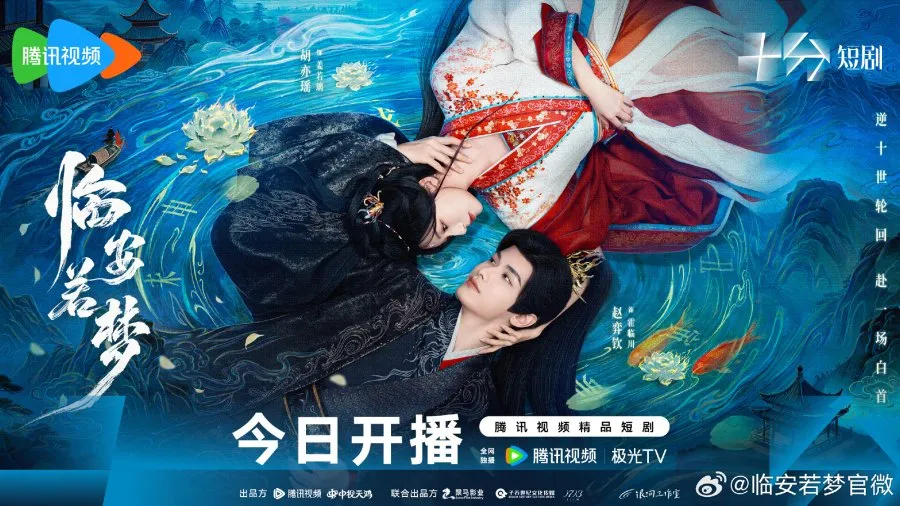
Locandina di Reincarnated Love - Courtesy Tencent Video

|
DetailsRATING: (6/10)
NATIVE TITLE: 临安若梦 - Lín'ān ruò mèng YEAR: 2026 EPISODES: 24 DURATION: 15’ DIRECTOR: Hao Hongyuan SCREENWRITER: Yu Qi, Xu Jinjin, Gao Mo RESPECTED CLICHÉS: 1 - 4 - 5 - 6 - 11 - 12 - 13 - 14 |


IN A NUTSHELL
- What to expect: Reincarnated Love is a short drama full of promises that, however, are only partially fulfilled. The story of the male protagonist's cycle of ten rebirths intertwines with the female protagonist's prescient abilities and a web of political and family intrigue, giving rise to an undoubtedly compelling tale but perhaps too dense for the format, which thus ends up feeling incomplete. The use of overused romantic clichés, including the inevitable love triangle, does not contribute to its quality, even if paradoxically it remains the element that infuses the plot with a certain emotional tension, otherwise weakened by the vagueness of the events revolving around the protagonists.
- Strengths: a story with strong narrative potential, engaging love triangle, effective antagonist.
- Weaknesses: a poorly defined political storyline, glaring plot holes, a rather banal and clichéd script.
- Recommended if you like: historical tales with supernatural elements such as rebirth and curses, dramas full of clichés, series that revolve around the love story between the protagonists.
- Would I rewatch it? Yes, although it's not a great production, it can work as a distraction.
Read on to find out the main flaws that make me dismiss this drama.
There are dramas that are remembered for their vivid imagery and memorable characters: Reincarnated Love leaves a more fleeting feeling, made up of intermittent emotions, moments of sincere involvement alternating with a subtle frustration that surfaces episode after episode. It's a watch that flows without ever truly stopping, entertaining without being deeply impactful, ultimately leaving more of an impression of what might have been than of what was.
In this review of the drama Reincarnated Love, I'll try to explain why its narrative and thematic construction eventually cracks, revealing all its fragilities, and I'll try to pinpoint the reasons why the drama still manages to hold the viewer's attention.
Plot
Jiang Rou Li, daughter of Chancellor Jiang, is tormented by premonitory dreams, and in one of them she witnesses her parents being murdered by a group of assassins during the Lantern Festival.
Determined to prevent this, she attempts to change the course of events in every way possible, and in doing so, she meets Huo Lin Chuan, Duke Huo's heir apparent, who ultimately dies at her hands.
The young man is in fact burdened by a curse that condemns him to a tragic death ten times over unless he can change his fate. The opportunity presents itself when Jiang Rou Li, determined to protect her parents from her uncle's machinations, proposes a marriage alliance: she can count on his military power, while he can rely on her premonitory dreams.
Over the course of this alliance, the two grow increasingly closer, but their union is thwarted by his half-brother, Lu Huai Jin, Rou Li's childhood friend, who has always been in love with her and is unable to accept their marriage.
Through suspicion, loss, and betrayal, the bond between Rou Li and Lin Chuan continues and deepens, leading them to discover the truth behind their respective misfortunes and the possibility of rewriting their destinies together.

Reincarnated Love Drama Review (No Spoilers)
Plot and Narrative Pace
Reincarnated Love is a short drama that I would describe as neither good nor bad, as it chooses to focus almost all its narrative energy on the tragic love triangle between the protagonists, leaving the political intrigue and family disputes that could have given it greater depth in the background—at times too much so.
The story, despite following well-trodden paths, still manages to maintain a certain level of engagement thanks to a fairly fast pace and constant emotional tension.
However, the events that lead to the protagonists' acquaintance and collaboration often seem vague, almost sketchy, generating considerable confusion in the construction of the backstory, further complicated by the presence of an antagonist who remains in the shadows for the entire first half of the drama.
Numerous revealing flashbacks help fill these gaps, only partially shedding light on past events without fully filling the plot holes. These holes are made even more evident by the element of rebirth which, in the protagonist's constant attempt to rewrite her family's destiny, ends up reshuffling the cards without always offering a narrative coherence that lives up to expectations.
Screenpelay and Characters
The tone of the story is primarily affected by a rather banal screenplay, which unimaginatively rehashes the familiar repertoire of rhetorical quips from romantic dramas, both in the love dialogues between the protagonists and in the usual moralizing speeches addressed to the antagonists.
As often happens in productions of this type, the characters are barely sketched and operate within an overly simplistic distinction that divides them into "good" and "bad"; yet, paradoxically, it is precisely the latter who emerge most incisively. The antagonists have clear objectives, which they pursue with consistency and unwavering ruthlessness, while the protagonists seem more swept along by events, forced to react from time to time without any real plan or discernible strategy.
This gives the impression that many of the events involving them exist primarily as narrative pretexts, serving to inevitably lead the two towards their romantic epilogue, rather than as organic stages of a truly constructed journey.

Cast
The cast proves, overall, to be the least problematic element of the entire production, although it still fails to significantly elevate it.
Zhao Yi Qin confirms a certain aptitude for tragic and romantic roles, an area in which she manages to convey sincere involvement, although the feeling remains that his talent continues to be confined to secondary characters in major productions, as happened in Glory and Love Beyond the Grave.
Hu Yi Yao is all in all convincing as the tragic Jiang Ruo Li, especially in the more emotionally charged sequences, where she manages to convey a believable fragility, while appearing less incisive in moments when the character should be asserting herself most forcefully.
Bai Chuan offers an interesting take on the ambiguous Lu Huai Jin, but his performance always seems to stop short of being truly memorable, as if lacking a spark capable of fully defining him.
Shi Rui Yi plays the female protagonist's rival quite effectively, coming across as appropriately irritating, but without that subtle layer of malice that could have made her more charismatic and memorable.
Finally, Wu Jia Hui creates a functional but undeveloped antagonist, whose performance suffers from excessive theatricality that ends up dampening his credibility, allowing artifice to emerge more than spontaneity.
Visual Aspects and Soundtrack
Visually, Reincarnated Love reveals a director with interesting insights, yet one that fails to maintain stylistic coherence throughout the narrative. Moments of reasonable solidity—with well-constructed shots and an image composition that betrays a certain technical awareness—alternate with sequences in which the camerawork appears more uncertain, almost improvised, contributing to an overall uneven delivery.
The use of lighting also follows this alternating pattern: the successful atmospheres of the night scenes, often evocative and instrumental to the tone of the story, are contrasted by more artificial solutions, with spotlights clearly positioned to create a dramatic effect that, however, ends up revealing their artifice to the attentive viewer.
Added to this is the unconvincing gimmick of using wires and fans to simulate drowning, a functional solution that here, however, feels more awkward than immersive due to the sloppy staging.
The sets, on the other hand, are generally well-crafted and surprisingly believable, especially in the exterior settings, where similar productions often tend to expose budget limitations. The fight scenes — particularly those involving Zhao Yi Qin — hold their own with a certain dignity, favoring a more concrete physicality than spectacle, and find an involuntary ally in the night sequences, where the reduced visibility helps mask choreographic imperfections.
Finally, the costumes and hairstyles are interesting, and while they don't aspire to impeccable elegance, they still manage to convey a coherent and overall pleasing aesthetic.
The soundtrack fits within the well-defined boundaries of romantic series, relying on slow and sentimental melodies that, while functional to the story, are not distinguished by their originality.

WARNING!
FROM THIS POINT ON THE SPOILER SECTION BEGINS. DO NOT CONTINUE IF YOU DO NOT WANT TO KNOW ALL THE DETAILS OF THE DRAMA.
Reincarnated Love Drama Review (Spoilers)
What Works: the Love Triangle
Despite fitting into the more classic genre of romantic series, the love triangle between the female protagonist and the two male leads ends up being the only real driving force of the drama, the element that, despite everything, manages to engage and hold the viewer until the very last episode.
In Reincarnated Love,** the most overused repertoire of romantic clichés** is clearly recognizable: the rescue of the little FL from drowning by the ML, who, however, is destined to remain unknown to her; the childhood friend who transforms into an obsessive SML, convinced he has some sort of emotional claim on the protagonist, and who lavishes himself with repeated promises of protection should the ML treat her badly; the jealous and possessive male protagonist with the usual corollary of exclusive declarations such as "You must not speak to any other man but me," up to the inevitable misunderstandings and misunderstandings that punctuate a relationship born out of convenience and developed in a violent and continuous alternation of feelings ranging from overwhelming passion to exhausting distrust.
These are dynamics seen and reviewed, almost exhausting in their repetitiveness, and yet it is precisely in this familiarity – almost mechanical – that the series finds its fragile strength: because, while everything else struggles to leave its mark, it is in these reiterated emotional tensions that the only form of suspense capable of giving a minimum of impetus to a plot that, otherwise, would slip into an all too uniform linearity, is concentrated.
What Doesn't Work: Plot Development
Beyond the stereotypical love dynamics—which represent both the drama's most obvious limitation and its only real emotional connection — Reincarnated Love suffers from a surprisingly vague and repetitive main plot, which ends up serving a dual purpose: on the one hand, an indistinct backdrop, on the other, a forced narrative mechanism whose sole purpose seems to be to cyclically bring the protagonists together and then separate them.
Moving between barely sketched political intrigues and dynamics of rebirth that are never truly explored, the story proceeds by piling up events that rarely find any real internal justification, generating a constant sense of incoherence.
The rebirth factor, which could have been the story's most distinctive element, instead ends up amplifying this confusion, leaving too many unanswered questions and transforming the mystery into mere narrative opacity.
Many of the questions that arise throughout the narrative remain unanswered: who is behind the men in black who attack Chancellor Jiang at the beginning? Who collaborates with Lu Huai Jin in providing the Emperor with evidence against Duke Hou, and why does this evidence incriminate Chancellor Jiang after Jiang Ruo Li's rebirth? What happens to General Chen Guang, a figure evoked but never shown, and what role does he play in Duke Hou's accusation? How does the relationship between Jiang Huai Kang and Ruyan develop, and why does Jiang Ruo Li disappear after Jiang Ruo Li's rebirth (she never existed or was removed from the Jiang residence)? And why, in the eleventh cycle, is Huo Lin Chuan the only one with no memory of his previous lives? Even key elements such as the functioning of the Jade of Purity and the cycle of ten reincarnations remain treated superficially, more like plot devices than true narrative devices with clear rules.
The result is a plot that, rather than being enriched through complexity, progressively falls apart, leaving the impression that what could have distinguished the drama – the temporal stratification and the play of rebirth – ends up instead becoming a disturbing element, incapable of supporting the weight of the narrative ambitions.

Characters and Cast
Primary Characters
Jiang Rou Li/Yuan Yuan (Hu Yi Yao) only daughter of Chancellor Jiang Huai'an. A premonitory dream tells her that her parents are destined to die in an ambush during the Lantern Festival, so she does everything she can to avoid it. This leads her to meet Duke Huo's heir apparent, who protects her on several occasions and even agrees to marry her to help her defend her family.
Huo Lin Chuan/Yanzhi (Zhao Yi Qin) Duke Huo's heir apparent and Lu Huai Jin's half-brother. As a child, he saved Jiang Rou Li from drowning, but she had always ignored it, believing Lu Huai Jin was her savior. He has been condemned by his half-brother to undergo the cycle of ten reincarnations, which leads him to see his life come to a tragic end with each cycle until he manages to make Jiang Rou Li fall in love with him who helps him break the curse.
Lu Huai Jin/Yunzhou (Bai Chuan) Duke Huo's adopted son and Huo Lin Chuan's half-brother. He believes he is the illegitimate son the Duke refused to acknowledge, and for this reason he deeply hates both the Duke and his half-brother. He has always been in love with Jiang Rou Li and over the years has done everything to stay by her side in the hope that she will marry him. However, when she decides to marry Huo Lin Chuan to gain his protection, this fuels his desire for revenge. He eventually discovers that he is not the Duke's biological son, which leads him to commit suicide.
Supporting Characters
Jiang Huai'an, chancellor and father of Jiang Rouli. He is a profoundly good and honest man, and for this reason, he is targeted by his younger brother, who hopes to take his place as clan head.
Shen Shuang Hua (Yang Ping) wife of Jiang Huai'an and mother of Jiang Rouli. She is also very good and kind and is strongly attached to her husband and daughter.
Xiao Tao (Cao Zi Han) personal maid to Jiang Rou Li.
Ruyan, personal maid to Jiang Rou Li. She is unwillingly drawn into an affair with Jiang Huai Kang, who threatens her to gain her help in killing his niece, and then ends up murdering her.
Ruyi, Ruyan's twin sister. After her sister's disappearance, she tries to kill Jiang Rou Li, believing her to be responsible.
Jiang Huai Kang (Wu Jia Hui) Jiang Rou Li's uncle and Jiang Wan Yue's father. He is a devious, slimy, and evil man who has no qualms about using any means to obtain the title of clan head.
Jiang Wan Yue (Shi Rui Yi) Jiang Rou Li's cousin and Jiang Huai Kang's daughter. She grew up in her cousin's shadow and, driven by her authoritarian father, is always looking for ways to humiliate her.
Qiao Qiao, Jian Wan Yue's personal maid. She is so close to her mistress that she refuses to abandon her even after Jiang Huai Kang's imprisonment.
Hou Wenyuan, Duke and father of Huo Lin Chuan. During one of his military campaigns, he saves a pregnant widow who turns out to be Lu Huai Jin's mother. To help her, he entrusts her with his seal, which Lu Huai Jin will use years later to gain refuge at his residence.
Shi Tou (Cao Xing Yu) Huo Linchuan's attendant.
General Chen Guang, Duke Huo's deputy. He suddenly disappears after the Duke is accused of high treason, arousing Huo Lin Chuan's suspicions.
Mrs Liu, friend of Lu Huai Jin's mother. After his mother's death, she shelters the boy for a while before he decides to turn to Duke Huo. She knows that Lu Huai Jin is not the Duke's biological son and tells him the whole story before he kills himself.
Zhang San, man Jiang Wan Yue hires to rape her cousin and humiliate her in front of the entire family. He is stopped by Huo Lin Chuan.

Favorite Character: Jiang Rou Li
She is a determined and resilient girl, capable of combining strength of spirit and profound sensitivity.
Her affection for her family drives many of her choices: when her premonitory dreams reveal the tragic fate of her parents, she does not hesitate to risk everything she has to protect them, even sacrificing her own reputation by pretending to be pregnant with Huo Lin Chuan's child, in order to ensure the safety of Duke Huo's household. This devotion is accompanied by a sincere emotional bond with her maids, whom she considers true sisters, testifying to a character capable of profound loyalty.
Over the course of the story, what begins as a union of convenience with Huo Lin Chuan gradually transforms into a genuine and profound feeling, which finds its maximum expression when she is willing to sacrifice her life to activate the second Jade of Purity and save him, thus repaying the protection and dedication she has received.
Alongside this emotional dimension, her strategic intelligence also emerges: she is capable of cunningly navigating intrigue and deception, even feigning memory loss after her rebirth to deceive Lu Huai Jin and carry out her plan of revenge, having her devious uncle imprisoned and ensuring justice for her family.
Equally significant is her ability to forgive those who have wronged her, which enables her to overcome deep-seated resentments. This quality is especially evident with her cousin, who has repeatedly attempted to frame her and ruin her reputation by attempting to rape her.
Overall, Jiang Rou Li emerges as a luminous and multifaceted figure, capable of acting with determination without losing her humanity.
Un-Favorite Character: Jiang Huai Kang
He is a deeply corrupt figure, driven by ambition, resentment, and an insatiable thirst for power.
Deceitful and ruthless, he is willing to forgo all family ties to gain control over the family, even plotting against his brother and allying with Lu Huai Jin to eliminate him.
His cruelty is not limited to the political sphere: he manipulates his own daughter, fueling her envy of her cousin Jiang Rou Li, orchestrating a rivalry that he unscrupulously exploits to humiliate his niece and undermine her reputation within the family.
Without any moral restraint, he does not hesitate to commit the most heinous crimes: he poisons his brother and sister-in-law under his own roof and uses Rou Li's maid's unborn child as a tool for blackmail, pushing her to betray her mistress, only to then get rid of her once she becomes inconvenient.
The evidence accusing Duke Hou of high treason bears his signature, but it is cleverly manipulated to fall on his brother, in a game of deception that reveals his skill at moving in the shadows.
Unable to accept defeat, he is even willing to submit to Lu Huai Jin in order to obtain the means to achieve the title of clan leader.
To the very end, he remains true to his nature, never showing remorse: his incarceration thus appears to be the only possible outcome of a life marked by envy, greed, and callousness.
RECOMMENDED:
- TWISTED FATE OF LOVE
- A TALE OF LOVE AND LOYALTY
- HARD TO FIND
- ECHOES OF THE SELF
- SI JIN
Thanks for reading this far!
I hope you enjoyed my article. If you like my work and want to support me, buy me a coffee ☕