
Mobius (2025) Chinese Drama Review | Plot and Cast
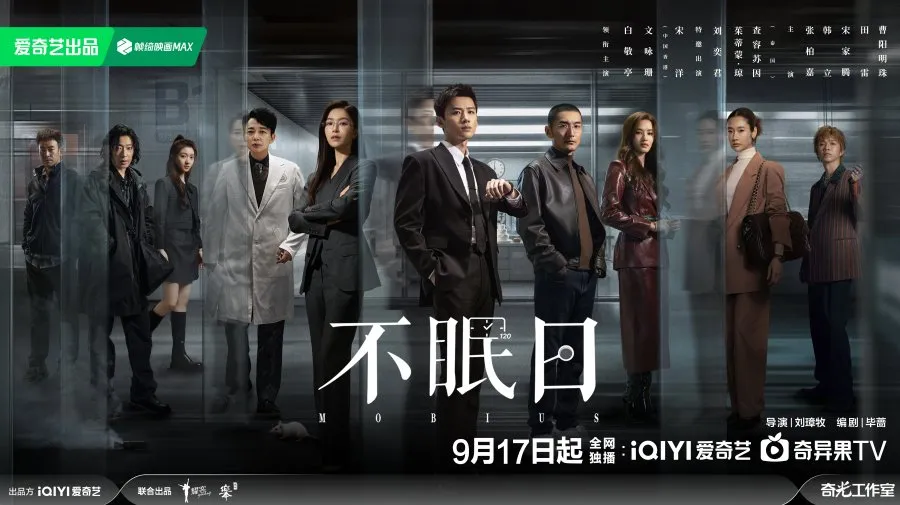
Mobius Poster - Courtesy of iQIYI

|
DetailsRATING: (8/10)
NATIVE TITLE: 不眠日 – Bùmián rì YEAR: 2025 EPISODES: 16 DURATION: 45’ DIRECTOR: Liu Zhang Mu SCREENWRITER: Bi Qiang, Jiang Wu Ji ORIGINAL CREATOR: Zhang Xiao Mao (逆时侦查组 – Reverse Time Investigation Team) |


IN A NUTSHELL
- What to expect: with a plot that straddles psychological thriller and sci-fi action movie, Mobius presents itself as an ambitious and intriguing experiment, combining introspective analysis, mystery, and a circular narrative that seems to rewrite the rules of the game at every turn. The combination of an elusive assassin, a cop with a unique ability, and the controversial testing of an experimental drug makes the story gripping, with an ending that is anything but predictable.
- Strengths: the high-quality visuals, the engaging action plot, the cunning and slippery antagonist.
- Weaknesses: the weak romantic plot, the action scenes that are sometimes too over the top, the poor management of the temporal loop in the central part of the drama.
- Recommended if you like: Bai Jing Ting's good looks, stories that prioritize action over romance, thrillers and detective stories with sci-fi elements, and breathtaking panoramas of China's big cities.
- Would I rewatch it? Yes, if I wanted a short, action-packed drama.
Read on to find out what makes this series truly unmissable!
With its elegant visual style and deliberately hypnotic pace, Mobius effortlessly moves between psychological thriller and science fiction, building anticipation and tension. The excellent Bai Jing Ting manages to convey the controlled vulnerability of a protagonist trapped in a time loop where every choice seems wrong and every reset becomes a piece of a puzzle that never seems to fit together.
In this Mobius review, I will focus not only on the plot, but also on the actors' performances and the overall aesthetic to understand why this series has managed to intrigue and captivate viewers.
“Lost time is never found again.”
Plot
Ding Qi is a college student who, after a near-death experience, suddenly gains the ability to perceive time loops.
He discovers that certain days throughout the year repeat themselves five times, starting over at the stroke of midnight, and he is the only one who remembers what happened during all five repetitions of the cycle.
To put this ability to good use, he decides to become a police officer, and thanks to it, he is able to solve the most brutal crimes by gathering clues over the first four days and using them on the final day to capture the culprits.
However, when he is assigned to protect Mo Yuan Zhi, founder and CEO of the biomedical company MOMA Group, from death threats from the assassin known as Squid, he begins to suspect that he is not the only one capable of perceiving time loops.
As the cycle repeats itself, Deng Qi learns increasingly disturbing details about the deaths of the company's majority shareholders and about Mo Yuan Zhi's past, and he grows convinced that someone with the same powers as him is manipulating events.
Thanks to the help of his team and the collaboration of An Lan, a researcher at MOMA Group, the cop will eventually uncover Squid’s true identity, but his career will face a crossroads when he discovers he must choose between his life and his ability.

Mobius Review (No Spoilers)
From the very first teasers, Mobius captured audiences' attention with the promise of something different and unique: an enigmatic and intriguing tale, ready to disrupt the reassuring and predictable rhythms of traditional dramas.
Online discussions focused not only on the complexity of the plot, but also on Bai Jing Ting's intense and measured performance, returning to a time-loop drama after the resounding success of Reset. This return feels both challenging and consecrated, making Mobius one of the most anticipated and discussed titles of the year.
Plot and Screenplay
The story, although not original, is certainly captivating due to the fact that temporal repetition is set within a thriller context, and the protagonist is a policeman constantly forced to question the effectiveness and appropriateness of his actions and the accuracy of his memories in order to develop the right strategy to catch the killer.
The script, however, fails to fully exploit the potential of the time loop, focusing the narrative too much on a single case, making it at times boring to watch. It should be noted that stories with time loops are already inherently repetitive, so the authors’ failure to include other criminal cases to temporarily shift the investigators’ (and the viewer’s) attention while the main case is underway, is a flaw that somewhat diminishes the series’ momentum, diluting the tension of some episodes and making certain revelations and plot twists lose their impact.
On the other hand, from a detective perspective, the story proves quite interesting and the characters quite complex, so much so that, at first, it’s quite difficult to identify who the killer is and what his motives are. These are revealed to us little by little as the plot unfolds through flashbacks that are often shown at the beginning of each episode. This, in my opinion, somewhat disrupts the narrative flow and interrupts the continuity between episodes, but it seems to be one of the series’ distinctive stylistic features.
Another distinctive stylistic feature of Mobius are the spectacular panoramic shots of the city and the car rides to the various locations where the main events of the story take place. Despite the script’s flaws, these scenes manage to enliven the narrative, lending it dynamism and a sense of urgency that distracts the viewer from the dullness of the plot.
I really appreciated the drama’s comedic timing, which I found perfectly coherent and thoughtfully inserted within the narrative. Indeed, despite being a detective series with tense and, at times, dramatic exposition, there was no shortage of funny moments and they helped to keep the viewer engaged, breaking up the monotony of a plot that was at times too slow and repetitive.
Love Story
Romance is the notable absentee in Mobius, or rather, it’s the part of the script that was most neglected and poorly conceived. The pseudo-love story between Ding Qi and An Lan emerges only vaguely throughout the narrative, with hints from one or the other of the protagonists, but neither of them ever takes the initiative seriously, and their relationship goes beyond the scope of the Squid investigation.
The attraction between them is practically nonexistent, and their passion is on par with that between the ML and any of his colleagues, so much so that it seems as if their relationship was inserted to add a touch of liveliness to a plot that is at times too linear.
Furthermore, the romantic scenes between the protagonists always appear flat and inserted randomly within the narrative.

Cast
As for the cast, with a few rare exceptions, I found it quite convincing and really appreciated its ensemble performance.
Bai Jing Ting was very effective as Ding Qi, and I really appreciated him in both the action and the purely investigative scenes (I also adore his sense of humor, which I also loved in New Life Begins).
Janice Man‘s performance, however, left me with some doubts. Although she played the role of a disillusioned scientist devastated by the tragedies that befell her mother and friend, she didn’t strike me as very expressive, so much so that she failed to move me even in the most touching scenes. Furthermore, her attitude towards her co-star seemed rather distant.
I was favorably impressed by Song Yang‘s performance, which demonstrated his ability to perfectly portray an ambiguous character with a wide range of personalities like Mo Yuan Zhi.
I also greatly enjoyed Fion Qian‘s delicate and moving portrayal of Feng Wan Qing.
Special mention goes to Chen Bao Yuan, who made his Duan Zheng a funny yet emotionally engaging character, perfectly complementing Bai Jing Ting.
Visual Aspects and Soundtrack
Aesthetically, Mobius strikes with its elegant yet unsettling atmosphere (typical of iQIYI productions). The cool colors and materials—predominantly blue and gray, glass and concrete—create a constant sense of solitude and unease, as if each scene were suspended in a specific time. The direction often plays with symmetries and deliberately unbalanced shots to convey the confusion and instability of a protagonist trapped in a constantly repeating yet ever-changing reality.
Among the most successful shots are the city panoramas, which alternate between illuminated skyscrapers, labyrinthine working-class neighborhoods, seemingly endless streets, and silences suspended in the night. These urban views don’t just place the action, they accompany it, becoming a silent witness to each cycle that renews and unfolds. The use of lighting—sometimes cold and artificial, others warmer—sensitively accompanies the characters’ emotions, emphasizing their expressions, sometimes calm and reflective, sometimes impetuous and devastating.
I also really liked the soundtrack: it’s modern, tense, and with clear references to the hip-hop sounds of American thrillers, successfully lending rhythm and depth to the most intense scenes. It’s a shame the same attention wasn’t paid to the romantic moments, where suddenly—and completely forcedly—a romantic melody breaks up the dialogue, instantly erasing the tension that had built up until that point.

WARNING!
FROM THIS POINT ON THE SPOILER SECTION BEGINS. DO NOT CONTINUE IF YOU DO NOT WANT TO KNOW ALL THE DETAILS OF THE DRAMA.
Mobius Review (Spoilers)
What Works
The Story and Theme of Scientific Experimentation
The drama demonstrates a remarkable solidity in its narrative construction.
Although the time loop, over time, tends to generate a certain monotony and risks weighing down the pace, the overall structure of the story remains coherent and well-organized. Despite the complexity of the subject matter, the series manages to maintain good clarity between the different timelines, avoiding confusing the viewer.
The only real disturbing element is the numerous flashbacks: while very useful for clarifying the more intricate aspects of the plot and giving emotional depth to the characters, they are sometimes inserted a bit abruptly, so much so that they interrupt the narrative tension.
Another aspect I appreciated about Mobius was the series’ courage to tackle a complex and controversial topic like genetic drug trials for cancer treatment.
It’s rare to see a mainstream Chinese drama devote so much space to ethical and scientific reflections of this magnitude, and Mobius does so with surprising clarity.
The narrative doesn’t simply present the research as a narrative device; it explores its moral implications, its consequences on patients’ lives, and the fine line between medical progress and personal ambition. Without turning into a “medical” drama, the series manages to raise authentic questions about the value of human experimentation and the responsibility of those who conduct it, adding depth to a plot that would otherwise risk being reduced to a mere detective story.
The Relationship Between Ding Qi and His Colleagues
Unlike the inconsistency that characterizes the main love story, I found the camaraderie within Ding Qi’s team surprisingly engaging.
Although the drama focuses heavily on the protagonist and his unique investigative skills, he is always supported by his team, especially Duan Zheng. Together, the two form a very close-knit pair with a balanced mix of impulsiveness and wisdom that gives depth to the narrative.
Duan Zheng is an almost fatherly figure to Ding Qi: he embodies the kind of gentle authority that doesn’t impose, but guides, alternating jokes and reprimands, always attentive to his junior’s mental and physical health. Even when pressured, Ding Qi finds comfort in his colleague’s practical advice and calm, and they engage in believable interactions that help deepen their relationship, built on trust and mutual respect.
This chemistry gives the series a broad emotional scope, balancing the more cerebral aspect of the story with something deeply human. Amidst time loops and intricate investigations, their scenes remain a constant amidst the chaos and perhaps one of Mobius‘s true strengths.

What Doesn't Work
Narrative Rhythm and Action Scenes
Mobius‘s biggest flaw is its uneven pacing, due to the script’s poor development of the concept of cyclical repetition.
The idea of a time loop, while interesting on paper, ended up slowing the pace and weakening the narrative tension. Each reset erases what has happened before, draining many events of their emotional and dramatic weight. Knowing that everything will repeat itself makes it difficult to feel truly invested: the characters’ decisions lose urgency, and their consequences feel fleeting (like the death of Ding Qi’s entire team at the end of episode 3).
Furthermore, the fact that the “decisive day”, the one on which everything is at stake and from which there is no turning back, is the fifth, made the previous four seem almost superfluous. The viewer ends up watching variations on the same theme, knowing that nothing that happens will have any real impact. Thus, instead of fueling suspense, the looping structure dampened it: the anticipation turned into a predictable routine, and the tension—which should have built with each cycle—progressively diluted, giving way to a feeling of stasis.
In practice, the first three episodes are compelling and capture the viewer’s attention with their fast pace and tense atmosphere. However, after the discovery that December 12th is a loop day, the pressure eases significantly, and a series of episodes unfold in which revelations and new characters merely add a few more pieces to the puzzle, but fail to increase interest in the investigation (also because Squid never enters into action). Only towards the final episodes does the plot begin to flow again due to the fact that, being the fifth day, everything that needed to be revealed has been revealed, and the story must reach its natural conclusion.
Another aspect of Mobius that left me a bit perplexed is the fact that some scenes seem to be a nod to American productions, but they do so so emphatically as to be almost excessive. Between shootouts, displays of strength, and hand-to-hand combat, the series at times slips into a deliberately spectacular aesthetic that risks appearing a bit farcical, almost as if trying to ridicule the genre or compulsively capture the viewer’s attention.
Some examples of what I mean are the (two) firefights between Ding Qi and the Fortune Bank robbers, the shot in the air to drive away the protesters in episode 3, the shootout between the ML and Ye Kun in episode 11, and the fight between the protagonist and Squid in the final episode.
I understand the desire to make the story more modern and dynamic, but perhaps a little more restraint—and less flaunting of the protagonist’s physical prowess—would have benefited the overall tone. The series is at its best in its more investigative and introspective moments, when it lets the atmosphere and story speak for themselves rather than the noise.
This point was also highlighted by some viewers who also watched the drama Reset and drew a comparison between it and Mobius, emphasizing the narrative superiority of the former over the latter. In their opinion, while in Reset the entire narrative framework was supported by a complex and layered plot, in Mobius the story developed around an action-packed detective concept that doesn’t do justice to the sci-fi idea of the time loop, which, alone, could have easily sustained the entire narrative arc.
The Romantic Subplot
The romantic subplot, as mentioned, is unconvincing and, at times, pointless. Despite the actors’ efforts, the bond between the two protagonists feels forced and uncoordinated with the overall story. It lacks that spark of genuine passion that would make one believe there’s something between them, and the kiss they share in episode 12 is worthless: the chemistry between the two characters is minimal, and, above all, no shared interests or values emerge that justify their attraction.
The relationship seems to exist more out of narrative necessity than real emotional coherence, seemingly grounded in the tragic event that binds them—the accident that left her mother in a coma. While it provides a dramatic connection, it feels too fragile to sustain a full romantic storyline, which thus ends up slipping to the margins, leaving no real impact, and instead making the interactions between the two almost annoying.
Linguistic Coherence
A final point concerns the series’ linguistic aspect. At certain moments, Mobius suddenly switches between Cantonese and Mandarin, a choice that may be interesting for local audiences but somewhat unsettling for international viewers, who find themselves disoriented by these passages, which aren’t always justified by the narrative.
Added to this is a curious detail: the protagonist displays excellent English pronunciation, decidedly more natural than that of Maggie, the representative of the American company Volly, who is supposed to have been born and raised in the United States. It’s an ironic inversion that takes away some of the credibility of the English-language interactions, leaving the impression that the actors’ linguistic preparation isn’t always optimal.

Characters and Cast
Primary Characters
Ding Qi (Bai Jing Ting) police officer form the Hua Ao Criminal Investigation Bureau. In 2017, after accidentally falling into the lake at his university, he discovers he can perceive time loops and relive the same day five times after the stroke of midnight.
An Lan (Janice Man) researcher at MOMA Group and a friend of Ding Qi. The two met during her mother’s investment, because the investor was a fugitive criminal whom Ding Qi was hunting. She is looking for her friend Feng Wan Qing who disappeared years earlier from the hospital where she was being treated for grade four spinal cancer.
Mo Yuan Zhi (Song Yang) CEO of MOMA Group, one of Hua Ao’s largest biopharmaceutical companies, engaged in testing new biogenetic drugs called RAN. He is one of the company’s founders and majority shareholders, and after the deaths of his partners Han Song and Tang Shao Rong, he receives death threats from the assassin known as Squid. His research stems from his desire to find a cure for the spinal tumor that took away his beloved fiancée Feng Wan Qing.
Supporting Characters
Huang Yuan, head of the first division of the Hua Ao Criminal Investigation Bureau. He handled the deaths of Han Song and Tang Shao Rong, ruling them out as accidents.
Yu Pei Shan (Luo Yan), Huang Yuan’s subordinate assigned to the Squid case.
Gu Song, Huang Yuan’s subordinate assigned to the Squid case.
Duang Zheng (Chen Bao Yuan), head of the fourth division of the Criminal Investigation Bureau and Ding Qi’s superior.
Fang Lu (Gladys Li), Ding Qi’s colleague and Duang Zheng’s subordinate assigned to the Squid case.
Da Kai (Xia Ming Hao), Ding Qi’s colleague and Duang Zheng’s subordinate assigned to the Squid case.
Wang Hao Xin, Ding Qi’s colleague and Duang Zheng’s subordinate assigned to the Squid case.
Han Song (Tai Bo), MOMA Group executive, friend and colleague of Tang Shao Rong. He dies from electrocution on October 25, 2024 (loop day) while exercising in a park near his home.
Han Yu Fei (Song Jia Teng), Han Song’s son. He is a womanizer, dissolute, and a party animal, but after his father’s death, he joins MOMA Group because he wants to discover the reasons behind his father’s death. He is one of the company’s three majority shareholders and wants to convince Tang Xin and Yu Shi Ya to oust Mo Yuan Zhi from the MOMA Group’s board of directors.
Tang Shao Rong (Tang Xu), MOMA Group’s chief scientist. He is crushed to death by a neon sign while walking down the street on November 26, 2024, the day of the Fortune Bank robbery and loop day.
Tang Xin (Cao Yang Mign Zhu), Tang Shao Rong’s daughter. She works at MOMA Group as an intern and, after inheriting her father’s stake, becomes one of the company’s three majority shareholders. She is actually the daughter Jiang Yu Wen gave up for adoption after his wife’s death because he was unable to care for her.
Yu Shi Ya (Baby Zhang) Mo Yuan Zhi’s wife. She is the daughter of wealthy investor Yu Ying Hua and a shareholder in MOMA Group.
Feng Wan Qing (Fion Qian) An Lan’s friend and Mo Yuan Zhi’s mentor during his hospital internship in 2016. The two fall in love, but she must transfer to the Mourn Vale Medical Center hospice due to the worsening of her grade 4 spinal cancer diagnosis. Due to her critical condition, she agrees to undergo an unauthorized trial of the drug RAN, but the treatment fails and she dies, leaving Mo Yuan Zhi devastated.
Ye Kun/Feng Qi Ming (Han Li) Wan Qing’s older brother. In 2008, he ended up in prison for participating in a brawl in which a classmate was seriously injured. After being released from prison fifteen years later, he rented an apartment in the Mei’an Building in Hua Ao and began working as an extra at the city’s film studios. He is Squid’s enforcer.
Jiang Yu Wen (Li Yi Jun) Mo Yuan Zhi’s supervisor and mentor during his doctorate at Ivy Bay University. He is the one who began the unauthorized experimentation on patients at the Mourn Vale Medical Center hospice and who administered RAN to Wan Qing. He is also a time loop perceiver, which is how he managed to escape Mo Yuan Zhi’s revenge for killing Feng Wan Qing with the experimental version of RAN.
Maggie (Aokbab Chutimon Chuengcharoensukying) is a representative of the American venture capital firm Volly. In reality, she is Jiang Yu Wen’s daughter born and raised in the United States by her mother, a Chinese woman Jiang Yu Wen later helped get rich by suggesting her profitable investments in the stock market.
You Yu Xiang (Qian Yi), biologist, laboratory researcher, and former associate professor at Ivy Bay University. He was demoted for online harassment after accusing Mo Yuan Zhi of murdering Professor Jiang Yu Wen. In the first loop, on December 12, 2024, he assaults Mo Yuan Zhi as he leaves Ivy Bay University.
Fu Jun (Tian Lei), MOMA Group technician who signed a resignation agreement three months earlier but has not yet received his compensation. In the first loop, on December 12, 2024, he assaults Mo Yuan Zhi as he leaves Ivy Bay University.
Zhao Shi Jie, MOMA Group client. On December 12, 2024 (loop day), Mo Yuan Zhi is scheduled to attend the wedding of his daughter Zhao Zi Xin to the wealthy scion Liu Hao Tian.
Ms. Cai (Xu Nan Nan), head of the MOMA Group’s human resources department.

Favorite Character: Feng Wan Qing
She is a cheerful, optimistic, and dreamy girl.
She loves her brother dearly, and when he is incarcerated, she promises to wait for him and take care of their mother while he is in prison.
She is a great friend and would do anything for An Lan, so much so that she offers to finance her study trip to the United States with her hard-earned savings when she discovers she won’t be eligible for the scholarship promised to her due to bureaucratic issues.
She loves painting, even during her hospital stay, to distract herself in the brief moments of respite from the pain her illness affords her.
She meets Mo Yuan Zhi almost by chance, because she is one of his supervisors during his hospital internship, and he is the only one who shows her any compassion and sympathy when he sees her lying on the hospital bed in agony.
Again by chance, the two fall in love, and while he tries everything he can to speed up the development of the genetic drugs he’s experimenting with to cure her, she reassures him, distracts him, and tries to cheer him up even when his work seems to be stalling.
Up until the very end, she tries to comfort everyone and act confident, assuring them she’s fine and keeping quiet about the increasingly unbearable pain she feels from her illness.
When she finally decides to agree to undergo the unauthorized trial of the RAN drug, she does so simply in the hope of being able to spend a little longer with her beloved and because she can’t stand watching him spend all day poring over data in search of a cure for her.
Un-Favorite Character: Jiang Yu Wen
He is a selfish and success-hungry man who would do anything to achieve the prestigious scientific recognition he covets, including illegally testing the genetic drug he is developing on terminally ill patients in a hospice simply to gather data that will help him advance his research.
He is so obsessed with his work that he abandoned a daughter he had in the United States and gave up his legitimate newborn daughter for adoption after his wife’s death so he wouldn’t have to care for her.
His sole goal is to succeed in the creation of genetic drugs, which is why he ignores his academic duties and refuses to advise his students unless they prove extremely brilliant in genetic research.
He is insensitive to the suffering of the patients he should be working to cure, treating them like laboratory animals and harshly reprimanding Mo Yuan Zhi for becoming attached to the study subject Feng Wan Qing.
He shows his pettiness one last time when, after realizing the side effects RAN has had on him, he tries to take over the MOMA Group by eliminating Mo Yuan Zhi, and he does so by sending his daughters ahead of him, so much so that we almost feel like absolving Squid for trying to kill him.
RECOMMENDED:
- TWISTED FATE OF LOVE
- LOST TRACK OF TIME
- RESET
- LADY REVENGER RETURNS FROM THE FIRE
- TWELVE LETTERS
Thanks for reading this far!
I hope you enjoyed my article. If you like my work and want to support me, buy me a coffee ☕