
Love Beyond the Grave (2026) Chinese Drama Review | Plot & Interpretation of the Ending
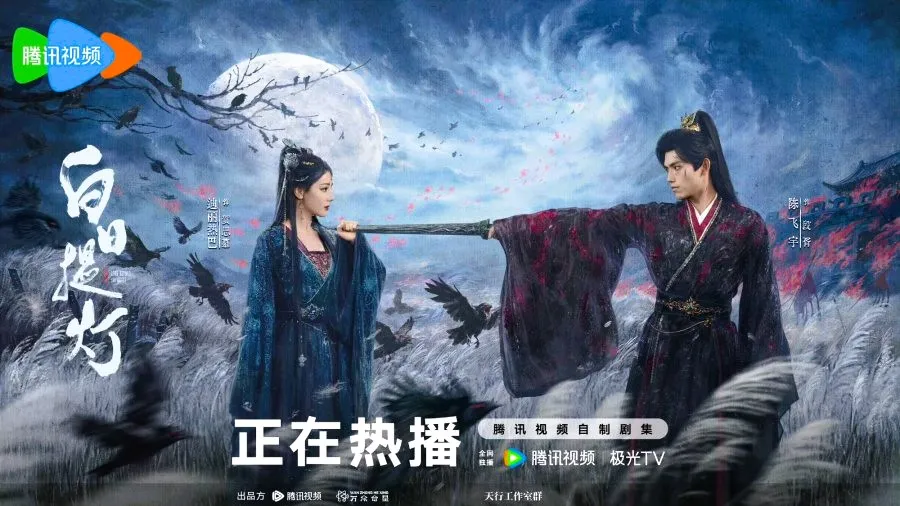
Love Beyond the Grave Poster - Courtesy of Tencent Video

|
DetailsRATING: (6.5/10)
NATIVE TITLE: 白日提灯 - Bái rì tídēng YEAR: 2026 EPISODES: 40 DURATION: 40’ DIRECTOR: Zoe Qin SCREENWRITER: Tang Qicen, Song Tang, Yu Zhancheng, Tang Song e Yang Ting ORIGINAL CREATOR: Li Qing Ran (白日提灯 - Carrying a Lantern in Broad Daylight) RESPECTED CLICHÉS: 1 - 4 - 6 - 7 - 8 - 9 - 11 - 13 - 18 |


IN A NUTSHELL
- What to expect: Love Beyond the Grave is a fantasy drama with great visual ambitions, but it's held together by a rather simple plot and a slow-burn romance that's uninspiring. The cast makes an effort to add depth to the story and make the dynamics between the characters more incisive, but this effort isn't enough to fill the gaps in the script. The linearity of the plot, combined with the slow pace and constant fluctuations of the main relationship, ends up dampening the immersion, while the visual effects fail to sustain the aesthetic to which the drama seems to aspire. The result is a series that entertains, but rarely manages to truly amaze.
- Strengths: the interesting premise, the excellent cast, the situations created by the love triangle.
- Weaknesses: the slowness of the plot, the poor characterization of the secondary characters, the weak worldbuilding.
- Recommended if you like: Dilraba Dilmurat, Chen Feiyu and Miles Wei, fantasy dramas with strong and independent protagonists, slow burn romances, not too complex political plots.
- Would I rewatch it? Yes, but only because I'm a huge fan of Dilraba Dilmurat.
Read on to see if this drama is for you.
Love Beyond the Grave is a drama that walks the delicate line between suggestion and melodrama: its world of spirits, obsessions, and impossible bonds evokes a sense of melancholy, suspense, and a constant yearning for something unattainable. It's a story that promises emotional intensity and visually powerful imagery, but often leaves a more ambiguous impression, one of anticipation rather than fulfillment.
In this review of the drama Love Beyond the Grave, after watching all episodes, I will attempt to analyze this duality: on the one hand, its aesthetic and narrative ambitions, on the other, its limitations, to understand how well this series truly delivers on its promises.
Plot
He Si Mu is the powerful Sovereign of the Guixu Spirit Realm, the place where the souls of those who die with a strong obsession gather.
Born partially deprived of her five senses, for four hundred years she has searched for the bearer of the Illusion-Breaking Sword (“Deliverance” on Rakuten Viki), who, according to a prophecy, is the Spell Bearer, the only one capable of temporarily granting her her senses and allowing her to perceive the outside world.
During one of her visits to the mortal world, He Si Mu chances upon the young general of the Tabai Army, Duan Xu, and recognizes him as the possible possessor of the sword. Determined to verify his identity, she approaches him and, while investigating his past, offers her help to stop the impending advance of the Bei Chong army.
Duan Xu immediately senses that He Si Mu is no ordinary person, but when he discovers her true identity, he nevertheless agrees to make a pact with her that will allow her to regain her senses.
As time passes, Duan Xu grows increasingly fond of her, and even the cold and distant ruler seems to begin to feel something for him. Feelings intensify when he decides to follow her into the Spirit Realm. There, Duan Xu finds himself dealing with Jiang Ai, Si Mu's cunning but loyal left-hand man, and Yan Ke, her ambitious right-hand man, who is deeply obsessed with her.
Despite He Si Mu's attempts to keep her distance — for fear of reliving the fate of her parents, separated by the death of her mortal mother — circumstances continue to draw her closer to Duan Xu, even when he returns to the human world.
Eventually, she decides to give in to her feelings and open herself to love, arousing the jealousy and wrath of Yan Ke, who will do everything to separate them: he will attempt to kill Duan Xu, confine Si Mu, and even seize the throne.
It is only with the help of her most trusted allies that He Si Mu will be able to overcome him, but the challenges for her and Duan Xu seem to continue.
"If someone’s body is confined, he can break free. But if his heart is held captive, he’ll just willingly confine himself."

Love Beyond the Grave Drama Review (No Spoilers)
Plot and Narrative Pace
The plot of Love Beyond the Grave has, on paper, interesting potential, but struggles to develop as the story unfolds. In the first few episodes, the drama manages to build a certain tension: ambiguities, secrets, and dynamics yet to be deciphered keep the reader guessing and suggest a more layered development of the story. However, as the story progresses, the pace gradually slows to the point of becoming, at times, almost soporific. The story gradually loses momentum and settles into a much simpler and more predictable narrative, with few real twists and a tension management that loses its edge episode after episode.
What ultimately dominates is a repetitive dynamic: constant romantic tug-of-war between the protagonists, skirmishes between the ML and SML that never seem to lead anywhere, and situations that recur with little variation. Even the political intrigue subplots, which initially seemed promising, are carried forward rather blandly, without really impacting the pacing or overall tension. The result is a story that could have held the reader's attention much more, but at a certain point chooses to slow down too much, ultimately squandering much of its potential.
Characters and Screenplay
In terms of characterization, Love Beyond the Grave leaves an equally frustrating impression: the characters are often interesting, but many are underdeveloped and quickly dismissed without truly realizing their narrative potential.
The antagonists also suffer from this approach: they are introduced as potentially threatening figures, but ultimately prove to be uninspiring. Their identities and intentions are often clear from the start, and the plans they implement are often naive, rarely truly challenging the protagonists. This contributes to the overall tension, as it lacks the sense of real danger that should accompany true antagonism.
The screenplay clearly contributes to the impression of superficiality: the dialogue often feels flat and lacks impact, while the reasoning appears basic and rarely developed with the depth one would expect. The very theme of the loneliness of an immortal being, contrasted with the fullness — however brief — of mortal life, remains more hinted at than truly explored, and this is especially reflected in He Si Mu's journey. In the first half of the drama, a sense of disillusionment prevails, but it is never truly explained or explored, ultimately remaining a vague feeling that weighs down her character without offering the viewer the tools to understand and empathize with her. This also significantly weakens her developmental arc, that is, the transition from a distant and disenchanted spirit to a figure capable of rediscovering the value of life thanks to Duan Xu and the sharing of their senses.
Love Story
The love story, despite having all the makings of an intense one, ends up developing so slowly that, rather than building emotional tension, it tends to dampen it. Much of this stagnation stems from He Si Mu's constant indecision, trapped between the desire to bond with Duan Xu and the fear of losing him due to his mortal nature. The result is a relationship that progresses in fits and starts, constantly moving closer and further apart, which, rather than fostering commitment, becomes rather exhausting to follow over time.
Chen Feiyu, for his part, tries to imbue his character with warmth, passion, and a certain spontaneity in his displays of affection, often succeeding in making Duan Xu's attachment believable. However, this energy finds no real counterbalance: He Si Mu's character appears excessively restrained for much of the series, almost incapable of give in to her feelings, and this emotional distance ends up weakening the couple's dynamic. Thus, what should be a relationship filled with tension and emotion remains suspended, unable to truly transform into a passionate and engaging love story.
At times, the story also slips into a melodrama so marked as to be almost repulsive: some scenes insist so much on emotion that they achieve the opposite effect, generating more detachment than engagement. In these moments, the director's limitations clearly emerge, as instead of supporting the actors through atmosphere, lighting, and visual construction, he ends up unloading the entire emotional weight of the scene onto them. The result is often forced and over-the-top acting, in which intensity doesn't arise organically but appears artificially reproduced.
In short, Love Beyond the Grave is a drama that works especially well for those looking for a slow-burn romance fantasy with subdued tones, accompanied by a present but never overly complex political plot.

Cast
As for the cast, Love Beyond the Grave boasts some top-notch names, but in my opinion, they don't really lift the drama from the monotony of the script.
Dilraba Dilmurat proves herself, as always, to be a very solid actress: her cool, at times austere beauty is perfectly suited to the role of He Si Mu, and her expressiveness allows her to credibly transition from a distant, regal figure to lighter, almost childish moments, without ever being out of place. The chemistry with Chen Feiyu also works, although her character's lack of emotional drive sometimes hinders their interactions.
Chen Feiyu's performance left me most perplexed: I couldn't tell whether her character is so disorienting because of his acting or the writing. His performance, in fact, constantly oscillates between a more carefree tone and a suddenly colder and more ruthless one, creating a contrast that, instead of enriching the character, ends up making him less credible. I've read that this ambivalence may stem from his original characterization, but on screen, he appears more inconsistent than multifaceted (I found him much more convincing in Love Story in the 1970s).
A positive surprise, however, is the young Fu Bo Han, who manages to handle both the lighter scenes and the more emotionally intense ones, proving to be a natural and convincing presence alongside the composed Queen of Ghosts He Si Mu.
Always reliable are Wei Zhe Ming and Zhang Li (remarkable in Flourished Peony and Love on the Turquoise Land, respectively), capable of conveying the nuances of their characters with measured and authentic performances. I also appreciated the presence of Ding Jia Wen and Gu Zi Cheng, two faces I continue to find interesting and with good potential.
However, I am left with a bit of regret for Gao Han and Zhao Yi Qin, who once again find themselves penalized by poorly written characterizations, which once again deprives them of the opportunity to make their mark.
Visual Aspects and Soundtrack
Visually, Love Beyond the Grave starts off ambitiously, thanks to an evocative and impactful CGI opening, but struggles to fully deliver on this promise. After such an evocative start, the direction seems increasingly uncertain, drawn toward bold and poorly controlled solutions, especially in the use of lighting. Lighting, in particular, rarely seems to be "in the right place": in some scenes, it appears too uniform, completely flattening the atmosphere, while in others, it focuses excessively on certain points, resulting in a disorienting reading of the images rather than accompanying and enhancing the scene. In this respect, the war sequences are emblematic: stylized battlefields, characterized by symbolic and theatrical lighting that ends up dampening the emotional impact of the conflict rather than amplifying it.
CGI, rather than aiding the viewer's immersion in the story, often contributes to confusion: the rendering of some spells appears unbelievable, and the digital landscapes resemble animation more than live action, creating a disorienting effect. Even the exterior sets constructed by the crew suffer from a general lack of polish, appearing too clean and artificial, almost lifeless, while backdrops and props betray their artificiality. This gap is further accentuated by the contrast with the decidedly more refined interior settings and the costumes designed by Huang Wei, the "queen of fantasy," which remain as refined and richly detailed as ever. These two details help restore the drama's imaginative, fairy-tale feel, which, at least aesthetically, partially enhances its visual impact.
To complete the picture, the editing doesn't always appear coherent: in particular, in the first episodes, the choice to insert short "preview" sequences at the end of episodes is ineffective, revealing themselves to be mere excerpts from the beginning of the following episode. Rather than true previews, they seem like decontextualized sneak peeks that, once revisited and explored in the following episode, give the feeling of unnecessary repetition. This discontinuity becomes even more evident in the final part of the drama, where real flaws in the editing emerge: the episodes no longer appear well connected to each other and one often gets the impression that entire scenes have been cut, compromising the flow of the story and making some narrative passages difficult to understand.
That said, I must also admit that, if you're not particularly demanding aesthetically, the drama still manages to work: the level of realism remains acceptable overall and doesn't really prevent you from being fully engaged in the story. However, the feeling remains that the visuals could have done much more, but often settle for less refined solutions.
The soundtrack of Love Beyond the Grave moves along rather classic coordinates, building on slow, melancholic melodies with a fairytale touch and accompanying the narration in a coherent way, helping to give it that bittersweet emotional nuance that well fits the tone of the story. Overall, while not being particularly innovative, it still manages to create an enveloping atmosphere, thanks also to sounds that, while familiar, maintain a certain identity. Among the songs, the romantic theme performed by Liu Yuning inevitably stands out, which, however impeccable, ends up sounding far too similar to his other interpretations for similar productions, giving a feeling of déjà-vu that is difficult to ignore. 初醒 (Sudden Awakening) clearly stands out, breaking away from this more traditional approach and offering more modern and slightly mysterious sounds, managing to fit into the drama's musical fabric with greater personality.

WARNING!
FROM THIS POINT ON THE SPOILER SECTION BEGINS. DO NOT CONTINUE IF YOU DO NOT WANT TO KNOW ALL THE DETAILS OF THE DRAMA.
Love Beyond the Grave Drama Review (Spoiler)
What Works
The Premise
The most compelling aspect of Love Beyond the Grave is undoubtedly its premise, which — aside from a rather obvious reference to the dynamics of the drama Moonlit Reunion — appears overall well-conceived and full of potential. The idea of a ghost world set beneath the sea, where the obsessions of the dead take shape and are kept at bay by a ruler who is the only one with the power to control them, is in itself extremely evocative.
Even more interesting is the choice to imagine this figure as a female ruler, partially deprived of her five senses, who can regain them only temporarily through a pact with a "Spell Bearer": a narrative connection that introduces a fascinating and highly imaginative dynamic, especially since this bearer is a mortal boy inevitably destined to fall in love with her. This is where one of the drama's most promising themes comes from: the moral dilemma of whether it's possible for a mortal and an immortal being to build a lasting bond, knowing their lives are destined to follow incompatible trajectories.
Added to this are other potentially prolific elements, such as the storylines that intertwine the realms of mortals and spirits, the war to reconquer the lost territories of Da Liang, and the protagonist's past, marked by brutal dynamics and a dark context that could have offered powerful narrative insights.
It's a shame that all of this remains, in practice, more of a collection of good ideas than a truly developed structure: the story, while so promising, is translated into a rather flat screenplay that fails to convey its complexity or enhance its implications. The feeling is one of a missed opportunity, in which a rich and layered narrative material is treated far too superficially, losing much of its power in the transition to the actual production.
What Doesn't Work
The worldbuilding
One of the most glaring weaknesses of Love Beyond the Grave is undoubtedly the worldbuilding, which is rather fragile both in the mortal world and — especially — in the ghost world.
As for the latter, the basic idea of the drama is fascinating: ghosts born from the obsessions of mortals and who can ascend only by freeing themselves of their obsessions and voluntarily entering the Ascension Pool. The problem is that the drama stops there, never truly building a coherent system around this concept. Watching the story, I found myself repeatedly wondering how this Spirit Realm actually works: how do the spirits sustain themselves if they don't eat? Do they absorb energy from humans? And if so, shouldn't that be prohibited by the Thirty-Two Golden-Wall Decree? And where do the spirit stones they use as currency and to control their obsessions come from? Even fundamental dynamics, such as the choice of ruler, remain completely in the shadows, leaving everything in a sort of vagueness that makes the world less believable.
This lack of structure is also reflected in the protagonist: where does her excessive power come from? And what accounts for her lack of five senses? Is it because she was born not from an obsession but from the love of the previous Spirit Lord for a mortal? All these details seem more dictated by narrative needs than by any internal logic within the story.
Likewise, even the more "emotional" implications of the system remain underexplored: if spirits are born from the obsessions of mortals, then if Duan Xu died, could his obsession with He Si Mu lead him, in turn, to become a spirit? Is it possible that such a powerful premise is never truly explored?

The mortal world appears equally undefined and nebulous. I would have expected greater development, for example, of the story of the All-Knowing, of their connection to the royal family of Bei Chong, and a clearer reference to the struggle for succession, which instead remains in the background, never truly taking shape. The relationships between the characters involved are ill-defined, and some figures like Da Lu and Han Ling Qiu end up appearing as mere extras serving as brief subplots, lacking any real narrative weight. The political framework of Da Liang itself is only hinted at: the motivations of the various court factions are never explored, so much so that their plots seem disjointed, without the impression of being part of an organic strategy.
The result is a worldbuilding that remains superficial, full of fascinating insights but never truly explored, and that ends up leaving more questions than answers.
Direction and Visual Effects
The drama opens with a CGI scene that immediately captures the attention thanks to an immersive long shot and an unusual yet evocative aesthetic choice: depicting the spirits as floating jellyfish, which lends the whole an ethereal, almost hypnotic aura. This good initial intuition, however, doesn't seem to be reflected in the direction, which, while proving capable of supporting the basic set compositions, often feels superficial and inclined to bold but disorienting choices, especially in the use of lighting. The battle sequences, for example, appear excessively stylized, with lighting and color rendering that evoke a symbolic and theatrical dimension — almost evocative of Francis Ford Coppola's Dracula — rather than a real conflict. This stylistic approach, while interesting, fails to sustain the narrative, ultimately dulling the emotional impact of the battles rather than amplifying it.
Some CGI choices are also quite disorienting: a prime example is He Si Mu's magical sedan chair, which, despite being carried by twelve spirits in human form, moves at an unnatural speed, as if propelled by a superhuman force rather than tangible entities. Likewise, the flight of his lantern/mount appears unstable and unrealistic, reminiscent of CGI interventions from a decade ago.
The outdoor settings further contribute to this feeling of artificiality: both the digital reconstructions and the real locations often appear poorly refined. In particular, the CGI landscapes seem more like something out of a donghua than a live-action drama, with a visual rendering that resembles an imaginary animated film rather than actual fantasy settings inserted into a realistic context. As for the physical sets, the rocks in the cemetery in the second episode betray a clearly fictitious workmanship, while the cities and military camps appear excessively tidy and clean, lacking the worn details that lend credibility and a lived-in feel.
The green screen backdrops also appear poorly detailed, as do some props — like the magical weapons in episode 12 — which reveal an overly modern nature in their materials and workmanship.
Overall, the visuals of Love Beyond the Grave give the impression of constantly chasing an ambition that never quite reaches its goal: between interesting, poorly developed insights and unfortunate choices, the result is a discontinuous aesthetic that, rather than supporting immersion, often ends up undermining it. The feeling remains of a project that could have stood out for its visual identity, but is lost in an unstable balance between suggestion and artifice, failing to find a truly convincing form.
Interpretation of the Ending
The ending of Love Beyond the Grave unfolds, predictably, along tragic lines: Duan Xu sacrifices himself to the point of consuming his own body in order to continue lending He Si Mu his senses, offering her the ability to perceive the world and, in a sense, feel mortal. It's an epilogue consistent with the story's melancholic tone, but what really left me perplexed were the implications it drew, which felt rather confusing and, at times, forced.
The sequence in which Duan Xu, after his death, appears enveloped in a snowstorm and promises to find a way back to Si Mu introduces a suspended dimension that is never fully clarified. The subsequent scenes show the protagonist accompanied by a spirit — in the form of a jellyfish — whom she treats as if it were Duan Xu himself: an element that seems to suggest that his obsession with her has transformed him into a spirit destined, sooner or later, to regain human form and remain with her forever. A potentially plausible idea, but left too implicit to be truly satisfying.
Even more questionable is the brief "fan-service" clip that attempts to lighten the drama's tone by providing an alternative ending: the intervention of the immortal Zi Ji, who grants the two protagonists a new life as mortals in a reality similar to the illusion they experienced in the Nine-Square Maze Prison, appears more like an artificial concession than a natural narrative conclusion. Rather than offering relief, it almost gives the impression of diminishing the emotional weight of the sacrifices made by the protagonists throughout the story.
Added to this is the rather hasty closure of some key issues, such as the one related to Chen Ying's return: the way in which the boy, having become a spirit, finds himself in the right place at the right time to absorb the power of the Ten Thousand Spirit Lantern and thus become the new Lord of the Spirit Realm seems far too convenient and unjustified. This gives the impression of a solution constructed more to bring back a character who was abruptly eliminated and to finally allow Si Mu to abdicate, than to provide any real internal coherence to the narrative.

Characters and Cast
Primary Characters
He Si Mu/He Xiao Xiao (Dilraba Dilmurat) Ghost Queen of the Guixu Spirit Realm. She is the daughter of the previous Lord and a mortal sorceress of the Xingqing Palace. Three hundred years earlier, she managed to quell the war that broke out after her father's death and obtain the power of the Ten Thousand Spirit Lantern, and since then, she has ruled all spirits with equity. She was born partially deprived of her five senses, and according to a prophecy, she would only be able to regain them by finding the bearer of the Illusion-Breaking Sword, the Spell Bearer, who can temporarily restore her senses. Now resigned to the idea of remaining unconscious, she accidentally encounters Duan Xu and, after discovering that he is the Spell Bearer, begins a journey with him that will lead her to rediscover the joy of life.
Duan Xu/Shun Xi/Seventeenth Master (Chen Feiyu) Commander of the Tabai Army of the Da Liang Army. Coming from a family of scholars, he managed to place second in the Imperial Exams, but due to his rivalry with the top-scholar, he ended up in the army defending the northern borders of the empire. His desire is to reconquer the seventeen prefectures north of the Guan River that were taken from Da Liang by Bai Chong sixty years earlier. This was because as a child, he had been kidnapped by enemies who wanted to blackmail his father, who had disowned him. He then joined the All-Knowing Sect, a ruthless organization of assassins under the orders of the Bei Chong royal family, but was dissatisfied with that life. He therefore fled and returned to his homeland where he swore to fight to free the country from the threat of Bei Chong. After years of battle, he finally obtains the title of Supreme Commander of the Three Armies of Da Liang, but his life has been marked by his encounter with He Si Mu.
Yan Ke (Miles Wei) He Si Mu's right-hand man and Lord of the Qiling Temple. His obsession is power. He is secretly in love with Si Mu, but given her constant refusals, he decides to take over the Spirit Realm to finally gain control over her and all the spirits.
Jiang Ai (Zhang Li) He Si Mu's left-hand man and Lord of the Xuling Temple. Her obsession is greed. She is in charge of managing the kingdom's finances and is a loyal ally of Si Mu. She runs the Qifeng Tavern, the largest pleasure den in the Guixu Spirit Realm.
Supporting Characters
Mortal World
Hejia Feng Yi (Ding Jia Wen) current leader of the Xingqing Palace and great-grandson of He Si Mu (he is the twentieth-generation descendant of Si Mu's aunt). He is very frail in health, but always does his best to assist the "Great Ancestor". To be able to stay in Nandu and protect the royal family, he is appointed Imperial Preceptor. He assists He Si Mu on several occasions and protect Duan Xu while Si Mu is busy foiling Yan Ke's rebellion.
Zi Ji (Hu Yi Yao) Hejia Feng Yi's personal maid, who is actually an immortal sent to the mortal world to care for him.
Qiao Yan (Jiang Lai) sickly girl whom He Si Mu agrees to nurse as her dying mother's dying wish. To do so, he possesses her body, which is why she is so frail when Duan Xu meets her. She is later possessed by Fang Chang, who attempts to reveal He Si Mu's true identity to mortals, but Si Mu ultimately saves her and sends her back to her home village.
Xue Chen Ying (Fu Bo Han | Xu Wai Luo) child He Si Mu saves in Liangzhou after making a pact with his dying father, Xue Mu Tou (Yan Jie) and absorbing his obsession. When He Si Mu returns to the Spirit Realm, she entrusts him to the care of Duan Xu, who trains him to become a capable soldier and a man able of defending his nation and his loved ones.
Meng Wang (Yan Bi Guo) Captain of the Tabai Army, a friend and subordinate of Duan Xu. She is his xiao mei, having studied together at the Nandu Academy.
Xia Qing Sheng (Xu Bin) Captain of the Tabai Army, friend and subordinate of Duan Xu. He studied alongside Duan Xu and Meng Wang at the Nandu Academy and has long been in love with Meng Wang.
Wu Sheng Liu (You Xian Chao) Commander of the Da Liang Army who has a heated rivalry with Duan Xu. After challenging him to a duel, he realizes his worth and becomes his most loyal supporter.
Han Ling Qiu/Eighteenth Master (Zhao Yi Qin) Lieutenant of the Tabai Army's Defense Division. He is actually a member of the All-Knowing Sect whom Duan Xu saved from death during the rite of passage of the Blindfold Trial.
Lin Jun (Liang Da Wei) the richest merchant in Shuozhou, hosts Duan Xu after the city's reconquest by the Da Liang army. He is kidnapped and impersonated by the Fifteenth Master of the All-Knowing Sect, but Duan Xu and He Si Mu discover him and free him.
Lin Huai De (Yang Zi Hua) Lin Jun's uncle, who is like a father to him after his parents' death. He is captured and killed by Awo Erqi to send a warning to the people of Shouzhou.
Ming Feng (Song Qing) Taoist priest who accuses He Si Mu of being an evil spirit at the instigation of Fang Chang.
Duan Cheng Zhang (Xiu Qing) Minister of Rites of the Da Liang and father of Duan Xu. To obtain the location of a strategic mine, Bei Chong's enemies kidnap his son and blackmail him, but he substitutes his son and makes them believe they've kidnapped the wrong child. For this reason, Duan Xu isn't very fond of him.
Duan Jing Yuan (Yang Xi Zi) Duan Xu's younger sister. She grew up with Fang Ji, believing him to be her brother. When she meets him again after years of separation, she doesn't recognize him but falls in love with him.
Bi Qing (Zhou Jing) Duan Jing Yuan's personal maid.
Du Yan Ting (He Qiang) Chancellor of Da Liang and Duan Xu's mentor. He is Duke Pei's political opponent. He is sentenced to death for supporting the rebellion of Princes Ji and Su.
Yao Jian He (He Zhong Hua) Duke Pei and Fang Ji's mentor. He is Chancellor Du's political opponent. He is sentenced to death for supporting the rebellion of Princes Ji and Su.
Fang Ji/Xian Ye (Gao Han) top-scholar in the imperial examination in the year Duan Xu took it, he was appointed Censorial Counselor. Due to his accusations, Duan Xu was forced to join the army and sent to the front to fight against the enemies of Bei Chong. He is actually the child that Duan Cheng Zhang used as a replacement when his son was kidnapped by enemies. He befriended Duan Xu after he saved his life and the two agreed to pretend to be rivals in order to expose court intrigues and eliminate corrupt officials. Following Duan Xu's reconquest of the prefectures of Shouzhou, Yunzhou, and Luozhou, he was appointed Deputy Commissioner of Border Control and sent to Luozhou alongside Luo Xian. For having saved the Emperor during the rebellion of Princes Ji and Su, he is granted the title of Marquis of Zhonghe, and the positions of Vice Military Commissioner and Vice Chancellor, but to enforce the decree he must have Duan Xu sentenced to death for rebellion, which he refuses.
Luo Xian (Xu Mu Chan) courtesan at the Yuzao pleasure house who is actually an agent of the Wensheng Agency founded by Duan Cheng Zhang. Following Duan Xu's reconquest of the prefectures of Shouzhou, Yunzhou, and Luozhou, she is appointed Commandery Princess and sent to Luozhou to teach at the local academy.
Wang Jin (Huang Zhen Yu) Prince of Da Liang. He ranked third in the imperial examination the year Duan Xu took it and was appointed Vice Minister of the Court of Judicial Review. He allied himself with Duan Xu and Fang Ji in the fight against corrupt officials of Da Liang and, after the Emperor's death, ascended the throne.
Qin Huan Da/Marshal Qin (Cheng Cheng) Supreme Commander of the Three Armies of Da Liang and Duan Xu's superior. He is in league with Duke Pei and is dismissed following the embezzlement case involving the Shunzhou horse administration.
Sun Chang De Registrar of the Imperial Stud involved in the embezzlement case involving the Shunzhou horse administration. He was supposed to testify against the Minister of the Imperial Stud, but suddenly retracts his testimony, leaving Duan Xu in an awkward position.
Li Li Minister of the Imperial Stud. He is involved in the embezzlement case involving the Shunzhou horse administration and is dismissed.
Sun Zi An Minister of War. He is involved in the embezzlement case involving the Shunzhou horse administration and is dismissed.
Han Ming Xuan (Jiao Hao) Fifth Prince. He is related to the Minister of War Sun Zi An and remains involved in the embezzlement case involving the Shunzhou horse administration. In reality, he has been dead for some time, and his body is being controlled by Song Xing Yu.
Consort Yu (Xu Rong Zhen) mother of Hang Ming Xuan. After her son's sudden death, she makes a deal with Song Xing Yu to allow the Prince to continue competing for the throne.
Wang Su Yi (Gong Wan Yi) third daughter of Revenue Minister Wang and potential wife of Duan Xu. She is secretly in love with the master perfumer of the Yueran fragrance shop, so Duan Xu proposes a deal: pretend to marry her, and while she escapes with her lover, he accuses the enemies of Bei Chong of her kidnapping and vows never to marry anyone else.
Xuan Shifu (Qi Pen Xin) master perfumer of the Yueran Fragrance shop in Nandu, where Duan Jing Yuan regularly buys her supplies. He is secretly in love with Wang Su Yi, and thanks to Duan Xu, the two manage to elope together.
Wang Qi (Wu Yi Jia) legitimate son of Revenue Minister Wang and brother of Wang Su Yi. He is a cowardly and lustful boy and attempts to rape Duan Jing Yuan, but is punished by Si Mu.
Lu Chang Ling (Li Yuan Jing) fifth daughter of the Imperial Tutor, Academician Lu, and a potential wife for Duan Xu. To prevent Duan Cheng Zhang from benefiting from this union, Duke Pei pressures Han Ming Xuan to ask for her hand in marriage.
Xie Qiu Yan (Xu Ling Ruo) fourth daughter of Prince Xie and a potential wife for Duan Xu. To prevent Duan Cheng Zhang from benefiting from this union, Duke Pei pressures Han Ming Xuan to ask for her hand in marriage.
Awo Erqi (He Gang) general who commands the Bei Chong Hulan Force, responsible for grave atrocities against the people of Da Liang. He is beheaded by Duan Xu during a nighttime raid on his military camp.
Fifteenth Master (Wang Rong) assassin belonging to the All-Knowing Sect and a former comrade of Duan Xu. He assumes the identity of Lin Jun to infiltrate Shouzhou and provide his army with secret information on the Da Liang army's plans.
Yili Er (Maio Hao Jun) merchant related to the Bei Chong royal family who made his fortune by discovering a gold mine near Youzhou. In reality, his fortune is due to a pact with Song Xing Yu, who, in exchange for the lives of his children, helps him enrich himself and raise his firstborn, the Young Priest, to become the future High Priest of the Cangshen Cult.
Lu Da (Gu Zi Cheng), Yili Er's eldest son, is the only one of the merchant's sons to have reached adulthood. He is the Young Priest of the Bei Chong, the favorite disciple of the High Priest of the Cangshen Cult. However, when his father, in a fit of madness, kills his master, Lu Da is arrested. To avoid death, he accepts Yan Ke's help and becomes High Priest in exchange for his cooperation in killing Duan Xu.
Liu Ru Yu (Zhu Jin Tong), master perfumer at the Fujian (Youzhou) fragrance shop and Duan Xu's informant in the Bei Chong.
Mu Er Tu (Lu Xin) leader of the All-Knowing Sect and former master of Duan Xu. He is eliminated by He Si Mu after setting a trap for Duan Xu and nearly killing him.
He Yan (Cao Sai Ya) courtesan of Shouzhou. When the city was controlled by Bei Chong, she entertained the enemy, and after their defeat, she is ostracized by her fellow citizens. In revenge, she burns the city's granary, destroying the few food supplies still available in preparation for the enemy siege.
Spirit Realm
Si Wei (Deng Sha) mother of He Si Mu. She was a mortal and a sorceress of the Xingqing Palace.
He Yi Cheng (Edward Zhang) father of He Si Mu and former Lord of the Guixu Spirit Realm.
Hejia Jixi He Si Mu's aunt and the best sorceress of the Xingqing Palace. She is the creator of the Illusion-Breaking Sword, the weapon that distinguishes the Spell Bearer, the only person capable of exchanging senses with Si Mu.
Xu Sheng spirit of the mountain that gives the Spirit Realm its name. His body constitutes the Guixu Mountain, and in his skull, Si Mu created the prison called the Nine-Square Maze Prison, where the most unrepentant spirits are held. To venture inside, one needs a soul candle that prevents souls from being lost among its illusions.
Yan Zhang (An Yue Xi) Deputy Lord of the Xuling Temple. She collaborates with Yan Ke to help him gain the throne of the Guixu Spirit Realm, but is killed by the latter after attempting to eliminate Si Mu.
Bai San Xing (Baron Chen) known as "the White Terror", former Lord of the Qiling Temple and former lover of Jiang Ai. After Si Mu's father dies, he is accused of rebellion and imprisoned in the Nine-Square Maze Prison, but his spirit persists after three hundred years. His Chiling Secret Technique, which allows its user to absorb the powers of another spirit, is stolen by Yan Zhang to strip He Si Mu of her powers, but fortunately her plan fails. Once she discovers the truth about the events of three hundred years earlier, Si Mu frees him and allows him to return to Jiang Ai's side.
Shao Yin Yin (Lu Yan Qi) wandering spirit of the Shanling Temple who saves Fang Chang and falls in love with him. She is obsessed with motherhood and steals the souls of mortal children, but this goes against the rules and Si Mu decides to punish her. To do so, Yan Ke pressures Fang Chang into killing her, unleashing his hatred for the Queen.
Fang Chang (Shao Wei Tong) Deputy of the Old Master of the Shanling Temple. Grateful to Shao Yin Yin for saving him in the past, he tries everything he can to prevent her from being punished. In the end, however, to save his own life, he kills her, but this instills in him a deep resentment towards Si Mu. He therefore attempts to kill the Queen while she is deprived of her powers, but fails and is annihilated.
Guan Huai (Chen Chuang) Old Master of the Shanling Temple. He is Fang Chang's superior, but he is a cowardly and vain man who takes little interest in the affairs of his Temple, entrusting all duties to his deputy.
Song Xing Yu (Xiaoli Zhen Zhen) long lost lord of the Jiling Temple who went into hiding in the mortal realm following the attempted rebellion against He Si Mu. He has been wanted for years because he can conceal his aura using the Glazed Pagoda, an artifact embodying the power of the Xingqing Palace. He masters the Puppet Technique, which he teaches to Fang Chang to help him kill Si Mu, but is ultimately captured and destroyed.
Mai Zi (Tu Zhi Ying) spirit belonging to the Jiling Temple whom Duan Xu and He Si Mu encounter in Youzhou while she's attempting to capture a fugitive spirit. Like all the spirits of the Jiling Temple, she is childish and possessive, but also dutiful. During Duan Xu's stay in the Guixu Spirit Realm, she serves as his guide.
Yun Zheng (Liu Yu Han) Lord of the Shaoling Temple. His obsession is his appearance, and he is very vain, but he proves to be a valuable ally to Si Mi during the attempted usurpation of Yan Ke.
Lei Qi (Cheng Tao), Lord of the Zhuangling Temple. He is obsessed with excelling, like his brother Wu Kui (Zhu Hong) who fought against Si Mu several times during the Spirit Realm Tournament, the competition in which anyone can challenge her to claim the throne.
A'Si (Zhang Hong Ming) dweller of Luofeng Village who lost all his fellow citizens during the siege that cost the life of General Zhui Si. Obsessed with defending his village, his spirit remained guarding the Ascension Pool of the Spirit Realm for a millennium, not allowing anyone to approach. He is the first spirit to free himself of his obsession and ascend.

Favorite Character: Duan Xu
He is a young man who embodies resilience, optimism, and a profound sense of altruism.
Despite a harsh childhood — spent within an organization of assassins in a foreign land, where he was forced to imbibe values such as coldness, oppression, and the law of the strongest — he has never lost his humanity. On the contrary, it is precisely from that past that he seems to have drawn an even stronger determination to fight for his people and contribute to the liberation of his homeland.
One of the most touching aspects of his character is his relationship with his father: despite being disowned and abandoned in the hands of his enemies, a wound that continues to haunt him, he does not give in to resentment. Instead, he is able to understand his father's choices, coming to recognize in his apparent harshness an act of extreme devotion to his country, for not giving in to Bei Chong's blackmail and revealing information crucial to the survival of the state. This ability to see beyond personal pain reveals a rare maturity and emotional depth.
He places enormous value on the lives of others, often putting them before his own. This is demonstrated repeatedly in his relationship with Han Ling Qiu, whom he saves both during the All-Knowing Sect's Blindfold Trial, sparing him and helping him rebuild his life under a different identity, and when he returns to risk everything to free him from his enemies, who use him as bait.
At the same time, however, he displays a certain disregard for his own life: his choices are often bold, if not reckless, and he doesn't hesitate to risk his own existence in pursuit of what he believes is right. His pact with He Si Mu is also clear evidence of this: he accepts the consequences of the sensory exchange without hesitation, even knowing that it will lead to their progressive weakening and a shortening of his lifespan, simply to allow her to experience the world and its emotions.
His love for He Si Mu is equally emblematic: despite knowing who she truly is and the distance she tries to maintain, he is undaunted. On the contrary, he falls deeply in love with her and chooses to stay by her side, even at the cost of challenging fate itself.
This same determination is also reflected in his loyalty to the nation and, above all, to his principles: once he returns home, he does not hesitate to save Feng Ji, his "substitute", and offer him the chance to enter the court, working together to expose the corruption from within.
Despite his dedication, he faces the Emperor's distrust and disapproval, a consequence of his independent choices. Yet, it is precisely his integrity, combined with his courage and his ability to act according to his conscience, that leads him to gain the trust of his comrades-in-arms and his allies at court.
In a world marked by strife and intrigue, he remains a profoundly human figure: imperfect, yes, but guided by an unshakable moral compass and unparalleled empathy.
Un-Favorite Character: Lu Da
He's one of those characters who perfectly embody hypocrisy masquerading as righteousness.
Proud, ungrateful, and deeply power-hungry, during his childhood he presents himself as the perfect disciple of the Cangshen cult: dutiful, rigorous, seemingly immune to earthly desires. To others, particularly the young members of the All-Knowing Sect who look up to him as a role model, he appears as an exemplar of discipline and absolute devotion, completely absorbed in the dictates of the cult.
This image crumbles when he discovers that his position as a Young Priest is not the result of merit, but of a pact made by his father with a spirit. Initially, he reacts with disdain, going so far as to blame his father and appear willing to give up everything to free himself of that stain. But it is precisely here that his true nature emerges: when faced with the prospect of severe punishment, he abandons all principles without hesitation, easily corrupted by Yan Ke's promises of power.
From that moment, he reveals himself for what he truly is: an opportunist willing to do anything to save himself and advance. He doesn't hesitate to deceive and exploit his fellow citizens, even poisoning his own army to gain an advantage in battle.
The pinnacle of his perfidy is reached when he fatally poisons Duan Xu, using him as leverage to blackmail He Si Mu into handing over the Lantern of Ten Thousand Souls in exchange for the antidote. Once he has it, however, his thirst for power pushes him even further: instead of simply handing it over to Yan Ke, he even swallows it in an attempt to harness its strength and bend it to his own dominion. When he discovers that He Si Mu's vital core has been fused with the lantern, he does not hesitate to attempt to destroy it in order to eliminate her, confirming his utter lack of scruples and his obsession with power to the very end.
An act that perfectly encapsulates his moral decline: from a devout paragon of virtue to a cynical and corrupt figure, willing to sacrifice anyone to get what he desires.
RECOMMENDED:
- LOVE BETWEEN FAIRY AND DEVIL
- BACK FROM THE BRINK
- MOONLIT REUNION
- WHEN DESTINY BRINGS THE DEMON
- SEEDS OF SCARLET LONGING
Thanks for reading this far!
I hope you enjoyed my article. If you like my work and want to support me, buy me a coffee☕