
Love Between Lines (2026) Complete Review | Plot & Characters
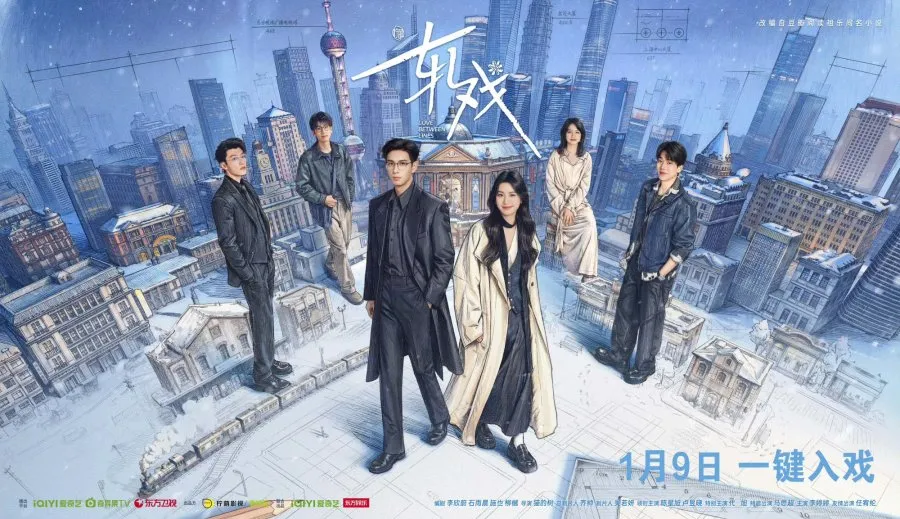
Love Between Lines Poster - Courtesy of iQIYI

|
DetailsRATING: (7/10)
NATIVE TITLE: 轧戏 – Yà xì YEAR: 2026 EPISODES: 28 DURATION: 45’ DIRECTOR: Mao De Shu SCREENWRITER: Li Xin Wei ORIGINAL CREATOR: Zhang Zu Le (Ga Xi- 轧戏) |


IN A NUTSHELL
- What to expect: a modern drama about the world of architecture that combines romance and personal growth in the setting of a Shanghai suspended between past and present, with an interesting foray into the world of role-playing games, intended as an escape from a life that doesn't always align with what we desire.
- Strengths: the tenderness of the main love story, the intense performances of Chen Xing Xu and Lu Yu Xiao, the intriguing playful setting, the careful and expressive direction.
- Weaknesses: the extensive use of genre clichés, the disappointing development of the secondary love story, the evanescence of the subplots.
- Recommended if you like: dramas with a strong romantic component and frequent displays of affection from the protagonists, plots that make extensive use of clichés, stories that deal with the career ambitions of young people in modern China and that deal with conflicting family relationships.
- Would I rewatch it? Yes, if I wanted a drama that focused on feelings.
Read on to find out what clichés are included in the series (some are truly unmissable!).
Love Between Lines is a story of feelings and ambition in which love, work, and personal dreams intertwine in a journey of shared growth. Between play and reality, ambition and fragility, the drama recounts the birth of love between Xiao Zhi Yu and Hu Xiu, a story that began on an uphill slope, then revealed itself to be a safe and welcoming place for both.
In my review of the drama Love Between Lines, I will explore this delicate balance, focusing on its strengths and weaknesses, to understand if and to what extent this story can move beyond its inevitable narrative limitations.
Plot
Hu Xiu is an architectural designer who has been working as an assistant at a real estate company for three years, with no career prospects. The day of her engagement banquet to Zhang Qi Ran, he doesn't show up, throwing her into a deep crisis.
To help her overcome this difficult time, her friend Zhao Xiao Rou convinces her to participate in a role-playing game at a theme park. There she meets Qin Xiao Yi, a charismatic and charming NPC who doesn't hesitate to use her to complete his mission, eliminating her from the game immediately afterward. This first encounter motivates her to continue participating in subsequent sessions in an attempt to beat him and gives her the courage to take charge of her life.
She thus decides to quit Shiyuan Real Estate and pursue her dream of becoming an architectural designer. However, the job search proves long and difficult, and to earn some money, Hu Xiu decides to rent her apartment in Shanghai's longtang to a wealthy professional.
Coincidentally, the tenant turns out to be none other than Qin Xiao Yi, aka Xiao Zhi Yu, the young founder of the Dynamism design firm, where Hu Xiu dreams of working. Thanks to this fortunate combination, Hu Xiu manages to secure a position as an assistant designer at Dynamism, and her relationship with Xiao Zhi Yu deepens until it becomes a stronger bond.
Together, the two face family and professional challenges, but everything falls apart when the truth emerges: Xiao Zhi Yu is the son of Qin Yu Zhe, the late chief architect of the New City Stadium, whose collapse twenty years earlier killed three workers and injured six, including Hu Xiu's father.

Love Between Lines Drama Review (No Spoilers)
Love Between Lines is a modern drama where love and personal growth meet against the backdrop of a Shanghai suspended between past and present. The drama explores the contrast between professional ambition and emotional fragility, between success and insecurity, revealing the value of collaboration, mutual support, and trust. It's a story of shared dreams and desires, where love becomes the place where we feel encouraged to pursue our goals, and play takes on the role of refuge, a momentary respite from the pressures of everyday life.
Plot
The plot, as a whole, presents a certain originality, especially thanks to the role-playing element, which makes the acquaintance between ML and FL less conventional than usual. It's true that the playful setting is more nuanced than the trailer suggests, but it still serves as a delicate emotional catalyst and the basis for some later twists.
As often happens in dramas — especially modern ones where action gives way to emotion — the plot doesn't aspire to rigorous realism. The coincidences that accompany the protagonists' meeting and growing closer sometimes seem almost too benign and are clearly intended to further the love story. However, far from clashing, these elements contribute to creating a familiar atmosphere, where verisimilitude gives way to the enchantment of the story.
Characters and love story
Despite its strict adherence to classic romantic stereotypes, the main love story manages to maintain a certain semblance of authenticity. The relationship between the two protagonists begins by following the familiar tropes of the enemy to lovers narrative, with a cold and reserved ML pitted against a naive and dreamy FL. However, it does so with such sweetness that the cliché isn't a limitation, but rather a promise of comfort and emotional continuity.
The narrative, in fact, doesn't dwell excessively on either the initial rivalry between the two or on the game of misunderstandings: the conflicts between the protagonists aren't dragged out beyond what's necessary, and misunderstandings don't become the main driving force of the story, leaving room for a more relaxed and sincere growth of their bond.
The drama then continues with the timeless trope of she fell first but he fell harder: while the FL is the first to take steps toward the ML, he is the one who becomes more deeply involved. As their relationship shifts from the playful to the real world, Xiao Zhi Yu becomes increasingly fascinated, almost enchanted, by Hu Xiu's sweet, naive nature, as if their every interaction renewed an unexpected sense of wonder within him.
In keeping with this deliberately idealized narrative dimension, the characters move within clearly recognizable boundaries. He embodies the now-familiar model of the wealthy and successful man: a prestigious professional position, a measured bearing, and that aura of confidence that suggests a far from modest bank account. She, on the other hand, embodies the figure of a talented young woman without solid financial foundations, forced to struggle to make ends meet while doggedly pursuing her career dream, until she is taken under the wing of the influential male protagonist.
And yet, what might easily seem predictable or even irritating on paper finds surprising restraint on screen. This is mainly due to the performances of the two main actors, who are capable of smoothing out the more rigid edges of their respective roles: he appears less distant and unpleasant than his archetype would suggest, she less awkward and petulant, creating characters that, despite their recurrence, manage to arouse empathy and participation.

Cast
The cast of Love Between Lines proves overall worthy of a story that intertwines strong family conflict with an equally pronounced romantic and dreamy element.
Chen Xing Xu proves himself a solid and charismatic performer—as well as a naturally affable actor—sensitively toning down his character's more rigid traits, making him less cold and unsympathetic than one might expect.
Alongside him, Lu Yu Xiao spontaneously brings to life a naive and dreamy protagonist, avoiding the classic tendency of the clumsy or whiny FL, and delivering a bright and credible young female figure.
The supporting cast of Li Ting Ting and Ren You Lun — the latter recently appearing in the unforgettable Twelve Letters — is also convincing, portraying two newlyweds tested by the ups and downs of daily life.
Dai Xu is intriguing enough as the protagonist's mischievous and not always correct half-brother, while Chen Yi Sha and Fu Jia enrich the narrative with performances rich in emotional contrasts and unspoken words, as Xiao Zhi Yu's mother and Hu Xiu's father, respectively.
Visual Aspects and Soundtrack
Overall, the staging helped make the drama engaging, readable, and enjoyable to watch, highlighting both the emotions and the visual beauty of the protagonists.
The direction stood out for its aesthetic care and narrative strength: the shots are refined and original, the visuals captivating, and the use of close-ups and scenic compositions helps guide the viewer through the characters' feelings and thoughts with almost didactic clarity.
The makeup, hair, and costumes were also very well done, but I must admit that I found the men's costumes particularly brilliant: Chen Xing Xu and Dai Xu's hairstyles and outfits were so captivating that I fell in love with them every time, while the women's costumes, while coherent, were less convincing.
The soundtrack for Love Between Lines is firmly rooted in the tradition of romantic soundtracks, featuring slow, melodic pieces that consistently accompany the more emotional scenes. While moving within familiar contexts, the songs stand out for their originality in sound, giving them a recognizable identity.
In the early stages of the story, the music is sometimes overly insistent, almost forcefully highlighting the romantic moments, dominating the scene rather than accompanying it. As the narrative progresses, however, it gradually becomes more discreet, learning to breathe with the characters and gracefully following the story's developments. It thus becomes a delicate thread, capable of marking and highlighting the different phases of the protagonists' relationship, gracefully supporting the narrative rather than overpowering it.

WARNING!
FROM THIS POINT ON THE SPOILER SECTION BEGINS. DO NOT CONTINUE IF YOU DO NOT WANT TO KNOW ALL THE DETAILS OF THE DRAMA.
Love Between Lines Drama Review (Spoilers)
What Works: The Love Story and the Socio-Cultural Insights
One of the most evident strengths of Love Between Lines lies precisely in its love story, which, despite starting with a series of largely stereotypical narrative devices, manages to stand out for its delicacy. The viewer's involvement grows slowly as the story progresses, following the very rhythm with which the feelings take shape on screen. When the relationship between the FL and the ML shifts from the playful to the professional level and he becomes her boss, their dynamic transforms naturally: she begins to treat him with solicitous attention, supports him, cares for him, and chooses to avoid contradicting him, as if wanting to protect her fragility beyond her apparent coldness. He, in turn, finds himself increasingly involved and affectionate, until he becomes deeply protective of her and sincerely desires to see her realize her dreams. It is in this silent growth, made up of small gestures and attentive glances, that the story finds its most authentic strength and manages to tug at the heartstrings.
Another interesting aspect of the drama lies in its nostalgic references to the old longtang (alleys) of Shanghai, to which the young protagonists show a clear attachment, both for family and professional reasons. The historic neighborhoods, with their buildings steeped in memory and architectural beauty, seem to tell of a past that resists the formidable, and often impersonal, modernity of the "new city," now pressing and oppressive. The result is a contrast that is not only visual but also emotional, evoking a sense of belonging and sweet melancholy in the protagonists. In this juxtaposition of past and present, the drama succeeds in instilling a sense of rootedness and fascination for what resists time, underscoring the value of history and urban identity.
No less interesting is the depiction of the internal dynamics of the Dynamism design firm: a workplace, as its name suggests, young, dynamic, and surprisingly harmonious, where collaboration and mutual support between colleagues and superiors allow projects to proceed smoothly. In this context, the firm stands out for its professionalism and talent, earning deserved recognition despite its relative inexperience, conveying an image of the workplace as a space for shared growth and mutual trust.

What Doesn't Work: Overuse of Romantic Stereotypes and Managing Subplots
It must be admitted that Love Between Lines isn't exactly a standout for its realism. As the plot unfolds, fortunate coincidences pile up with a predictability that's all too functional to the love story's progression, sometimes giving the impression that events meekly bend to the narrative's demands rather than adhering to a coherent internal logic. From ML's frantic desire to move into the very building where FL lives, to the ironically providential revelation that he's the architect she admires most, as well as the founding partner of the firm where she dreams of working, everything seems so perfect as to be fake. Added to these devices is a particularly overused stereotype, that of the love triangle, with both brothers — Pei Zhen and Xiao Zhi Yu — inevitably in love with FL, as if the narrative couldn't avoid this form of conflict.
This tendency to force things becomes particularly evident in certain narrative twists, such as when Hu Xiu accompanies Xiao Zhi Yu to a wedding only to discover that the groom is her ex: a revelation as predictable as it is unintentionally grotesque, made even more ridiculous by the groom's mother's reaction, who locks her in a hotel room for fear of a scene, forcing her to make a daring escape out the window worthy of a comedy film.
Other key sequences are no less stereotypical, from the scene in which ML blocks the car of his rival brother with his own car, which FL has climbed into, to his almost miraculous appearance to stop the statue from the set of Midnight Express from falling on her, or the kiss FL gives him while under the influence of hallucinogenic mushrooms.
Also emblematic is the scene in which Pei Zhen removes the bandage Hu Xiu applied to his forehead and carefully places it in a box, as if it were a relic. This gesture imbues the drama with emotional intensity, but it ends up veering into the surreal, raising a legitimate question: in what universe would a grown man keep a bandage used as a token of love?
To complete the picture, the screenwriters even manage to include a fire, an event typically found in period dramas, where flammable materials and open fires made such catastrophes more plausible. Here, however, the impression is that the fire appears not out of narrative necessity, but purely out of archive duty, as if the writers had a checklist of romantic clichés (similar to the one I identified in this article) to scrupulously tick off.
The drama's narrative structure, in short, takes refuge in tried-and-true tropes, seamlessly reproducing first the trope of enemy to lovers and then the trope of she fell first but he fell harder, without any real attempt to introduce new or subversive elements. The result is a story that favors the reassuring repetition of familiar formulas in pursuit of authentic originality, relying more on emotional delicacy than on a truly original narrative construction.
Another weakness of the drama is its handling of subplots, which, despite offering potentially interesting insights, often remain relegated to the background. A prime example of this is ML's secret investigation into the collapse of the New City Stadium, a tragedy that claimed the life of his father and which becomes the central narrative thread of the final episodes. Introduced with extreme discretion and initially treated rather marginally, this subplot only gains weight later, but ultimately proves to be central: it is, in fact, the true origin of the conflictual relationship between Xiao Zhi Yu and her mother and is also closely linked to the accident involving FL's father, which almost caused the breakup between the protagonists in episode 23. This late progression, however, weakens its emotional impact, leaving the feeling of narrative potential not fully exploited.
The development of the secondary couple is also unconvincing. Zhao Xiao Rou's request for divorce is made with a succinctness and decisiveness that seem unnatural: the decision to end the marriage after seeing her husband kissing a colleague — a gesture that seems to arise more from her initiative than from any real emotional involvement on his part, unable to react due to his innate indecision — comes across as a narrative device rather than an organically coherent choice. The attempt to introduce a strong, decisive female character, not prone to extreme sentimentality, is understandable in its intentions, but it ends up providing a less than edifying portrait of a figure who should have been among the most mature in the story.

Characters and Cast
Primary Characters
Hu Xiu/Xiu Xiu (Lu Yu Xiao) architectural designer who, due to her father's health problems, takes a job as an assistant at Shiyuan Real Estate after graduating. She remains stuck in that position for three years with no career prospects. After being dumped by her boyfriend, she enters a deep crisis from which she only emerges by participating in a role-playing game in which she is beaten by the charismatic and charming NPC Qin Xiao Yi, who later discovers that is Xiao Zhi Yu, the founding partner of the architectural firm where she applied for a job. Thanks to Xiao Zhi Yu, she manages to get the position of assistant designer at Dynamism and, despite her parents' misgivings, will embark on a promising career in architecture. In the Midnight Express universe, she plays the roles of: Sun Jia Ying, a Overseas Chemistry PhD who must help Feng You Jin become the new Lord of Rong City by giving him a secret formula for manufacturing weapons; An Na, a financial advisor for Country M., who must pretend to help Qin Xiao Yi become City Lord and then collaborate with Ning Ze Chen; Wu Jin, an investigator sent by S., who must obtain the token from the former City Lord to help a candidate of her choice become the new City Lord; Han Ying Zhi, a reporter, who must pretend to interview Qin Xiao Yi to steal his pocket watch and help Ning Ze Chen become the new City Lord; Song Li Na, a spy paid by a mysterious entity, who must help Governor Qin Xiao Yi become City Lord; Liu Ru Shi, a person of letters who must obtain Qin Xiao Yi's sapphire ring to prevent him from becoming City Lord.
Xiao Zhi Yu/Xiao Yu/Qin Xiao Yi (Chen Xing Xu) founding partner of the Dynamism design firm and a young talent on the Chinese architectural scene. He is actually Qin Xiao Yi, the son of the late chief designer of the New City Stadium, whose collapse twenty years earlier killed three workers and injured six, including Hu Xiu's father. Raised in the United States with his mother, he has never stopped secretly investigating the tragedy that occurred twenty years earlier, searching for evidence of his stepfather's involvement in his father's death. He is also one of the owners of Club ME, the graphic designer of the role-playing game Midnight Express, and one of the characters for the NPC Qin Xiao Yi.
Zhao Xiao Rou (Li Ting Ting), close friend of Hu Xiu and the owner of the Regard Cafe located next to Club ME. She has been married to Wang Guang Ming for two years, but their relationship is going through a period of crisis. After her friend's boyfriend dumps her, she drags her to play the role-playing game Midnight Express, where she meets Xiao Zhi Yu.
Pei Zhen (Dai Xu) son of Pei Kang Hua, General Manager and heir to the Forma Group (Feng Qiang). He is often pressured by his father, who deems him less capable than his half-brother, and has always been envious of Xiao Zhi Yu's successes so he has always tried to hinder her career. He falls in love with Hu Xiu, unaware that she actually has a weakness for Xiao Zhi Yu, and when he finds out, he tries everything he can to discredit his half-brother in order to win her over.
Supporting Characters
Bai Ren Zi (Chen Yi Sha), Hu Xiu's mother.
Hu Ding (Fu Jia), Hu Xiu's father. He was the lighting engineer in charge of the New City Stadium project and was injured in the leg in the building collapse.
Han Chuan Zhi, Hu Ding's co-worker and captain of the lighting construction team of the New City Stadium. He died in the building collapse, leaving his pregnant wife a widow.
Zhou Yan (Wang Ting), senior member of Dynamism and Xiao Zhi Yu's work partner.
Dong Qi, Dynamism's HR manager, who welcomes Hu Xiu on the day of the interview.
Jiang Tian Yi (He Long Long), Dynamism's lead architectural designer. He is bribed by Pei Zhen to reveal confidential details about the competing firm's projects. He is eventually forced to leave Dynamism.
Sun Yi Fei (Chen Tian Ming) senior architect at Dynamism. He is very easy-going and immediately takes a liking to Hu Xiu, with whom he often collaborates.
Shen Jie (Wang Zhi Min) financial director of Forma Group. He helps Pei Kang Hua falsify the books to obtain funds for new projects, often by inflating orders or purchasing inferior materials.
Wu Bin (Mu Tong) Pei Zhen's personal assistant.
Pei Kang Hua (Wang Zhi Fei) Pei Zhen's father and Xiao Zhi Yu's stepfather. He is Qin Yu Zhe's former partner and the current chairman of Forma Group. He purchased the inferior steel that caused the collapse of the New City Stadium and caused Qin Yu Zhe's death by passing it off as suicide.
Xiao Wan Yue (Tao Hui Min) mother of Xiao Zhi Yu and stepmother of Pei Zhen. She married Pei Kang Hua after her husband's untimely death to secure a future for her son.
Qin Yu Zhe (Yang Jun Bai) father of Xiao Zhi Yu and founding partner of the Forma Group. According to newspapers, he committed suicide after the stadium he had designed collapsed, killing three workers and injuring six, including Hu Xiu's father. In reality, he was framed by Pei Kang Hua, who killed him to avoid being reported.
Xu Fang (Wu Qi) associate of Qin Yu Zhe and owner of the steel mill that supplied the construction materials for the New City Stadium. Over the years, he helped Xiao Zhi Yu investigate the affair, not believing in Qin Yu Zhe's guilt.
Huang Yi De (Gao Guo), owner of Xinde Building Materials, a partner company of the Forma Group, founded immediately after the collapse of the New City Stadium. In reality, he is the only witness to the crimes committed by Pei Kang Hua, who, over the years, agreed to remain silent in exchange for financial support from Forma.
Xie Lin (Cai Gang), owner of the Lyman Group, a friend of Qin Yu Zhe. He issues a tender for the construction of the "Future Living" Project, aimed at redeveloping a suburban area of Shanghai, which is won by Dynamism.
Sun Da Qin (Li Bin), manager of the Lyman Group, oversees the tender for the "Future Living" Project.
Mr. Wu, director of Huasheng Building Materials. Initially, he agrees to supply Dynamism with the materials it needs for the "Future Living" Project, but then, under pressure from Forma, he backs out, forcing Xiao Zhi Yu to collaborate with his brother to obtain the necessary supplies.
Mr. Shen, owner of the small 3D ceramics company that Hu Xiu contacts when he discovers that all the large ceramic wall tiles manufacturers are controlled by the Form and cannot supply them with the materials necessary for the realization of the "Future Living" Project.
Mr. Wang (Guo Zhen), Dynamism client for whom Xiao Zhi Yu designed a hotel in a difficult-to-build area, he asks him to allow him to meet Xie Lin.
Wang Yue (Ding Xiao Ying), Mr. Wang's daughter and Xiao Zhi Yu's college junior. He attends her wedding to Zhang Qi Ran so he can meet Xie Lin, unaware that the groom is Hu Xiu's ex-fiancé.
Zhang Qi Ran (Wang Run Ze), Hu Xiu's fiancé, who dumps her on the day of their engagement banquet. Hu Xiu meets him again on the day of his wedding to Wang Yue, causing considerable embarrassment between him, the bride, her father-in-law, and Xiao Zhi Yu.
Wang Guang Ming (Ren You Lun), Xiao Rou's husband, who works at Longyuan as a software developer but has been developing an independent project with some colleagues for some time. To secure funding for the company, Zhiteng agrees to collaborate with Chi Xin, his college junior who has long been in love with him, which leads to a breakup with Xiao Rou.
Zhan Jie (Liu Yu Feng) Guang Ming's colleague, working together on the independent project "Solar Tech."
Chi Xin (Zhan Ni) Guang Ming's college junior, who has always been secretly in love with him. She works for Zhiteng, the company that will finance the "Solar Tech" project, and thus becomes close to him, causing the breakdown of his relationship with Xiao Rou.
Gong Huai Cong (Ma Si Chao) boss of the ME Club and Xiao Zhi Yu's business partner. He helps him on more than one occasion, including when he needs to rent Hu Xiu's apartment. After Zhi Yu stops acting as Qin Xiao Yi, he takes over the management of the ME Club. He is secretly in love with Zhao Xiao Rou and supports her when she divorces her husband.
Li Yue (Guo Zhe), junior student at the Drama College, is one of the NPCs in the game Midnight Express, where he plays Qin Xiao Yi during Xiao Zhi Yu's off duty. In one game session, he plays Zhang Bo Lun, a character tasked with obtaining Qin Xiao Yi's sapphire ring. To do so, he asks for Hu Xiu's help by agreeing to marry her in-game, much to Xiao Zhi Yu's ire.
Qian Jin Xin, operations manager of the park where Club ME and the Regard Cafe are located. To gain his favor, Wang Guang Ming invites him to play a Midnight Express session, but he tries to take advantage of Hu Xiu and gets into a heated argument with Zhao Xiao Rou, causing chaos among the players. To avenge his treatment, he attempts to report Zhao Xiao Rou for irregularities and then attempts to run the car she and Hu Xiu are riding in off the road. He is ultimately fired by the park management.
Qin Xiao Yi, NPC in the Midnight Express game, is the Military Governor of Rong City and a candidate to become the new City Lord. He is a very cunning and extremely calculating warlord.
Bao Luo Yu, NPC in the Midnight Express game, is the shady owner of the Central Hotel.
Ning Ze Chen, NPC in the Midnight Express game, is the devious Police Chief of Rong City and a candidate to become the new City Lord.
Feng You Jin (Zhao Hao Hong), NPC in the Midnight Express game, is the powerful Minister of Finance of Rong City and a candidate to become the new City Lord. He enjoys immense wealth and, as such, is very cautious.

Favorite Character: Hu Xiu
She is a complex and contrasting young woman: strong yet fragile, intelligent yet naive, determined yet in need of validation.
Despite life's difficulties and the burden of a past marked by her father's accident, she demonstrates remarkable courage, leaving her permanent job to pursue her professional dreams, and an innate talent that allows her to work with dedication and develop brilliant intuitions.
Her determination keeps her from slipping into self-pity or resentment: she holds nothing against her parents and seeks to fulfill herself through her own efforts, never relying on Xiao Zhi Yu's abilities, fame, or financial resources.
She has a sweet and understanding nature, capable of forgiving and encouraging: she doesn't blame Xiao Zhi Yu for her father's alleged mistakes and urges Pei Zhen not to be bent by Pei Kang Hua's authoritarian and domineering will.
Thanks to her optimism and positivity, she always manages to get what she wants and, at the same time, melts away the pain and hatred that have haunted Xiao Zhi Yu since childhood, helping him reconnect with his mother, from whom he had distanced himself after his father's death.
Despite her young age, she proves to be a balanced person, capable of managing her relationship with Xiao Zhi Yu in an adult manner without ever being too capricious or unreasonable, and of dealing with the small and large crises that affect them with maturity.
At the same time, she is a fair and consistent person: she always upholds her principles, rejecting Pei Zhen's advances and gifts even before she is officially linked to Xiao Zhi Yu.
Her strength, kindness, and emotional balance make her a positive character, both admirable and credible, capable of leaving a profound impression on those around her.
Un-Favorite Character: Zhao Xiao Rou
She is an ideally positive character who ends up becoming negative due to the exasperation of some of her character traits.
A woman who is extremely determined, resolute, and self-confident, her sweetness and altruism are overshadowed by a pride that makes her inflexible and at times authoritarian, and by an independence so marked that she always seems self-sufficient.
Although she represents a spur to Hu Xiu in times of crisis, her strength sometimes turns into withdrawal and stubbornness: sincerity becomes cynicism, determination becomes inflexibility.
She dislikes showing her vulnerability: she cries and expresses pain over her husband's betrayal only once, while the rest of the time she buries her suffering in her work and in plans to grow her business.
When she discovers her husband's alleged betrayal, she reacts with an almost surgical detachment: she doesn't want explanations, immediately asks for a divorce, and declares that she wants only to keep the good memories of their relationship. Rather than process the pain, she seems to want to erase it, immediately replacing it with new projects, new business ventures, new ambitions.
This coldness, however, is punctuated by subtle contradictions: his closeness to Gong Huai Cong, chosen as a confidant and comforting presence shortly after the divorce, betrays a longing for affection and reassurance that belies his ostentatious independence.
It is in this interplay of strength and fragility, of rigor and weakness, that the full complexity — and limitations — of a character are revealed, one who risks transforming his own firmness into arrogance and his determination into excessive rigidity, weakening his internal coherence.
RECOMMENDED:
- THE ROMANCE OF TIGER AND ROSE
- A DREAM WITHIN A DREAM
- RETURNING PEARL
- TWELVE LETTERS
- WHEN DESTINY BRINGS THE DEMON
Thanks for reading this far!
I hope you enjoyed my article. If you like my work and want to support me, buy me a coffee☕