
Legend of Zang Hai (2025) Chinese Drama Review | Plot and Cast
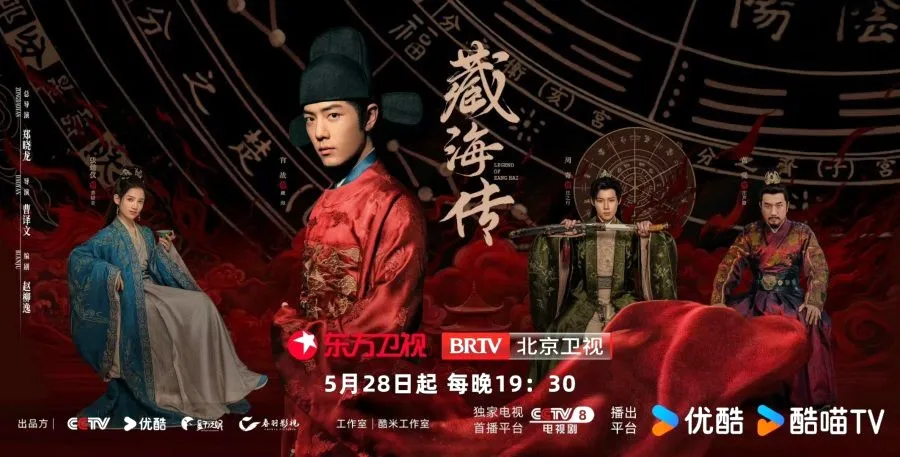
Legend of Zang Hai Poster - Courtesy of Youku

|
DetailsRATING: (8/10)
NATIVE TITLE: 藏海传 – záng hǎi zhuán YEAR: 2025 EPISODES: 40 DURATION: 45’ DIRECTOR: Zheng Xiao Long, Cao Yi Wen SCREENWRITER: Zhao Liu Yi ORIGINAL CREATOR:Nan Pai San Shu (藏海传 - The Legend of Cang Hai) |


IN A NUTSHELL
- What to expect: a gripping drama that blends revenge, intrigue, and political tension against the backdrop of a corrupt and ambitious court. Amid palace conspiracies, dangerous alliances, and power games, the story follows the young Zang Hai's quest for revenge as he navigates shady and dangerous figures, each driven by their own secret ambitions. Thanks to its subtle balance between strategy and restraint, the drama presents a tale rich in mystery and intricate relationships, where nothing is as it seems and every decision could put the protagonist's life at risk.
- Strengths: the complex and multifaceted characters, the deep script, the carefully crafted visuals.
- Weaknesses: the fluctuating narrative pace, the dissonance of some narrative elements, the weak romantic plot.
- Recommended if you like: Xiao Zhan, revenge stories set in bygone eras, realistic dramas with fantasy elements.
- Would I rewatch it? Yes, I always enjoy watching a drama with Xiao Zhan.
If you're curious to know what aspects of this drama didn't convince me, keep reading.
When revenge and fate intertwine in the vast sea of memory, Legend of Zang Hai is born, an epic that overwhelms and captivates. In this highly anticipated drama, Xiao Zhan returns to the small screen with a magnetic and intense role, embodying an enigmatic protagonist suspended between the shadows of a tragic past and the uncertainties of a precarious future.
In this review of the drama Legend of Zang Hai, I will explore every twist and turn of the plot, the direction, and the characters, trying to understand if this legend really can enter the Olympus of the most discussed and acclaimed titles of 2025.
" 知天易, 逆天难 "
[Knowing the sky is easy, going against the sky is difficult]
Plot
In the sixth year of the Zhenshun era, Kuai Duo, Director of the Imperial Astronomical Bureau of the Da Yong and an expert geomancer, is commissioned by the Emperor to build a Feng Shan altar at the foot of Mount Dansui, intended to celebrate the Da Yong's victory over Dongxia.
Three years later, however, a freak earthquake causes the altar to collapse. Kuai Duo rushes home, but is met by Zhuang Lu Yin, Marquis of Pingjin and general of the Da Yong, who has him and his entire family massacred in an attempt to gain something from him.
The only survivor of the massacre is Zhi Nu, Kuai Duo's eldest son, saved at the last minute by a mysterious benefactor who promises to help him avenge his parents.
The man entrusts the boy to the care of the stern Xing Dou and the jovial Gao Ming, who raise him and instruct him in everything he will need to carry out his revenge.
Ten years later, the death of the Empress Dowager and the dispute over her burial offer Zhi Nu the opportunity to get closer to the Marquis of Pingjin. Assuming the new identity of Zang Hai, an expert in geomancy and feng shui, he manages to enter the Marquis's residence and take the first steps on his long journey towards revenge, a journey that will lead him to uncover the hidden secrets of the court and the true motives for his family's massacre.
During this quest, he will be able to count on the aid of trusted allies — including Gao Ming, his childhood friends Guan Feng and Shi Lei, Marquis Zhuang's son Zhi Xing, and Princess Xiang Antu — while he must defend himself from the scheming of Zhuang Lu Yin and his subordinates, the influential Eunuch Cao Jing Xian, and the shadow of a third, mysterious adversary who will only reveal himself at the end, threatening to derail his plans and claim his life.
Thanks to his cunning and the support of his allies, Zang Hai will eventually achieve his revenge. But victory, as so often happens, will come at a price.
Focus: What Was Feng Shan Ceremony?

Legend of Zang Hai Drama Review (No Spoilers)
Legend of Zang Hai is a gripping revenge drama in which mystery and political machinations are effectively intertwined against the backdrop of a corrupt court and a timid and resigned Emperor, more inclined to rely on mysterious and arcane artifacts than to truly take the reins of the Empire and guide his ministers with determination.
The choice of protagonist is interesting: in contrast to many recent dramas, dominated by female heroines, the center of the story is a man who is neither a martial artist, nor a prince, nor even a deity, yet manages, using only his intellect, to overcome treacherous and powerful enemies.
Plot and Narrative Pace
The revenge plot, the driving force of the first half of the series, gradually gives way in the second half to the enigma surrounding the massacre of the protagonist's family and the search for the lost treasure that sparked the entire story. The alternation between these two threads creates an interesting narrative dynamic that, however, ultimately fails to always hold the viewer's attention.
The narrative, in fact, progresses slowly, following the plans and machinations with which Zang Hai seeks to trap his enemies. The twists, however, are inevitably limited by the fact that the protagonist can neither die nor be unmasked — otherwise the story would end — and by the fact that his stratagems are almost always revealed to the viewer in advance, making their outcome predictable, at least in general terms.
The lack of true parallel plots also contributes to the slower pace: aside from the protagonist, few characters have their own narrative space, and the only story we're truly called upon to follow is Zang Hai's.
Flashbacks to the protagonist's childhood and moments spent with his father break this monotony. These sequences not only enliven the narrative and offer insights into Zang Hai's extraordinary technical skills, but also allow the viewer to delve deeper into his past, making them empathize with him and drawing them closer to his family and the tragedy that marked his life.
Screenplay and Characters
The script for Legend of Zang Hai flows naturally and captures the viewer's interest with precise and well-crafted lines that add humanity and depth to the characters. From this perspective, certain narrative choices stand out for their visual and emotional impact, while also functioning as small acts of retribution within Zang Hai’s broader scheme of revenge.

The characters in this drama are never flat or predictable: almost all of them display surprising depth, with lights and shadows that make their choices believable and intense. Even the most arrogant hide weaknesses, and the most astute are not immune to mistakes or the specter of doubt and power.
Cast
The performances of the cast are remarkable, fully living up to the drama's ambitious production values.
Xiao Zhan confirms his gifted and talented acting and is extremely convincing as Zang Hai. His acting today seems much more mature and credible than in the past — just think of his decidedly more lighthearted portrayal of Ji Chong in the series The Wolf — though I was a little disappointed by his lack of affinity with his female co-lead.
Zhang Jingyi is as spontaneous and natural as ever, but as Princess Mingxiang Antu, she seemed slightly restrained. A real shame, because I remembered her as brilliant and intense as Hua Zhi in Blossoms in Adversity.
A pleasant surprise, however, were Zhou Qi and Yang Bo Xiao — the latter also recently seen in Youthful Glory — both convincing and promising performers whom I hope to see more often in leading roles.
Liang Chao was absolutely adorable as Master Gao Ming, the affectionate and ironic Shifu we all wish we had by our side.
Finally, I confess to having a soft spot for Wallace Chung, whom I already loved in The Sword and the Brocade and whom I equally appreciated in this drama as the charming Kuai Duo.
Finally, a round of applause goes to all the child actors, and especially Jiang Rui Lin, who plays the young Zhi Nu, offering a surprisingly believable and moving performance.
Visual Aspects and Soundtrack
Visually and aurally, Legend of Zang Hai offers moments of great charm.
The costumes are excellent without indulging in excessive ostentation: sober and elegant, they often appear even more refined precisely because they are far from the most ostentatious pomp. But what truly captures the eye are the hairstyles and elaborate hair accessories, particularly those of the Dongxia rulers, small masterpieces of craftsmanship that embellish the scenes with refined detail.
The battle and kung fu sequences are dynamic and enjoyable to watch, while the interiors — rich in antique objects and furnishings and perfectly lit — effectively convey the atmosphere of the court and noble residences. The exterior locations, on the other hand, are more conventional and rarely manage to leave such a distinctive impression.
Orchestrating everything is a refined and measured direction, fully commensurate with the work's ambition, capable of enhancing both the most intimate moments and the most spectacular sequences.
Completing the picture is an original and intriguing soundtrack, which immerses the viewer in the mysterious and solemn atmosphere of the story from the very first seconds.

WARNING!
FROM THIS POINT ON THE SPOILER SECTION BEGINS. DO NOT CONTINUE IF YOU DO NOT WANT TO KNOW ALL THE DETAILS OF THE DRAMA.
Legend of Zang Hai Drama Review (Spoilers)
What Works
The Screenplay
I greatly appreciated the screenplay for its fluidity and its ability to constantly maintain a subtle narrative tension. The dialogue is well-crafted, balanced, and rarely banal, and on more than one occasion the writing subtly captures the dynamics between the characters and the weight of their choices.
Some moments, in particular, reveal the elegance of the narrative construction. Such as the bitter irony of the scene in which the Marquis of Pingjin burns his arm while saving Zang Hai from the flames—the very man who, ten years earlier, had started the fire at the Kuai residence, risking the life of little Zhi Nu. Or the mirror effect in the episode in which Cao Jing Xian takes Zhuang Lu Yin's family hostage and threatens to kill them to obtain the Gui Seal, effectively replicating the same gesture Zhuang Lu Yin had made against Kuai Duo years earlier.
The climax comes in the sequence in which the Marquis of Pingjin, freed from prison by the Muji Army, marches toward the Imperial Palace while the martial drum of Eunuch Cao — busy in his residence performing a feat of war — ideally marks the rhythm of the march toward battle.
Moments like these demonstrate the screenplay's ability to weave together tension, irony, and emotional resonance, crafting a story that, despite some imperfections, often manages to engage and leave its mark.
The Construction of the Characters
In terms of character development, I must admit that this series consistently hits the mark. With rare exceptions, each character appears complex and multifaceted, with lights and shadows that make their choices believable and engaging. Even the most influential and arrogant characters hide a past marked by weakness and fragility, and the cunning are not immune to mistakes or the gnawing doubts of doubt, nor the sirens of power.
Of all of them, I found Zhuang Zhi Xing's evolution particularly touching. From a naive, spoiled, and lazy boy, he transforms into a determined and ambitious man, ready to fight for the recognition he deserves and the future he desires. Even though Zang Hai helped him avenge his mother by destroying his family and forcing him to start over in the army, Zhuang Zhi Xing never loses his determination, integrity, and values: in the end, he manages to achieve the future he had always hoped for, confirming the depth of the narrative path and the care put into building the characters.

What Doesn't Work
Questionable Narrative Choices
Although the series' story is developed in an interesting and original way, some plot details feels somewhat questionable.
The drama, in fact, begins as a highly realistic tale of court intrigue, personal vendettas, and power games, before gradually introducing overtly fantastical elements, such as the Gui Seal and the unkillable ghost warriors. This narrative choice seems a bit forced and unnecessary, especially since the rest of the story is already extremely intriguing and carefully crafted. The object around which events revolve could have remained a supposedly magical artifact — lacking real power, but charged with symbolic meaning — capable of representing the dominion and control of power without having to resort to the usual supernatural element that endangers the entire nation.
Another aspect that feels slightly redundant is the way the story evolves over the course of the episodes. Initially presented as a tale of Zang Hai's personal revenge, the drama ultimately devolves into the more standard narrative in which the protagonist must save the world from a lethal — and a supernatural — threat, somewhat distancing itself from the genuinely individualistic dimension that characterized the first half of the series.
The writers' handling of the explanatory narratives also seems to slip a bit in the final moments. While in the first episodes they were well-distributed and inserted at the right times, providing information without weighing down the narrative, in the final episodes they become decidedly more frequent. At a certain point, it almost seems as if everyone who meets Zang Hai has a long story from their past to tell him, often to clarify concepts that could have been summarized in a few lines.
The most obvious case concerns the Queen of Dongxia, who retraces her relationship with Kuai Duo and narrates the legend of the Gui Seal, but also the Emperor, who recalls the origin of his friendship with Kuai Duo, and Zhao Bing Wen, who recounts how he became close to Zang Hai's father and how his partnership with Zhuang Lu Yin and Lu Min, who later became Cao Jing Xian, was born.
Romance
As for the romantic element, I had the impression that in this series it ended up functioning more as a disturbance than as a true completion of the plot. The two protagonists, in fact, never seem truly involved or attracted to each other: on the contrary, every scene they have together conveys more of a sense of awkwardness and unease than of genuine tenderness.
The fact that Xiang Antu was initially mistaken by Zang Hai for an enemy certainly didn't help build a sincere relationship between the two, but even when the misunderstanding is overcome, their dialogue remains surprisingly unromantic, and their affections seem cold and restrained.
Even when Zang Hai finally manages to loosen his grip on his obsession with revenge and open himself to the possibility of experiencing feelings other than hatred, he never seems truly fascinated by Antu.
For her part, she seems to admire his intelligence, wit, and rhetorical skill more than his person. The result is a relationship that always remains a little distant, incapable of generating the emotional complicity that one would expect from a true romantic storyline.
Ending
The ending, unfortunately, is the part that left me most perplexed. After a narrative construction that was solid and measured in many respects, the final episodes suddenly seem to lose direction, as if the story, having reached the decisive moment, no longer knows which path to take.
The constant movement of the two protagonists from one country to another—always pursued by the omnipresent Zhao Bing Wen, who appears almost everywhere like an inescapable shadow—ends up giving the narrative a frenetic yet paradoxically chaotic pace, closer to an improvised escape than the conclusion of a patiently developed plan.
The feeling is that the screenwriters, rather than tightening the plot threads, have chosen to add new ones, piling on situations and twists that seem more designed to prolong the story than to truly bring it to completion. The result is a somewhat confusing epilogue, in which some narrative choices seem a bit hasty—such as the sudden appearance of the new Emperor, a figure never shown or introduced in previous episodes.
After such a carefully constructed plot, one would have expected a clearer and more linear conclusion; instead, the ending leaves the feeling of a story that, at the very last moment, loses its bearings.

Characters and Cast
Primary Characters
Kuai Zhi Nu/Zang Hai/Xiao Hai (Jiang Rui Lin | Xiao Zhan) son of Kuai Duo. He is the sole survivor of his family's extermination and, to exact revenge, assumes the identity of Zang Hai, an orphan from the city of Qingquan in Jiangning Prefecture, and takes a job as an attendant at the residence of the Marquis of Pingjin.
Mingxiang Antu/Xiang Antu/Princess Rou Yuan (Zhang Jingyi) Princess of Dongxia who arrived in Da Yong as a hostage in the ninth year of the Zhenshun era. She is the owner of the Zhen Tower, an entertainment venue whose main attraction is the Ba Gong Zi shadow theater. She falls in love with Zang Hai, but their relationship does not have an easy outcome.
Gao Ming (Liang Chao) shifu of Zhi Nu who gives him lessons in strategy and diplomacy. He follows Zhi Nu/Zang Hai to the capital to aid him in his revenge, but is ultimately forced to sacrifice himself to allow him to escape his third enemy.
Zhuang Zhi Xing (Zhou Qi) is the second son of the Marquis of Pingjin. He is intelligent and ambitious, but the First Lady has pushed him to lead a life of idleness and pleasure in order to elevate her son in his father's eyes. Zang Hai will exploit the resentment he harbors over his mother's death to enlist his help in the fight against the Marquis.
Zhuang Lu Yin (Huang Jue) is the Marquis of Pingjin and a general of the Da Yong, appointed Grand Master of Glorious Happiness after his victory over Dongxia. In the thirty-fifth year of the Wuhe era, he fights against the ghost warriors of Dongxia and is heavily defeated, but, having reorganized his troops, in the sixth year of the Zhenshun era, he manages to conquer enemy territory. He is one of the architects of the massacre at the Kuai residence, during which he stole the bronze fish needed to activate the Gui Seal.
Cao Jing Xian/Lu Min (Xing Min Shan) Chief Eunuch, Keeper of the Imperial Seal, Director of the Ceremonial Directorate, and Head of the Imperial Surveillance Bureau. At around the age of ten, he entered the Da Yong Academy, where future Imperial officials are trained, but coming from a poor family, he was constantly bullied by his classmates. The only ones he got along with were Zhuang Lu Yin and Zhao Bing Wen, because they came from less prestigious families like his. To avenge the bullying, one night the three let one of their tormentors drown, and he was accused of the murder, castrated, and forced to enter the palace as a eunuch.
Zhao Bing Wen (Tian Xiao Jie) Minister of Revenue and Deputy Director of the Grand Secretariat. In the first year of the Zhengshun era, when he was appointed Deputy Minister of Revenue, he was unjustly implicated in a major construction corruption case. Only thanks to Kuai Duo's intercession did he receive a light sentence, namely demotion and expulsion from the capital. From then on, he kept in touch with Kuai Duo by letter, and when he learned that his friend was returning to the capital to collect his family after the collapse of the Feng Shan altar, he rushed to him but found his residence destroyed by fire.
Supporting Characters
Kuai Duo (Wallace Chung), former Director of the Imperial Astronomical Bureau and Da Yong's finest geomancer. During his childhood, he was a classmate of the future Emperor, sharing their passion for carpentry. Later, he became one of the Emperor's most trusted ministers, so much so that he was ordered to find the Gui Seal, a national treasure of Dongxia, which supposedly summons a powerful army of ghost soldiers. In the ninth year of the Zhenshun era, he accomplished this task by delivering the Gui Seal to the Emperor, but failed to present him with the bronze fish needed to activate it. That same night, he and his entire family were killed by the Marquis of Pingjin, who sought to steal the Gui Seal.
Zhao Shang Xian (Chen Yan Xi), wife of Kuai Duo and mother of Zhi Nu and Yue Nu. She died during the massacre at the Kuai Residence.
Kuai Yue Nu (Wang Xing Yi) Kuai Duo's daughter and Zhi Nu's younger sister. She dies during the massacre at the Kuai Mansion.
Gou Sheng (Zhang Jing Yi) Kuai Duo's disciple and friend of Zhi Nu. During the massacre at the Kuai Mansion, he is mistaken for Zhi Nu and dies in her place.
Guan Feng/Hui Jian (Song Yuan Fu) Kuai Duo's disciple and friend of Zhi Nu. During the massacre at the Kuai Mansion, he is out cutting firewood in the mountains and is saved, but upon learning of the tragedy, he decides to take revenge on Zhuang Lu Yin. To do so, he takes a job as an attendant at his residence, but after Yang Zhen's death, he is fired like all the other younger attendants, so he decides to infiltrate the organization again, stealing Zang Hai's face and identity. However, he recognizes him and manages to gain recognition by retrieving a member of his family and gaining an ally for his revenge.
Shi Lei (Yang Bo Xiao), an orphaned disciple of Kaizhen Sanren (Xu Ai Min). His shifu dies of illness shortly after taking Guan Feng as his disciple, so he becomes the newcomer's shifu, but in reality the two boys share a close friendship.
Xing Dou (Zhang Duo), Zhi Nu's shifu, who teaches him geomancy and construction at his residence in Qingquan, Jiangning Prefecture, which he has converted into a school. He commits suicide by setting fire to his residence shortly after Zhi Nu's departure to avoid leaving clues about the boy's past.
Liu Chu (Chen Dong), Zhi Nu's shifu, who teaches him to control his emotions and not give in to his feelings. She will be the only one of her three shifu to survive the third enemy's plots.
Jiang Xiang (Zhao Zi Qi) First Lady of the Marquis of Pingjin Residence and mother of Zhuang Zhi Fu. She is the daughter of the former Minister of Rites, Jiang Jin, who helped the Marquis of Pingjin advance his career within the court. To maintain her title as First Lady, she discredits Shen Wan, Zhuang Lu Yin's second wife and his beloved consort, in the eyes of her husband and slowly poisons her with the Southern Lone Star flower until she dies.
Zhuang Zhi Fu (Liu Chao) eldest son of the Marquis of Pingjin and Deputy Minister of Works. He is a greedy and petty man who exploited his father's prestige to obtain the post of Deputy Minister of Works and over the years has embezzled a large sum of public money thanks to the secret support of the Eunuch Cao Jing Xian.
Yue Rou, wife of Zhuang Zhi Fu.
Shen Wan (Xu Ling Yue) Second Lady of the Marquis of Pingjin Mansion and mother of Zhuang Zhi Xing. She is the daughter of a former comrade-in-arms of Zhuang Lu Yin's father and the love of his youth. During the campaign against Dongxia, she stood by the Marquis in place of his wife, and their union produced Zhi Xing. However, to avoid ruining his career, she agreed to step aside in favor of Jiang Xiang. Later, to safeguard his son's future, Jiang Xiang poisoned her to death with the seeds of the Southern Lone Star flower.
Zhang Shu (Wang Hai Tao) and Xiang Hong (Liu Hao Yu) were Zhuang Zhi Xing's battalion comrades who later became his subordinates.
Zhuang Shan (Tan Yang) butler of the Marquis of Pingjin's Mansion.
Yang Zhen (Shao Wen) right-hand man of the Marquis of Pingjin and head of the attendants at the Zhuang Mansion. He is devious and influential, keeping all of the Marquis's attendants in check, preventing them from being noticed by their master and preventing the most intelligent ones from emerging. He is the one who faked the bandit attack on the Kuai Mansion and set fire to the house to cover up the evidence.
Qu Jiao (Yang Fan) bodyguard of the Marquis of Pingjin and commander of the guards at his residence. He does the Marquis's dirty work and has no qualms about killing innocents, acting cruelly and brutally. He is the one who carries out the massacre at the Kuai Mansion.
Chu Huai Ming (Sha Bao Liang) is a low-ranking official in the Imperial Astronomical Bureau and Kuai Duo's subordinate. He is a mediocre and opportunistic man, so much so that, after Kuai Duo's death, he allies himself with the Marquis of Pingjin and, thanks to him, obtains the role of Director of the Imperial Astronomical Bureau.
Emperor of Da Yong (Zhang Guo Qiang) is a meek and timid man whose greatest desire is to devote himself exclusively to carpentry. He is the one who tasks Kuai Duo with finding the Gui Seal, and it is to him that the man delivers it immediately after returning from Dongxia, failing, however, to give him the bronze fish needed to activate it. He will die at the hands of Zhao Bing Wen.
Sun De Fang (Shi Yu) is a eunuch palace attendant and personal secretary to the Emperor.
Xue Zhao (Zhao Li Jing) Commander of the Imperial Guards.
Prince of Yong Rong (Qiao Zhen Yu) The Emperor's younger brother and a passionate collector of ancient coins. To get close to him, Zang Hai will use the Zhenyou Tongbao coin collection assembled by Chu Huai Ming, but will have to compromise with Xiang Antu to obtain the extremely rare Zhesan coin that completes the collection.
Shen Yong (Rui Wei Hang) Assistant Minister of the Imperial Entertainment Court and secretary to the Prince of Yong Rong.
Lu Jin (Shi Yan Pei) Adopted son of Cao Jing Xian and Supervisor of the Imperial Surveillance Bureau.
Lu Yan (Li Jia Xin) Adopted daughter of Cao Jing Xian, his attendant and bodyguard.
Lu Ran (Wu Zhi Qiang) adopted son of Cao Jing Xian and Sub-Officer of the Imperial Surveillance Bureau.
Mingyu Suti (Yu Nan) tenth Queen of Dongxia, mother of Mingxiang Yin Zhu and Mingxiang Antu. She is the daughter of Minglv Huda.
Minglv Huda, ninth Queen of Dongxia, the last to use the Gui Seal to summon the 30,000 ghost warriors and defeat Da Yong's army. Before her, the only one to have harnessed its power was Fuxian, the founding Queen of Dongxia, who, three hundred years earlier, had conquered the northern plains using the Gui Seal. Legend has it that the royal lineage of Dongxia descends directly from the Lady of Kunlun, creator of the Seal. However, this implies that controlling the ghost warriors requires the blood sacrifice of a descendant of the Lady of Kunlun. For this reason, the Queens who used the Seal died and forbade their descendants from using it.
Zhang Mie, advisor to Queen Minglv Huda, who, in the thirty-fifth year of the Wuhe era, advised her to use the Gui Seal to defeat the Da Yong, who was dangerously advancing into their territories. After the Queen's death, he became the guardian of the shrine housing the Gui Seal and recorded the unfortunate events related to its use in a memorial.
Mingxiang Yin Zhu (Wang Yun Zhi), Antu's older sister. She ascends to the throne of Dongxia after Mingyu Suti is killed by Eunuch Cao.
Feng Liu (Wu Jiao) and Ying Qi (Ying Shi Ming) attendants of Xiang Antu.
Zhao Tong Er/Ba Gong Zi (Yang Yu Tong) daughter of the Minister of Revenue and friend of Xiang Antu. He is the playwright of Zhen Tower.
Shi Yi Ping (Jin Tie Feng) Minister of Personnel and Chief of the Grand Secretariat.
Wang Shi Qi (Sun Yi Li) Deputy Minister of Personnel.
Huang Shen (Ma Xue Lei) Minister of Rites.
He Zi Qing (Jiang Kai Wen) Deputy Minister of the Ministry of Rites. He is one of Cao Jing Xian's supporters at court.
Lv Yi Ze (Leng Hai Ming) Minister of Public Works.
Feng Zhang (Zhao Cuo Ying) Deputy Minister of War and Chief Examiner of the Imperial Military Examination. He is bribed by Zhaung Lu Yin to help Zhuang Zhi Xing come first in the Imperial Military Examination.
Wang Ren Liang, Superintendent of the Ministry of War and Examiner of the Imperial Military Examination. He is bribed by Zhaung Lu Yin to help Zhuang Zhi Xing win the Imperial Military Examination.
Yuan Cong, Section Chief of the Ministry of War. He is bribed by Zhaung Lu Yin to help Zhuang Zhi Xing win the Imperial Military Examination.
Shi Quan/Lu Fen (Liu Ming Ming) Mortuary Officer, Prison Mortuary Division, Imperial Astronomical Bureau, later appointed Deputy Inspector of the Imperial Astronomical Bureau by Zang Hai. He is actually one of Eunuch Cao's adopted sons, infiltrating the Imperial Astronomical Bureau to monitor Chu Huai Ming's search for the Gui Seal.
Ming Shi Ning (Wang Fei) Calendrical Officer of the Five Bureaus, Astronomical Division, Imperial Astronomical Bureau.
Lin Wei, Hydraulic Clock Officer of the Five Bureaus, Time Recording Division, Imperial Astronomical Bureau.
Shang Jiu (Chen Wei Xu) Forestry Officer, Forestry Division, Imperial Astronomical Bureau.
Chang Wu Yi (Zhao Zhi Gang) Calender Officer of the Five Bureaus, Observation and Surveying Division, Imperial Astronomical Bureau.
Ji Qun (Huang Jun Peng) Former Calender Officer of the Five Bureaus of the Imperial Astronomical Bureau and colleague of Kuai Duo. After the latter's death and the promotion of Chu Huai Ming to Director of the Imperial Astronomical Bureau, he was dismissed and forced to work as a laborer for the Ministry of Works.
Fu Zhi Song, grandson of the late Empress Dowager, General of the Central Army and Commander-in-Chief of Zhongzhou Prefecture. He dies during the Zhongzhou flood, fulfilling Zang Hai's prediction and allowing him to gain the trust of the Marquis of Pingjin and the post of Director of the Imperial Astronomical Bureau following Chu Huai Ming's demotion.

Favorite Character: Gao Ming
He is cheerful, positive, and encouraging.
From the first day Zhi Nu arrives at Xing Dou's residence, he supports him and stays by his side, so he doesn't miss his recently deceased family.
He is a master of transformation and persuasion, as well as a skilled forger, all qualities that make him indispensable to Zang Hai on his perilous journey toward revenge.
He constantly accompanies him on his journey, helping him reflect and find solutions in the most difficult situations.
He faces adversity with a positive spirit and never fails to lend a hand to Zang Hai, even by making his home welcoming or preparing him breakfast in the morning.
He is one of the few people Zang Hai trusts unconditionally, so much so that he considers him a father, and he sees Xiao Hai as a son, so much so that he harshly rebukes him when, to free Xiang Antu, he presents himself alone before the Emperor.
His kindness will cost him his life because he will be betrayed by the very benefactor who had saved him as a child and he will sacrifice himself to ensure Zang Hai's survival.
Un-Favorite Character: Mingxiang Antu
While not a negative character, she's the one I liked the least due to her insolent, ambiguous, and capricious attitude.
She's the one who, during her first meeting with Zhi Nu, hits him with her whip simply for sneaking into her carriage.
When she meets Zang Hai, although she appreciates his wit and eloquence, because he refuses to work for her, she tries everything she can to sabotage him.
As the owner of the Zhen Tower, she's expected to be as smart and persuasive as Zang Hai, but in reality, she only manages to get the better of him by exploiting her power and the foolish blackmail she uses against him.
Even in romantic moments, she can't please him, always ending up imposing her will by force.
When he imprisons her in the underground chamber beneath his residence, she never tries to escape, only trying, with limited success, to convince him that she is not the enemy he seeks.
The only thing she is truly skilled at is fighting, but this skill still prevents her from saving her mother in the fight against Eunuch Cao.
Her knowledge of Dongxia prevents her from escaping Zhao Bing Wen's spies, who immediately report her presence to the new queen. Despite being her sister, the queen plans to marry her to an enemy king, and even then she must rely on Zang Hai's advice to escape.
Focus: What Was Feng Shan Ceremony?
Feng Shan (封禪 – Fēng Shàn) was a special ceremony performed by the Chinese Emperors (from the Zhou Dynasty onwards) to honor heaven and earth. The Feng sacrifice was performed on top of the mountain to honor heaven, while the Shan sacrifice was performed at the foot of the mountain to honor earth. Completing the Feng Shan ceremony allowed the Emperor to be regarded as one who enjoyed the support of heaven.
RECOMMENDED:
- TWISTED FATE OF LOVE
- JUN JIU LING
- THE LONG BALLAD
- THE INGENIOUS ONE
- LOVE OF NIRVANA
Thanks for reading this far!
I hope you enjoyed my article. If you like my work and want to support me, buy me a coffee ☕