
C-Drama Locations: South China's Most Famous Film Studios
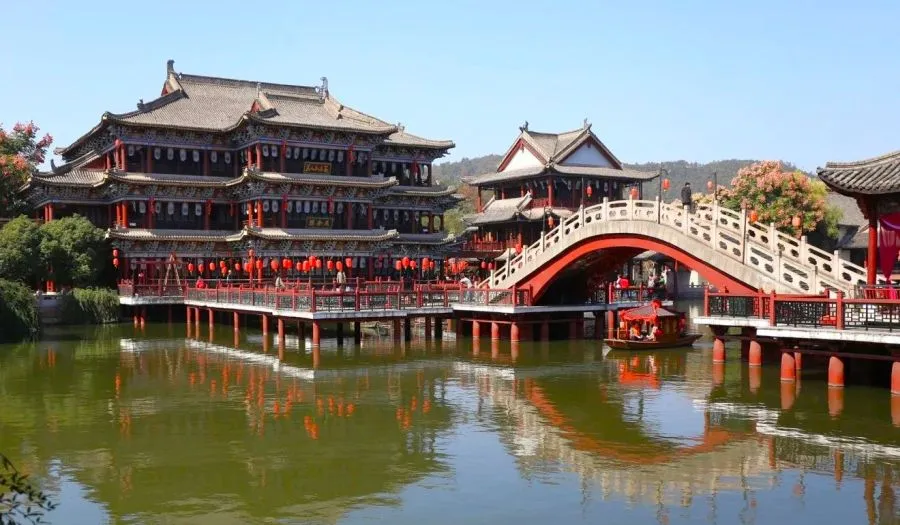
Hengdian World Studios: main building of Along the River During the Qingming Festival Area - Courtesy of South China Morning Post
IN A NUTSHELL
- Contents: In China, the boom in costume dramas has required the creation of large-scale, ad hoc infrastructure to accommodate filming. This has led to the construction of large film campuses that have over time become national and international tourist attractions. In this first article, I introduce the main audiovisual production hubs in southern China, encompassing the provinces of Zhejiang and Guangdong.
- Locations described:
- Hengdian World Studios
- Jiuxietan Scenic Area
- Xiangshan Global Studios
- Duyun Qin and Han Studio City
- CCTV Nanhai Movie and Tv Town
- Zhongshan Movie and Television Town
Context and Development
Over the past thirty years, the boom in C-dramas—particularly costume productions—has transformed entire areas of China into veritable cinematic universes. In the south of the country, between Zhejiang and Guangdong, monumental-scale production campuses have sprung up: life-size reconstructed historical cities, modular backlots, imperial palaces, ancient streets, and soundstages equipped with advanced technology.
Here, the sets are not just a filming location, but a complete production ecosystem: different crews can work simultaneously, sharing infrastructure and reducing time and costs.
Over time, these spaces have transformed into tourist attractions, attracting fans and the curious from China and abroad, creating a commercial network beneficial to both the film industry and the regions involved.
In this first article, I will focus on the main hubs in southern China, starting with the imposing Hengdian World Studios, the largest film complex in the world, and then moving on to equally strategic entities such as Xiangshan Film and Television City, CCTV Nanhai Movie and TV Town, Zhongshan Movie & Television Town, and the picturesque Jiuxietan Scenic Area. These facilities differ in origin, size, and importance, but they all share a central role in the Chinese audiovisual industry and a strong appeal for fans of historical dramas.
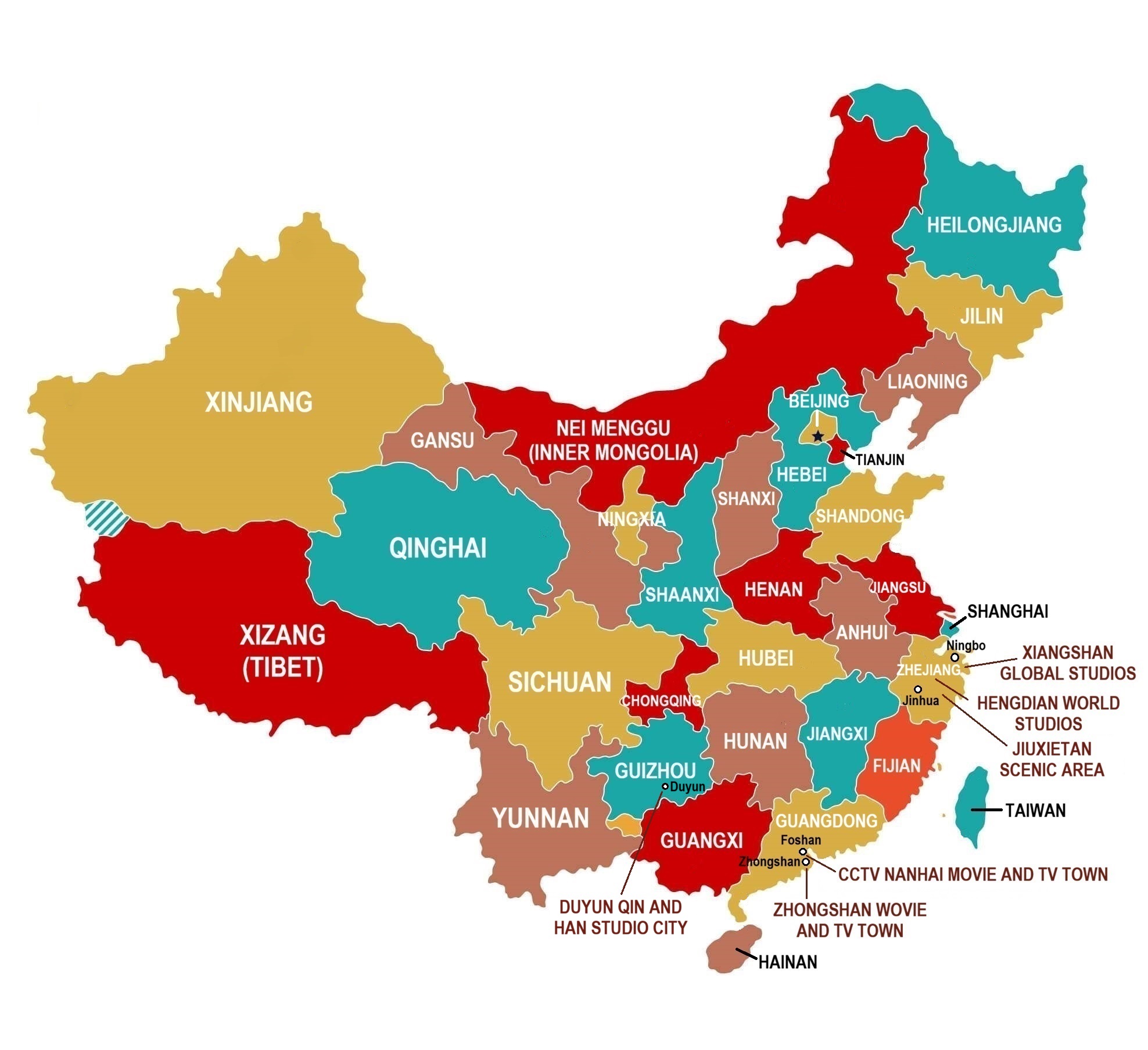
NOTE: the complete list of Chinese film locations is potentially endless. The places mentioned here — visually identified in the map at the end of the article — are the most well-known, that is, those most cited in travel guides and those most frequently featured in television and film productions. If you plan to visit one of the parks mentioned in the article, always refer to the facility's official website and/or the websites of the tour operators that organize trips there to ensure you have access to the most recent and up-to-date information.
Hengdian World Studios

Where It Is Located and Numbers
Hengdian World Studios (横店影视城) is located in the town of Hengdian (Dongyang City-County, Zhejiang Province), about five hours from Shanghai. It is considered the largest film set complex in the world in terms of size and variety: many international news sources classify it as the most impressive and important production center for historical films and dramas in China.
Their history began in 1996 with the reconstruction of a Guangzhou street for director Xie Jin's blockbuster film The Opium War. The following year, a set was built to film a film about Emperor Qin Shi Huang, and a series of locations were subsequently added, making this complex one of the largest and most used for the production of Chinese historical films and dramas.
Every year, Hengdian World Studios hosts hundreds of film crews, and a significant number of Chinese historical dramas are shot here. Indeed, two-thirds of historical dramas use Hengdian sets to film at least some of their scenes.
In 2010, Hengdian World Studios received accreditation as a 5A National Tourist Site, and is now considered the most popular tourist destination in Dongyang District—visited by as many as 20 million people annually.1
Location and Attractions
According to the official website, Hengdian is home to a total of a dozen filming sites (or “cities”) and permanent sets that include themed backlots and 1:1 scale ancient cities, as well as indoor soundstages and soundstages for controlled scenes and VFX production.
The outdoor sets are mainly eight:
- The Palace of Ming and Qing Dynasties. An exact replica of Beijing's Forbidden City. Built in 1998, it is the largest set at Hengdian World Studios and perfectly reproduces the interiors of the palaces and courtyards of the Ming and Qing eras.
- The Palace of Emperor Qin. This imperial residence, located not far from the Palace of the Ming and Qing Dynasties, is modeled after the Xiangyang Palace, the imperial palace of the ancient Qin Dynasty. Its construction dates back to 1997 and comprises a total of 72 buildings and rooms, including the throne hall, a pagoda, the main gate, and an imposing defensive wall measuring 1.6 kilometers long and up to 18 meters high. Unlike the Palace of the Ming and Qing Dynasties, the Palace of the Qin Emperor does not strictly follow the architectural dictates of the Qin era, and is therefore often used as a setting for fantasy dramas or those generally set in ancient times.
- Along the River During the Qingming Festival. A scenic area dedicated to the Northern Song Dynasty shooting, it was inspired by the painting Along the River During the Qingming Festival (清明上河图 - Qīngmíng Shànghé Tú) by the famous Song Dynasty painter Zhang Zeduan. The set is divided into inner and outer walls and occupies an area of 40 hectares, with over 120 buildings, 6 bridges, 9 piers, 6 ships, and 14 archways.
- Guangzhou e Hong Kong Street. A faithful recreation of the streets of Guangzhou and Hong Kong in the 1840s, a time when British influence in China was still very strong. Here you can admire 30 splendid European-style buildings, meticulously recreated based on a photo taken of Guangzhou in 1840 (the era of the Opium War and the Sino-Japanese War). This set also features some iconic buildings of Victorian Hong Kong, including the British Governor's Palace, HSBC Bank, Queen's Road, St. John's Church, Chatter Street, and government buildings.
- The Ming and Qing Dynasty Folk Residences Exhibition Area. It is the most picturesque and complex location of the entire structure, the one that required the greatest investment and the longest construction times. Thanks to its historical accuracy and architectural precision, it has been named "China Foundation for Cultural Heritage Conservation Demonstration Base" and "China Ancient Folk Houses Protection Base." It recreates the area of Nanjing located along the Qinhuai River, known, in the Tang and Ming eras, as the "Ten-Mile Qinhuai River" (十里秦淮 - Shílǐ qínhuái). During the Ming era, this was the most flourishing area of the city, frequented by poets, artists, and scholars, and characterized by buildings with pointed eaves and white walls, typical of the Gangnam area. The set extends over 60 hectares and is divided into the Qinhuai River Scenic Area and the Peach Blossom Scenic Area: the former recreates the appearance of the ancient city of Nanjing located along the banks of the Qinhuai River (including the Confucius Temple), while the latter is an urban agglomeration of around 200 houses reminiscent of the buildings of the provinces of Zhejiang, Anhui and Jiangxi.
- The Old Summer Palace. Set dedicated to the Yuánmíng Yuán (圓明園), whose unique history makes it the most visited location in the park. Historically, the Old Summer Palace was a complex of buildings and gardens located not far from the Imperial City of Beijing (紫禁城 - Zǐjìnchéng) and was almost completely destroyed in 1860 due to a fire started by the British during the Second Opium War. The original structure was never rebuilt because the Chinese authorities wanted the people to remember that event, but in 2015, the Hengdian Group decided to bring the Old Summer Palace back to life through the visual aid of old documents. The professionals in charge of the design managed to reconstruct the complex with a 95% accuracy rate, faithfully reproducing, among other features, the western tower, the fountain, the pavilion, and the complex's enormous lake.
- The Spring and Autumn and Tang Park. A location primarily dedicated to film and television shooting, it features architectural styles typical of the Spring and Autumn Period and the Tang Dynasty. It comprises the Spring and Autumn North Park, the Spring and Autumn South Park, and the Tang Dynasty Park, and covers a total area of 50,000 square meters.
- The Chinese Culture Park. Complex that includes buildings inspired by ancient Chinese architecture and has been the setting for some very famous dramas including Chinese Paladin, Legend of the Ancient Sword and Eternal Love of Dream.

Hengdian also has no shortage of recreational areas, including:
- the Dream Valley, a large night-time amusement park dedicated to the environment and natural phenomena;
- the experimental theme park Dream Bund which recreates Shanghai in the 1930s and 1940s, integrating an exhibition dedicated to the history of cinema and television with various entertainment activities;
- the Dreamful Spring Valley, a luxurious spa resort surrounded by imposing mountains and crossed by numerous streams, excellent for relaxation and outdoor activities.2
During the visit it is also possible to make souvenir films in the specially prepared sets or attend the numerous shows offered in the various themed locations, such as traditional dances with high-tech visual effects, acrobatic shows and theatrical performances inspired by Shanghai in the 1930s and 1940s.
Hosted Productions
Hengdian is a prime location for a wide range of productions: from major historical films to blockbusters to television series. The vast array of sets allows directors to shoot spectacular and historically accurate scenes without leaving the studio grounds.
The Qin Emperor's Palace, for example, has been the setting for films such as The Emperor and the Assassin, Hero, The Promise, and Painted Skin, as well as TV series including A Step into the Past and Joy of Life.
The Palace of the Ming and Qing Dynasties hosted the filming of Curse of the Golden Flower, War and Beauty, The Palace: the Lock Heart Jade, Empresses in the Palace, and Story of Yanxi Palace.
The Scenic Area Along the River During the Qingming Festival served as the backdrop for the dramas Chinese Paladin, The Journey of Flower, The Story of Ming Lan, The Untamed, and Legend of Zanghai.
Finally, the Ming and Qing Dynasty Folk Residences Exhibition Area was the setting for the films The Warlords, Detective Dee and the Mystery of the Phantom Flame, and the 2017 series The Legend of the Condor Heroes.

What to Know Before your Visit
Hengdian World Studios is a large, class 5A tourist attraction with visitor trails, shows, museums, and the opportunity to watch public filming.
The complex offers tourists over 40 hotels, ranging from luxury to budget, and the opportunity to enjoy various amenities, including restaurants and shops scattered throughout the various citadels.
The park is open year-round, but the best times to visit are spring and autumn, as temperatures can drop to 10°C in winter and reach 33°C in summer.
Entrance tickets are available for the various attractions, including costume shows, parades, and guided tours of the most famous film sets. Tickets can be purchased through the official website; however, a valid Chinese ID is required when booking, a requirement that may pose difficulties for foreign tourists. While it's possible to make a purchase using a Chinese citizen's ID and then contact the park's customer service to replace the information with the visitor's passport, the process can be a bit cumbersome. Therefore, it's generally advisable to use a local or international tour operator, which can simplify booking and access.
Several dramas are filmed simultaneously daily on the various sound stages scattered throughout the complex, but it's important to check beforehand because the sets aren't always open to the public, and when filming takes place in the tourist area, it's often closed to visitors as well.
Fans can, however, gather in front of the stars' hotels and attend the filming opening ceremony (开机仪式) and wrap ceremony (杀青), as well as the actors' public birthday parties held in the park's recreational areas.
Useful information
Official website (in English):https://www.hengdianworld.com/en/
Address:
No. 218 Qinqing Rd, Hengdian Town, Dongyang City, Zhejiang Province (浙江省东阳市横店镇横店影视城)
Opening hours:
8:00am - 5:00pm (summer)
8:00am - 4:30pm (winter)
Jiuxietan Scenic Area

Where It Is Located and Numbers
In the heart of eastern Zhejiang Province lies Jiuxietan Scenic Area (九泄潭风景区), a natural area that in recent years has become one of the most recognizable locations for Chinese historical and fantasy television series.
Located in Yongkang County, under the jurisdiction of the prefecture-level city of Jinhua, Jiuxietan is about a half-hour drive from Hengdian World Studios.
Administratively, Jiuxietan is officially classified as a scenic area, meaning a scenic area open to the public. It is not an institutionally recognized film studio like Hengdian, but rather a natural location equipped for television productions.
Location and Attractions
The name "Jiuxietan" can be translated as "Nine Waterfall Pond", a reference to the site's layout, characterized by waterfalls, rocky gorges, and mountain trails. Over the years, wooden structures, bridges, ancient-style pavilions, and the iconic staircase, often used as a backdrop for television productions, have been built alongside the natural elements.
The atmosphere suspended between nature and traditional architecture has made the site particularly suited to historical dramas and the xianxia and wuxia genres: the sets, integrated into the natural landscape, help create the effect of a fairytale world without the need for extensive digital interventions.
Hosted Productions
Memorable sequences from dramas such as Till the End of the Moon, Lost You Forever, Mysterious Lotus Casebook, The Legend of Shen Li, A Journey to Love, My Journey to You, Moonlit Reunion and The Journey of Legend were filmed here, series that have helped make the complex's monumental staircase an instantly recognizable symbol for fans.
What to Know Before your Visit
Visitors can access the park by purchasing an entrance ticket and explore the trails that pass waterfalls, viewing terraces, and scenic structures. For drama fans, this means strolling among familiar and beloved views; for others, it's a stunning natural destination in Inner Zhejiang, lesser-known than the coastal destinations.
Caution is advised, however, as some areas may be temporarily closed during filming.
Useful information
Address:
Jiuxie Tan Scenic Area, Shangchan Village, Yongkang City, Jinhua City, Zhejiang Province (南馬鎮九泄潭風景區)
Opening Hours:
8:00am - 5:00pm
Xiangshan Global Studios

Where It Is Located and Numbers
Xiangshan Global Studios (象山影视城) is another of China's major movie cities. Located not far from Hengdian, in the town of Xinqiao (Ningbo City, Zhejiang Province), it was established in 2003 as a major private investment for wuxia and historical productions. In 2012, it was classified as a level 4A tourist site by the China National Tourism Administration (CNTA).
The studio complex, also known as the Xiangshan Audiovisual Industrial Base, covers over 1 million square meters and includes, in addition to the sound stages, the Xiangshan Film and Television College.
The facility hosts a comprehensive audiovisual production ecosystem, with over 4,300 companies and recording studios, and has been a key driver of economic growth and tourism revitalization in the area.4
Location and Attractions
The complex has six main thematic areas:
- The Condor Heroes Town. It was the first to be built in 2003 to host the filming of the series The Legend of the Condor Heroes and is still the park's main attraction. Inside you can visit:
- The big banyan forest. A must-see for fans of the saga and those seeking evocative settings, it is located at the entrance to the Jueqing Valley. It is the largest artificial banyan forest (Ficus benghalensis) in China, built with a reinforced concrete structure covered in cement sand and costing approximately 2.7 million yuan (390,800 dollars). The forest covers an area of approximately 1,000 square meters and faithfully reproduces the appearance of a real tropical jungle. It is at night, however, that the location becomes particularly evocative thanks to the scenic lighting and artificial fog system, also used during the filming of the series The Legend of the Condor Heroes, largely shot in this area.
- The Gongsun Mansion. It is a complex composed of six independent buildings: the main hall, the study, the sutra room, the alchemy room, the sword room and the Zhifang room, which recall the settings of the famous saga.
- The Guiyunzhuang. It is the home of Lu Chengfeng, Dongxie's disciple in The Legend of the Condor Heroes. The building follows the traditional structure of Chinese homes, with the typical shadow wall (zhaobi or xiaoqiang) placed behind the main entrance to regulate the flow of air and energy.
- The Lujiazhuang Village. It is the home of brothers Lu Zhanyuan and Lu Liding and the main setting of the events narrated in the first chapter of The Legend of the Condor Heroes. The area includes a pier, a storm pavilion, a shelter for travelers, the Lujiazhuang Court, and a farmyard. Surrounded by water on three sides, the village recreates the simple, rural atmosphere of the ancient Chinese countryside.
- The Town of Spring-Autumn and Warring States Period. It is a vast set complex built in 2009 for the filming of The Orphan of Zhao. It covers an area of approximately 615,100 square meters and is now China's most comprehensive film location dedicated to the Spring and Autumn and Warring States periods. It includes major permanent sets, including Taoyuan Palace, Zhao Dun Mansion, Tu'an Mansion, Zhuang Ji Mansion, and Gongsun Mansion. The area features a workshop for making props, an exhibition space for costumes and props, filming areas, and the "Chen Kaige's The Orphan of Zhao Exhibition Hall," as well as other functional spaces for production purposes. Strolling through the buildings, courtyards, and cobbled streets, one feels like they're stepping into the historical series Nirvana in Fire, and it's not uncommon to encounter actors and celebrities from the entertainment world.
- The Town of Republic of China. This is the third major themed area created after the City of the Condor Heroes and the Spring and Autumn City. Located along the southern side of the Cinema and Television Avenue, it ideally connects all the areas, expanding the complex's scenic experience. It meticulously recreates the urban atmosphere between the late Qing Dynasty and the Republic of China period. Hundreds of buildings, combining Chinese and Western elements, convey the image of a society in transformation, suspended between feudal tradition and nascent capitalist modernity. Strolling through the streets, visitors pass through various settings and encounter costumed figures, while rickshaws, vintage cars, and bicycles help evoke the charm of early 20th-century China. Qipao performances, musical performances, and traditional dances enliven the area daily, transforming the visit into a true journey through time. Alongside traditional settings, the area also offers immersive high-tech experiences. In the themed rooms "Ghost Ship," "Songhu Battle," and "Film and Television Revealed," visitors can experience virtual adventures featuring holographic sound effects, augmented reality, and interactive environments: from sailing a mysterious vessel to simulating historical battles, to the chance to virtually "enter" a film set and experience acting firsthand.
- The Town of Song dynasty (Xiangyang City). Built in 2017, it stands at the park's northern entrance and is entirely enclosed by imposing walls measuring 400 meters long, 10 meters high, and 6 meters wide. The walls feature two gates of different shapes: to the northwest is a striking water gate with a Southern-style covered bridge, which allows access to the city by boat; next to it stands a large tower typical of the Song period, surrounded by a moat. After passing through the main gate, you find yourself on the 120-meter-long central road, at the eastern end of which is Villa Dashuai. Two roads branch off from the heart of the city, one to the north and one to the south, forming a crossroads that constitutes the nerve center of Xiangyang. Commercial activities are concentrated here, housed in carefully reconstructed historic buildings: restaurants, teahouses, shoe and hat shops, traditional pharmacies, and fabric shops enliven the area. South of the Nanxi Bridge lies a particularly lively area, with inns, trading companies, and courtyards where merchants and travelers once gathered. The alleys, designed according to the Song Dynasty urban plan and inspired by the architectural traditions of eastern provinces such as Zhejiang, Anhui, and Fujian, evoke the charm of the riverside towns of southern China. During your visit, you can sample traditional wines and beverages, watch theatrical performances, and martial arts demonstrations, immersing yourself in the vibrant, folksy atmosphere of a faithfully reconstructed Song Dynasty city.
- The Dali Palace. Built in record time—just one month—for the filming of Dragon the complex reproduces the solemn architecture of a Tibetan Buddhist monastery.
- The Thematic area dedicated to Journey to the West. This area recreates the settings of the famous novel Journey to the West. Construction of the set began in September 2009 and has resulted in a vast themed area spanning approximately 364,200 square meters, with over 5,800 square meters of scenic structures. The attraction includes some of the story's most iconic settings: the Water Curtain Cave on Mount Huaguo, the Garden of Heavenly Peaches (Pantao), the primeval forest, the village of Gaolaozhuang, the Ridge and Bagu Cave, and even the evocative setting of the Underworld. Each area is designed to recreate the fantastical and adventurous atmosphere of the story, offering visitors an immersive journey, ideal for those who wish to explore firsthand the symbolic locations of one of the most beloved works of Chinese literary tradition.5

Hosted Productions
The property is a recurring location for film adaptations of martial arts novels and dramas and has hosted over 1,800 projects, including beloved series such as The Legend of Condor Heroes, The Return of Condor Heroes, Nirvana in Fire, Eternal Love, Go Princess, Go!, Chinese Paladin 3, The Demi-Gods and Semi-Devils.6
What to Know Before your Visit
You can visit Xiangshan Global Studios by purchasing a day ticket that allows access to all the attractions within the facility.
You can also attend the various shows held daily within the park by purchasing tickets on-site.
Useful information
Official Website (in Chinese):http://www.xgslot.com/index.html
Address:
Xinqiao Town, Xiangshan County, Ningbo City, Zhejiang Province (宁波象山新桥镇)
Opening hours:
8:45am - 4:00pm (Last admission 3:30pm)
Duyun Qin and Han Studio City

Where It Is Located and Numbers
Duyun Qin and Han Studio City (都匀秦汉影视城) is located in the Duyun Economic Development Zone in Guizhou Province. This impressive film and television complex, modeled after the ancient city of Chang'an, recreates the architecture of the Qin and Han dynasties on a monumental scale.
The project, launched in March 2016 under the name Han-Tang Film and Television City (later renamed Duyun Qin and Han Studio City due to the site's primary historical inspiration), was completed and inaugurated in July 2017. With a total investment of 900 million yuan (approximately $130 million), the complex covers approximately 364,200 hectares, with a built-up area of 160,000 square meters.
Today, it is recognized as a National Level 4A Tourist Attraction and can accommodate up to twenty film crews simultaneously. The entire urban layout, layout, and architectural style of the park have been reconstructed based on historical documents and expert studies, with the aim of faithfully reproducing the atmosphere of the imperial capital of the Qin and Han dynasties.7
Since 2023, over 300 film and television productions have been filmed here, while the average daily tourist attendance has reached 100,000. The immersive project "I Become a Star in Duyun" was launched in 2025, which includes a reconstructed ancient market, role-playing experiences, and exhibitions dedicated to China's intangible cultural heritage, and is expected to attract 140,000 daily visits to the park.
Locations and Attractions
The park consists of 230 buildings distributed across two large areas: the Imperial Palace and the Outer City.
The Imperial Palace (Weiyang Palace) is the largest reconstruction of a Han Dynasty palace in the world. It covers 120,000 square meters, with approximately 60,000 square meters of built area, and includes:
- The Xuanshi Hall. Measuring 8,136 square meters, 102 meters long, and 41.5 meters high, Xuanshi Hall is one of the most impressive buildings in the complex. During the Han Dynasty, it was the place where the emperor discussed state affairs with his ministers and where solemn events such as coronations, royal weddings, and official ceremonies were celebrated. Today, the hall is used for both filming and sightseeing. The large plaza in front extends for approximately 26,000 square meters.
- The Chengming Hall. The second-largest palace, with a built area of 12,330 square meters, the Chengming Hall was historically the place where the emperor studied and consulted academics and scholars. In its current form, it serves as a creative workshop for film crews and can be adapted as a set for various institutional settings of the Han Dynasty.
- The Tianlu Pavilion. This was the library of the Weiyang Palace and, during the Han Dynasty, housed cultural archives and classical texts. Considered the first imperial library and archive in Chinese history, it is one of the most popular filming locations within the complex.
- The Imperial Garden.
- The Altar.
- The Jade Lake (瑶池). It is a recreation of the legendary site where the Queen Mother of the West hosted divine banquets. It was often included in imperial gardens as a symbol of longevity, divine power, and the emperor's otherworldly origin.
- The Huainan Palace. Covering an area of approximately 7,200 square meters, it is one of the three main palaces of the complex.
- The Hengshan Palace. The residence of Prince Hengshan, it covers an area of 5,700 square meters and is located at the entrance to the main road.
- The Grand Sima's Residence. Covering approximately 6,500 square meters, it is located along the main road, centrally located between the park's three main palaces.
Hosted Productions
Numerous historical dramas and films set in the Qin and Han eras have chosen this location for their filming, including famous titles such as The Fated General, Qin Dynasty Epic, Battle Through the Heavens, Joy of Life and Kill Me, Love Me
Useful informations
Address:
Dukai Avenue, Duyun City, Qiannan Buyi and Miao Autonomous Prefecture, Guizhou Province (黔南布依族苗族自治州都匀市都凯大道)
Opening hours:
9:00am - 7.00pm (last admission at 5:30pm)
CCTV Nanhai Movie And Tv Town

Where It Is Located and Numbers
CCTV (China Central Television) operates a film and television production base in Shishan (Foshan, Guangdong Province), known as Nanhai Movie and TV Town (中国中央电视台南海影视城), or simply CCTV Nanhai Studio.
The complex, completed in 1998, covers an area of over 1 million square meters and includes dedicated film and television production sets, recreational tourism areas, picturesque outdoor spaces, and brand promotion zones.
In August 2016, the park was certified as a Level 4A National Tourist Attraction by the CNTA and is now a popular destination thanks to its scenic locations and the many cultural activities it organizes throughout the year, such as the Peach Blossom Festival, the March Flag Robe Cultural Festival, and the National Day Kung Fu Food Carnival.7
Locations and Attractions
The main thematic areas present in the park are currently five:
- The Heavenly Palace District. The monumental heart of the complex is home to the majestic Tianchao Palace, a replica of imperial palaces inspired by the styles of the Ming and Qing dynasties. Among the most impressive structures are the 33-meter-high Cangzhengge Hall and the Zhenshen Shengtianmen Gate. The buildings house stage props such as dragon thrones, sedan chairs, weapons, costumes, and decorated artifacts, preserved in dedicated spaces. The area also includes an exhibition space dedicated to Chinese culture and a museum of stage costumes. The buildings' modular design allows film productions to use the spaces to represent different eras (from the Sui and Tang dynasties to the 20th century).
- The Jiangnan Water Village. Inspired by the landscapes of southern China, it depicts a typical waterside village with narrow alleys, small bridges, and pavilions overlooking the canals. The blue brick and black tile houses blend the architectural styles of Huizhou Prefecture and Zhejiang Province, evoking the understated and poetic elegance of Jiangnan's riverside towns. Courtyards shaded by banyan trees and lake views contribute to the particularly evocative nature of the outdoor shots.
- The Hong Kong and Macao Cultural District. This section recreates urban atmospheres from the Republican era, with colonial facades, retro streets, and spaces also designed for action scenes. The contrast between nostalgic elements and more modern details conveys the image of two cities in transformation, offering versatile settings for productions set in the 20th century.
- The CCTV IP Animation Paradise. An area dedicated to children offers attractions inspired by popular China Central Television animated productions. Completing the family offering is the "Forest Pet Tribe" theme park, where children can interact with animals in a fun and educational setting.
- The Lingnan Pastoral Impression. Introduced for the 2020 Spring Festival, this scenic area is characterized by a vast field of rapeseed that transforms into a golden expanse in spring. The rural landscape, with its vibrant colors and tranquil atmosphere, attracts numerous visitors and is one of the most photographed spots in the park.
The park hosts several annual events, including the Cheongsam Cultural Festival, the CCTV Mid-Autumn Festival Gala, and the opening ceremony of the Foshan Greater Bay Area Kung Fu Film Week, as well as five daily shows:
- the show entitled “The Three Heroes vs. Lü Bu”, an equestrian battle based on the fifth chapter of the Romance of the Three Kingdoms;
- the “Jinggang River Battle”, a water show inspired by the historic naval battle that took place in the ancient city of Jinggang (Hunan province) in 1854;
- the collective experience “Poetic and Picturesque Jiangnan”, a real-life performance integrated into the scenery of the Jiangnan Water Village in which costumed extras mingle with tourists, making them relive the charm of a bygone era;
- the performance “Joyful Harmony in Traditional Style” which combines the music and dances typical of Han culture with the most representative wedding dresses of the various dynasties;
- the show “Diva of the Rose” which alternates dances and scenes inspired by the film Road Angel against the backdrop of Old Hong Kong Street.8

Hosted Productions
Known as “the Ancient Imperial Palace of Southern China” (华南故宫), the Nanhai Movie and TV Town soundstages have hosted over 500 crews since 1997, filming movies and television series such as Ip Man: The Final Fight, Bodyguards and Assassins, The Learning Curve of a Warlord, Breath of Destiny as well as various television programs and reality shows.9
What to Know Before your Visit
Nanhai Movie and TV Town is a theme park where tourists can not only watch shows and performances, but also experience the fascination of film and television production firsthand.
If you're planning your visit, please note that in case of bad weather or when the park hosts film shoots, shows in the themed areas may be subject to change or, at times, canceled.
Since it's located just steps from pristine woodlands, it's important to stay within the park's perimeter and be aware of the possible presence of reptiles, which are said to be quite common in the area.
And for those dreaming of romantic shots in a special setting, there's also the option of wedding photography by purchasing a dedicated "wedding photo ticket."7
Useful informations
Official Website (in English):https://en.cctvnh.com/
Address:
No. 1, Film City Avenue, Taoyuan Community, Shishan Town, Nanhai District, Foshan City, Guangdong Province (广东省佛山市南海区狮山镇桃园社区影城大道1号)
Opening hours:
8:30am - 6.30pm (last admission at 5:30pm)
Zhongshan Movie and Television Town

Where It Is located and Numbers
Located in Nanlang Town (Zhongshan City, Guangdong Province), Zhongshan Movie and Television Town is an integral part of the Level 5A Tourist Area dedicated to the birthplace of Sun Yat-sen, the first President of the Republic of China.
Built for the filming of the major CCTV television series Sun Yat-sen, the location recreates the symbolic places of the leader's life and revolutionary work, both in China and abroad.
Location e Attractions
The complex extends over approximately 107,650 hectares and includes four main sections with over 40 attractions, organised into as many themed scenic areas:
- The China Scenic Area. This is the historical heart of the park and encompasses more than 20 commemorative sites linked to Sun Yat-sen's revolutionary activities in his homeland. The area is divided into two main spaces: a visitor area and an exhibition area. The latter includes, among others, the photographic room dedicated to the Xinhai Revolution, an exhibition of stills from the television series Sun Yat-sen, and a section dedicated to modern figures associated with the leader. Among the most significant buildings in the scenic area are the Presidential Palace Office and the President's Mausoleum in Nanjing, the Whampoa Military Academy, Sun Yat-sen's former residence in Shanghai, and the headquarters of the Guangzhou Uprising.
- The United States Scenic Area. This section recreates urban settings inspired by New York, Chinatown, and North American cities, evoking the atmosphere of places frequented by immigrants. Highlights include Sun Yat-sen's New York residence, the American Chinatown Association Hall, and a Manhattan-style shopping mall. Western Street, with wooden arcades and an old water tower overlooking a cobblestone plaza, recreates the typical atmosphere of American provincial towns, recalling the period when Sun, in exile, promoted his revolutionary ideas and raised funds among the overseas Chinese community.
- The United Kingdom Scenic Area. Featuring elegant buildings and European-style gardens, it includes over 10 attractions, including the London Metropolitan Police Station, the Qing Dynasty Embassy to Great Britain, and the site where Sun Yat-sen was held in London. The complex traces the key stages of his British experience.
- The Chang’an City Scenic Area. Inaugurated in 2022, it hosts large-scale immersive theatrical performances, enriching the park's cultural offering with engaging performances.
Free folk music and dance performances and an equestrian reenactment of the Northern Expeditionary Army are offered daily in the scenic areas.
Visitors can also rent period costumes and take themed photos to immerse themselves in early 20th-century Chinese history in an engaging and interactive way.
Hosted Productions
Since its inauguration, the site has hosted the filming of nearly one hundred film and television productions, for a total of over one thousand episodes, including Sun Yat-sen, 1911 Revolution, Towards the Republic, Xian Xinghai, General Ye Ting and Soong Ching-ling.10
Useful informations
Official Website (in English):https://www.sunzhongshanguli.com/en/
Address:
No. 45 Cuiheng Avenue, Nanlang Town, Zhongshan City, Guangdong Province (广东省中山市南朗街道翠亨大道45号)
Opening hours:
9:00am - 5:30pm (Last admission at 5:00pm)
Conclusion
Today, these large film complexes are no longer simple workplaces hidden behind the scenes: they have become true drivers of the local economy, attracting millions of visitors each year and transforming entire regions into cultural destinations. Strolling through reconstructed imperial palaces, historic alleys, and imposing sound stages, one feels as if one is traversing parallel worlds, suspended between fiction and reality.
These studios represent a complex ecosystem that combines industry, art, and tourism in a surprising balance. For CD-drama enthusiasts, visiting them means seeing up close the "machine" that brings their favorite stories to life; for professionals, they are strategic infrastructures without which many large-scale productions would not be possible; and for local communities, they represent a concrete opportunity for economic development and national and international visibility.
The journey through the great sets of southern China ends here, but the journey into the heart of China's audiovisual industry continues. In the second part, we'll move north to discover other film hubs that reveal a different—and equally fascinating—side of the C-drama world. Don't miss it!
Where are the film studios mentioned in the article located?
Sources
Thanks for reading this far!
I hope you enjoyed my article. If you like my work and want to support me, buy me a coffee☕