
The Paradox of Last-Minute Announcements: Is Surprise Marketing the Best Way to Launch a Chinese Drama?
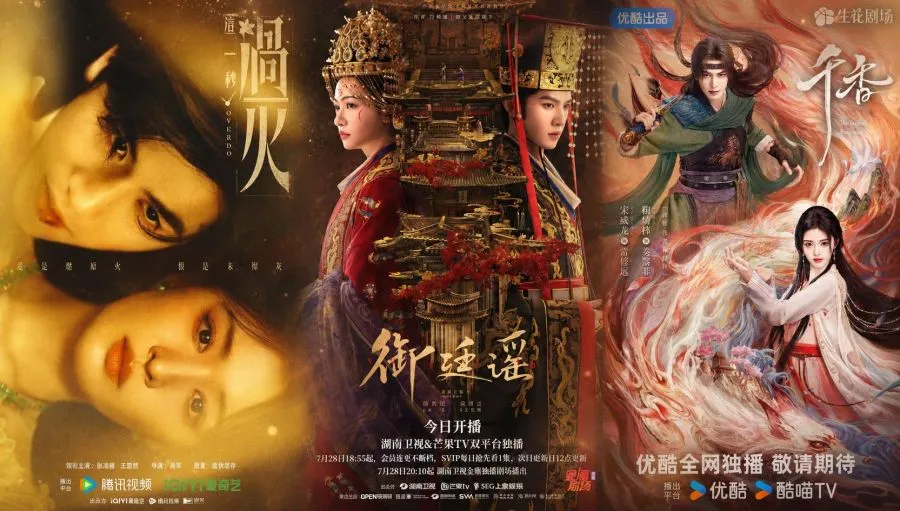
Overdo, Royal Betrothal and The Eternal Fragrance Posters - Courtesy of Tencent Video | Hunan TV | Youku
IN A NUTSHELL
- Contents: in recent years, the Chinese drama market has gradually adopted a peculiar practice: last-minute release announcements. Highly anticipated titles can spend months unannounced, fueling rumors and speculation, only to hit platforms with very little notice. While a sudden debut can generate a sharp spike in attention and fuel hype, not all viewers experience this strategy equally. In an industry where audience attention is the most precious resource, is it really worth turning programming into a surprise?
- Aspects Analyzed:
- The logic behind the practice of surprise announcements
- Two examples that show the variations of this practice
- Different audience needs
- Potential repercussions on the final product
- The value of transparency in platform communications
- Conclusion: the C-drama industry has demonstrated an extraordinary ability to transform releases into collective events. However, the future of international distribution will likely require a greater balance between surprise and reliability. Because to win over viewers in the long run, it's not enough to create anticipation: you also need to learn to respect their time and attention.
Read on to understand my perspective on the topic.
Introduction
In recent years, the Chinese drama market has developed a characteristic that many viewers are now familiar with: the surprise release announcement.
Highly anticipated titles can spend months unannounced, accumulate rumors, suddenly appear on the schedule, and then hit the platform with little notice. This strategy, on the one hand, creates strong hype, but on the other raises an increasingly frequent question among fans: how effective can communication based on unpredictability be?
The recent case of Royal Bethrotal (initially presented under the title Jiang Shan Wei Pin, then released under the new title Yu Ting Yao) is a good example of this trend. After weeks of rumors and anticipation about a possible imminent release, the final confirmation arrived practically on the eve of its premiere.
For casual viewers, this type of release may seem like an insignificant detail, or it may even prove to be one of the most exciting aspects of viewing: the sudden appearance of a long-awaited title can almost turn into an event. But for an increasingly large segment of the audience, who watch multiple dramas simultaneously and organize their time around their releases, this approach presents several problems.
The Sudden Announcement Strategy
The sudden announcement strategy has a very specific commercial logic. An unexpected debut can create a spike in attention on social media: the drama immediately becomes a topic of discussion, hashtags increase, viewers rush to learn more, and the platform can capitalize on the hype created by the surprise effect.
However, the surprise effect works best when it remains an exceptional event. When it becomes a recurring feature of the system, however, it can produce the opposite effect.
For months, fans can follow rumors, unofficial schedules, and possible dates. Each new piece of information fuels anticipation, but also uncertainty. After several failed announcements, some viewers risk switching from "I can't wait for it to come out" to "I'll only believe in its release when it's actually available."
The difference may seem small, but trust is a fundamental element in the relationship between platform and viewer. Hype can quickly attract the public's attention, but it's trust that builds a lasting relationship with the audience.

An example of how, after months of uncertainty and programming hypotheses linked to the platform's schedule changes, the official confirmation of the release can arrive only the day before the debut, transforming the expectation into a sudden wave of FOMO.
A Paradox Affecting Many Productions
The case of Royal Bethrotal is not isolated. The c-drama schedule is often characterized by sudden changes and announcements made close to broadcast. The most surprising aspect is that this trend also affects productions that required years of preparation, large financial investments, and the work of hundreds of people.
In recent years, several titles have followed a similar pattern: highly anticipated dramas, with production long completed, saw the official release date confirmed only in the final phase of distribution.
A case in point is that of The Eternal Fragrance. After a long wait and numerous scheduling hypotheses circulating online without official confirmation, partly due to changes in the platform's programming priorities, the drama was announced only the day before its debut. This choice certainly amplified the surprise effect, but it also highlighted a recurring problem: when audiences spend months chasing rumors and unconfirmed dates, a sudden announcement risks generating more FOMO than excitement.
A different dynamic, but one rooted in the same mechanism, was observed with Overdo. Despite having obtained the distribution license well in advance, the platform chose to announce the official broadcast date only shortly before the launch, after weeks of rumors surrounding its release.
These cases suggest an important reflection: The problem isn't necessarily the product's preparation, but rather the choice to focus programming communication so close to the release.
Of course, we, the layperson, don't know all the processes that govern the release schedule: approval procedures, reviews, commercial strategies, or regulatory constraints can significantly influence platforms' decisions.
However, from the viewer's perspective, a legitimate question remains: how much of this unpredictability is truly inevitable, and how much could be reduced through more transparent communication and clearer planning?
The Diverse Ecosystem of Drama Viewers
One of the main challenges is that platforms and audiences don't always have the same priorities.
For some audiences, especially those who follow daily updates and discussions on social media, a sudden announcement can even be part of the viewing experience.
For other viewers, however, a release date helps organize:
- free time;
- watching other titles;
- social media content;
- reviews and in-depth analyses.
Those who have a blog or channel dedicated to dramas inevitably end up being influenced by this dynamic: some creators might exploit the surprise effect to publish immediate content, while others might have less time to prepare more structured reviews or analyses.
Similarly, a viewer who follows a lot of dramas must necessarily choose where to invest their time. Advance notice would allow them to plan their viewing based on the releases that interest them most. However, when multiple eagerly awaited titles are suddenly announced at the same time, they might be forced to choose whether to postpone a new release or abandon an ongoing series to follow the one that interests them most at that moment.
From this perspective, platforms should consider the fact that a drama doesn't exist in isolation: its release competes with other titles, other interests, and viewers' limited time. And in an increasingly competitive market, the audience's available attention span is finite.

An example of how the wait for an official confirmation can be prolonged also due to a strategic choice of the platform: after weeks of rumours, the announcement of its broadcast arrived only shortly before the launch
Last-Minute Releases and the Impact on the Final Product
This issue, moreover, isn't just about the relationship between platforms and audiences. When a last-minute release is the result of a race against time to meet a specific release window, the pressure on the final stages of the project can also impact the final product.
Producing a television drama involves several steps: from writing the script to filming, from editing to post-production, all the way to distribution and promotion. A final stage handled under intense pressure can be efficient, but it leaves less room for review and refinement.
This doesn't mean that every last-minute announcement is indicative of rushed production. In many cases, the decision to announce the release date only so close to broadcast is purely a matter of distribution strategy, while the drama itself was completed long beforehand.
Furthermore, working to tight deadlines doesn't automatically translate into lower-quality content: although the most ambitious projects often involve intense final stages, creative teams are accustomed to managing complex operations under tight deadlines.
The problem arises when the final sprint isn't simply an organizational choice, but rather a consequence of overly compressed planning.
The difference is significant: accelerating after months of preparation is a strategic choice; reaching the deadline with too many variables still open is a risk.
Beyond Hype: The Value of Reliability
The CD-drama industry has demonstrated an extraordinary ability to generate anticipation and transform releases into collective events. However, the future of international distribution may require a greater balance between surprise and reliability.
Hype drives viewers' interest in a title, but it's communication that builds the relationship between platforms and audiences.
Announcing a drama at the last minute can generate immediate excitement, but a strategy based solely on surprise risks exhausting the most loyal viewers: those who follow the industry most closely, invest more time, and often contribute to the distribution of content.
The case of Royal Bethrotal isn't necessarily an isolated one, but it offers an opportunity to reflect on a broader question: In an industry where audience attention is the most precious resource, is it really worth treating programming as a surprise until the last minute?
Perhaps, to win over viewers in the long run, it's not enough to create anticipation. We must also learn to respect the time of those waiting. Because even the most anticipated drama can lose some of its magic if the viewer arrives on release day not with enthusiasm, but with the feeling that the platforms have taken their time and attention for granted.
Thank you for reading all the way to the end!
I hope you enjoyed this article and found it helpful.
☕ If you enjoy my content and would like to support Red Taotie, you can buy me a coffee on Ko-fi. Every contribution helps me continue creating reviews and in-depth articles.