
A Dream Within a Dream (2025) Chinese Drama Review | Plot & Ending
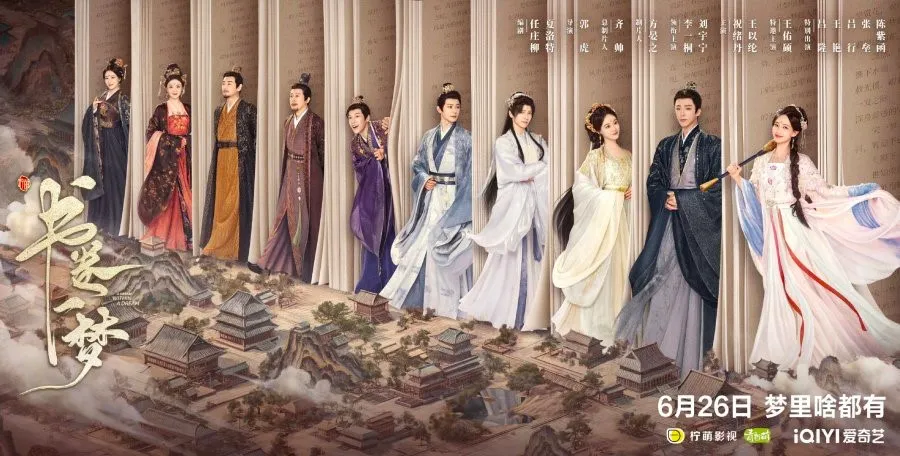
A Dream Within a Dream Poster - Courtesy of iQIYI

|
DetailsRATING: (8.5/10)
NATIVE TITLE: 书卷一梦 – Shūjuàn yī mèng YEAR: 2025 EPISODES: 40 DURATION: 45’ DIRECTOR: Guo Hu SCREENWRITER: Ren Zhuang Liu, Xia Luo Te |


IN A NUTSHELL
- What to expect: a classic transmigration drama in which the female protagonist tries everything she can to return to her reality but ultimately falls in love with the male protagonist. The plot, however, is original because the characters find themselves dealing with inevitable genre clichés, giving rise to comic situations bordering on the absurd.
- Strengths: the comically absurd situations, the ridicule of the main clichés of historical-romantic series, the evolution of the love story between the protagonists.
- Weaknesses: the initial narrative complexity, the romantic push and pull between the main and secondary couple, the approximate management of the subplots.
- Recommended if you like: Liu Yu Ning and Li Yi Tong, historical dramas with transmigration and comic situations bordering on the absurd, love stories enemy to lovers, poking fun at the main clichés of romantic dramas
- Would I rewatch it? Certainly yes!
Read on to discover the real strengths of this drama.
When reality and illusion merge in a dreamlike interweaving, A Dream Within a Dream is born, a journey where every emotion is suspended between an inescapable fate and the hope of being the architect of one’s own destiny. With a refined aesthetic, a fun yet intense script, and an epic soundtrack, this series stands out for its ability to engage the viewer from the very first episodes.
In this A Dream Within a Dream drama review, I will analyze the plot, the acting performances, and the narrative elements that make it one of the most unconventional productions of 2025.
" 白首同心 "
[White head, same heart]
Plot
Song Xiao Yu is a little-known and unenthusiastic actress who is fortunately cast in a major production alongside famous idol Nan Feng.
After a disastrous production meeting, she reads the script of “A Dream in the Past” and discovers that her character is a typical romantic comedy protagonist, subject to all the clichés of that genre and ultimately killed by the male lead, the cruel Prince Nan Heng.
When she suddenly finds herself thrust into the plot, she decides to change her character’s fate and tries everything she can to stay away from the protagonist.
Unfortunately, things don’t go as planned, and she soon finds herself at the mercy of Nan Heng and the script’s rules, which dictate that all the drama’s iconic scenes must be played out for the story to progress.
Living in the fictional world of Dajing, however, Xiao Yu discovers that all the characters have their own personalities and that Nan Heng isn’t as terrible as the script describes so, after a series of misadventures, she ends up falling in love with him.
Things get even more complicated when Bi Xiong, the screenwriter of “A Dream in the Past”, enters the story. He wants to force her to put an end to the constant plot changes and perform the series’ iconic scenes to bring the story to a close.
The girl thus finds herself at a crossroads: should she help Bi Xiong complete the story by sacrificing her life in the Dajing and her relationship with Nan Heng, or should she remain forever in the fictional world of “A Dream in the Past” giving up to return to modern reality?
Focus: The Butterfly Dream

A Dream Within a Dream Drama Review (No Spoilers)
A fun and irreverent drama that exposes and mocks all the clichés typical of period romance series, such as the love triangle, the fact that the ML must always save the FL when she is in danger, or the all-consuming love of one of the two protagonists for the other. Rather ironically it captivates the viewer exactly by narrating the romantic adventures of the protagonists and supporting characters.
Among the myriad dramas that focus on the modern protagonist’s entry into a historical tale while retaining all her present-time knowledge, I think this is one of the most successful because it focuses the viewer’s attention on the absurdity of romantic drama clichés rather than on the FL’s problems adjusting to life in the past. This gives the series an extra edge because the comedy is driven primarily by the plot and not by the misunderstandings that arise from the protagonist’s “unusual” behavior and dialogues.
Plot and Characters
The plot itself is simple, telling the love story between the ML and the FL against the backdrop of the battle for the throne, but thanks to its eccentricity, it features several unexpected and sometimes even unpredictable twists. A further element of engagement is the fact that such an absurd tale must be seen to the end to discover how it really ends.
All the characters are well-developed and deliberately stereotyped, making the script even more overflowing with clichés. Interestingly, this detail makes this drama even funnier and more enjoyable to watch, while in Youthful Glory, it is a source of frustration because it gives a grotesque edge to a supposedly serious story.
Finally, I found the references to Christopher Nolan’s movie Inception (the concept of “a dream within a dream”) and to Zhuang Zhou's philosophy (the anecdote of "The butterfly dream” [莊周夢蝶]) very interesting and stimulating, even if they were not developed much within the plot.

Cast
I must praise the excellent performances of the entire cast, which make the drama both entertaining and realistic, and captivating from start to finish.
Liu Yu Ning remains my favorite actor for his spontaneity and skill in both the romantic and battle scenes. His chemistry with his co-star was truly commendable, and his acting was flawless. He’s definitely rehabilitated, returning to being the Prince Charming we all love, after the terrible part he was given in The Prisoner of Beauty.
Li Yi Tong is very self-assured and extremely talented at playing comedic characters (as she already demonstrated in Warm on a Cold Night). In my mind, however, her figure remains inextricably linked to the dramatic role she played in Bloody Romance and her tormented relationship with Gong Zi from that series, played by Wang Duo.
Chang Long is one of my favorite comedians, along with Liu Guan Lin, and I’ve adored him in all his roles, including Sun Jin Ge in Song of Youth and the Fifth Prince in New Life Begins.
Wang You Shuo is certainly a great actor, although I find him more believable in positive roles, such as Ning Yun Zhao in Jun Jiu Ling.
Wang Chen Si is hilarious in his roles as the slightly dimwitted orderly and is the perfect comic foil for Liu Yu Ning (we’ve already enjoyed their chemistry in The Prisoner of Beauty).
Finally, the ever-present Wang Yi Lun, whom I especially appreciate in light-hearted, light-hearted roles like the one in this drama (even though I wasn’t entirely sold on him as Bai Xiao Sheng in Back From the Brink), and Zheng Guo Lin, who always manages to surprise me with his versatility (I also loved him in Till the End of the Moon and Lost You Forever).
Visual Aspects and Soundtrack
Kudos to the magnificent costumes by the always excellent Huang Wei, unparalleled in creating costumes for historical/fantasy series (she designed the costumes for A Dream of Splendor, Till the End of the Moon, Back Form the Brink, and Love of Nirvana) and the hairstyles. The CGI sets and environments are beautiful. The battle and kung fu scenes, performed admirably by Liu Yu Ning and Wang You Shuo, are thrilling.
I can’t help but express my enthusiasm for the soundtrack, which contains some real gems such as the opening theme Ballad of the Long Wind (长风谣) performed by Liu Yu Ning, A Dream Within a Scroll (书卷一梦) sung by Hu Yanbin, the theme for the Night Wanderers, Night Wanderers (夜游神) performed by Chen Xueran, and the romantic ballad Paper Person (纸片人), performed, once again, by Liu Yu Ning. I think this is the most musically interesting and multifaceted soundtrack I’ve heard from any 2025 drama so far.

WARNING!
FROM THIS POINT ON THE SPOILER SECTION BEGINS. DO NOT CONTINUE IF YOU DO NOT WANT TO KNOW ALL THE DETAILS OF THE DRAMA.
A Dream Within a Dream Drama Review (Spoilers)
What Works: the Charachters and the Underlying Message
One of the things I found most successful was the contruction of the characters. Although, as already mentioned, it is quite stereotypical, it worked admirably for this type of drama and made the narrative entertaining and captivating.
The figure of the cautious and diplomatic minister, the foolish prince destined to inherit the throne, the simpleton subordinate who worships his general, the ML mistreated and humiliated as a child who becomes a powerful warrior, the intelligent and nonconformist girl who wants to break free from social norms—these are all clichés that helped make the reality of “A Dream in the Past” interesting and fuel the comical interactions between the characters.
The underlying concept conveyed by the drama — that everyone is the architect of their own destiny — is also a strength of the plot and can be read from two perspectives: that of a motivational statement for all viewers of the series and that of a typical drama catchphrase, which must always convey some kind of positive message.
What Doesn't Work: the Initial Complexity of the Plot and the Management of Subplots
While I thought the idea of making a drama that pokes fun at drama stereotypes was brilliant, and I thoroughly enjoyed watching the trashy scripts often fed to us by lazy writers be destroyed, I must admit that this drama also has some writing flaws.
In the initial episodes, I found it difficult to follow all the political and family subplots that were somewhat forcefully introduced into the narrative through short stories and flashbacks. My attention was focused on following the plans hatched by the FL to avoid the ML and those conceived by the ML to kill the FL.
As the plot progressed, I got the impression that the writers purposely complicated the political plot to justify the constant back-and-forth between the protagonists, which brought them to the brink of marriage several times, but never quite brought it to fruition. I had the same impression of Shang Guan He’s attitude toward Song Yi Ting: it seemed as if he, too, was desperate to delay their wedding, not for serious reasons but simply to drag out the drama.

Another detail that bothered me a bit was Song Yi Meng’s excessive stubbornness in denigrating Nan Heng at every opportunity and rejecting him at all costs. Initially, it made sense because he had tried to kill her several times, but after dating him for a while, hearing about his sad past, and discovering that he and Li Shi Liu were the same person, she should have realized that the Nan Heng before her was no longer the ruthless killer described in the script.
I assumed this attitude was also one of the clichés the writers were trying to criticize, but the tenor of the scenes in which it appeared was anything but comical, so I fear it was part of the “serious” plot.
I don’t understand why, throughout the narrative, some subplots were abruptly abandoned, such as the one about the Qianyu Army’s sword-forging method (did someone eventually discover the formula, or did Chu Li take the secret to his grave?), and others were dismissed with somewhat overly simplistic explanations, such as Bi Xiong’s return to reality or the fact that iconic scenes no longer had to necessarily happen.
In the last few episodes, I found the introduction of the screenwriter as a character in the drama a bit forced, especially since he was disguised as someone who was supposed to be dead. His appearance only lengthened the story, but the narrative could easily have continued even without his absence, and Chu Gui Hong could have attempted the coup d’état even without knowing he was a fictional character and destined to die at Nan Heng’s hands.
Ending
The ending is certainly surprising, but not that astonishing. Discovering that Bi Xiong is actually a figment of another screenwriter’s imagination, just like the reality to which he, Song Xiao Yu, and the entire cast of “A Dream in the Past” belong, is certainly a nice twist. However, to a careful viewer, this was already known as early as episode 33, when Nan Heng, speaking to Song Yi Meng, mentioned Zhuang Zhou’s “Butterfly Dream” and the fact that the reality she came from could also have been a dimension as fictional as Dajing.
A little more unexpected, and perhaps not very useful, is the post-credits scene in which Song Xiao Yu awakens in her own reality and, at the costume fitting for the drama, meets Nan Feng, who reveals that she is Nan Heng and remembers everything that happened between them.

Characters and Cast
Primary Characters
Song Yi Meng/Meng’er/Song Xiao Yu (Li Yi Tong) eldest daughter of the Minister of War. In reality she is Song Xiao Yu, the actress hired to play the lead role in the drama “A Dream in the Past”, who suddenly finds herself transported into the script and tries everything she can to prevent her character from dying at the hands of the male lead, as planned.
Nan Heng/Nan Feng/Li Shi Liu (Liu Yu Ning) Prince Qi, Seventh Prince of Dajing, commander of the Xuanjia Army. Under the alias Li Shi Liu, he commands the group of fighters known as the Night Wanderers, who meet at the private club Moonshade.
Chu Gui Hong/Liang Chen (Wang You Shuo) General in charge of the Qianyu Army and Song Yi Meng’s betrothed. He is the only son of the God of War Chu Li and Nan Rui’s cousin.
Shang Guan He/Shang Guan Bai He/Chu He (Wang Yi Lun) second leader of the Night Wanderers and a notorious outlaw. Three years before the events of the drama, he was falsely accused of embezzling funds intended for flood victims and imprisoned. Nan Heng/Li Shi Liu saved him from capital punishment and hired him to manage the Moonshade. Through a misunderstanding, Song Yi Ting falls in love with him, but it will take him a long time to confess his true feelings.
Song Yi Ting/Ting Ting (Zhu Xu Dan) second daughter of the Minister of War, daughter of concubine Zhou Xue Yi. She is an intelligent and independent girl who refuses to submit to the retrograde rules that impose on women as wives and mothers, but longs to be free to do what she wants and love who she wants. Through a misunderstanding, she falls in love with Shang Guan He, but she finds it difficult to convince him to marry her.
Nan Rui (Chang Long) Prince Teng, Eighteenth Prince of Dajing, and the Emperor’s favorite son. He is the only son of the late Empress and is very close to his cousin Chu Gui Hong, with whom he joins forces to oppose Nan Heng. In reality, he is a naive and kind-hearted boy and willingly cedes the title of Crown Prince to his brother when he realizes that he is a worthy candidate to lead the country virtuously. It is thanks to his help and selflessness that Song Yi Ting manages to convince Shang Guan He to declare his feelings for her.
Supporting Characters
Song Yu De (Lu Ying) Duke of Guanping, Deputy Secretary of the Left and Minister of War. He is the father of Song Yi Meng and Song Yi Ting and is one of the Emperor’s most trusted ministers, having also been his study companion. He is cautious and diplomatic and does not like to openly take sides. He will be the first to realize that Nan Heng is truly in love with his daughter and is serious about caring for her.
Zhou Xue Yi (Chen Sha Sha) Second Lady of the Duke of Guanping’s Residence. Her primary goal is to marry her daughter into a prestigious family, so she pushes Yi Ting to approach Prince Nan Rui, but ultimately agrees to her marriage to Shang Guan He after he is adopted by Chu Li/Li Bi Xiong.
Shan Nai (Zheng Jia Mi) and Yin Zhu (Zhang Zhang) maids at the Song Residence serving Song Yi Ting.
Ying Qiu (Shu Meng Yun) and Zhi Xia (Wang Li Na) maids at the Song Residence serving Song Yi Meng.
Chu Li/Li Bi Xiong (Zheng Guo Lin | Li Huan) Lord Qianyu and God of War of Dajing. He is the father of Chu Gui Hong and the deceased commander of the Qianyu Army. Toward the end of the drama, Li Bi Xiong, the screenwriter of “A Dream in the Past”, transmigrates into his body and enter the script to try to convince Song Xiao Yu/Song Yi Meng to complete the plot.
Rong Hua (Li Dong He) Deputy General of the Qianyu Army and attendant to Chu Gui Hong.
Doctor Zhao, miracle physician of the Qianyu Army who saves Nan Heng after he is wounded by Chu Gui Hong and Fu Gui during the iconic wedding procession scene.
Nan Xu (Zhang Zheng Yang) Emperor of Dajing, father of Nan Rui and Nan Heng. He has always been much more attached to Nan Rui than Nan Heng, and after the Empress’s death, his preference for his eighteenth son has become even stronger. Initially, he intends to name Nan Heng Crown Prince, but after Gao Chang Yin’s confession, he is convinced to recognize Nan Heng’s innocence and his greater suitability to inherit the trone.
Liu Ming Xi (Niu Xi Kui) Chief Eunuch and Palace Superintendent.
Chu Yu Rong (Peng Yang) late Empress of the Daijing, mother of Nan Rui and aunt of Chu Gui Hong. She dies at the end of a hunting trip while accompanying Nan Heng on a rabbit hunt to console him after his father’s scolding. For years, the Emperor blames the Seventh Prince for the incident and treats him coldly and harshly, finally forgiving him only after Gao Chang Yin’s confession.
Gao Chang Rong/Consort Gao (Wang Yan) Nan Heng’s mother and Gao Chang Yin’s older sister. She was betrothed to Lord Pingyang, but to control the Gao family, Nan Xu had the engagement annulled and married her. After the Empress’s death, her relationship with the Emperor deteriorated, and the two did not speak for years.
Gao Chang Yin (Huang Wei De) Prime Minister of the Daijing and Nan Heng’s maternal uncle. He does everything he can to ensure his nephew becomes Crown Prince, even to the point of manipulating Nan Heng into usurping the throne. Once his atrocities are discovered, his nephew reports him to his father, sentencing him to capital punishment.
Ji Xiang/Xiang’er (Song Ji Yang) Nan Rui’s bodyguard.
Fu Gui (Wang Chen Si) Deputy Commander of the Xuanjia Army and Nan Heng’s attendant.
Po Yun Long/A’Long (Guo Xiao Tian) Third leader of the Night Wanderers
Duan Shan Hu/A’Hu (Li Qing) Fourth leader of the Night Wanderers
Yao Qian (Jia Jing Hui) Inspector of the Censorate, an ally of the Gao family at court.
Yan Yi (Guo Dong Hai) Minister of Justice, an ally of the Gao family at court.
Jia Ru Ru (Ling Mei Shi) Song Yi Ting’s friend and Song Yi Meng’s rival.
Fang Shi Ming (Wu Hong) Heyuan’s best general killed by Nan Heng in the Battle of Youcheng.
Miss Na (Wu Mochou) Nan Feng’s agent.
Xiao Huang (An Yue Xi) Song Xiao Yu’s agent.
Miss Zhuang screenwriter of “A Dream Within a Dream”.

Favorite Character: Nan Heng
Although he was always a diligent and capable child, he never received much recognition from his father due to the fact that his mother came from the influential Gao Family and his uncle, Gao Chang Yin, was one of the most powerful men in Dajing.
Because of this, the Emperor even went so far as to accuse him of being responsible for the death of his beloved Empress Chu Yu Rong, who was murdered while accompanying the young prince rabbit hunting to console him after his father’s scolding.
From that moment on, he was estranged from everyone, including his brother Nan Rui and his childhood friend Chu Gui Hong, who swore to avenge his aunt’s death. The only one who remained by his side was his uncle, who raised him to be insensitive and detached, aiming to push him to rebel against his father.
Despite everything, however, he maintained a pure heart, so much so that neither his uncle’s machinations and attempts at manipulation, nor his father’s punishments, nor his brother’s sarcastic rebukes, succeeded in convincing him to usurp the throne.
He always tried to make amends for his uncle’s misdeeds, even saving the innocent Shang Guan Bai He from capital punishment and providing homes to the flood victims whose compensation had been unduly stolen by Gao Chang Yin.
Together with the Night Wanderers, he helped rebuild the Nancheng neighborhood destroyed by the fire caused by Nan Rui, also trying to reconnect with Chu Gui Hong.
After receiving, in the guise of Li Shi Liu, Song Yi Meng’s gratitude and attention, he discovered what it means to be truly loved and fell deeply in love with the woman he had initially wanted to eliminate.
He has shown himself willing to fight for the people he loves and unwilling to surrender to the fate preordained by the script, changing the story at the cost of his own life.
He is the true hero of the drama because he is the one who encourages the compliant Song Xiao Yu to continue defying the plot and build the future she desires, always standing by her side to support her when things get tough and using his cunning to undermine the mechanics of the script.
Un-Favorite Character: Chu Gui Hong
As the second male protagonist, according to the script he was supposed to be the good guy, but in reality, over the course of the story, he becomes the cruelest and most ruthless character.
Although Nan Hang helped him several times as a child, teaching him to ride and treating his wounds with the Gao family’s special medicine, after the Empress’s death, he held Nan Hang responsible and, without even trying to uncover the truth,turned his back on him, abandoning him to his fate in the Cold Palace.
The fact that his father and aunt were killed by Gao Chang Yin gave him the justification to repeatedly try to eliminate Nan Heng, even though Nan Heng was never involved in his uncle’s plans and ended up denouncing him to the Emperor to stop him.
He used all his wit to repeatedly try to frame the Seventh Prince, unaware that he was a pawn in the hands of Gao Chang Yin himself, who hoped to exploit his recklessness to push his nephew into usurping the throne.
At the height of his unreason, he even went so far as to demean and insult his cousin, despite being his most fervent supporter, simply because he had the audacity to ask him to abandon his rivalry with Nan Heng.
His obsession with the Seventh Prince went so far as to push him to sacrifice innocent lives in order to seize power and obtain everything that, in his opinion, had been taken from him by the protagonist.
Focus: The Butterfly Dream
" 昔者庄周梦为蝴蝶,栩栩然蝴蝶也,
自喻适志与!不知周也。
俄然觉,则蘧蘧然周也。
不知周之梦为蝴蝶与?蝴蝶之梦为周与?
周与蝴蝶则必有分矣。
此之谓物化。"
Once upon a time, Zhuang Zhou dreamed he was a butterfly.
He fluttered lightly through the air, unaware that he was Zhuang Zhou,
happy only to be a butterfly.
Then suddenly the dream ended, he awoke
and returned to being Zhuang Zhou once more.
But was it Zhuang Zhou who had dreamed he was a butterfly?
Or was it the butterfly that was dreaming it was Zhuang Zhou?
The line between being Zhuang Zhou and being a butterfly is blurred.
This is called the Transformation of Things.
The Butterfly Dream (莊周夢蝶), Zhuangzi (莊子)
RECOMMENDED:
- THE ROMANCE OF TIGER AND ROSE
- THE QUEEN OF ATTACK
- REWRITING DESTINY
- GUARDIANS OF THE DAFENG
- LOVE GAME IN EASTERN FANTASY
Thanks for reading this far!
I hope you enjoyed my article. If you like my work and want to support me, buy me a coffee☕